
How to Read a Tape Measure at a Glance
A standard imperial tape measure uses five line heights to show fractions. Taller line means bigger fraction. The longest marks are inches (with printed numbers), then half-inch, then quarter-inch, then eighth-inch, then sixteenth-inch (shortest). Between any two inch marks there are exactly 15 tick marks, dividing the inch into 16 equal spaces. A 25-foot Stanley or Milwaukee tape runs $15–$30 and covers every measurement you'll need in a home shop.
| Smallest mark | 1/16" (0.0625 decimal) |
| Line height rule | Taller line = bigger fraction |
| Marks per inch | 16 total positions (1/16" each) |
| Red numbers | 16" stud-spacing marks for framing |
| Black diamonds | 19.2" truss/joist marks (5 per 8-foot sheet) |
| Floating hook | Intentional — compensates inside vs. outside measurements |

In this guide:
- The five line heights — your visual shortcut
- Decimal-to-fraction conversion table
- Special markings decoded
- Common mistakes and how to fix them
Part 1: The Five Line Heights
Reading a tape measure without counting marks every time comes down to one thing: the line heights tell you the fraction.
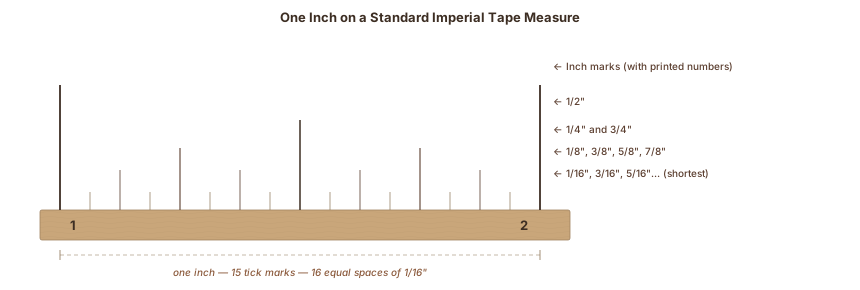
| Line height | Fraction it marks | Interval | Count per inch |
|---|---|---|---|
| Tallest (with number) | Inch | 1" | 1 |
| 2nd tallest | 1/2" | Every 1/2" | 1 |
| Medium | 1/4" and 3/4" | Every 1/4" | 2 |
| Short | 1/8", 3/8", 5/8", 7/8" | Every 1/8" | 4 |
| Shortest | All odd 16ths | Every 1/16" | 8 |
The rule: as the fraction gets smaller, so does the line. Half-inch is taller than quarter-inch. Quarter-inch is taller than eighth-inch. Eighth-inch is taller than sixteenth-inch.
All 15 fractions in order
Between any two inch marks, the 15 tick marks from left to right are:
1/16 — 1/8 — 3/16 — 1/4 — 5/16 — 3/8 — 7/16 — 1/2 — 9/16 — 5/8 — 11/16 — 3/4 — 13/16 — 7/8 — 15/16
The fractions that simplify (1/8, 1/4, 3/8, 1/2, 5/8, 3/4, 7/8) have taller marks because their simplified form has a smaller denominator. The ones that don't simplify (1/16, 3/16, 5/16, 7/16, 9/16, 11/16, 13/16, 15/16) are always the shortest marks.
Where is 5/16? It's the 5th tick mark past the inch number. It falls between 1/4" (4th mark, medium height) and 3/8" (6th mark, short). Since 5 is odd, it doesn't simplify. It's one of the shortest marks. Count: 1, 2, 3, 4, 5.
Part 2: Reading Any Measurement in Three Steps
Step 1. Find the last inch number before your measurement point. That's your whole-number part.
Step 2. Count the tick marks past that inch number until you hit the mark where your measurement falls. Each tick = 1/16".
Step 3. Name the fraction. 4 marks past the inch = 4/16" = 1/4". 8 marks = 8/16" = 1/2". Use the conversion table below if you get stuck.
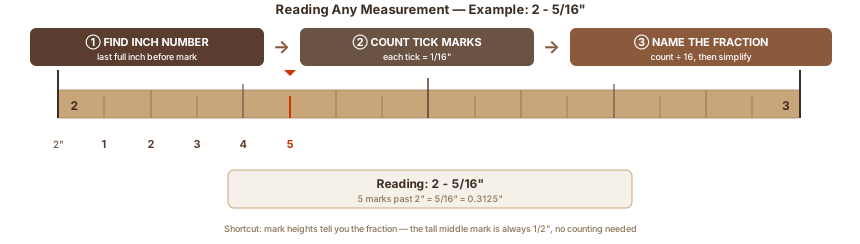
The faster visual method
Once you know the line heights, you don't need to count:
- Measurement lands on the tall middle mark? → 1/2"
- Lands on a medium-height mark (one of the two on either side of the halfway point)? → 1/4" or 3/4"
- Lands on a short mark between the mediums? → 1/8", 3/8", 5/8", or 7/8"
- Lands on the shortest mark? → one of the odd 16ths (1/16, 3/16, 5/16, 7/16, 9/16, 11/16, 13/16, 15/16). Count from the nearest inch to find which one.
Combining feet and inches
The tape reads running inches, not "feet then inches." Foot marks (12, 24, 36...) appear as larger numbers on most tapes, but the inch count runs continuously. To convert: divide inches by 12 for feet, remainder is inches. So 38" = 3'2".
Part 3: Decimal-to-Fraction Conversion Table
Every fraction on an imperial tape and its decimal equivalent.

| Marks past inch | Fraction | Simplified | Decimal | Line height |
|---|---|---|---|---|
| 1 | 1/16 | 1/16 | 0.0625 | Shortest |
| 2 | 2/16 | 1/8 | 0.125 | Short |
| 3 | 3/16 | 3/16 | 0.1875 | Shortest |
| 4 | 4/16 | 1/4 | 0.25 | Medium |
| 5 | 5/16 | 5/16 | 0.3125 | Shortest |
| 6 | 6/16 | 3/8 | 0.375 | Short |
| 7 | 7/16 | 7/16 | 0.4375 | Shortest |
| 8 | 8/16 | 1/2 | 0.5 | 2nd tallest |
| 9 | 9/16 | 9/16 | 0.5625 | Shortest |
| 10 | 10/16 | 5/8 | 0.625 | Short |
| 11 | 11/16 | 11/16 | 0.6875 | Shortest |
| 12 | 12/16 | 3/4 | 0.75 | Medium |
| 13 | 13/16 | 13/16 | 0.8125 | Shortest |
| 14 | 14/16 | 7/8 | 0.875 | Short |
| 15 | 15/16 | 15/16 | 0.9375 | Shortest |
| 16 | 16/16 | 1 | 1.0 | Tallest |
Decimal to fraction: Multiply the decimal part by 16. Round to the nearest whole number — that's the numerator over 16, then simplify. Example: 0.375 × 16 = 6 → 6/16 → 3/8.
Fraction to decimal: Divide the numerator by the denominator. 3/8 = 3 ÷ 8 = 0.375.
Part 4: Special Markings Decoded
Red numbers at 16-inch intervals
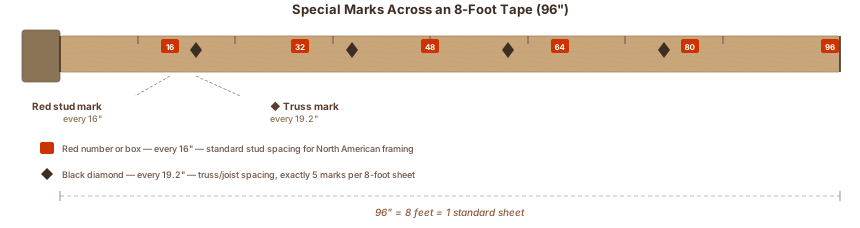
Some tapes print the numbers at 16", 32", 48", 64", 80", and 96" in red, or put them inside red boxes. These are stud-spacing marks.
North American framing code spaces wall studs 16 inches on center (OC — measured from the center of one stud to the center of the next). Family Handyman explains that the red marks let framers place studs without calculating. Line up the red number with each stud location. An 8-foot wall (96") has 7 studs at 16" OC.
When installing cabinets, shelving, or built-ins on walls, the red marks tell you where the studs are without a separate stud finder — start measuring from a corner.
Black diamonds at 19.2-inch intervals
Black diamond shapes appear at 19.2", 38.4", 57.6", 76.8", and 96". According to Woodsmith, these are truss marks — five equal divisions of a standard 8-foot sheet (5 × 19.2" = 96"). Floor trusses and roof trusses sometimes use 19.2" spacing across plywood sheets.
Most fine woodworkers never use the black diamonds. They're construction framing references. But they're on every tape, which is why people ask.
Special markings at a glance
| Mark | Interval | Purpose |
|---|---|---|
| Red number or box | Every 16" | Standard stud spacing (framing) |
| Black diamond | Every 19.2" | Truss/joist spacing (5 per 8-foot sheet) |
| Case width number | On the end cap | Add this value for inside box measurements |
Part 5: The Floating Hook
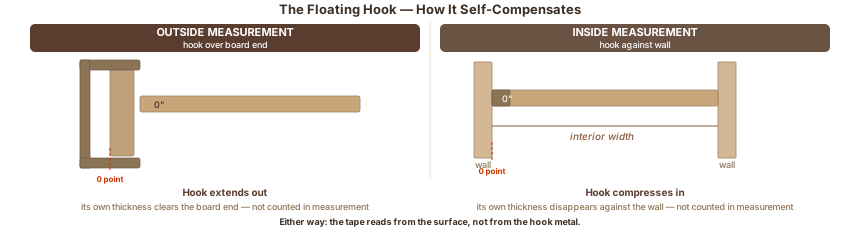
The metal hook at the end of the tape wiggles. That's not a defect.
According to Stanley Tools, the hook slides by exactly the thickness of its own metal. For an outside measurement (hooking over the end of a board), the hook pulls out — its thickness isn't counted. For an inside measurement (pushing the hook against a wall), the hook compresses in — its thickness is automatically compensated. Either way, the measurement is accurate.
A hook that moves more than its own thickness is worn out. Replace the tape.
Burn an inch
For cabinet fitting or fine joinery, hook the 1" mark over the board end instead of using the hook. Read the far measurement, subtract 1". Rockler calls this technique "burning an inch" and recommends it when you need the most accurate reading possible. The only risk: you must remember to subtract the inch every time.
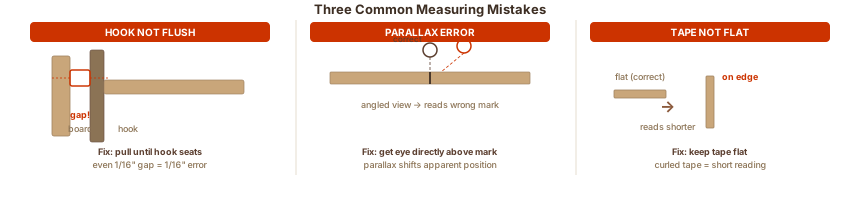
Part 6: Common Mistakes
1. Hook not flush. The most common error. If the hook doesn't sit snug against the end of the board, even a 1/16" gap creates a 1/16" error. Pull firm, make sure the hook seats.
2. Parallax error. Reading at an angle instead of straight down. The blade appears to shift position depending on your viewing angle. Get directly above the mark. Kreg Tool's guide flags this as the most common source of "my cut was off" frustration in woodworking.
3. Wrong scale on a dual-scale tape. Imperial is on one edge, metric is on the other (or the other face). They sit close together. The numbers look similar until you notice one says "cm" and the other says inches. Check which scale you're reading.
4. Tape rolling on its edge. If the blade curls sideways instead of lying flat, it reads shorter than it actually is. Keep it flat against the workpiece and taut.
5. Counting from the wrong inch mark. Count from the last full inch before your measurement, not the next one. If your measurement falls at 3-5/16", the inch mark is 3", and you count 5 marks past it.
6. Forgetting the case width on inside measurements. When measuring the inside of a cabinet or box with the case sitting against the wall, US Tape recommends checking the end cap for the printed case width (usually "Add 3"" or similar) and adding it to the blade reading.
Where This Fits
Reading a tape measure is the first measuring skill. It gives you the distance. The next step is transferring that measurement accurately to wood. A marking knife and combination square do that job.

Once you can read a tape without counting marks, study nominal wood sizes. A "2x4" doesn't measure 2 inches by 4 inches. Knowing the actual dimensions prevents one of the most common beginner measuring errors before you touch a saw.
FAQ
How do I read 5/16 on a tape measure?
Count 5 tick marks past the last inch mark before your measurement. Since 5 is odd, 5/16 doesn't simplify — it sits on one of the shortest marks on the blade, between the medium-height 1/4" mark (4 ticks past) and the taller 3/8" mark (6 ticks past). Once you recognize the mark heights by sight, you'll spot 5/16 without counting: it's the short mark just past the medium-height quarter-inch.
Why does the hook on a tape measure wiggle?
The hook is designed to slide by exactly its own metal thickness. For an outside measurement (hooking over a board end), the hook pulls out so its thickness isn't added to the reading. For an inside measurement (pressing against a wall), it compresses in so its thickness is subtracted. Either way the tape reads from the physical surface. A hook that moves more than about 1/16" has worn out its slots — replace the tape.
What do the red numbers mean on a tape measure?
Red numbers — or numbers inside red boxes — appear at 16", 32", 48", 64", 80", and 96". They mark standard stud spacing: North American framing code spaces wall studs 16 inches on center. Line each red mark up with one stud and you can lay out an entire wall without calculating. They're also useful when hanging cabinets or shelves — studs are behind each red mark from the corner.
How do I measure the inside of a cabinet with a tape measure?
Check the end cap on the tape case for the printed case width — most say "Add 3"" or a similar value. Hook the tape at one side, extend it to the opposite wall, and add the case width to the blade reading. Or use the burn-an-inch method: hook the 1" mark on one side, read the other side, subtract 1". Both give an accurate inside dimension; burning an inch is preferred for tight fits.
Sources
Tape measure anatomy, special markings, and hook design sourced from tool manufacturers and woodworking publications.
- Family Handyman: Red Square on Tape Measure — red stud-spacing marks explained
- Woodsmith: What is the Black Diamond on a Tape Measure? — black diamond / 19.2" truss marks
- Stanley Tools FAQ: Why the hook moves — floating hook design intent
- Rockler: Back to Basics — Using Your Tape Measure — burn-an-inch technique
- Kreg Tool: How to Read a Tape Measure — woodworker-specific guide, common mistakes
- US Tape: Hidden Features of a Tape Measure — hook design, case width, special features
Tools Used
Also Referenced
How We Research
We don't take affiliate revenue or accept review units. Picks come from multi-source research — manufacturer specs, OSHA / EPA / ASTM regs, and long-form practitioner threads — plus Ahmed's hands-on use where relevant. When we recommend something, we explain why.
Up Next
How to Use a Rafter Square
HAND TOOLS · Beginner