
Rasp Tool at a Glance
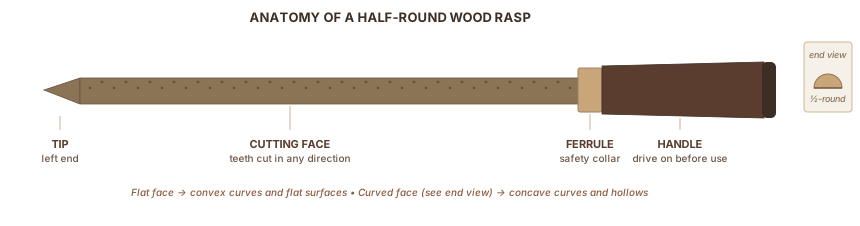
A wood rasp has individually raised teeth that bite into wood and remove material fast. Unlike a hand plane or chisel, you can push it in any direction without tearing grain. That makes it the right tool for shaping curves, rounding edges, and fitting irregular surfaces — and none of those jobs require any prior hand tool experience.
| Best starter tool | 10" half-round, second-cut patternmaker's rasp |
| Cuts on | Push stroke only — lift on the return |
| Grain direction | Any direction, no tearout risk |
| The progression | Rasp → file → card scraper → sandpaper |
| First buy (budget) | Nicholson #50, ~$15–20 |
In this guide:
- What a rasp does and why it beats sandpaper on curves
- Types, profiles, and cut grades
- Grip, stroke, and the 7-step shaping sequence
- Five mistakes beginners make
- What to buy first — specific recommendations with prices
Skill level: Beginner. No prerequisite skills. You need a way to clamp your workpiece and a rasp. That's it.
Part 1: What a Rasp Does and When to Reach for One
A rasp is a steel bar covered in individually cut teeth. Each tooth bites into wood and flicks out a chip. Run one across a piece of pine and it removes material fast, leaving a textured surface ready for a file, then a card scraper, then sandpaper.
A file is different. A file has fine parallel ridges that shave the surface lightly. You use a file after a rasp to smooth what the rasp left behind. Sandpaper uses loose abrasive particles to polish. Rasps don't polish. They shape.
The shaping progression
You don't choose between a rasp, a file, and sandpaper. You use all three in sequence.
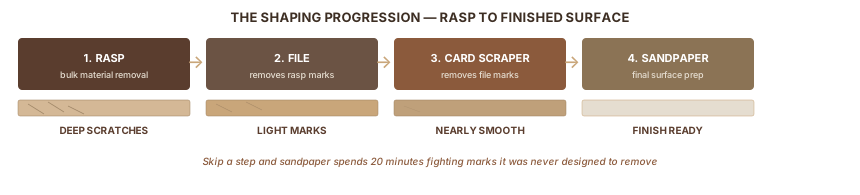
| Tool | What it does | Surface left |
|---|---|---|
| Rasp (coarse) | Establishes the shape; bulk material removal | Deep scratches |
| File or fine rasp | Removes coarse marks; refines the shape | Smooth but textured |
| Card scraper | Removes file marks | Nearly finish-ready |
| Sandpaper 120+ | Final surface prep | Polished |
Jump from a coarse rasp to 80-grit sandpaper and you'll spend 20 minutes fighting deep rasp marks. Each step removes the marks left by the previous tool. That sequence is the only way to get a clean surface on shaped wood.
Why rasps beat planes and chisels on curves
A plane works by taking a continuous shaving. Push it in the wrong direction and that shaving catches and tears, leaving a splintered surface. Chisels have the same problem on sculpted or curved work.
A rasp cuts individually with each tooth. There's no continuous shaving to run the wrong way. Fine Woodworking's guide to shaping with rasps and files notes that, unlike a spokeshave, a rasp won't catch and tear out the grain even in curly maple. You can rasp in any direction without tearout risk.
That's the reason to own one.
When to reach for a rasp
- Shaping curved furniture parts (chair legs, sculpted handles, decorative profiles)
- Rounding edges and chamfering corners — faster than a router setup for a one-off job
- Fitting irregular surfaces (trimming a drawer to fit, adjusting a half-lap joint)
- Working end grain (end-grain chamfers, rounding a corner that goes into end grain)
- Any surface where reversed grain would cause tearout with a plane
When to use something else
A rasp isn't always the answer:
- Large flat surface, lots of material to remove: a hand plane or power tool is faster
- Perfectly straight, square edge: a plane beats a rasp here
- Heavy roughing on a large blank: a drawknife gets you to rough shape quickly, then hand off to the rasp
Part 2: Rasp Types, Shapes, and Cut Grades
One shape in one grade handles most of what beginners need.
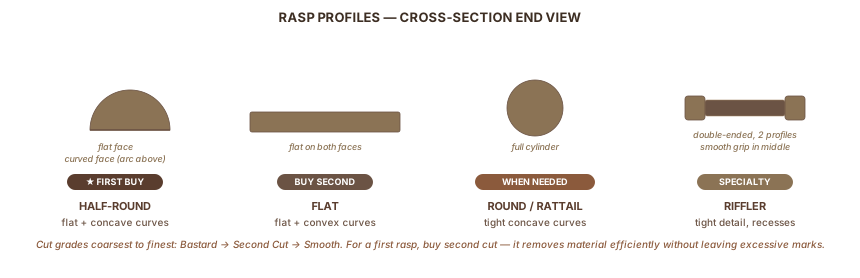
The three profiles
Half-round — the one to buy first
A half-round has a flat face on one side and a curved face on the other. The flat face handles flat surfaces and convex curves (the outside of a chair leg). The curved face handles concave curves (a seat saddle, the inside where two curves meet). One tool covers both types of curves.
Flat
Flat on both sides. Good for flat surfaces and gently convex curves. Can't reach concave areas. Buy this second if you do a lot of flat-surface shaping.
Round (rattail)
A full cylinder. Good for tight concave curves and enlarging rounded openings. Buy it when a specific project demands it.
Rifflers — for detail work
A riffler is double-ended with a short cutting face at each end (in different profiles: oval, triangular, half-round) and a smooth grip in the middle. The cutting faces are 3-4" long and angled to reach into tight recesses. Luthiers and carvers reach for these when other rasps can't fit. Not a first purchase.
Cut grades: bastard, second cut, smooth
American rasps come in three grades, coarsest to finest:
- Bastard cut — heavy material removal; rough-shaping blanks before you need control
- Second cut — the most useful grade; balances speed and surface quality
- Smooth cut — light refinement; closer to file territory; used to blend before switching to a file
For a first rasp, buy a second-cut half-round. It removes material efficiently and leaves a surface you can refine without hours of extra work.
French makers Auriou and Liogier use a different scale: #1 is coarsest, #15 is finest. Canadian Woodworking's half-round cabinet rasp guide covers the relationship between the two systems clearly. Most woodworkers use #9 for general shaping and #11-13 for refinement.
Machine-cut vs. hand-stitched
Most rasps are machine-cut. The teeth form in regular, parallel rows. That regular pattern leaves visible striations in the wood — parallel lines you have to file or scrape away.
Hand-stitched rasps from Auriou and Liogier have teeth raised one at a time using a hammer and punch. The process takes 90 minutes per 10" rasp. The result is completely random tooth placement: no two teeth follow the same path, so no striations form. Tools for Working Wood's page on hand-stitched rasps explains the geometry: the random placement means fewer secondary marks and less post-rasp sanding.
The tradeoff is price. Machine-cut rasps cost $10-40. Hand-stitched Auriou or Liogier rasps cost $80-200+.
Start machine-cut. The striations are manageable at the learning stage. Upgrade to hand-stitched when you're using rasps on every project and the extra sanding is adding up.
Part 3: How to Use a Rasp — Grip, Stroke, and Sequence
Grip and body mechanics
Hold the handle firmly in your dominant hand. Place your other hand near the tip — fingertips curled over the top or thumb pressing down. This two-handed grip separates controlled shaping from rough gouging. The front hand guides and controls pressure; the back hand provides power.
Push strokes only. Apply steady pressure as you push forward. On the return stroke, lift the rasp off the wood. Dragging it back doesn't cut. It wears the teeth faster.
Pressure: moderate and consistent. You'll feel when the teeth are cutting. Heavy pressure causes uneven gouges and fatigues you quickly. Light pressure polishes instead of cuts. Around 60% of what feels like "enough" is right. Use your whole upper body for long strokes, not just your wrists. Long strokes build smooth, flowing curves. Short choppy strokes leave flat facets.
Stroke direction and grain
Rasps work in any direction without tearout. Direction still affects the surface quality you end up with:
| Stroke direction | Best used for | Surface result |
|---|---|---|
| Diagonal (45°) to grain | Bulk removal on flat and convex surfaces | Efficient; medium quality |
| With the grain | Final finishing strokes | Smoothest, fewest marks |
| Against the grain | Access-limited spots; rough shaping | Slightly rougher |
| Across the grain | End-grain chamfers | Good for end grain |
Start diagonal for shaping, then finish with the grain before switching to a file.
On a curved surface, grain direction changes as you move around the curve. Adjust your stroke angle as you go. The rasp won't tear grain, but following the grain still leaves a better surface. Katz-Moses has a good visual walkthrough of reading grain direction if you want to build that skill alongside rasp work.
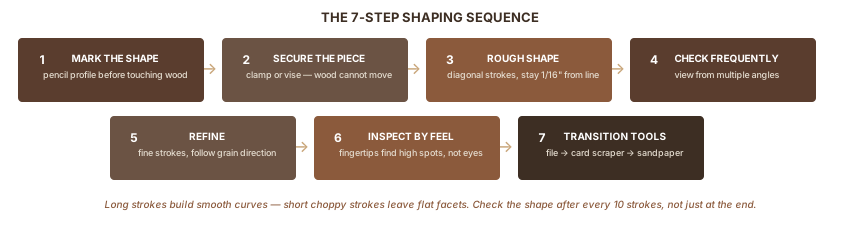
The 7-step shaping sequence
This works for any curved surface: a chair leg, a rounded handle, a sculpted edge.
-
Mark the target shape. Draw the final profile with a pencil before touching the wood. Use a template, a flexible curve, or a compass. Without reference lines, you'll overshoot.
-
Secure the workpiece. Clamp it in a vise or to the bench. The wood cannot move. Rasping against something that flexes produces inaccurate results.
-
Establish the shape with coarse diagonal strokes. Hold the rasp at 45° to the surface. Check frequently against your reference lines. Stay back from the line: get within 1/16" and stop.
-
Work toward the line in stages. Rotate the piece and view from multiple angles. A shape that looks right from the front may be wrong from the side. Short test strokes near the line are safer than long committed ones.
-
Refine with finer strokes or a file. Once the shape is established, switch to the smooth-cut face or a half-round file. Follow the grain direction for the cleanest surface.
-
Inspect by feel, not by eye. Run your fingertips along the surface after every few strokes. High spots and hollow spots register in your hands before they're visible. Close your eyes if it helps.
-
Transition: file, then card scraper, then sandpaper. Don't skip to sandpaper. Each step removes what the previous tool left.
Cleaning the teeth
A clogged rasp doesn't cut. It burnishes. The surface starts to look shiny where the rasp passes and you stop making progress.
Clean the teeth every 10-15 strokes with a file card (a short-bristle wire brush made for this). Drag it in the direction the teeth point. For resinous woods like pine or cherry, clean every 5 strokes. For hand-stitched rasps, Auriou recommends a natural bristle brush rather than a metal file card; metal bristles can damage fine hand-cut teeth.
Part 4: Five Mistakes Beginners Make (and How to Fix Them)
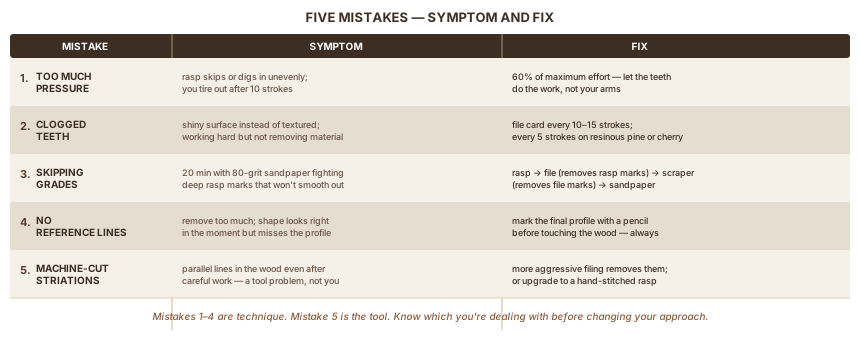
1. Too much pressure
Symptom: The rasp skips or digs in unevenly. You tire out after 10 strokes. The surface has irregular deep gouges rather than a consistent texture.
Fix: Back off to about 60% of what feels like enough. Heavy pressure clogs the teeth faster and drives them into the wood at the wrong angle. Let the teeth do the work.
2. Not cleaning the teeth
Symptom: The rasp stops cutting and starts polishing. The surface looks shiny rather than textured. You're working hard but not removing material.
Fix: Clean every 10-15 strokes with a file card, working in the direction the teeth point. A clean rasp cuts. A loaded one doesn't.
3. Skipping grades
Symptom: You spend 20 minutes with 80-grit sandpaper trying to remove marks the rasp left. The surface never smooths out.
Fix: Don't go from a coarse rasp directly to sandpaper. Add a file pass in between. The file erases coarse rasp marks. Sandpaper erases file marks. Each tool handles what the previous one left behind. Skip a step and sandpaper fights a losing battle.
4. Rasping without reference lines
Symptom: You remove too much material. The shape looks right in the moment but doesn't match the intended profile.
Fix: Mark the target shape with a pencil before touching the wood. On a chair leg, mark the diameter at both ends and connect them. On a rounded edge, scribe a reveal line on both faces. Stop frequently and compare against the lines.
5. Machine-cut striations mistaken for technique problems
Symptom: The rasp leaves visible parallel lines in the wood even after careful filing. The lines won't sand out without removing the shape.
Fix: This is a tool issue, not a technique issue. Cheap machine-cut rasps leave deep parallel marks from their regular tooth rows. Paul Sellers notes the quality difference between hand-stitched and machine-cut tools. Fix it with more aggressive filing, or upgrade to a hand-stitched rasp.
Part 5: What to Buy First
One rasp handles most of what a beginner needs: a 10" half-round, second-cut patternmaker's rasp.
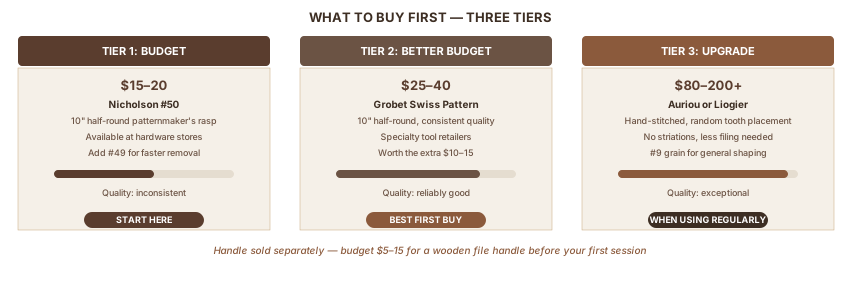
Budget: Nicholson #50
The Nicholson #50 is a 10" half-round patternmaker's rasp — the finer of the two standard cuts. It runs $15-20 at most hardware stores. The Nicholson #49 is the coarser companion: faster removal, rougher surface. If budget allows, buy both. If you buy one, start with the #50 and add the #49 when you need faster material removal.
Honest note: Nicholson moved production out of the US and current quality is inconsistent. Some leave deeper parallel marks than they should. If yours won't clean up with a file, that's a manufacturing issue, not your technique. Highland Woodworking's Nicholson product page has current pricing.
Better budget option: Grobet
Grobet makes Swiss-pattern rasps with consistently better quality than current Nicholson production. They run $25-40 at specialty tool retailers. Worth the extra $10-15 if you can find them.
The upgrade: Auriou or Liogier
Once you're using rasps regularly, one hand-stitched rasp changes the work. The difference is immediate: no striations, a smoother cut, less time with a file. Both Auriou and Liogier make excellent tools. For a 10" half-round in #9 grain, expect to pay $80-120.
Handle note
Most rasps ship without a handle — just a bare tang (the pointed metal spike at the end). You need a handle before you use it. A loose handle on a rasping tool is a safety hazard. Buy a wooden file handle ($5-15) or make one. Drive it on firmly.
Buying sequence
| Step | What to buy | Price | When |
|---|---|---|---|
| 1 | Nicholson #50 (or Grobet equivalent), 10" half-round | $15-20 | First shaping project |
| 2 | Nicholson #49 (or Grobet coarse), 10" half-round | $15-20 | When you need faster removal |
| 3 | Auriou or Liogier #9 grain, 10" half-round | $80-120 | When you're doing regular shaping work |
| 4 | Riffler set | $40-120 | When tight-detail work demands it |
Part 6: Caring for Your Rasp
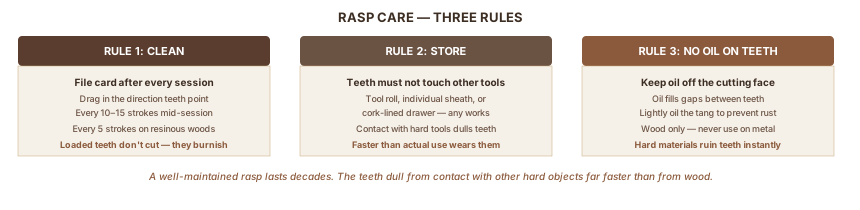
Clean after every session. A file card removes embedded wood fibers. Work in the direction the teeth point. For pine or other resinous woods, clean mid-session too. Loaded teeth don't cut.
Store so teeth don't contact other tools. A tool roll, individual sheaths, or a cork-lined drawer all work. The teeth dull faster from contact with other hard tools than from actual use.
No oil on the cutting face. Oil fills the spaces between teeth and prevents cutting. You can lightly oil the smooth tang and body to prevent rust. Keep oil off the teeth.
Only use on wood. Rasps are made for wood. Hardened steel, masonry, or metal ruins the teeth on contact.
Where This Fits
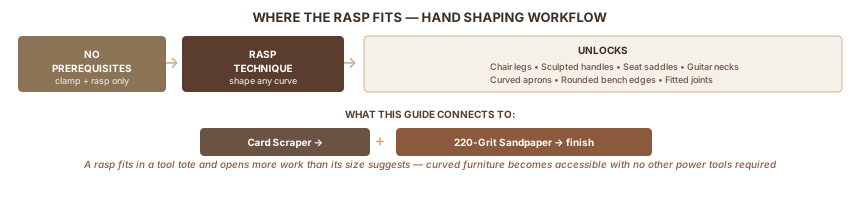
No prerequisites. Rasps are beginner-friendly by design. They work in any direction and the technique is physical, not fussy. A clamp or vise is the only other thing you need.
What this unlocks. Once you can shape with a rasp, curved furniture becomes accessible: chair legs, sculpted handles, rounded edges on a workbench, shaped aprons. Luthiers use rasps to carve guitar necks. Chairmakers use them to shape seat saddles. A hand rasp fits in a tool tote and opens up more work than its size suggests.
Related guides:
- Card Scraper — the tool that follows rasps and files in the shaping progression
- 220-Grit Sandpaper — final surface prep after the scraper
Sources
Research for this guide drew on technique guidance from Fine Woodworking, Paul Sellers, Auriou manufacturer documentation, Katz-Moses Tools, and community knowledge from Sawmill Creek and LumberJocks.
- Fine Woodworking — Shape Wood with Rasps and Files — technique guidance, grain behavior, and tool comparison
- Tools for Working Wood — All About Rasps and Rifflers — hand-stitched tooth geometry, Auriou grain system, care recommendations
- Paul Sellers — A Rasp by Liogier — hand-stitched vs. machine-cut quality comparison
- Katz-Moses Tools — Guide to Reading Grain Direction — grain behavior on curved surfaces
- Highland Woodworking — Nicholson #49 product page — pricing and availability
- Auriou — Cabinet Maker's Rasps — grain scale and specifications
- Liogier — Hand-Stitched Rasps — grain scale and product range
- Canadian Woodworking — Half-Round Cabinet Rasps — cut grades and machine vs. hand-stitched overview
Tools Used
Tagged