
Nominal Wood Sizes at a Glance
A 2x4 is a piece of lumber that actually measures 1-1/2" x 3-1/2" — every board sold at the hardware store carries a nominal name on the label and a smaller actual dimension left after the wood is dried and planed. The gap isn't trivial: a "2x6" is really 1-1/2" x 5-1/2", and a "1x12" is only 3/4" x 11-1/4". Plan a shelf using nominal numbers and it comes out nearly an inch too narrow; frame a cabinet with nominal widths and your joints won't line up. Always pull actual dimensions before you cut.
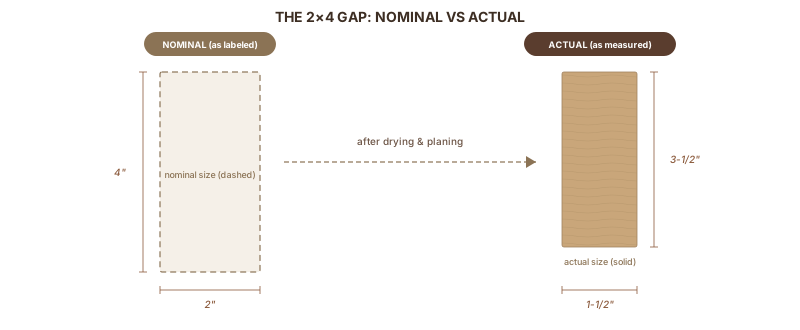
| The gap | A 2x4 is actually 1-1/2" x 3-1/2" |
| Why | Boards shrink during kiln-drying, then lose more material during planing |
| The standard | PS 20, published by the American Lumber Standard Committee |
| The rule | Always measure actual dimensions before cutting |
| Hardwood | Uses a separate quarter system (4/4, 5/4, 8/4), not nominal names |
In this guide:
- Complete dimension table for every common lumber size
- Why nominal and actual dimensions are different
- How the hardwood quarter system works
- Project planning mistakes to avoid
Part 1: Every Nominal and Actual Lumber Size
Print this page. Tape it to your shop wall. All dimensions follow PS 20, the American softwood lumber standard.
Boards (1x Series)
| Nominal | Actual (in) | Actual (mm) |
|---|---|---|
| 1 x 2 | 3/4 x 1-1/2 | 19 x 38 |
| 1 x 3 | 3/4 x 2-1/2 | 19 x 64 |
| 1 x 4 | 3/4 x 3-1/2 | 19 x 89 |
| 1 x 6 | 3/4 x 5-1/2 | 19 x 140 |
| 1 x 8 | 3/4 x 7-1/4 | 19 x 184 |
| 1 x 10 | 3/4 x 9-1/4 | 19 x 235 |
| 1 x 12 | 3/4 x 11-1/4 | 19 x 286 |
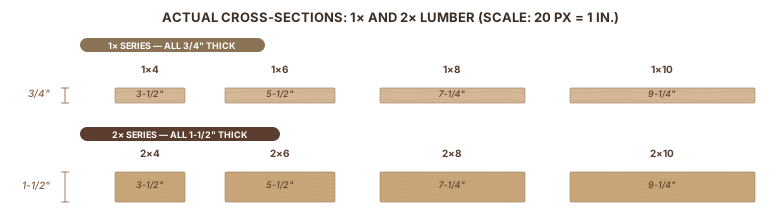
All 1x boards are 3/4" thick. Width loses 1/2" for boards under 8" nominal, 3/4" for boards 8" and wider.
Dimension Lumber (2x Series)
| Nominal | Actual (in) | Actual (mm) |
|---|---|---|
| 2 x 2 | 1-1/2 x 1-1/2 | 38 x 38 |
| 2 x 3 | 1-1/2 x 2-1/2 | 38 x 64 |
| 2 x 4 | 1-1/2 x 3-1/2 | 38 x 89 |
| 2 x 6 | 1-1/2 x 5-1/2 | 38 x 140 |
| 2 x 8 | 1-1/2 x 7-1/4 | 38 x 184 |
| 2 x 10 | 1-1/2 x 9-1/4 | 38 x 235 |
| 2 x 12 | 1-1/2 x 11-1/4 | 38 x 286 |
All 2x lumber is 1-1/2" thick. Same width pattern as 1x boards.
Timbers (4x and Larger)
| Nominal | Actual (in) |
|---|---|
| 4 x 4 | 3-1/2 x 3-1/2 |
| 4 x 6 | 3-1/2 x 5-1/2 |
| 6 x 6 | 5-1/2 x 5-1/2 |
| 6 x 8 | 5-1/2 x 7-1/2 |
| 8 x 8 | 7-1/2 x 7-1/2 |
The Pattern
Once you see the pattern, you can predict any size:
- Thickness: 1" nominal becomes 3/4". 2" nominal becomes 1-1/2". 4" and above loses 1/2".
- Width under 8": Subtract 1/2" from the nominal.
- Width 8" and above: Subtract 3/4" from the nominal.
A 2x10? That's 1-1/2" thick (2" nominal, subtract 1/2") by 9-1/4" wide (10" nominal, subtract 3/4"). You don't need the table once you know the rule.
Part 2: Why Nominal and Actual Dimensions Are Different
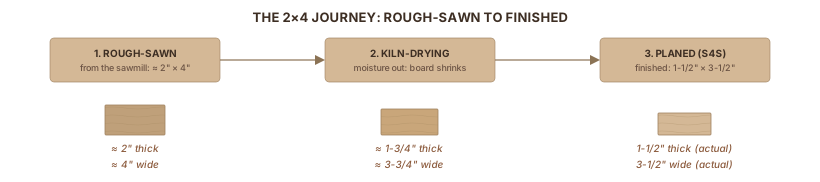
Lumber is named for its rough size before drying and planing. Between the forest and the hardware store, a board loses material twice.
Sawing
A log goes through a sawmill and gets cut into rough boards. At this point, a 2x4 really is about 2" x 4".
Kiln-Drying
Green (freshly cut) wood contains 30% or more moisture. The boards go into a kiln where hot air drops the moisture content to about 19% or below. As water leaves the cells, the board shrinks. A 2" thick board might lose 1/8" to 3/16" in thickness from drying alone.
Planing
The dried boards are rough and uneven. A planer shaves all four sides smooth. S4S (Surfaced Four Sides) means all four faces are planed. The planer removes another 1/8" or so from each face.
Result: a board that started at 2" x 4" ends up at 1-1/2" x 3-1/2".
The PS 20 Standard
Before 1964, a 2x4 could measure 1-5/8" x 3-5/8" from one mill and 1-3/4" x 3-3/4" from another. The American Lumber Standard Committee published PS 20 in 1964 to fix this. PS 20 sets the minimum actual dimensions for each nominal size of softwood lumber. Every piece of dimensional lumber sold in the United States meets this standard.
The current version is PS 20-20, last revised in 2020. The actual dimensions haven't changed since 1964. A 2x4 has been 1-1/2" x 3-1/2" for over 60 years.
What About Green Lumber?
PS 20 defines separate actual dimensions for green (wet, above 19% moisture) lumber. Green boards are slightly larger because they haven't finished shrinking:
| Nominal | Dry Actual | Green Actual |
|---|---|---|
| 2 x 4 | 1-1/2 x 3-1/2 | 1-9/16 x 3-9/16 |
| 2 x 6 | 1-1/2 x 5-1/2 | 1-9/16 x 5-5/8 |
If you buy green lumber for an outdoor project, expect it to shrink to the dry dimensions as it acclimates. Leave room in your joinery.
Part 3: Hardwood Lumber: The Quarter System
Hardwood lumber yards use a different sizing convention. Forget "1x" and "2x." Hardwood uses the quarter system.
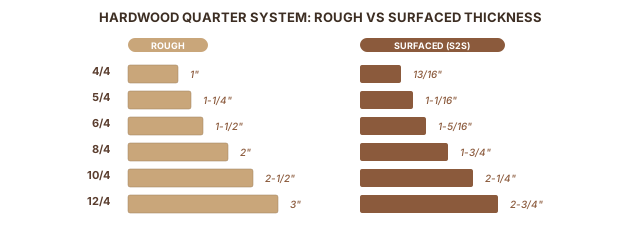
The name tells you the rough thickness in quarter-inches. 4/4 means "four quarters of an inch" or 1 inch rough thickness. 8/4 means "eight quarters" or 2 inches rough.
| Quarter Name | Rough Thickness | Surfaced (S2S) |
|---|---|---|
| 4/4 | 1" | 13/16" |
| 5/4 | 1-1/4" | 1-1/16" |
| 6/4 | 1-1/2" | 1-5/16" |
| 8/4 | 2" | 1-3/4" |
| 10/4 | 2-1/2" | 2-1/4" |
| 12/4 | 3" | 2-3/4" |
| 16/4 | 4" | 3-3/4" |
Surfacing removes about 3/16" total (roughly 3/32" from each face), per North Castle Hardwoods' sizing reference.
Three Key Differences from Softwood
Width is random. A hardwood board is whatever width the tree produced. You might get a walnut board that's 6" wide and another that's 11" wide. Both are priced the same per board foot.
Sold by the board foot. Hardwood is priced per board foot, not per linear foot. A board foot is 144 cubic inches of wood (1" x 12" x 12"). Thicker stock costs proportionally more. See How to Calculate Board Feet for the math.
You choose the surfacing. Big-box softwood comes ready to use (S4S). At a hardwood yard, you pick: rough-sawn (full thickness, you plane it), S2S (faces planed, edges rough), or S4S (all sides smooth). Rough-sawn gives you the most flexibility. S2S saves time. Know what you need before you buy.
Part 4: Plywood Thickness: One More Sizing Surprise
Plywood has its own nominal vs actual gap. Per Inch Calculator's plywood reference, most plywood is about 1/32" thinner than its label:
| Nominal | Actual |
|---|---|
| 1/4" | 7/32" |
| 3/8" | 11/32" |
| 1/2" | 15/32" |
| 5/8" | 19/32" |
| 3/4" | 23/32" |
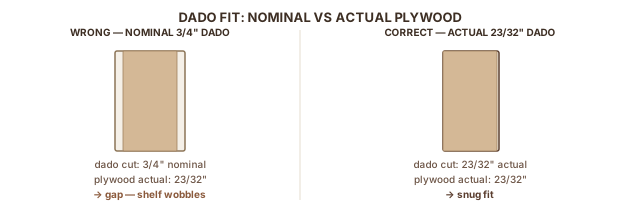
That 1/32" matters for joinery. Cut a 3/4" dado for a plywood shelf, and the 23/32" panel will rattle in the groove. The joint is sloppy and the shelf wobbles.
The fix: size your dadoes and rabbets to the actual plywood thickness, not the nominal. Use a dado stack or router bit that matches 23/32", or make test cuts in scrap until the fit is snug.
Part 5: Project Planning Mistakes to Avoid
These mistakes happen when you use nominal dimensions in your plans instead of actual.
The shelf that's too narrow
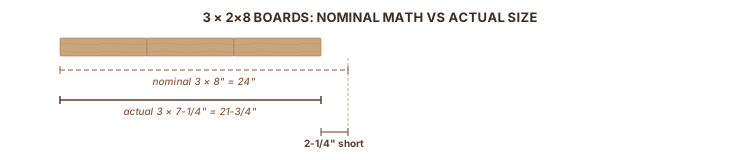
You want a 24" wide shelf. Three 2x8s side by side should work, right? 3 x 8" = 24".
Actual: 3 x 7-1/4" = 21-3/4". Your shelf is 2-1/4" too narrow. You need four boards, or a wider size.
The dado that doesn't fit
You rout a 3/4" groove for a plywood divider. The 23/32" plywood drops in and rattles. The cabinet looks fine from the outside, but the divider shifts every time you close a door.
The mixed-source mismatch
You buy 1x6 pine from two different stores. One measures 3/4" thick. The other is 11/16" because it came from a different batch or was cut from green stock that dried differently. Glue them into a panel and you have a 1/16" ridge down the middle.
The fix: buy all your lumber from the same source, same stack. And always read your tape accurately before you cut.
The hardwood-softwood confusion
Your plan calls for 1" thick stock. You buy 1x pine (3/4" actual) and 4/4 cherry (13/16" surfaced). The cherry is 1/16" thicker. Not a problem if you plan for it. A real problem if you don't.
Where This Fits

Related guides:
- How to Calculate Board Feet — the math for buying hardwood at a lumber yard
- Hardwood Species Guide — which species to choose and what they cost
What to learn next: Once you understand sizing, the next step is learning to select good boards. Not every 2x4 is straight, flat, or dry. A guide to buying lumber covers how to check for twist, bow, and moisture before you pay. To see these dimensions in practice, 2x4 Woodworking covers eight projects that use construction-grade 2x4 lumber with real materials lists and cost estimates.
Sources
The dimension data and standards in this guide come from lumber industry references and woodworking education resources.
- Archtoolbox: Lumber Dimensions — complete nominal vs actual tables, PS 20 standard history, green vs dry dimensions
- Rockler: What Does the Quarter System of Lumber Thickness Mean? — hardwood quarter system explained
- North Castle Hardwoods: Lumber Sizing Explained — rough vs surfaced dimensions, material loss during planing
- Inch Calculator: Actual Plywood Thickness and Size — plywood nominal vs actual thickness data
- Kreg Tool: Understand Lumber Sizing — beginner-friendly overview of nominal vs actual
- Saws on Skates: Beginner's Guide to Wood Sizes — project planning with actual dimensions
- Woodworkers Source: What Does 4/4 Mean in Lumber? — quarter system with surfaced thickness data
- Tree Plantation: Dimensional Lumber Sizes Explained — comprehensive dimensional lumber reference
Also Referenced
How We Research
We don't take affiliate revenue or accept review units. Picks come from multi-source research — manufacturer specs, OSHA / EPA / ASTM regs, and long-form practitioner threads — plus Ahmed's hands-on use where relevant. When we recommend something, we explain why.
Up Next
1-Inch Plywood: What You're Actually Buying
WOOD & MATERIALS · Beginner