
4x8 Plywood at a Glance
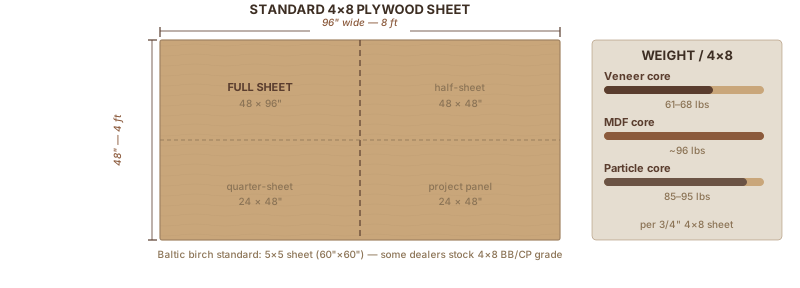
A 4x8 sheet of plywood is the standard panel for cabinets, shelves, and furniture. Every thickness is thinner than its name: 3/4" plywood actually measures 23/32". Choose veneer-core plywood for most furniture work. Big-box stores sell C-3 grade (decent for painting, mediocre for clear finish). Hardwood dealers stock A-1 and A-2 grades with better veneer, and often at competitive prices.
| Standard sheet | 48" x 96" (4 ft x 8 ft) |
| Actual 3/4" thickness | 23/32" (0.719") |
| Best all-around core | Veneer core (lightest, best screw holding) |
| Big-box grade | C-3 (PureBond at Home Depot) |
| Best cabinet plywood | 3/4" Baltic birch or A-1 hardwood veneer |
In this guide:
- Why your plywood isn't the thickness it says
- Choosing the right thickness for your project
- Species and veneer: what to buy for visible vs. hidden surfaces
- Big box vs. hardwood dealer: the real cost comparison
Part 1: What 4x8 Plywood Is and How It's Built
A standard sheet measures 48 inches by 96 inches. That's the size you'll find at every home center and lumber dealer in North America. You'll also see 5'x5' sheets (Baltic birch standard from European mills), 4'x4' half-sheets, and 2'x4' project panels, but 4x8 is the baseline.
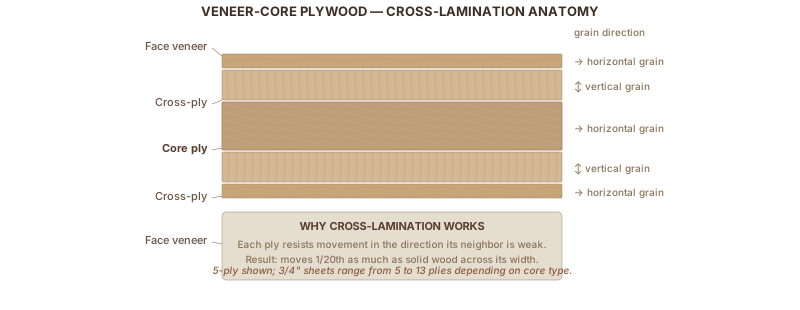
Plywood is thin layers of wood (called veneers or plies) glued together with alternating grain direction. That cross-lamination is the whole point. Solid wood has strength along the grain but splits easily across it. Plywood has strength in both directions and, according to HPVA's technical data, moves roughly 1/20th as much as solid wood across its width. A 24-inch solid wood panel can shrink 3/16" to 1/4" between summer and winter. A 24-inch plywood panel barely moves at all.
Core Types
Not all plywood is built the same inside. The core determines weight, flatness, screw holding, and cost.
Weight data from Hood Distribution; core comparisons from States Industries.
| Core Type | Weight (3/4" 4x8) | Flatness | Screw Holding | Bending Strength | Best For |
|---|---|---|---|---|---|
| Veneer core | 61-68 lbs | Good | Excellent | Excellent | All-around furniture and cabinets |
| MDF core | ~96 lbs | Excellent | Fair | Fair | Painted doors, dead-flat panels |
| Lumber core | ~65-75 lbs | Fair | Excellent | Excellent | Long shelves, premium cabinetry |
| Combination core | ~75-85 lbs | Good | Good | Good | Balance of flatness and strength |
| Particleboard core | ~85-95 lbs | Fair | Poor | Poor | Budget shelving, closet systems |
Veneer core is the best all-around choice for furniture and cabinet work. It's lighter than MDF core (you'll notice hauling sheets into your shop), holds screws well, and resists bending. Choose MDF core only when you need dead-flat panels for painted cabinet doors. Avoid particleboard core for anything that takes fasteners or load.
Combination core (MDF outer layers with veneer center) costs 10-20% more than straight MDF core but gives you better screw holding with nearly the same flatness. Worth the premium if you can find it.
Part 2: Nominal vs. Actual Thickness and Why It Matters
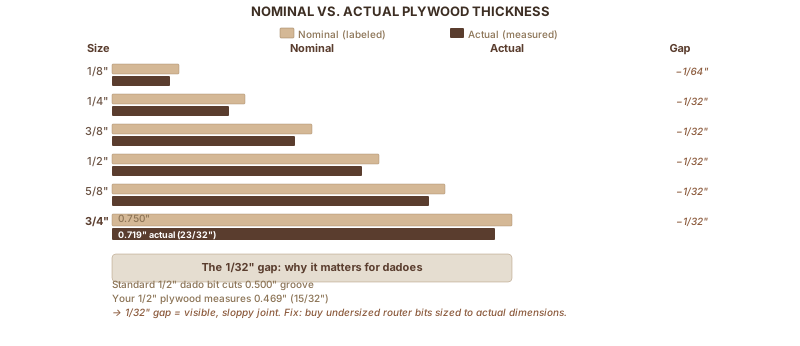
This is the single most important thing to know before you design anything with plywood. Every domestic plywood thickness is thinner than its name.
The Thickness Table
| Nominal | Actual | Decimal | Difference |
|---|---|---|---|
| 1/8" | 7/64" | 0.109" | -1/64" |
| 1/4" | 7/32" | 0.219" | -1/32" |
| 3/8" | 11/32" | 0.344" | -1/32" |
| 1/2" | 15/32" | 0.469" | -1/32" |
| 5/8" | 19/32" | 0.594" | -1/32" |
| 3/4" | 23/32" | 0.719" | -1/32" |
Each face gets sanded smooth at the factory, removing about 1/64" per side. That's 1/32" total. The NIST PS 1 standard allows +/- 1/32" tolerance on top of that, and manufacturers land on the thin side because thick panels jam factory tooling. Thin panels don't. Thickness data verified against Inch Calculator's plywood reference.
Metric vs. Domestic
Imported plywood (Baltic birch from Finland, Russia, and the Baltic states) uses metric measurements. They're close to domestic sizes but not identical.
| Import (metric) | Decimal | Nearest Domestic | Domestic Decimal |
|---|---|---|---|
| 6mm | 0.236" | 1/4" (7/32") | 0.219" |
| 12mm | 0.472" | 1/2" (15/32") | 0.469" |
| 18mm | 0.709" | 3/4" (23/32") | 0.719" |
18mm Baltic birch is 0.010" thinner than domestic 3/4". If you switch between domestic and imported plywood mid-project, measure both before cutting joinery.
The Dado Problem
This is where the thickness gap bites hardest. A standard 1/2" dado bit (a dado is a groove cut across the grain to hold a shelf or divider) cuts a 0.500" groove. Your 15/32" plywood measures 0.469". That leaves a 1/32" gap, which is visible, sloppy, and structurally weak.
Four ways to fix it, ranked by reliability:
- Undersized router bits. Whiteside, Infinity Tools, and Rockler sell bits sized for actual plywood: 23/32", 15/32", 7/32". Buy the set, use it forever. This is the cleanest solution.
- Shim your dado blade stack. Add paper or brass shims between blades until the width matches your measured plywood. Test on scrap first.
- Two-pass method. Cut a slightly narrow groove, then nudge the fence and make a second pass to widen it. Slower but accurate for any thickness.
- Rabbet the shelf. Cut a rabbet (a step-shaped notch) on the shelf end to create a tongue that fits the groove. Adds a step but guarantees a tight fit.
One more thing: 1/4"-deep dados are stronger than 3/8"-deep dados in pull-out tests. The deeper cut removes more material from the side panel, weakening it. Cut your dados 1/4" deep unless you have a specific reason to go deeper.
Part 3: Plywood Grades: What the Letters and Numbers Mean
Two separate grading systems exist. One covers softwood plywood (construction grade), the other covers hardwood plywood (furniture grade). They look different and work differently.
Softwood Grades (APA / PS 1 Standard)
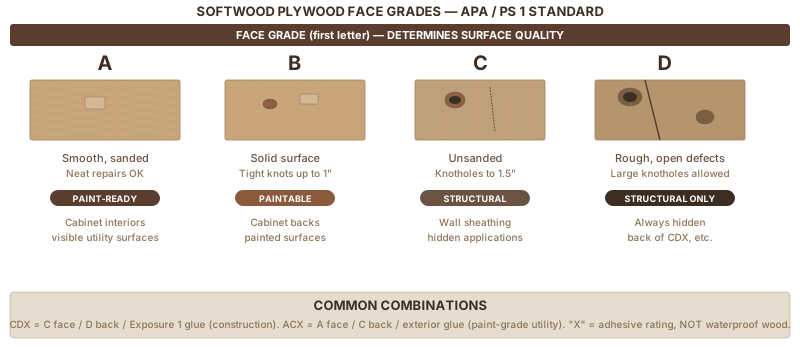
Softwood plywood (fir, pine) uses a two-letter system. First letter is the face grade, second is the back.
| Grade | What It Looks Like | Typical Use |
|---|---|---|
| A | Smooth, sanded, paint-ready. Neatly made repairs OK. | Cabinet interiors, visible utility surfaces |
| B | Solid surface, tight knots up to 1". Minor repairs. | Painted surfaces, cabinet backs |
| C | Unsanded. Knotholes up to 1-1/2", limited splits. | Wall sheathing, structural panels |
| D | Rough. Larger knotholes and defects. | Structural only, hidden applications |
Common combinations: CDX (C face, D back, Exposure 1 glue) is the workhorse of construction. ACX (A face, C back, exterior glue) is paint-grade with a structural back.
The "X" in CDX does NOT mean "exterior grade wood." It means Exposure 1 adhesive. The glue survives temporary moisture during construction. The wood itself isn't waterproof. This is one of the most common misconceptions about plywood.
Hardwood Grades (HPVA / ANSI HP-1)
This is what you're buying for furniture and cabinets.
Face grades run AA (premium, book-matched veneer) through D (utility, hidden surfaces). Back grades run 1 (best) through 4 (utility), per the ANSI/HPVA HP-1 standard. A typical furniture panel is graded "A-1" (premium both sides) or "B-2" (good both sides).
| Grade Combo | What You Get | Where to Find It |
|---|---|---|
| A-1 or A-2 | Premium face, good back. Plain-sliced veneer. | Specialty hardwood dealers |
| B-2 | Good both sides. Some minor defects. | Better lumber yards |
| C-3 | Sound face, utility back. Thin veneer. | Home Depot (PureBond) |
What Home Depot actually sells: PureBond plywood is C-3 grade by HPVA standards. It's formaldehyde-free (soy-based adhesive), which is genuinely good for indoor air quality. But the face veneer is thin (easy to sand through) and internal voids are possible. Good for painting. Mediocre for clear finish.
Interior vs. Exterior: When It Matters
For most shop furniture—including a fold-down workbench or wall cabinet (indoor use, climate-controlled space)—interior-rated hardwood plywood is fine. You need exterior-rated plywood only for outdoor furniture, unheated garages, or bathroom vanities near water. Don't pay for a rating you don't need.
Part 4: Species and Veneer: What to Use Where
The face veneer determines how your project looks. Species choice also affects stainability, hardness, and cost.
Species Comparison
| Species | Appearance | Stainability | Hardness | Cost (3/4" 4x8) | Best For |
|---|---|---|---|---|---|
| Birch | Light, fine grain | Poor (blotches) | Hard | $60-80 | Carcasses, painting, CNC work |
| Maple | Creamy white, tight grain | Poor (blotches) | Very hard | $73-130 | Modern cabinets, painting |
| oak) | Prominent grain, warm tone | Excellent | Hard | $70-100 | Traditional and Craftsman style |
| White oak | Similar to red, subtler | Excellent | Hard | $90-120 | Moisture-prone areas, Shaker style |
| Cherry | Reddish-brown, darkens | Good | Medium | $110-140 | Fine furniture, matching solid |
| Walnut | Dark brown, rich grain | Good | Medium | $150-210 | Statement pieces, high-end work |
| Pine | Knotty or clear, soft | Fair | Soft | $40-50 | Rustic projects, utility |
| Lauan | Reddish-brown, inconsistent | Poor | Soft | $15-20 (1/8"-1/4") | Underlayment, cabinet backs |
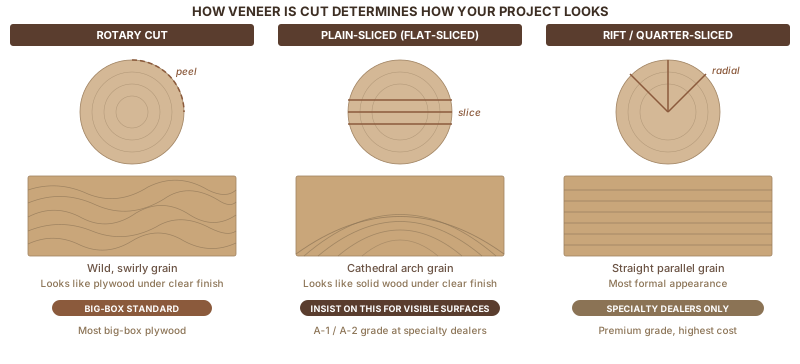
Veneer Cut Matters More Than You'd Think
How the veneer is sliced off the log determines whether your project looks like furniture or looks like plywood.
Rotary cut veneer is peeled off the log like unrolling paper towels. It produces wild, swirly grain that screams "plywood." Cheapest to manufacture. Most big-box plywood uses rotary-cut veneer.
Plain-sliced (flat-sliced) veneer is cut through the log like slicing bread. It produces cathedral grain patterns that look like solid wood. This is what you want for visible surfaces under clear finish.
Rift or quarter-sliced veneer is cut at an angle to the growth rings. Straight, parallel grain lines. Premium appearance for formal furniture.
If you're applying a clear finish and the surface will be visible, insist on plain-sliced veneer. Fine Woodworking's plywood guide recommends A1 or A2 grade with plain-sliced veneer for any clear-finished surface. Rotary-cut veneer under clear finish will always look like plywood, no matter the grade.
Quick Species Decision Guide
Painting it? Birch or maple. Both take paint well. Maple costs more for no visible benefit under paint. Save with birch unless you need the extra hardness.
Staining dark? Red or white oak. They absorb stain evenly. Birch and maple blotch without special prep (pre-stain conditioner or shellac wash coat).
Clear finish, modern look? Maple (light, clean) or birch (similar, cheaper).
Clear finish, traditional look? Red oak (Craftsman) or cherry (warm, darkens with age).
Matching solid wood components? Buy veneer plywood in the same species as your solid stock. Cherry frame deserves cherry plywood panels.
Cabinet backs and drawer bottoms? Birch 1/4" (nice) or lauan 1/4" (budget). Lauan is a tropical hardwood (Shorea genus) sold at $15-20 per sheet. It works for hidden surfaces, but many Shorea species are endangered. Birch is the responsible alternative at a modest premium.
Part 5: Which Thickness for Which Job
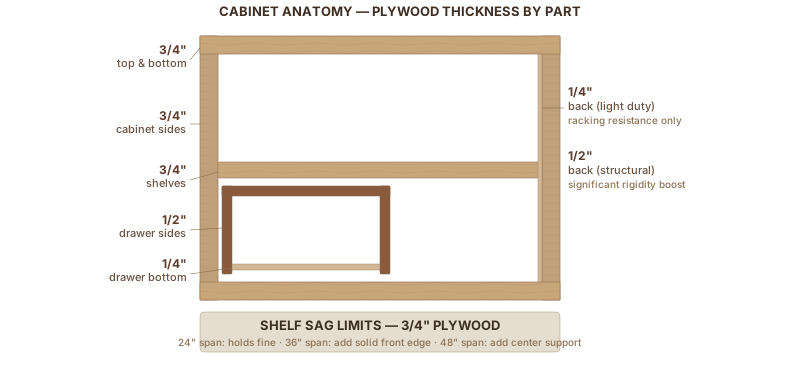
Match the thickness to the job. This table covers the most common furniture and cabinet applications.
| Application | Thickness | Species/Type | Why |
|---|---|---|---|
| Cabinet sides | 3/4" | Baltic birch, maple, birch | Needs screw-holding strength and rigidity |
| Cabinet shelves | 3/4" | Baltic birch, maple | Must support weight without sagging |
| Cabinet backs (light duty) | 1/4" | Birch, lauan | Prevents racking, no structural load |
| Cabinet backs (structural) | 1/2" | Birch, Baltic birch | Adds significant rigidity to the case |
| Drawer sides | 1/2" | Baltic birch | Void-free edges look clean, holds screws |
| Drawer bottoms | 1/4" | Baltic birch, birch | Slides into groove, carries contents |
| Large panels (tops, desks) | 3/4" | Hardwood veneer + solid edging | Visible surface, edging hides plies |
| Jigs and fixture bases | 3/4" | Baltic birch, MDF | Flatness and durability over appearance |
Shelf Span Guidelines
A 3/4" plywood shelf sags visibly under sustained load if the unsupported span is too long.
- 24" span: 3/4" plywood holds fine with moderate load (books, dishes).
- 36" span: 3/4" works, but add a solid wood front edge (3/4" x 1-1/2") for stiffness.
- 48" span: Add a center support, use lumber-core plywood, or laminate two sheets together.
Part 6: Where to Buy: Big Box vs. Hardwood Dealer
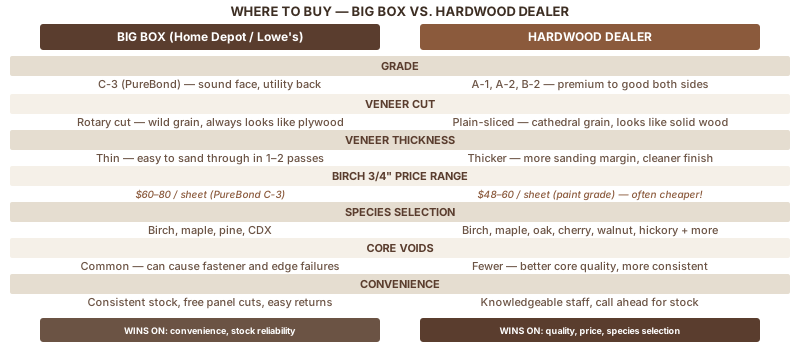
Where you buy matters as much as what you buy. The quality difference between sources is bigger than most people expect.
Price Comparison (3/4" 4x8 Sheet, 2025-2026)
Big Box Stores (Home Depot, Lowe's)
| Product | Price Range |
|---|---|
| CDX / sheathing (construction) | $35-55 |
| Sanded pine or fir | $40-50 |
| PureBond birch (C-3) | $60-80 |
| PureBond maple (C-3) | $73-83 |
Specialty / Hardwood Dealers
| Product | Price Range |
|---|---|
| Birch, paint grade | $48-60 |
| Shop grade maple (cosmetic seconds) | $55-65 |
| Maple, cabinet grade (A-1/A-2) | $95-130 |
| Cherry, cabinet grade | $110-140 |
| Walnut, cabinet grade | $150-210 |
| Baltic birch 18mm BB/CP (4x8) | $60-85 |
The Surprise: Dealers Often Beat Big-Box Prices
Multiple woodworkers report on LumberJocks and other forums that hardwood dealers sell better-quality plywood at the same price or lower than big-box stores. A hardwood dealer's birch paint-grade at $48-60 beats PureBond birch at $60-80, and the dealer's sheet typically has better core quality, thicker face veneer, and fewer internal voids.
Big-box stores win on convenience: consistent stock, no minimums, free panel saw cuts, and easy returns. Specialty dealers win on quality: A-1 and A-2 grades with plain-sliced face veneer, more species choices (cherry, walnut, white oak, hickory), knowledgeable staff who understand woodworking applications, and often lower per-sheet prices on equivalent quality.
Find a hardwood dealer near you and visit before your next project. Once you see the quality difference, you'll know which purchases belong at each source.
Baltic Birch: The Cabinet Maker's Choice
Baltic birch deserves special mention. Woodworkers Source's guide covers it in depth, and it's the go-to plywood for serious cabinet and furniture work.
| Feature | Baltic Birch | Domestic Birch |
|---|---|---|
| Ply count (3/4") | ~13 plies, all birch | 5-7 plies, mixed species core |
| Voids | Nearly void-free | Common |
| Standard sheet | 5' x 5' | 4' x 8' |
| Cost | 40-60% more | Standard |
| Screw holding | Excellent | Fair |
| Edge appearance | Clean, consistent layers | Visible voids and gaps |
Marc Spagnuolo (The Wood Whisperer) uses 3/4" Baltic birch for cabinet cases. Rob Cosman uses it for tool cabinet carcasses. The 5'x5' sheet size means more waste for some layouts, but some dealers now stock 4'x8' Baltic birch (BB/CP grade) for easier planning.
Baltic birch is worth the premium for drawer boxes (the laminated edges look beautiful with clear finish), cabinet carcasses (outstanding screw holding), and anything where exposed edges are part of the design.
Brands Worth Knowing
PureBond (Columbia Forest Products): Formaldehyde-free, C-3 grade. Home Depot. Good for paint-grade work. Thin veneer and possible internal voids limit it for clear-finish furniture.
Europly (Columbia's premium line): Hardwood face over Baltic birch core. Available at specialty dealers. Significant quality step up from standard PureBond.
ApplePly (States Industries): USA-made Baltic birch alternative. Virtually void-free. Available in 10+ face veneer species including cherry, walnut, and maple.
Part 7: Handling, Cutting, and Finishing Plywood
Breaking Down Full Sheets
A full 4x8 sheet of 3/4" plywood weighs 60-80 lbs. You can't run it across a table saw without help or outfeed support.
The practical approach: Break sheets down outside with a circular saw and a straightedge guide. Place the good side face-down (circular saw blades cut upward, so tear-out happens on the top face). Use a high-tooth blade (60+ teeth) and put painter's tape along the cut line to reduce splintering. Support the sheet on rigid foam insulation or 2x4s on the ground. Then bring manageable pieces inside for precision cuts on the table saw.
A track saw is the best single tool for sheet goods if you have one. Clean cuts, minimal tear-out on both faces, handles full sheets solo.
Home Depot and Lowe's will make free straight cuts on their panel saw when you buy sheets. Accuracy is rough (+/- 1/8"), but it gets panels down to a manageable size for transport.
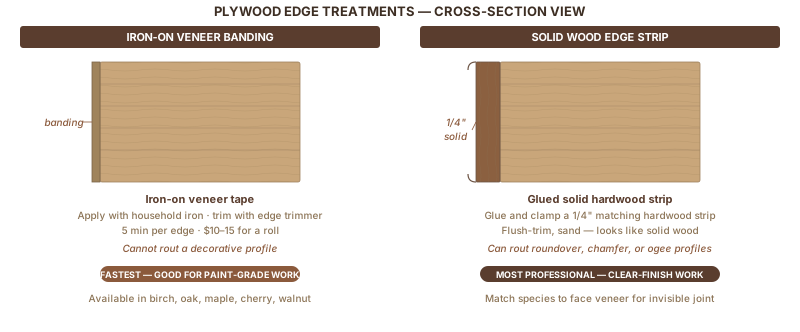
Edge Treatments
Plywood edges show the lamination layers. For visible edges, you have options ranked from easiest to most polished:
Iron-on veneer banding is the fastest. Apply with a household iron, trim with a FastCap edge trimmer ($15-20), sand flush. Takes 5 minutes per edge. Available in birch, oak, maple, cherry, and walnut to match your face veneer.
Solid wood edge strips produce the most professional result. Glue and clamp a 1/4" strip of matching hardwood to the plywood edge. Once flush-trimmed and sanded, the edge looks like solid wood. You can also rout a decorative profile (roundover, chamfer) into solid edging. You can't do that with veneer banding.
Finishing by Species
Each species has quirks. Ignore them and your finish will disappoint you.
Birch blotches severely with oil-based stain. The face veneer absorbs stain unevenly, creating dark splotches. Apply pre-stain conditioner or a thin shellac wash coat before staining. Gel stains work better than liquid penetrating stains because they sit on top rather than soaking in. For clear finish, water-based polyurethane (Polycrylic) dries clear without yellowing.
Oak has open grain that needs filling for a smooth finish. Apply paste pore filler before your topcoat. The upside: oak takes stain evenly and predictably. It's the easiest species to stain well.
Maple also blotches, like birch. Pre-seal with a shellac wash coat. Use water-based polyurethane to keep the light color. Oil-based poly adds a warm amber tone that deepens over time. If you want maple to stay light and natural, water-based is the only option. Maple raises its grain with water-based finishes. Wet the surface, let it dry, sand with 320 grit, then apply your finish.
Part 8: Common Mistakes
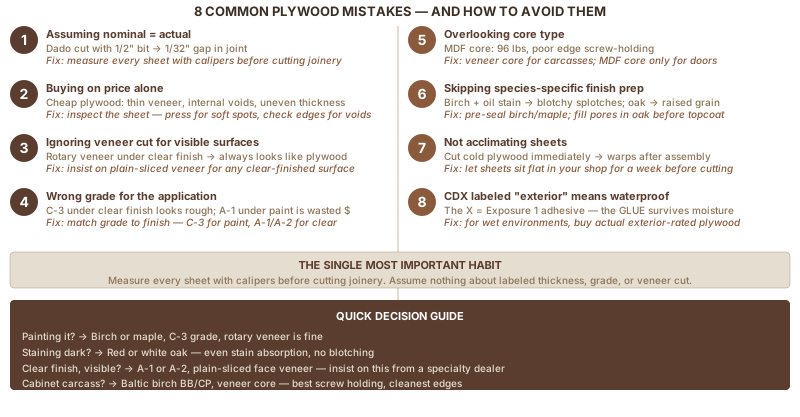
- Assuming nominal equals actual thickness. Your dado joints will be sloppy. Measure every sheet with calipers before cutting joinery. Buy undersized router bits.
- Buying on price alone. Cheap plywood has thin veneer, internal voids, and inconsistent thickness. The veneer sands through in two passes. Screws strip in the voids. Edges chip.
- Ignoring veneer cut for visible surfaces. Rotary-cut veneer under clear finish looks like plywood. Plain-sliced veneer looks like solid wood. Check the sheet or ask for plain-sliced.
- Not inspecting for voids. Press firmly across the sheet surface. Soft spots mean internal voids that will cause problems at fastener locations and edge cuts. Check edges for gaps between plies.
- Wrong grade for the application. C-3 PureBond paints great but looks mediocre under clear finish. A-1 cabinet grade under paint is wasted money. Match the grade to the finish.
- Overlooking core type. MDF core is dead flat but weighs 96 lbs per sheet and holds screws poorly. Don't build a carcass with MDF-core plywood if you're relying on screws.
- Skipping species-specific finishing prep. Birch and maple blotch without pre-treatment. Oak needs pore filling. These aren't optional. Skip them and the finish is the first thing people notice.
- Not acclimating sheets. Plywood brought from an outdoor lumber rack into a climate-controlled shop needs a week to reach equilibrium with your shop humidity. Cut it immediately and it may warp after assembly.
Where This Fits
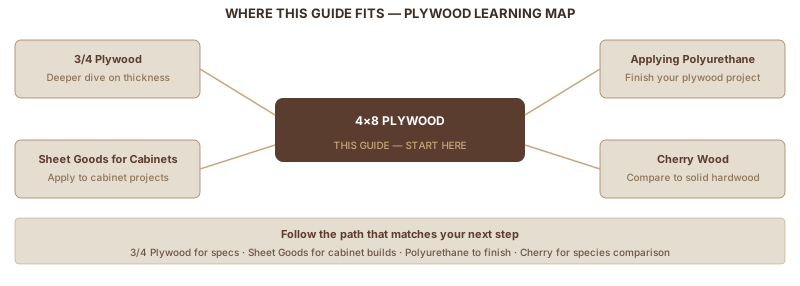
For a deeper look at 3/4" specifically, see 3/4 Plywood. If you're building cabinets, Sheet Goods for Cabinets covers substrates, brands, and specifying materials in detail. For finishing your plywood project, Applying Polyurethane walks through the full process. And if you're comparing plywood species to solid wood options, Cherry Wood is a good starting point for hardwood species.
Sources
Thickness data, grading standards, expert recommendations, and pricing surveys from industry standards bodies, woodworking publications, and manufacturer references.
- HPVA Technical Brief — dimensional stability data, cross-lamination benefits
- Hood Distribution — Product Weights — plywood weight by core type
- States Industries — Core Comparison — core type properties and trade-offs
- NIST PS 1-22 Standard — structural plywood thickness tolerances
- Inch Calculator — Actual Plywood Thickness — nominal vs. actual measurement reference
- Rockler — Undersized Plywood Router Bit Set — dado solutions for actual plywood thickness
- APA — The Engineered Wood Association — softwood plywood grades and exposure ratings
- ANSI/HPVA HP-1-2024 — hardwood plywood face and back grading standard
- Fine Woodworking — User's Guide to Plywood — grade selection, veneer cut types
- The Wood Whisperer — Shop Cabinets — Baltic birch carcass construction
- Rob Cosman — Tool Cabinet Build — Baltic birch for furniture carcasses
- Woodworkers Source — Ultimate Guide to Baltic Birch — Baltic birch specifications and selection
- LumberJocks — Big Box Store Plywood — community quality reports, dealer vs. big-box pricing
- Family Handyman — Edge Banding Guide — iron-on banding technique
- Columbia Forest Products — PureBond — formaldehyde-free plywood specifications
How We Research
We don't take affiliate revenue or accept review units. Picks come from multi-source research — manufacturer specs, OSHA / EPA / ASTM regs, and long-form practitioner threads — plus Ahmed's hands-on use where relevant. When we recommend something, we explain why.
Up Next
How to Laminate Plywood
WOOD & MATERIALS · Beginner