
Board Foot Calculations at a Glance
A board foot is 144 cubic inches of lumber. Picture a piece 12 inches long, 12 inches wide, and 1 inch thick. Multiply thickness (inches) by width (inches) by length (feet), then divide by 12. Hardwood dealers use board feet to price random-width lumber. Big-box stores sell by the piece.
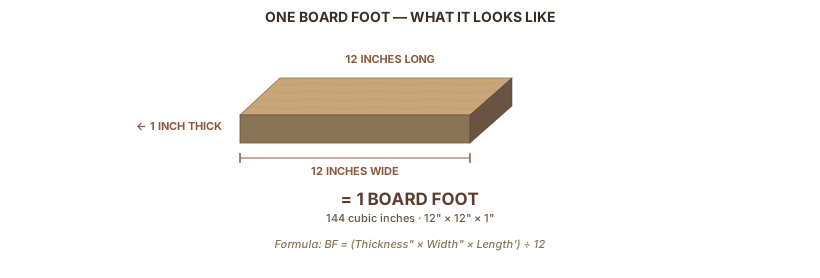
| One board foot | 144 cubic inches (12" x 12" x 1") |
| Formula | BF = (Thickness" x Width" x Length') / 12 |
| A 1x6x10 | 5 board feet |
| A 2x8x10 | 13.3 board feet |
| Which dimensions? | Nominal (labeled) size for pricing, actual size for cut planning |
| Waste factor | Add 20-25% for furniture projects in FAS-grade lumber |
In this guide:
- The formula and three ways to use it
- Which dimensions to use: nominal vs. actual
- Converting between board feet, square feet, and linear feet
- Mental math shortcuts for the lumberyard
- Calculating lumber for a real project
- Six mistakes that cost you money
Part 1: Why Lumber Is Sold by the Board Foot
Skill level: Beginner. No prerequisites. You need basic multiplication and division.
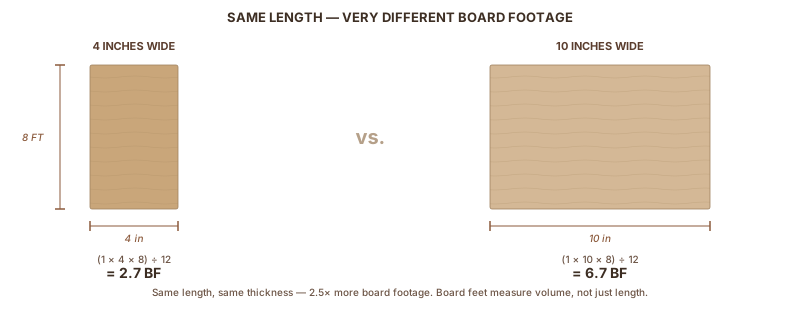
Hardwood comes in random widths and lengths. A 4-inch-wide cherry board and a 10-inch-wide cherry board of the same length contain different amounts of wood. Board feet measure volume instead of length, so a dealer can price any board consistently and you can compare across sizes.
The National Hardwood Lumber Association (NHLA) standardized this measurement in 1898. That standard still governs every hardwood transaction in the U.S. and Canada today.
For a quick-reference lookup table you can bookmark, see our Board Foot Calculator and Lookup Table.
Part 2: The Board Foot Formula and Three Ways to Use It
One formula, three arrangements depending on the units you have.
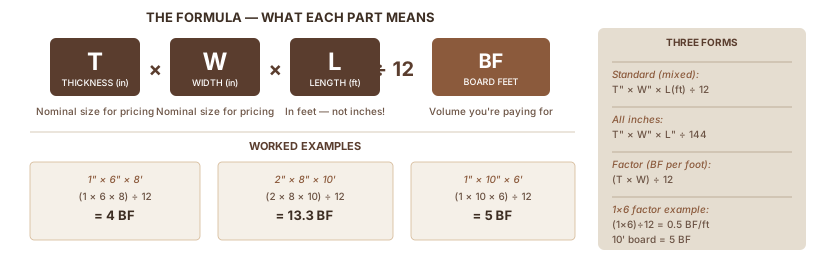
The standard formula (mixed units)
This is the one to memorize. Thickness and width in inches, length in feet:
BF = Thickness (in) x Width (in) x Length (ft) / 12
Four examples:
| Board | Math | Board Feet |
|---|---|---|
| 1" x 6" x 8' | (1 x 6 x 8) / 12 | 4 BF |
| 2" x 8" x 10' | (2 x 8 x 10) / 12 | 13.3 BF |
| 1.25" x 5.5" x 12' | (1.25 x 5.5 x 12) / 12 | 6.9 BF |
| 1" x 10" x 6' | (1 x 10 x 6) / 12 | 5 BF |
All-inches version
If you measured everything in inches (common when working from a tape measure):
BF = Thickness (in) x Width (in) x Length (in) / 144
Same board, same answer. A 1" x 8" x 96" (8-foot) board: (1 x 8 x 96) / 144 = 5.3 BF.
Board foot factor
For repeat calculations on the same size lumber, calculate the factor once:
Factor = (Thickness x Width) / 12 = board feet per linear foot
Then: BF = Factor x Length (ft).
A 1x6 has a factor of (1 x 6) / 12 = 0.5. So any 1x6 board: multiply its length in feet by 0.5. A 10-foot 1x6 = 5 BF. A 12-foot 1x6 = 6 BF. No division needed at the rack.
How dealers tally board feet
Professional lumber tallying uses a two-step method set by the NHLA, as described in the AHEC measurement guide:
- Surface Measure (SM): Width (inches) x Length (feet) / 12, rounded to the nearest whole number
- Board Feet: SM x Thickness (inches)
The critical detail: round surface measure before multiplying by thickness. Gene Wengert at WoodWeb explains that this rounding step is why a dealer's tally sometimes differs from your phone calculator. Both are correct; the dealer's method is the NHLA standard.
Part 3: Which Dimensions to Use: Nominal vs. Actual
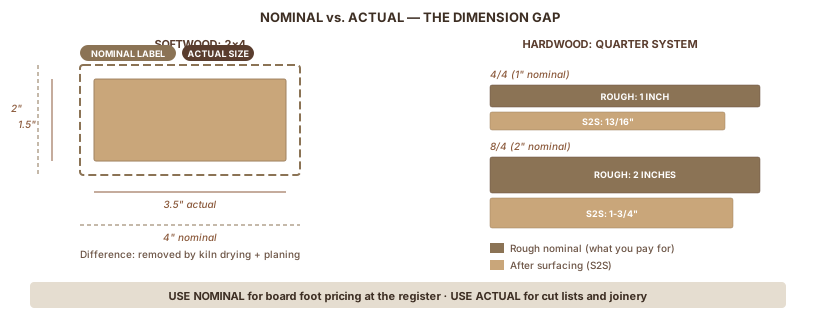
The number printed on the label isn't the number you'll measure with a tape. A "2x4" measures 1-1/2" x 3-1/2". A "4/4" hardwood board measures 13/16" after surfacing. This trips up more beginners than the formula itself.
The rule: Use nominal (labeled) dimensions for board foot pricing. Use actual (measured) dimensions for cut planning and joinery layout.
Softwood dimensional lumber
| Nominal | Actual |
|---|---|
| 1x4 | 3/4" x 3-1/2" |
| 1x6 | 3/4" x 5-1/2" |
| 1x8 | 3/4" x 7-1/4" |
| 1x12 | 3/4" x 11-1/4" |
| 2x4 | 1-1/2" x 3-1/2" |
| 2x6 | 1-1/2" x 5-1/2" |
| 2x8 | 1-1/2" x 7-1/4" |
| 2x12 | 1-1/2" x 11-1/4" |
The difference comes from kiln drying (shrinks the wood ~7%) and planing smooth. See Nominal Wood Sizes for the full table of every standard size and the manufacturing process behind it.
Hardwood quarter system
Hardwood thickness uses the quarter system. "4/4" (said "four-quarter") means 4 quarters of an inch = 1 inch rough. "8/4" = 2 inches rough.
| Designation | Rough Thickness | After Surfacing (S2S) |
|---|---|---|
| 4/4 | 1" | 13/16" |
| 5/4 | 1-1/4" | 1-1/16" |
| 6/4 | 1-1/2" | 1-5/16" |
| 8/4 | 2" | 1-3/4" |
| 12/4 | 3" | 2-3/4" |
The S4S pricing rule
S2S means "surfaced two sides" (both faces planed). S4S means all four faces planed. As The Wood Whisperer explains, the pricing rule is: you pay for the pre-surfaced nominal thickness. A 4/4 board surfaced to 13/16" is still tallied as 1" thick for board foot pricing. You pay for the wood that was removed.
Surfacing adds a separate charge, typically $0.25 to $1.25 per board foot on top of the lumber price.
Part 4: Converting Between Board Feet, Square Feet, and Linear Feet
Board feet to square feet
One board foot of 4/4 stock covers one square foot of surface. Thicker stock covers less.
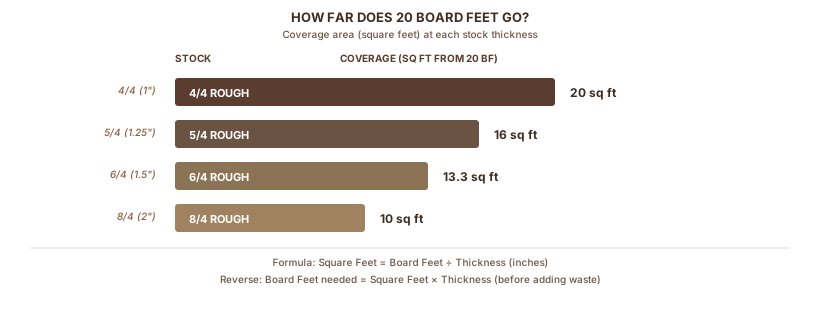
Square Feet = Board Feet / Thickness (inches)
| Stock | Rough Thickness | 20 BF covers... |
|---|---|---|
| 4/4 | 1" | 20 sq ft |
| 5/4 | 1-1/4" | 16 sq ft |
| 6/4 | 1-1/2" | 13.3 sq ft |
| 8/4 | 2" | 10 sq ft |
Going the other direction: a tabletop needs 12 square feet of surface, built from 8/4 stock. Board feet needed = 12 x 2 = 24 BF (before waste).
Board feet to linear feet
The board foot factor tells you how many board feet per running foot for any given size.
| Lumber Size | BF per Linear Foot | Linear Feet per 1 BF |
|---|---|---|
| 1x4 | 0.333 | 3.0 |
| 1x6 | 0.500 | 2.0 |
| 1x8 | 0.667 | 1.5 |
| 1x10 | 0.833 | 1.2 |
| 1x12 | 1.000 | 1.0 |
| 2x4 | 0.667 | 1.5 |
| 2x6 | 1.000 | 1.0 |
| 2x8 | 1.333 | 0.75 |
| 2x12 | 2.000 | 0.5 |
You need 30 BF of 1x8 lumber. How many linear feet? 30 / 0.667 = 45 linear feet.
Part 5: Mental Math Shortcuts for the Lumberyard
You don't need a calculator at the lumber rack. Memorize three numbers and you can estimate any board in your head.
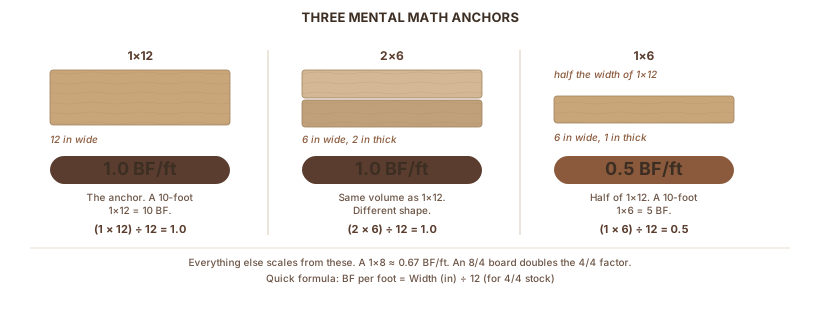
Three anchors
- 1x12 = 1.0 BF per foot. The universal anchor. A 10-foot 1x12 = 10 BF.
- 2x6 = 1.0 BF per foot. Same volume as a 1x12, different shape.
- 1x6 = 0.5 BF per foot. Half of a 1x12. A 10-foot 1x6 = 5 BF.
Everything else scales from these. A 1x8 is two-thirds of a 1x12, so it's about 0.67 BF per foot. A 2x4 works out the same.
Width-over-12 fraction
For 4/4 stock (1" thick), board feet per foot = width / 12. A 6" board = 6/12 = 0.5 BF per foot. An 8" board = 8/12 = 0.67 BF per foot. For 8/4 stock, double it.
Doubling and halving
8/4 stock has twice the board feet of 4/4 at the same width and length. If a 4/4 board is 5 BF, the same board in 8/4 is 10 BF. A board half as wide has half the board feet.
The quick calculation at the rack
Pick up a board. Multiply thickness by width (both in inches). Divide by 12. That's your board feet per foot. Multiply by the board's length.
An 8/4 board that's 7 inches wide and 9 feet long: 2 x 7 = 14, divided by 12 = 1.17 BF per foot, times 9 feet = about 10.5 BF.
Part 6: Calculating Lumber for a Real Project
Board feet matter most when you're planning a real project. Here's how to go from a cut list to a lumber order.
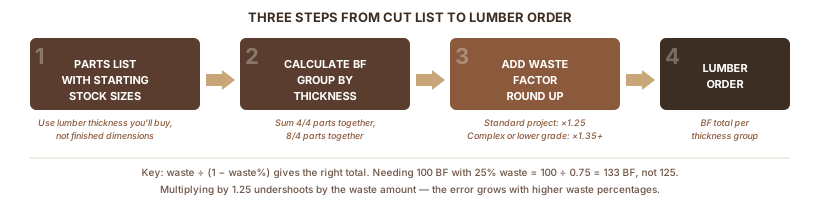
The three-step method
Woodworkers Source recommends a three-step process:
- Make a parts list with starting stock dimensions. Not finished dimensions. A part that ends up 3/4" thick starts from 4/4 lumber (1" thick). Use the lumber thickness you'll buy.
- Calculate board feet for each part. Group by thickness. Sum all 4/4 parts together, all 8/4 parts together.
- Add waste factor. Round up. Multiply each thickness group total by your waste factor.
Worked example: small bookshelf in red oak
| Part | Qty | Starting Stock | BF Each | BF Total |
|---|---|---|---|---|
| Sides | 2 | 4/4 x 11" x 38" | 3.1 | 6.2 |
| Top | 1 | 4/4 x 11" x 32" | 2.4 | 2.4 |
| Bottom | 1 | 4/4 x 11" x 32" | 2.4 | 2.4 |
| Shelves | 3 | 4/4 x 10" x 30" | 2.1 | 6.3 |
| 4/4 Subtotal | 17.3 BF | |||
| + 25% waste | 21.6 BF | |||
| Order | ~22 BF |
Red oak at $5.50/BF: 22 x $5.50 = $121. At a premium dealer ($9.00/BF): 22 x $9.00 = $198.
The back panel is 1/4" plywood, sold by the sheet. No board foot calculation needed.
How much waste to add
| Situation | Waste Factor |
|---|---|
| Simple cuts, FAS/Select grade, S4S stock | 10-15% |
| Standard furniture project, rough lumber | 20-25% |
| Complex project (curves, grain matching) | 25-35% |
| Lower-grade lumber (#1 Common or below) | 30-50% |
Watch the math: "add 30% for waste" and "30% waste" give different numbers. If you need 100 BF of usable lumber and expect 30% waste, divide by 0.70 to get the total: 100 / 0.70 = 143 BF. Multiplying 100 x 1.30 gives you 130 BF, which is 13 BF short. WoodWeb's waste calculation guide explains why the difference grows with higher waste percentages.
Part 7: Irregular Boards and Live-Edge Slabs
Not every board has straight, parallel edges. For live-edge slabs, tapered boards, or other irregular pieces, use the average-width method.
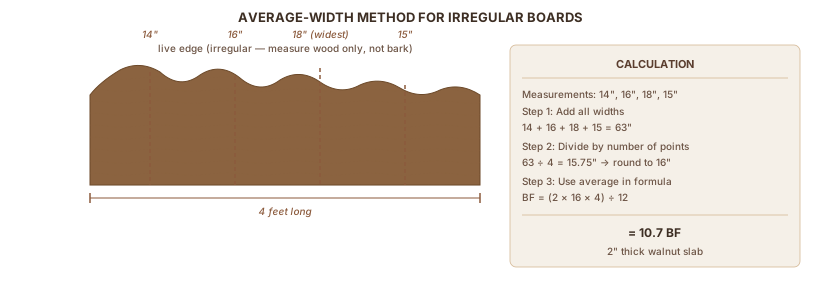
- Take 3-4 width measurements evenly spaced along the length.
- Average them.
- Round to the nearest inch.
- Plug the average into the standard formula.
A walnut slab: 2" thick, 4 feet long. Widths at four points: 14", 16", 18", 15". Average = (14 + 16 + 18 + 15) / 4 = 15.75", round to 16". Board feet = (2 x 16 x 4) / 12 = 10.7 BF.
Measure the wood, not the bark. Dealers exclude bark from width measurements.
Part 8: Six Mistakes That Cost You Money
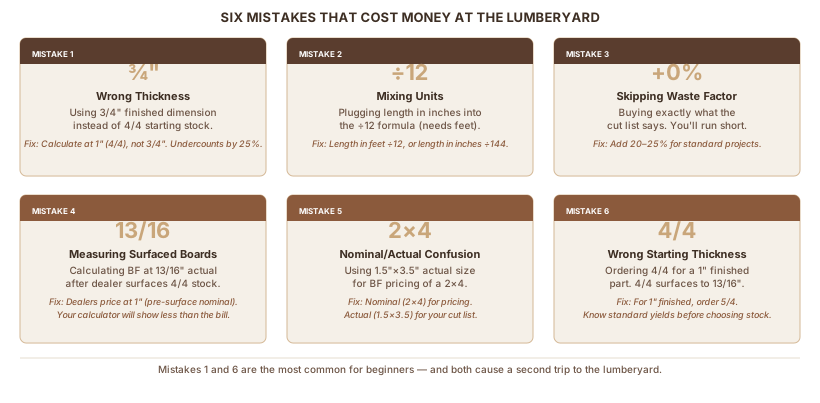
1. Using finished thickness instead of starting stock
A 3/4"-thick shelf comes from 4/4 lumber (1" thick). Calculate board feet at 1", not 3/4". Using the finished dimension undercounts by 25%. Over a full project, that's a second trip to the lumberyard.
2. Mixing units in the formula
The formula BF = (T x W x L) / 12 needs length in feet. If you plug in length in inches without switching to the /144 version, your answer is 12 times too large. The reverse mistake gives you 1/12 the correct answer. Pick one form and stick with it.
3. Forgetting the waste factor
Saw kerfs eat 1/8" per cut. Planer snipe ruins the first few inches of every pass. Defects need cutting around. You'll mess up at least one part. If you buy the exact board footage from your cut list, you'll run out. Add 20-25% for standard projects.
4. Measuring surfaced boards at actual thickness
S2S lumber at 13/16" thick is still priced at 1" (4/4). Don't be surprised when the register shows a higher total than your phone calculator predicted. The dealer charges for the wood before surfacing, not after.
5. Confusing nominal and actual for softwood
A 2x4 is priced and sold as 2" x 4", even though it measures 1-1/2" x 3-1/2". Board foot calculations at the register use the nominal dimensions. Your project cut list should use the actual dimensions. Keep the two separate.
6. Not accounting for surfacing yield
4/4 rough stock surfaces to about 13/16". 8/4 surfaces to about 1-3/4". If you're planning a 1" thick finished tabletop, 4/4 stock won't get you there. You need 5/4. Know the standard surfaced yields before you choose your starting thickness.
Part 9: What Board Foot Calculations Unlock
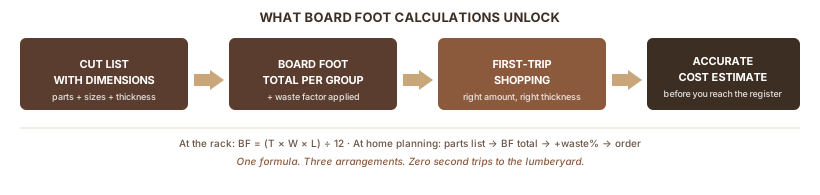
With the formula and a few mental math anchors, you can walk into any hardwood dealer, pick boards from the rack, and know what you'll pay before you reach the register. You can plan a project's materials from a cut list and buy the right amount on the first trip.
For a quick-reference lookup table you can bookmark and pull up on your phone mid-project, see the Board Foot Calculator and Lookup Table.
Sources
This guide draws on NHLA measurement standards, university extension publications, and hardwood dealer practices.
- NHLA Grading Rules — the governing standard for hardwood lumber measurement in North America
- AHEC Measurement Guide — NHLA board foot formula, surface measure, and rounding rules
- WoodWeb: Calculating Board Feet (Gene Wengert) — NHLA two-step method and rounding order of operations
- Archtoolbox: Lumber Dimensions — complete nominal vs. actual tables for softwood and hardwood
- The Wood Whisperer: S2S and S4S — surfacing designations and pricing implications
- Woodworkers Source: Estimate Board Footage for a Project — three-step project estimation method
- WoodWeb: Calculating Waste from Rough Lumber — waste factor math and yield calculations
- Purdue Extension FNR-130 — NHLA grading overview and lumber yield data
- Virginia Tech Extension 420-085 — board foot definition and log scaling rules
- Rockler: Quarter System — hardwood thickness designations and NHLA history
Also Referenced
Tagged
Up Next
How to Stain Pressure Treated Wood
WOOD & MATERIALS · Beginner