
Biscuit Joints at a Glance
Biscuit joints use small compressed-wood wafers — about $12 per hundred for #10s — to align boards during glue-up. In edge joints, alignment is the whole point. The glue carries all the structural load. In miter joints, biscuits add real mechanical strength that end-grain glue can't provide on its own.
| Primary purpose | Alignment during glue-up — not structural in edge joints |
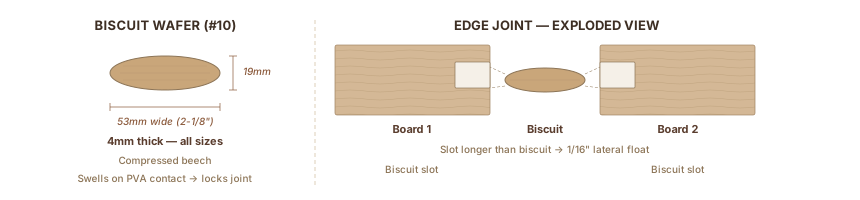
| Biscuit material | Compressed beech — swells on contact with PVA glue |
| Standard sizes | #0, #10, #20, FF — use the largest that fits your stock |
| Assembly window | 5–10 minutes from first glue contact before swell locks joint |
| Spacing rule | 6–8" apart; first biscuit 3" from board ends |
| Best applications | Panel glue-ups, miter reinforcement, face frame attachment |
Skill level: Beginner. You need a biscuit joiner. If you're still deciding whether to buy one, read Biscuit Joiner first.
In this guide:
- How biscuits work and what they can't do
- Sizes, dimensions, and spacing rules
- Technique for all four configurations
- Glue-up timing and assembly strategy
- Biscuits in plywood, MDF, and thin stock
- Troubleshooting biscuit joint problems
- When to use biscuits vs. alternatives
Part 1: Why Biscuit Joints Work and What They Can't Do
A biscuit is an oval wafer of compressed beech wood, about 4mm thick. When PVA glue contacts the wood fibers, they absorb moisture and swell, locking the biscuit into its slot. The joint pulls tight as the biscuit expands back toward its original shape.
The slot runs slightly longer than the biscuit. That gap is by design. It gives you about 1/16" of lateral float. You can slide boards sideways into perfect alignment after the joint closes, while the glue is still wet. Without biscuits, clamping pressure pushes boards sideways and you spend the glue-up chasing them around the bench.
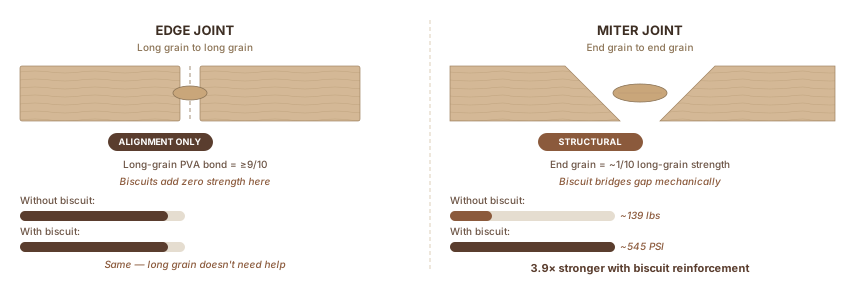
But understand what you're getting before reaching for the joiner. Woodgears.ca's independent joint strength tests show that a long-grain edge joint with biscuits is no stronger than one without. The wood-to-wood PVA bond on long grain is already one of the strongest connections in woodworking. Biscuits don't improve it. They just stop boards from sliding during clamping.
Miter joints are different. A mitered corner meets end-grain to end-grain, and Woodweb's glue science reference puts end-grain bond strength at roughly 1/10th of a long-grain bond. An unreinforced miter fails at around 139 lbs of force. A biscuited miter, tested by Dowelmax's joint strength research, holds at 545 PSI tensile strength. The biscuit adds mechanical strength the glue can't provide.
Biscuits are an alignment tool in edge joints and a structural reinforcement in miter joints.
Part 2: Biscuit Sizes, Spacing, and When Each Applies
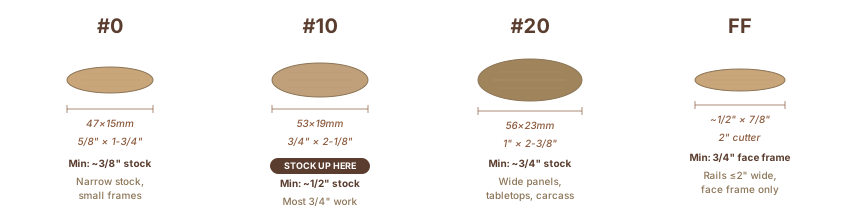
All biscuits are 4mm thick. Size refers to length and width. Use the largest size that fits your stock without breaking through.
| Size | Dimensions | Min. stock thickness | Use it for |
|---|---|---|---|
| #0 | 47×15mm (5/8"×1-3/4") | ~3/8" | Narrow stock, small frames, thin panels |
| #10 | 53×19mm (3/4"×2-1/8") | ~1/2" | Standard for most work — stock up here |
| #20 | 56×23mm (1"×2-3/8") | ~3/4" | Wide panels, tabletops, carcass assembly |
| FF | ~1/2"×7/8" (2" cutter) | 3/4" face frame member | Face frame rails ≤2" wide |
Per WWGOA's biscuit size guide: use the largest size that fits. For most 3/4" solid wood and plywood work, #10 handles the job. #20 gives you more contact area on tabletops and cabinet sides. FF biscuits use a smaller cutter that fits into 1.5" wide face frame rails without blowing out the edges.
Don't use #20 in narrow boards under 3" wide. The slot extends close to the edge. Test on scrap first.
Spacing rules (from Popular Woodworking's 12 Tips and Fine Woodworking's spacing discussion):
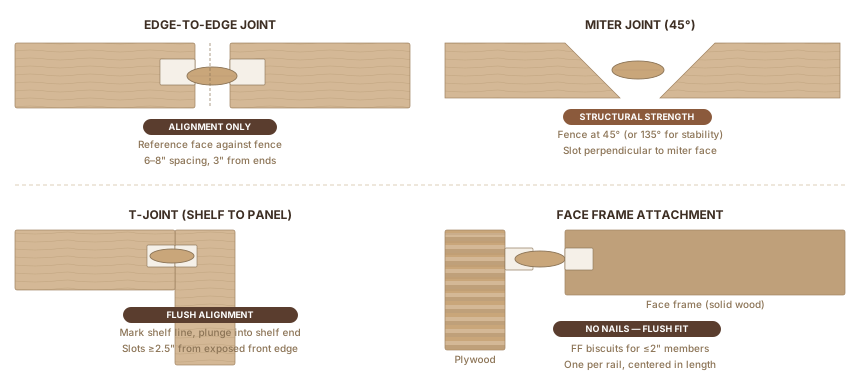
- 6–8" between biscuits for panel glue-ups and structural joints
- First biscuit 3" from each board end to prevent blowout
- Two biscuits per linear foot as a quick planning rule
- 2–3" from final cut lines on raised panels (biscuit exposure during shaping ruins the piece)
- For light picture frames: wider spacing (10–12") is fine; alignment isn't as critical
Part 3: Four Configurations: Edge Joints, Miters, T-Joints, and Face Frames
Edge-to-Edge Joints (Panel Glue-Ups)
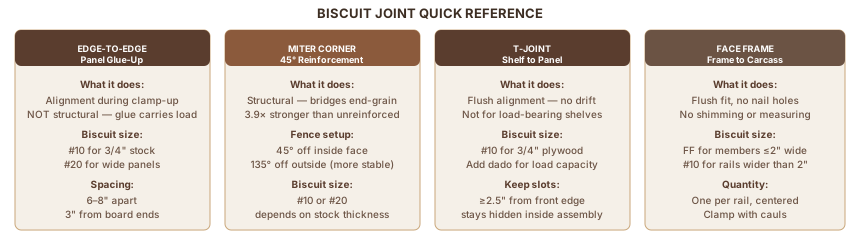
Most woodworkers use biscuits to join boards edge-to-edge for tabletops, wide panels, and cabinet sides.
Setup and marking:
- Mill boards to final thickness. Joint edges flat and square. Biscuits don't correct out-of-flat edges.
- Lay boards face-up in glue-up order. Mark the show face on every board. This is your reference face.
- Mark biscuit center lines across both boards at once. Draw a single pencil line straight across the joint so marks land identically on both pieces.
- Set the fence to center the blade in your stock. For 3/4" material: 3/8" from face.
- Set the depth dial to match your biscuit size (#10 or #20).
Slot depth test (from Popular Woodworking's plate joiner tips): Cut a test slot in scrap. Insert a biscuit and mark with pencil. Pull the biscuit out, rotate it 180°, reinsert. The second mark should be exactly 1/16" beyond the first. This confirms 1/32" of clearance on each side: enough room for glue to move, not so much that the joint slops.
The reference face rule — and why it matters:
Woodcraft's biscuit joint guide is emphatic on this point: the show face of both boards always goes against the fence. Always. If you flip one board and cut from the opposite face, the slots won't align. The result is a step at the joint line after clamping. It can't be fixed without starting over.
Mark your reference face with pencil before you cut anything. Flip it wrong once and you'll mark it every time after.
Cutting and assembly:
- Keep the tool body resting on the workpiece, not the workbench. If the board is thin, overhang it from the bench edge so the joiner has nothing to rest on but the board.
- Grip the D-handle firmly, press forward to plunge, hold briefly, release.
- Dry-fit before gluing. Insert biscuits without glue, close the joint, check flush. Anything that doesn't work dry won't work wet.
Miter Joints
Biscuits in mitered corners align faces during clamp-up and add mechanical strength the end-grain glue bond can't provide on its own.
Fence setup (from Rockler's carcase miter guide):
- Fence that pivots to 90°: Set fence to 45°. Reference off the inside (shorter) face of the mitered piece.
- Fence that pivots to 135°: Set fence to 135°. Reference off the outside (longer) face. This is more stable and easier to hold.
Cut the 45° miters first. Mark center lines on both mitered faces. Align marks and plunge. The slot runs perpendicular to the miter face, into the interior of the corner. Use this configuration for picture frames, box corners, and cabinet carcass face miters.
T-Joints (Shelf to Side Panel, Cabinet Carcass)
The T-joint (a shelf meeting a side panel at 90°) is standard cabinet work. Biscuits hold the shelf flush and prevent it from dropping during glue-up.
Technique (per WWGOA's Build with a Biscuit Joiner):
- Mark shelf height on the inside of the side panel with a sharp pencil line.
- Clamp shelf flush to that line. Mark biscuit center lines across both pieces simultaneously.
- For the shelf slots: lay the joiner on the face of the side panel, plunge into the end of the shelf.
- For the side panel slots: flip the joiner upright with fence against the face, plunge into the side panel.
- Keep slots at least 2.5" back from the front exposed edge so they stay hidden inside the assembly.
Use #10 biscuits for 3/4" plywood cabinet sides. For fixed shelves that carry real weight, add a dado to the side panel and use the biscuit for flush alignment. Biscuits in a T-joint aren't designed to hold shelf load long-term.
Face Frame Attachment
Attaching a solid wood face frame to a plywood carcass is one of the best uses for a biscuit joiner. No nail holes, no shimming, flush alignment without measuring.
Setup:
- FF biscuits for face frame members 1.5"–2" wide. The FF cutter is smaller (2" diameter) and fits these narrow pieces without blowing out the edges.
- #10 for rails wider than 2".
- One biscuit per rail, centered in the length.
- Mark matching positions on the face frame back and the carcass front face.
Apply glue to the face frame back and the slots. Clamp with cauls to distribute pressure evenly across the frame. The biscuits force the face frame flush with the carcass edge. No measuring, no shimming.
Part 4: Glue-Up Strategy: The 5-Minute Window
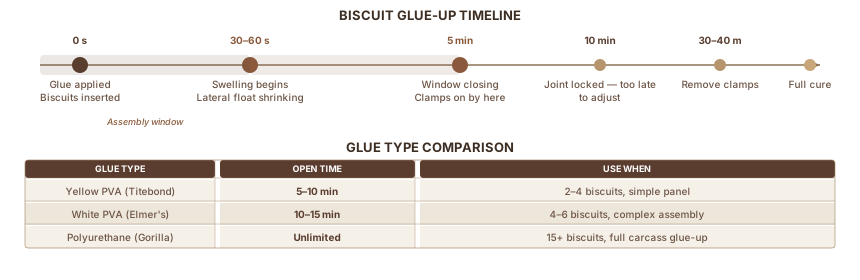
Most failed biscuit assemblies come down to running out of time. Once PVA glue contacts the compressed wood fibers, the biscuit starts swelling within 30–60 seconds. From first glue application to clamps on, you have 5 to 10 minutes.
Before you open the glue bottle:
- Set every clamp to approximate width and place it within reach.
- Do a dry-fit. Every biscuit in, joint closed, check flush. If it doesn't work dry, don't add glue.
Glue choice by complexity:
Yellow PVA (Titebond Original) is standard for simple joints. It grabs fast, which is fine when you have two biscuits and a panel clamp. For a full breakdown of glue types, see Glue and Adhesives.
White PVA (Elmer's) sets slower. Fine Woodworking's biscuit gluing discussion notes that chairmakers have moved to white PVA for complex assemblies specifically because of its longer open time. Use it for anything with more than 4–6 biscuits.
Polyurethane glue (Gorilla Glue, Titebond III Polyurethane) doesn't cause early swelling at all. Unlimited working time. The trade-off is expansion during cure and harder cleanup. Use it for cabinet carcass glue-ups where you need 15+ minutes of positioning time.
Biscuit sorting tip (from Popular Woodworking's 12 Tips): Open a new box and test each biscuit in a typical slot. Sort into three piles: too tight, just right, and slightly loose. Bag each pile separately. Use snug biscuits for normal work. Save the slightly-loose ones for complex glue-ups where you need extra sliding time after insertion.
Glue placement: Slot walls on both pieces. Mating surfaces on both pieces. A light coating on the biscuit itself. All four locations. Woodcraft's glue sequence guide makes this clear: missing any one of them weakens the joint.
Clamping pressure: Firm, not maximum. You want the joint closed and held. Over-clamping squeezes out all the glue and starves the joint. Remove clamps after 30–40 minutes. Full cure takes 2 hours.
Part 5: Biscuit Joints in Plywood, MDF, and Thin Stock
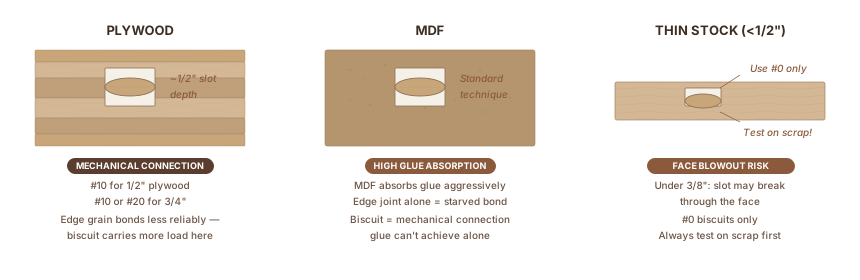
Plywood: Biscuits work better in plywood than many woodworkers expect. Plywood edge grain doesn't bond as reliably as solid wood long grain, so the biscuit's mechanical connection carries more value here. Use #10 for 1/2" plywood; #10 or #20 for 3/4" plywood depending on board width.
MDF and particleboard: These materials absorb glue aggressively, which starves edge joints. Biscuits provide the mechanical connection that pure edge glue can't achieve in MDF. Standard technique applies.
Thin stock (under 1/2"): Use #0 biscuits. Below 3/8" stock thickness, the slot may break through the face. Always test on scrap before cutting production pieces.
After gluing up solid wood with water-based PVA, moisture raises the grain slightly around the biscuit. Let the assembly sit several days before flush-sanding. Sand too soon and the wood settles into a shallow depression.
Part 6: Six Biscuit Joint Problems and How to Fix Them
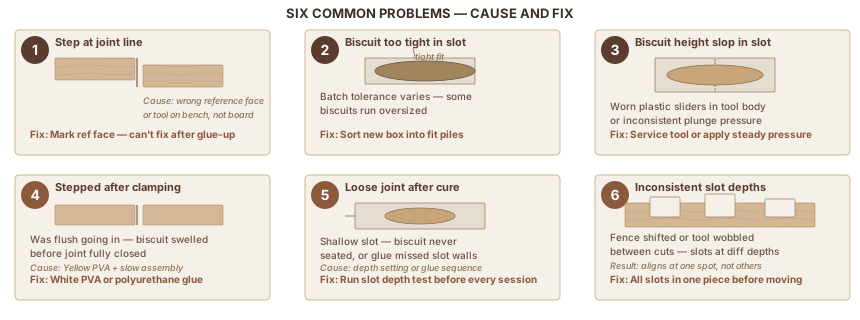
1. Step at the joint line
The most common problem. One board sits higher than the other after clamping.
Cause A: Different reference faces used on mating pieces. Slots cut from opposite sides. Cause B: Tool body resting on the workbench instead of only on the workpiece. Creates a height error equal to the height difference between the bench and the board face.
You can't fix this after glue-up. Prevention: mark your reference face before cutting anything. When cutting slots in boards thinner than the tool body, overhang the board from the bench edge.
2. Biscuit won't fit into slot (too tight)
Batch tolerance varies. Some biscuits are slightly oversized for some slot widths.
Use the sorting technique from Popular Woodworking's 12 Tips: test each biscuit dry and bag them by fit. This takes 5 minutes with a new box and saves assembly frustration every time you use them.
3. Biscuit has height slop in the slot
Lateral float (side-to-side) is by design. Height slop (where the biscuit moves up into or away from the slot face) is not.
Causes: worn plastic sliders in the tool body; inconsistent plunge during cutting. Check your tool's fence mechanism for play. If the sliders are worn, the tool needs service. Apply consistent perpendicular pressure during every plunge.
4. Joint stepped after clamping (was flush going in)
The biscuit swelled before the joint fully mated.
Switch to white PVA or polyurethane glue for more working time. Practice the assembly sequence dry so your hands know what to do. Set all clamps before touching the glue.
5. Loose joint after cure
Cause A: Slots too shallow. Biscuit never fully seated. Cause B: Glue applied only to biscuit, not to slot walls and mating surfaces.
Run the slot depth test (rotate biscuit, check for 1/16" gap) before every session. Apply glue to all four locations: slot walls on both pieces, mating surfaces on both pieces.
6. Inconsistent slot depths along the joint
Boards align at one spot but not another. Usually means the fence shifted between cuts, or the tool wobbled during the plunge.
Cut all slots in one piece before moving to the other. Don't alternate. Grip the tool firmly and push straight in, not at an angle. If your tool has visible wear in the fence mechanism, get it serviced or replace it.
Part 7: When to Use Biscuit Joints and When to Use Something Else
| Application | Best method | Why |
|---|---|---|
| Wide panel glue-up (tabletop, cabinet side) | Biscuits | Alignment float; fast; clean |
| Miter joint reinforcement | Biscuits | Bridges weak end-grain; hidden |
| Face frame to plywood carcass | Biscuits | Flush alignment without nails |
| Face frame member connections (right-angle) | Pocket holes | Faster; screws add clamping force |
| Fixed shelf under load | Dado + glue | Long-term load capacity |
| Furniture frame (chair, table apron) | Mortise and tenon | Repeated stress; biscuits fail here |
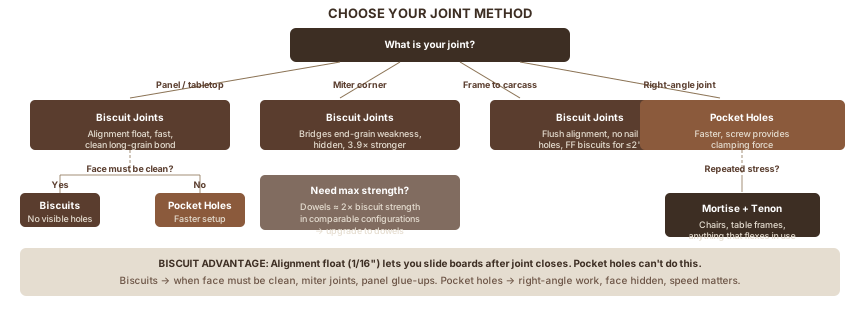
When to use biscuits over pocket holes: The joint face must be clean (no visible holes). Alignment precision matters more than speed. Miter joints where pocket holes can't reach.
When to use pocket holes over biscuits: Right-angle joints (face frame members, drawer boxes) where speed matters and the face is hidden anyway. The Kreg Jig is faster for these joints and the screw provides clamping force without separate clamps.
When to upgrade to dowels or mortise-and-tenon: Anything taking repeated stress: chairs, table frames, anything that moves or flexes in use. Rockler's doweling vs. biscuit comparison puts dowel joints at roughly twice the strength of biscuits in comparable configurations.
If you're working on edge joints and panel glue-ups specifically, that guide covers the full glue-up process in depth.
Part 8: Where Biscuit Joints Fit in Your Shop
Biscuit joints handle a specific set of problems well: keeping panels aligned during glue-up, reinforcing miters, and attaching face frames cleanly. They don't replace structural joinery.
Once you can execute biscuit joints consistently across all four configurations, panel work becomes predictable. A tabletop glue-up stops being an exercise in chasing boards and becomes a 20-minute process.
Read next:
- Edge Joints and Panel Glue-Ups — the full edge-to-edge glue-up process, from surfacing to final clamp-up
- Miter Joints — miter geometry, clamping strategies, and all reinforcement options
- Pocket Hole Joinery — the faster alternative for right-angle assembly
- Biscuit Joiner — if you're still evaluating whether to buy one, and which model
FAQ
Do biscuit joints actually strengthen edge joints?
No. Independent testing from Woodgears.ca confirms that a long-grain edge joint with biscuits is no stronger than one without. The wood-to-wood PVA bond on long grain is already near-maximum strength. Biscuits prevent boards from sliding sideways during clamping — that's their job in panel glue-ups. In miter joints it's different: a biscuited miter holds at roughly 545 PSI tensile strength versus about 139 lbs for an unreinforced one.
What size biscuit should I use for 3/4" lumber?
#10 handles most 3/4" solid wood and plywood work. If you're gluing up wide panels or tabletops, #20 gives you more glue surface and better alignment float. Only switch to #0 for stock under 1/2" thick, where a #10 slot risks breaking through the face. FF biscuits are a different shape entirely — they're for face frame members 2" wide or narrower.
How long do I have to close a biscuit joint after applying glue?
Five to ten minutes from first glue contact before the biscuit swells enough to lock in the slot. This window shrinks in hot, dry conditions. Dry-fit the assembly first so you know exactly how many clamps to stage and where. Once the biscuit starts to swell, you can't slide the joint into alignment — that's the one mistake that ruins a glue-up.
Can I use biscuits in plywood?
Yes, with a few adjustments. Use #10 for 3/4" plywood and #0 for 1/2" material. Plywood edge grain bonds less reliably than solid wood long grain, so the biscuit carries more load here. Keep slots at least 2.5" from the front edge on shelves and cabinet sides so the biscuit stays hidden inside the finished assembly.
Sources
Strength data comes from independent woodworking tests. Technique guidance draws on professional publications and practitioner communities with documented real-world use.
- Woodgears.ca: Wood Joint Strength Testing — independent test data confirming biscuits add no strength to long-grain edge joints
- Woodweb: End Grain to End Grain Gluing — end-grain bond weakness, 1/10th long-grain strength
- Dowelmax Wood Joint Strength Tests — tested miter strength with biscuit reinforcement
- WWGOA: What Size Biscuit to Use — biscuit size selection guidance
- Popular Woodworking: 12 Tips for Better Biscuit Joining — slot depth test, biscuit sorting, common mistakes
- Fine Woodworking Forum: Biscuit Spacing — practitioner consensus on spacing rules
- Popular Woodworking: Plate Joiner Tips and Techniques — slot depth verification method
- Woodcraft: Mastering the Biscuit Joint — reference face rule, glue placement sequence
- Rockler: How to Join Carcase Miters with Biscuits — miter fence setup for both tool types
- WWGOA: Build with a Biscuit Joiner — T-joint and face frame technique
- Fine Woodworking Forum: Gluing Biscuits — glue type selection for complex assemblies
- Rockler: Doweling vs. Biscuit Joints — strength comparison between methods
How We Research
We don't take affiliate revenue or accept review units. Picks come from multi-source research — manufacturer specs, OSHA / EPA / ASTM regs, and long-form practitioner threads — plus Ahmed's hands-on use where relevant. When we recommend something, we explain why.
Up Next
Is a Biscuit Joiner Worth It?
JOINERY · Beginner