
How to Use This Guide
A standard 55-gallon rain barrel weighs close to 500 pounds when full. A stand built from the wrong lumber, or with joints that can't handle real load, will fail. The question is when, not if.
This guide gives you two complete cut lists (a 4×4 box frame and an all-2×4 platform), a step-by-step build sequence, and specific lumber and finish recommendations that hold up outdoors for 15+ years.
Picking a design: Start with Part 3 and Part 4.
Ready to build: Jump to Part 5.
Stand already built: Check Part 7 for the pre-load checklist.
Rain Barrel Stand at a Glance
A full rain barrel sits in the 480–500 lb range. Build the stand for that load from day one. At 24 inches of height, you get enough gravity pressure for drip irrigation and watering cans. A regular garden hose at useful pressure needs 4 feet or more.

| Full barrel weight | ~484 lbs — design for 500 lbs |
|---|---|
| Recommended height | 24 inches |
| Platform opening | 24"–26" wide |
| Best lumber | Ground-contact PT SYP or Western Red Cedar |
| Build time | 2–3 hours (box frame) |
| Total cost | $50–$90 all-in |
In this guide:
- Why height matters and what 24 inches gets you
- Which lumber lasts outdoors and which fails in three years
- Complete cut lists for two proven designs
- Step-by-step assembly for the box frame platform
Part 1: Why the Stand Height Matters
The weight
A full 55-gallon barrel weighs 484 lbs. San Diego Drums & Totes puts water weight at 459 lbs (55 gal × 8.34 lbs/gal) plus 20–25 lbs for the barrel itself. Rutgers NJAES FS1118 confirms this range. Design for 500 lbs to give yourself a margin.
That's three adults standing on a 26-inch square platform. Stacked cinder blocks can hold that in compression, but rain barrels shift as they drain and refill. A jointed wood frame handles dynamic loads better than masonry. Concrete deck blocks under the posts give you the best foundation.
Height and water pressure
Rain barrels run on gravity. Every foot of elevation adds 0.43 PSI of water pressure. At 24 inches, you get roughly 0.87 PSI.
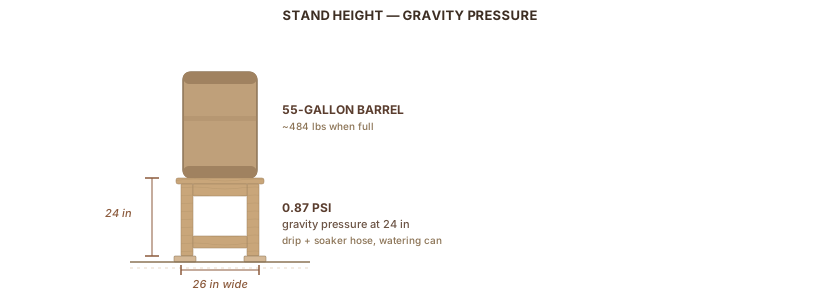
BlueBarrel Systems lays out what 0.87 PSI gets you: drip irrigation and soaker hoses work well at this pressure. You can fill a watering can from the spigot. A standard garden hose at useful pressure needs 4 feet minimum, and even then the flow is slow.
The 24-inch standard comes from Clemson HGIC, multiple cooperative extension guides, and dozens of community workshop plans. It's the practical minimum: height without the complexity of diagonal bracing a taller stand requires.
Part 2: Choosing Your Lumber
Ground-contact pressure-treated lumber
For any part of the stand that touches the ground or sits on wet pavers, buy UC4A Ground Contact pressure-treated lumber. Look for the green end tag at Home Depot or Lowe's. It should read "Ground Contact" and list "AWPA UC4A" or equivalent.
Current PT chemistry is Micronized Copper Azole (MCA) or Alkaline Copper Quat (ACQ), both non-arsenic. Either works for this application.
One step you cannot skip: when you cut PT lumber, the outer shell holds most of the preservative. Fresh cuts expose untreated interior wood. Brush copper naphthenate end-cut preservative (Woodlife CopperCoat or Copper-Green Brown) onto every cut end before assembly. AWPA Standard M4 requires a minimum 2% copper concentration. One quart handles this project with plenty left over.
Western Red Cedar
workbench/buyers-guides/western-red-cedar-guide) contains thujaplicins, natural fungicides that persist in the wood for decades. No pressure treatment required, no end-cut treatment needed. Janka hardness is 350 lbf, soft enough to work easily and strong enough for a load-bearing platform.
Expected outdoor life: 15–20 years with periodic sealing, 10+ without — the [USDA Forest Products Lab Wood Handbook](https://www.fpl.fs.usda.gov/documnts/fplgtr/fpl_gtr190.pdf) classifies western red cedar's heartwood as "resistant to highly resistant" to decay even with no preservative treatment. Cedar 4×4s cost $10–$25 more than PT equivalents for a project this size, not a meaningful difference.
Cedar is the better choice for any stand in a visible location. PT lumber weathers to gray and bleeds copper staining onto concrete without a finish coat.
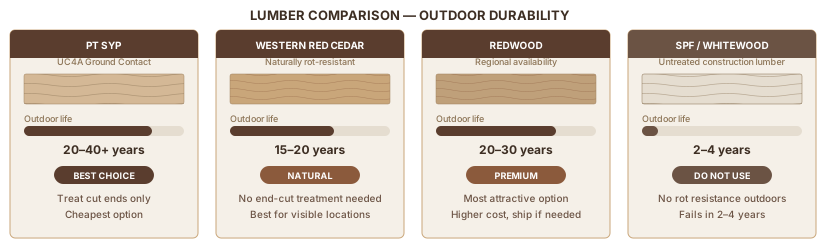
Material comparison
| Material | Outdoor life | Notes |
|---|---|---|
| PT SYP (UC4A) | 20–40+ years | Treat cut ends; finish for appearance |
| Western Red Cedar | 15–20 years finished | No end-cut treatment needed |
| Redwood | 20–30 years finished | Regional availability; overkill if you have to ship it |
| Untreated SPF/whitewood | 2–4 years | Do not use outdoors |
What not to use
Standard construction lumber (SPF, whitewood, stud grade) has no rot resistance. In wet outdoor conditions, it fails in 2–4 years. Above-ground-rated PT (UC3A or UC3B) has insufficient treatment depth for posts that contact wet pavers or soil. OSB and plywood delaminate when wet.
Part 3: Design and Dimensions
Barrel dimensions
A standard 55-gallon plastic barrel measures about 23 inches in diameter and 35–37 inches tall. BASCO and Powerblanket document these:
| Barrel type | Height | Diameter |
|---|---|---|
| Plastic, closed top | 34-3/4" | 23-1/4" |
| Plastic, open top | 36-3/4" | 22-7/8" |
| Steel, closed top | 33" | 23" |
| Steel, open top | 34-3/4" | 24-1/2" |
Build the platform with a 24"–26" interior opening. That gives a 1"–1-1/2" lip on each side: enough bearing surface to hold the barrel, wide enough for any standard 55-gallon size.
Three designs
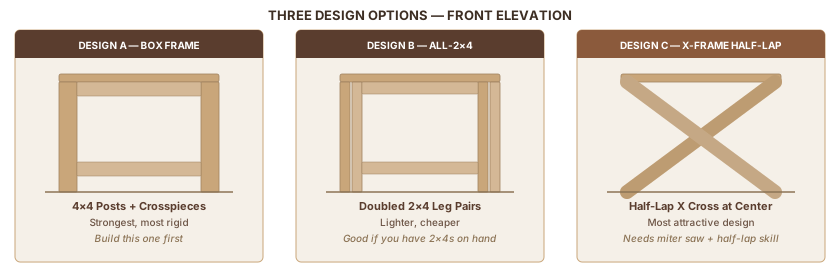
Design A — Box Frame Platform: Four 4×4 corner posts connected by 4×4 crosspieces, topped with 2×4 deck slats. Weight transfers through the legs directly to the ground. Simple butt joints with lag bolts. Rigid without cross-bracing at 24" height. Build this one first.
Design B — All-2×4 Platform: Doubled-up 2×4 leg assemblies, no 4×4s needed. Slightly less rigid than Design A but adequate at 24". Lighter and cheaper. Good if you only have 2×4s on hand.
Design C — X-Frame Half-Lap: Two 4×4s crossed at center with a notched half-lap joint. Weight rests on wood grain at the cross point rather than fasteners. The most attractive option but not forgiving of measurement errors. Best for cedar in a visible location when you have a miter saw and some experience with half-laps.
Build Design A for your first stand. Switch to Design C once appearance matters and you have half-lap experience.
Part 4: Cut List
Design A — 4×4 Box Frame Platform
Overall dimensions: 26"W × 26"D × 24"H. Based on The Emerging Home and the REEP Green Solutions community workshop plan.
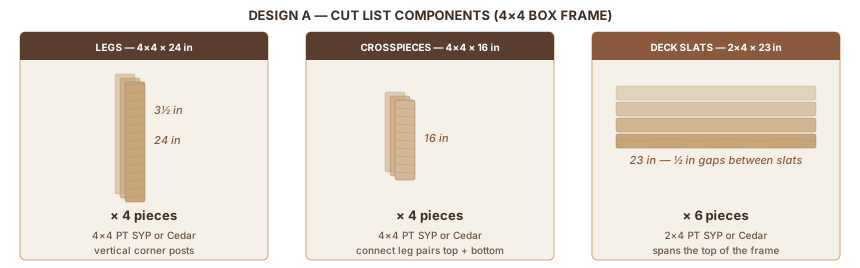
| Part | Material | Qty | Cut length | Notes |
|---|---|---|---|---|
| Legs | 4×4 PT SYP or Cedar | 4 | 24" | Vertical corner posts |
| Crosspieces | 4×4 PT SYP or Cedar | 4 | 16" | Connect leg pairs at top and bottom |
| Deck slats | 2×4 PT SYP or Cedar | 6 | 23" | 1/2" gaps between slats |
Lumber to buy:
- (2) 4×4×8' boards — yields 4 legs and 4 crosspieces with minimal waste
- (1) 2×4×10' board — yields 6 slats at 23" with about 2" waste
Hardware:
- 6" lag bolts, 1/4" hex head — 12 bolts (3 per leg-to-crosspiece joint)
- 4" flat-head exterior screws — 12 screws (2 per slat end)
- 1/16" pilot bit
- Copper naphthenate end-cut preservative — 1 qt
- Exterior oil stain or sealant — 1 qt
Cost estimate: $40–$55 lumber, $20–$35 hardware and finish. Time estimate: 2–3 hours with pre-cut lumber and a drill; 4–5 hours if cutting yourself.
Design B — All-2×4 Platform
Overall dimensions: 26"W × 26"D × 24"H. Based on Construct101's 2×4 rain barrel stand plans.
| Part | Label | Material | Qty | Cut length | Notes |
|---|---|---|---|---|---|
| Side rails, long | A | 2×4 PT SYP | 2 | 23-1/2" | Top frame, long sides |
| Side rails, short | B | 2×4 PT SYP | 2 | 20-1/2" | Top frame, short sides |
| Interior supports | C | 2×4 PT SYP | 4 | 10-1/2" | Mid-frame vertical blocking |
| Corner leg blocking | D | 2×4 PT SYP | 4 | 7" | Double-up at corners |
| Corner leg blocking | E | 2×4 PT SYP | 4 | 7" | Double-up at corners |
| Deck slats | F | 2×4 PT SYP | 6 | 23-1/2" | 1/2" gaps between slats |
Lumber to buy:
- (4) 2×4×8' PT SYP boards — yields all pieces with normal waste
Hardware:
- 3" exterior deck screws (GRK RSS or equivalent galvanized) — 1 lb box
- Titebond III exterior wood glue — 1 bottle (supplement to screws at each joint)
- 1/8" pilot bit
- Copper naphthenate — 1 qt
- Exterior stain — 1 qt
Cost estimate: $35–$50 lumber, $25–$40 hardware and finish.
Part 5: Building the Stand
These steps follow Design A (box frame). Steps 1 and 5 apply to any design.
Tools you need
Minimum: drill/driver, 1/16" and 1/8" pilot bits, speed square, tape measure, 2–4 clamps. Useful additions: miter saw for cleaner cuts, impact driver for faster bolting.

Prepare the site first
Level the ground before you start building. This is the step most people skip, and it causes most failures. Use a 4-foot level on a 2×4 to check flatness. On soil, compact the area and add 2–3 inches of 1/4" crushed stone. Set four concrete pavers (12"×12") as the base, one under each post. Check all four corners for level; adjust gravel as needed.
Concrete pavers lift the post bases off wet ground. That small gap reduces rot at the base more than any finish coat.
Build the first side frame
Work on a flat garage floor or driveway.
- Lay two legs parallel, 16 inches apart (inside edge to inside edge).
- Position one crosspiece flush at the top of the legs; clamp in place.
- Drill two 1/16" pilot holes through the crosspiece into the leg end grain, staggered to avoid splitting.
- Drive 6" lag bolts snug. Don't overtighten PT lumber; it compresses around the threads.
- Position the second crosspiece 4 inches up from the leg bases; repeat the drilling and bolting.
- Check each corner with the speed square. Adjust now before the assembly sets.
Build the second side frame
Repeat exactly. Lay the first completed frame on top of the second assembly to confirm dimensions match. Faster than re-measuring.
Connect the two frames
- Stand both frames upright, parallel, 23 inches apart (outside face to outside face).
- Clamp them to something stable — lean against a workbench or prop with a bucket.
- Position a crosspiece across the top between the frames; clamp; check level.
- Pre-drill and drive lag bolts.
- Repeat on the opposite side.
- Check: level, no wobble, square corners. Fix before adding the deck.
Attach the deck slats
- Lay 6 slats across the top frame. First and last slats flush with outside edges.
- Space the remaining four slats evenly. A scrap piece of 1/2" plywood makes a consistent gap.
- Clamp each slat before drilling.
- Drill two 1/8" pilot holes per slat end.
- Drive 4" screws through each slat into the crosspiece below.
Verify before moving
Put the level on the deck in both directions. Rock the stand. Any movement means a loose joint. Find it and tighten it now. Fixing a loose joint before loading is a five-minute job. Fixing a failed stand after the barrel is full is not.
Part 6: Finishing and Weather Protection
When to finish PT lumber
New PT lumber holds moisture from the treatment process. Finish it too soon and the product won't penetrate. The PreservedWood.org field treatment guide calls for 30–60 days after purchase. Check with the water bead test: sprinkle water on the surface. If it beads up, the wood is still too wet. When water soaks in immediately, it's ready.
Build the stand. Wait a few dry weeks. Then finish it. Cedar takes finish immediately after construction.
Which finish to use
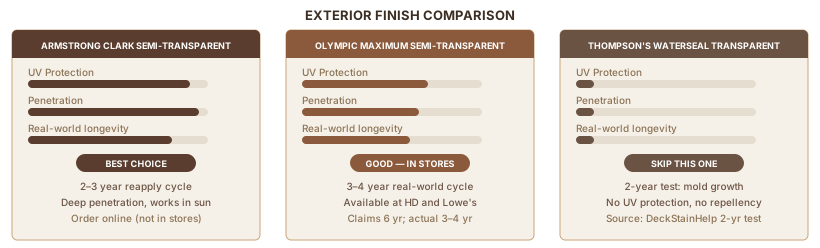
Armstrong Clark Semi-Transparent Oil-Based Stain is the strongest performer in independent testing: deep penetration, good UV resistance, applies in direct sunlight. Reapply every 2–3 years.
Olympic MAXIMUM Semi-Transparent Stain + Sealer is at Home Depot and Lowe's. Manufacturer claims 6 years; real-world performance on exposed structures is closer to 3–4 years. Reliable and convenient if you don't want to order online.
Skip Thompson's WaterSeal Transparent. DeckStainHelp's 2-year test found no water repellency, no UV protection, and mold growth on the test boards. Don't waste the money.
Part 7: Keeping It Standing
Six ways rain barrel stands fail
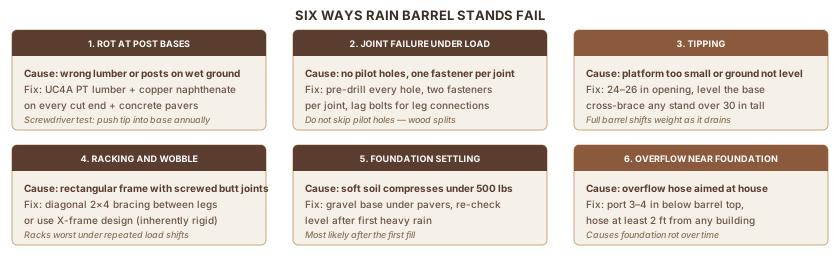
1. Wood rot at post bases is the most common long-term failure. Wrong lumber grade, or posts sitting on wet concrete without drainage. Fix it before it starts: UC4A ground-contact PT lumber, copper naphthenate on every cut end, concrete pavers under the posts. Check post bases annually. Push a screwdriver tip into the wood at ground level. If it sinks, rot has started.
2. Joint failure under load. Screws pull out when you don't pre-drill (wood splits around the threads) or when joints get only one fastener. Two fasteners per joint, always pre-drilled, and lag bolts instead of deck screws for the leg-to-crosspiece connection.
3. Tipping. Platform too small, ground not level, or a stand taller than 30" without diagonal bracing. Keep the interior opening at 24"–26", level the base, and cross-brace any stand taller than 30".
4. Racking and wobble. A rectangular frame with screwed butt joints racks under repeated load shifts. Add diagonal 2×4 bracing between legs, or use the X-frame design, which is inherently racking-resistant.
5. Foundation settling. Soft soil compresses under 500 lbs. Gravel base under pavers, and re-check level after the first heavy rain.
6. Overflow flooding near the foundation. Overflow directed toward a house foundation causes rot and drainage problems over time. Install an overflow port 3–4 inches below the barrel top; run the hose at least 2 feet from any building.
Checklist before loading the barrel
- Stand level in both directions
- All joints tight, no wobble under hand pressure
- Post bases on concrete pavers over a gravel bed
- All cut ends coated with copper naphthenate
- Finish coat applied and fully cured
- Overflow direction confirmed (away from foundation)
- Gravel drainage bed in place if stand is on soil
Sources
This guide used cooperative extension publications, industry standards, manufacturer documentation, and tested DIY plans.
- Rutgers NJAES FS1118 — rain barrel installation and weight data
- Clemson HGIC — 24" height standard and gravity flow guidance
- BlueBarrel Systems — gravity feed irrigation — PSI calculations for elevated barrels
- BlueBarrel Systems — raised foundations — foundation design options
- PreservedWood.org — use categories — UC4A/UC4B ground-contact selection
- PreservedWood.org — field treatment — end-cut preservative requirement and PT drying guidance
- AWPA Standard M4 — copper naphthenate minimum concentration
- BASCO — 55-gallon drum dimensions — barrel sizing data
- Powerblanket — drum dimensions guide — barrel diameter verification
- SD Drums & Totes — weight of water in a 55-gallon drum
- The Emerging Home — 4×4 box frame plan — Design A basis
- REEP Green Solutions community workshop plan — Design A validation
- Construct101 — 2×4 rain barrel stand plans — Design B basis
- Duffield Timber — Western Red Cedar guide — cedar durability and thujaplicins
- Mother Earth News — rain barrel water pressure — gravity pressure guide
- DeckStainHelp — Armstrong Clark review — finish performance testing
- DeckStainHelp — Thompson's WaterSeal review — 2-year failure data
- Olympic MAXIMUM product page — 6-year warranty claim
Wood Species
Also Referenced