
How to Tell If Wood Is Pressure Treated at a Glance
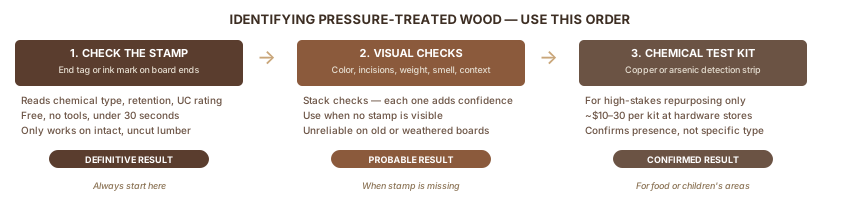
The end tag or ink stamp on the board is the fastest and most reliable check. Look at both ends. You'll see a plastic tag or faint ink stamp with a chemical code (ACQ, CA, CCA), a retention level in pcf (such as 0.15 lbs per cubic foot for above-ground use), and a use category like "GROUND CONTACT" or "UC4A." If there's no stamp, look for a green or brownish-green tint, small evenly-spaced incision marks running roughly 1 inch apart on all four sides, and a chemical smell on fresh wood. For high-stakes situations (repurposing old wood near food or children), a copper detection test kit ($15–25 at most hardware stores) gives you a definitive answer.
| Most reliable method | End tag or ink stamp |
| Visual clues | Greenish color, incision marks, heavier weight |
| Treatment era cutoff | January 1, 2004 (CCA phased out; ACQ/CA took over) |
| Hardware rule | Post-2004 PT requires corrosion-resistant fasteners |
| Never do | Burn or compost PT wood of any type |
| Definitive test | Copper detection kit (for modern PT); arsenic kit (for suspected CCA) |
In this guide:
- Read the stamp: fastest method, works on new and intact lumber
- Visual and sensory checks: for unmarked or weathered boards
- Chemical test kits: for high-stakes repurposing decisions
- CCA vs. modern treatment: what changed in 2004 and why it matters
- Safe uses and hard limits: indoor use, burning, disposal rules
Part 1: Reading the End Tag or Stamp
No tools required for most of this guide. You need your eyes, a light source, and the ability to read the stamp printed on the board. Beginner-friendly.
The stamp is the only definitive way to know if wood is pressure treated. It tells you the exact treatment chemical, how much of it is in the wood, and what the lumber is rated for.
Where to look
Check both ends of the board first. Most treating plants attach a plastic or paper end tag there: a small label with colored print showing all the key information. If you don't see a tag, scan all four faces along the board's length for an ink stamp. Stamps can be faint; angle a light across the surface at a low angle to make them readable. They're usually within 12 inches of the end.
One catch: if the board has already been cut, the stamp may be gone. Cut boards from a stack of mixed lumber with no visible stamp need the visual checks in Part 2.
Reading each field
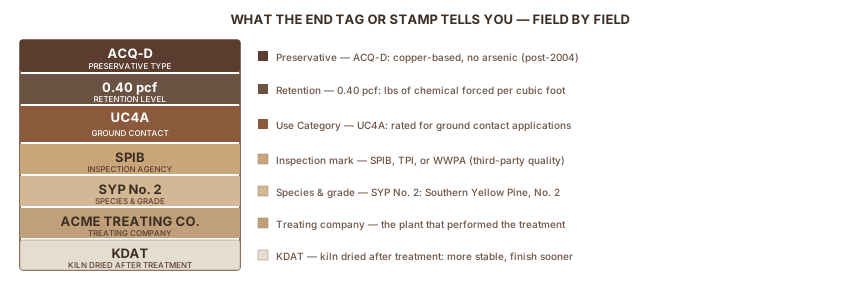
A complete end tag or stamp contains:
| Field | What It Shows | Example |
|---|---|---|
| Preservative type | Chemical used in treatment | ACQ-B, CA-C, MCQ, CCA-C |
| Retention level | Pounds of preservative per cubic foot | 0.40 pcf |
| Use Category | Exposure rating (UC code) | UC4A |
| Plain-language label | Easy-read exposure | GROUND CONTACT |
| Inspection agency logo | Third-party quality control | TPI, SPIB, WWPA |
| Treating company | Who treated the lumber | Smith Lumber Co. |
| Species and grade | Wood type | SYP No. 2 |
| KDAT notation | Kiln Dried After Treatment | KDAT (if applicable) |
The Culpeper Treated Lumber end tag guide has sample images of real tags for cross-reference. Hansen Buildings also walks through what each mark means in practice.
Preservative codes: what they mean
These are the codes you'll actually see on boards at a lumber yard or home center:
- ACQ-B, ACQ-D: Alkaline Copper Quaternary. The most common post-2004 residential treatment. Copper-based, no arsenic. What you'll find on most deck boards and fence posts bought after 2004.
- CA-B, CA-C: Copper Azole. Also copper-based, no arsenic. Widely used in western states.
- MCQ: Micronized Copper Quaternary. Newer formulation with finer copper particles. May appear less green than standard ACQ.
- CCA-C: Chromated Copper Arsenate. The old formulation used before 2004. Still used for utility poles, industrial lumber, and some agricultural applications. Contains arsenic.
- KDAT: Not a preservative. Means Kiln Dried After Treatment. Already kiln-dried, so more stable and ready to finish sooner.
Use Categories: what the UC code means for your project
The AWPA (American Wood Protection Association) assigns use categories by exposure condition:
| UC Code | Exposure | Common Uses |
|---|---|---|
| UC1 | Interior, dry | Interior framing |
| UC2 | Interior, damp possible | Condensation-prone areas |
| UC3A | Above ground, protected | Fascia, trim under eaves |
| UC3B | Above ground, exposed | Deck boards, railings, fences |
| UC4A | Ground contact, general | Deck posts, fence posts |
| UC4B | Ground contact, heavy duty | Building poles, permanent foundations |
| UC4C | Ground contact, extreme | Critical structural members |
| UC5 | Saltwater | Marine pilings |
The code on the stamp tells you what the wood is rated for, not what it was actually used for. Finding UC3B boards buried in the ground in an old fence is common. That's a problem for whoever installed it, not a property of the wood. For deck framing applications (UC4A joists and ledger boards), see 2x8 Treated Lumber for span tables and structural installation requirements.
Retention levels: what pcf tells you
The retention level shows how much preservative was forced into the wood, measured in pounds per cubic foot (pcf). More pcf means more protection against decay and insects. It also means more corrosion potential for metal fasteners.
| Retention | Typical UC | Common Application |
|---|---|---|
| 0.15 pcf | UC3A | Light above-ground, protected |
| 0.25 pcf | UC3B | Standard above-ground exterior |
| 0.40 pcf | UC4A | Standard ground contact |
| 0.60 pcf | UC4B | Heavy duty ground contact |
| 2.5+ pcf | UC5 | Marine/saltwater exposure |
Southern Pine's guide to choosing preservative levels explains when each retention level is required by building codes.
Part 2: Visual and Sensory Identification
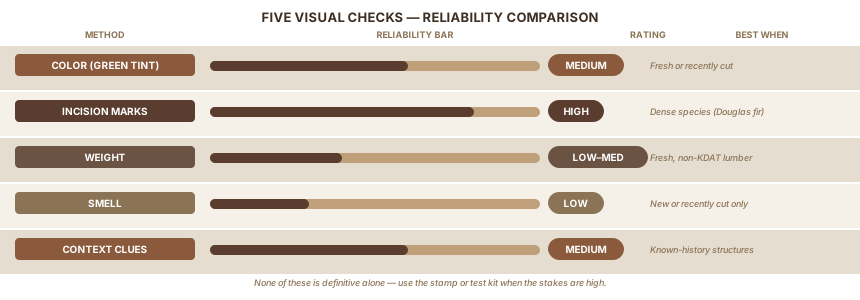
No stamp? Use these checks in order. Each one adds confidence, but none alone is definitive. Use several together.
Check 1: Color
Modern PT wood (ACQ, CA, MCQ) typically has a greenish or brownish-green tint from copper compounds. CCA-treated wood (pre-2004) is more distinctly green: yellow-green to dark olive. The color comes from the interaction between the copper or chromium and the wood fibers.
Two limitations worth knowing:
- Color fades. Weathered gray boards may show no surface tint at all. If you cut into the board, the fresh wood underneath should reveal color if it's treated.
- Not all PT is green. MCQ and some newer formulations are barely tinted. A board that looks natural isn't necessarily untreated.
The best color check is end grain. Cut or look at a fresh end. The color penetrates into the wood, not just the surface.
Check 2: Incision marks
Look closely at all four sides of the board. Pressure treated lumber often has small, evenly-spaced slits (roughly 1/2 to 3/4 inch long) running in a regular pattern. Treating plants cut these incisions before treatment to help preservatives penetrate dense wood species.
Douglas fir, Hem-Fir, and other dense softwoods common in western US lumber yards need incisions. Southern yellow pine (SYP) absorbs treating chemicals naturally and rarely does. If you're buying in the South or Southeast, incision marks are less common even on treated boards.
Incision marks are a strong positive indicator. Their absence doesn't prove the wood is untreated.
Check 3: Weight
Fresh PT wood (not KDAT) is noticeably heavier than dry untreated lumber of the same dimensions. The treating process forces a water-based preservative solution into the wood under pressure, and that solution hasn't fully dried out yet. Pick up a 2x4. If it's surprisingly heavy for its size, pressure treatment is likely.
Fails for KDAT lumber or boards that have dried out over time. Without a comparison piece of untreated wood nearby, the difference can be hard to gauge.
Check 4: Smell
Cut a small piece or look at a fresh end cut. Freshly treated lumber has a distinctive chemical smell: faintly oily, slightly pungent, unlike the natural scent of pine or fir. If you've ever walked through the treated lumber section at a home center and noticed the smell, that's what you're looking for.
Only reliable for new or recently cut lumber. The smell fades as the wood dries and weathers. An old board from a salvage pile won't give you anything to go on.
Check 5: Context clues
Where the wood came from matters. Deck boards, fence posts, raised garden beds, exterior framing, and anything in or near the ground was almost certainly pressure treated. Big box store lumber in the "exterior" or "deck" section is PT unless explicitly labeled otherwise.
If you're looking at boards from a structure built before 2004 with a distinctly green tint, that's CCA. After 2004, it's ACQ or CA. The building era narrows your identification significantly.
Confidence summary
| Method | Reliability | Best For |
|---|---|---|
| End tag or stamp | Definitive | New lumber, intact boards |
| Color (green tint) | Medium | Fresh or recently cut boards |
| Incision marks | High | Dense species (Douglas fir) |
| Weight | Low-medium | Fresh, non-KDAT lumber |
| Smell | Low | New or recently treated only |
| Context clues | Medium | Reclaimed structures with known history |
Part 3: When to Use a Chemical Test Kit
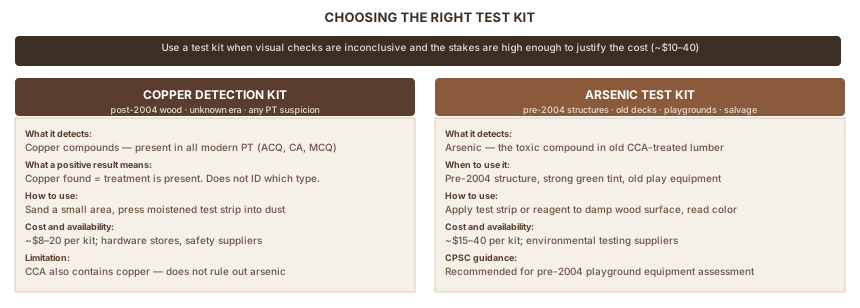
Visual checks give you a strong probability. Test kits give you certainty. Use them when the stakes are high enough to justify it.
Situations that warrant a test
- Repurposing old boards for a children's play structure
- Building raised garden beds for food crops, especially from reclaimed wood
- Any structural use indoors where you're unsure whether old boards are CCA
- Before cutting or sanding a lot of old green-tinted lumber (knowing whether it's CCA changes your respiratory protection decisions)
Copper detection kits
All modern PT treatments (ACQ, CA, MCQ) use copper as the primary biocide. A copper detection kit gives you a positive or negative result on copper presence. Sand a small area of the board, collect a pinch of dust on a damp test medium, and observe the color change.
Positive for copper means treatment is present. It won't tell you which type. CCA also contains copper, so a positive result doesn't rule out CCA.
Search "wood preservative test kit" or "copper detection test strip for wood" online. They're available from environmental testing suppliers.
Arsenic test kits
For wood you suspect is CCA (strongly green, from a pre-2004 structure, or from playground equipment), arsenic test kits can detect arsenic residue. The CPSC recommended testing pre-2004 playground equipment before making decisions about replacement or continued use.
What the tests don't tell you
Test kits tell you whether a compound is present. They don't give you the UC rating, retention level, or specific preservative type. Negative copper on old wood likely means untreated. Non-copper treatments exist but are rare in residential lumber.
Follow the kit manufacturer's instructions precisely. Sampling technique affects accuracy.
Part 4: CCA vs. Modern Treatment and What It Means for You
Identifying the treatment type matters as much as knowing the wood is treated. The preservative code determines your safety precautions, hardware selection, and whether the wood fits your project.
The 2004 cutoff
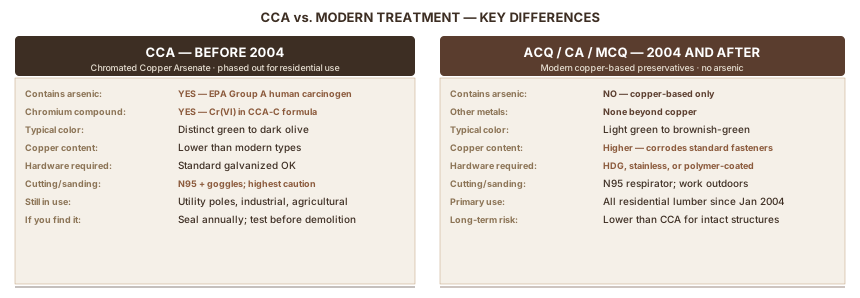
On January 1, 2004, the EPA, CPSC, and the wood treating industry agreed to phase out CCA (chromated copper arsenate) from residential lumber production. All PT lumber sold for residential use since then uses copper-based alternatives: ACQ, CA, MCQ.
The EPA's overview of wood preservative chemicals covers the full chemical landscape. CCA is still used for utility poles, industrial applications, and some agricultural lumber where it's not accessed by the public regularly.
If you're looking at boards from a deck, fence, or structure built before 2004 with a distinct green tint, treat them as CCA until proven otherwise.
What CCA means for safety
Arsenic is an EPA Group A human carcinogen. The arsenic in CCA lumber is chemically fixed into the wood fibers by chromium chemistry. An intact, sealed CCA board poses low ongoing risk. The hazard comes when you disturb it.
The CPSC's CCA guidance recommends:
- Apply a penetrating deck sealer annually to existing CCA structures to reduce leaching
- Wear gloves, N95 respirator, and safety glasses when cutting or sanding
- Work outdoors; don't let sawdust accumulate
- Wash hands and exposed skin before eating, drinking, or touching your face
- Don't sand CCA boards without respiratory protection
What modern ACQ/CA/MCQ means
No arsenic. No chromium hexavalent compounds. The main workplace hazard is copper-laden sawdust when cutting. Wear an N95 respirator and work outdoors. Same precaution as CCA, different reason.
Long-term exposure concerns with modern PT are much lower than with CCA for intact structures. The absolute rules still apply: never burn, never compost, no food contact surfaces.
The hardware issue: easy to miss, costly to ignore
Post-2004 ACQ and CA contain more copper than CCA did, and copper corrodes metal. Standard electroplated galvanized screws and nails will corrode in ACQ or CA lumber within one to two seasons. You'll see the fastener heads rust and the wood around them stain.
For any post-2004 PT wood, Decks by E3 recommends hot-dip galvanized (HDG), double-dip galvanized, stainless steel (Type 304 or 316), or polymer-coated fasteners. Copper and copper-alloy hardware are naturally immune. The copper in the preservative doesn't attack itself.
Most builders miss this until the fasteners corrode. The wrong hardware on a deck built with modern ACQ can fail structurally within a few years.
Part 5: Safe Uses and Hard Limits
What PT wood is designed for
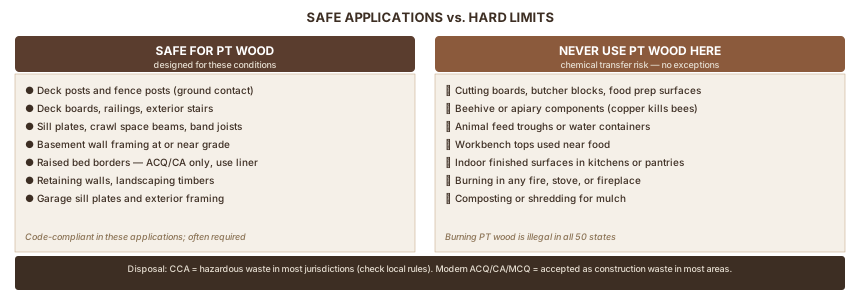
- Outdoor ground contact: deck posts, fence posts, sill plates, retaining walls, raised bed framing (with caveats)
- Above-ground exterior: deck boards, railings, fencing, exterior trim
- High-moisture interior framing: crawl spaces, basement walls, garage framing near grade
Building codes and engineering tables assume PT wood in these applications. Using it this way is the expected, unremarkable choice. Many outdoor builds pair PT framing lumber with exterior-rated plywood sheathing. For grade selection and the Exposure 1 vs. Exterior distinction that matters in moisture-exposed assemblies, see Exterior Plywood.
Hard limits: don't use PT wood here
- Cutting boards, countertops, butcher blocks: Never. Any surface where wood contacts food directly. Preservatives can transfer to food, especially in warm, moist conditions.
- Beehives and beekeeping equipment: Copper and other preservatives are toxic to bees.
- Animal feed troughs, water troughs, feed storage bins: Same issue. Preservatives leach into food and water.
- Workbench tops where you prepare or handle food: Not worth the risk.
The NPIC Treated Wood Fact Sheet from Oregon State University lists these exclusions clearly based on the underlying chemistry.
The indoor-use question, answered directly
PT wood for structural interior framing (crawl space beams, basement wall plates, garage sill plates) is standard practice and safe. Building codes permit it and often require it in high-moisture conditions.
PT wood for anything involving food or prolonged skin contact? No.
For raised garden beds: modern ACQ/CA is generally considered acceptable for ornamental plantings. For vegetable beds, most extension services recommend lining the bed interior with landscape fabric to minimize any preservative contact with soil. Old CCA boards from a salvaged deck are a different matter. That's where the arsenic risk in a food production context becomes real.
ProWood's indoor use guide covers the current guidance from major manufacturers.
Burning and disposal
Never burn PT wood, regardless of type. Burning removes the cellulose and concentrates the heavy metals in the ash. Burning CCA releases arsenic; burning ACQ releases copper compounds. Both produce toxic smoke. The NPIC notes that the EPA classifies burned PT wood as hazardous waste, and burning it is illegal in all 50 states.
Never compost PT wood or use it as mulch. The preservatives leach into the soil and bioaccumulate.
For disposal:
- CCA wood: take to a permitted landfill. Some jurisdictions require hazardous waste disposal. Check local rules before putting it in a dumpster.
- Modern ACQ/CA/MCQ: most areas accept it as regular construction waste. Verify locally.
The NPIC Regulation and Disposal guide has state-by-state disposal information.
What to read next
Once you know what you have, finishing is usually the next question. See how to stain pressure treated wood for moisture testing, surface prep, and stain selection.
FAQ
Is greenish-tinted wood always pressure treated?
Almost always, but not 100% of the time. The green tint comes from copper-based preservatives (ACQ, CA-B, MCQ) reacting with the wood — and modern PT lumber is the only thing that uses those chemicals at scale. The exception is naturally green wood like freshly cut poplar, which has a faint olive-green tone in the heartwood that fades within months. If the green is dull, even, and still vivid after a year of exposure, it's pressure treated. The USDA Forest Products Laboratory's General Technical Report on wood preservatives documents the standard color reactions in detail.
How can I tell modern PT lumber from older CCA-treated wood?
The hard cutoff is January 1, 2004 — the EPA banned CCA for residential use after that date. Wood from before 2004 is likely CCA (arsenic-based). Wood from 2004 onward uses ACQ, CA-B, or MCQ (copper-based, no arsenic). Visual clues: CCA tends toward an olive or grayish-green, while modern treatment is brighter green or brown. A copper-only test kit will positive on both. An arsenic-specific test kit only triggers on CCA. When in doubt about an older deck or fence, assume CCA and treat accordingly.
Can I plane or sand pressure-treated wood?
You can, but use protection. Sawdust from PT lumber contains copper compounds (and arsenic, in pre-2004 CCA stock) that you don't want in your lungs or on your skin. Always wear an N95 respirator, work outdoors or with strong dust collection, and bag the offcuts. Don't use PT sawdust as mulch or compost. The CPSC's CCA guidance is conservative — for any pre-2004 wood, treat the dust as a hazardous material.
What does "pcf" mean on the end tag?
Pcf stands for "pounds per cubic foot" and refers to the preservative retention level — how much chemical is loaded into the wood. Common values: 0.15 pcf for above-ground use (UC3B), 0.40 pcf for ground contact (UC4A), and 0.60 pcf for permanent wood foundations (UC4B). Higher pcf means more preservative and more rot resistance. Don't substitute a lower-pcf board into a ground-contact application — it will rot within a few years.
How long does pressure-treated wood last?
Above-ground modern PT (UC3B at 0.15 pcf) lasts roughly 20–40 years if kept clean and finished every 3–5 years. Ground-contact PT (UC4A at 0.40 pcf) lasts 30–60 years. Permanent foundation PT (UC4B at 0.60 pcf) is rated for 100 years. The Forest Products Lab tracks these durability figures in its long-term field studies. Failure usually starts where end grain meets soil or where the finish has worn through and water sits on the surface.
Sources
This guide draws on government agency guidance (EPA, CPSC), extension service research (Oregon State NPIC), AWPA standards documentation, and manufacturer technical resources from treating plants. Sources are cited inline at the claims they support.
-
USDA Forest Products Laboratory — Wood Handbook (FPL-GTR-190) — Chapter 15 covers wood preservatives, retention values, and durability service life
-
Culpeper Treated Lumber — How to Read an End Tag — field-by-field stamp reading guide
-
AWPA Residential Infographic 2021 — official Use Category definitions
-
Southern Pine — Choosing Preservative Level — retention levels by use category
-
EPA Overview of Wood Preservative Chemicals — chemical types, regulatory history
-
CPSC CCA Guidance — arsenic safety guidance for existing CCA structures
-
NPIC Treated Wood Fact Sheet — chemistry, safety, and food-contact exclusions
-
NPIC Regulation and Disposal of Treated Wood — disposal rules by state
-
ProWood — Is Pressure Treated Wood Safe for Indoor Use? — indoor use manufacturer guidance
-
Decks by E3 — Pressure-Treated Grades and Retention Levels — retention levels explained
-
Hansen Buildings — The Mark on Pressure Preservative Treated Lumber — stamp markings in practice
Also Referenced
Tagged
Up Next
Why a 2x4 Isn't Actually 2x4
WOOD & MATERIALS · Beginner