
Cross Lap Joint at a Glance
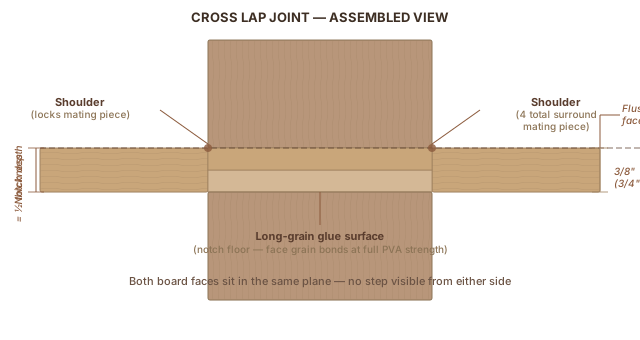
A cross lap joint (also called a cross halving joint) cuts a notch from each of two crossing boards — each notch exactly half the board's thickness — so the pieces interlock flush at the crossing point. Both faces sit in the same plane. From the front, it looks like the two boards pass through each other.
It's stronger than a pocket-screw joint, takes about 15 minutes of layout, and you need nothing beyond a circular saw, a chisel, and a marking gauge.
| Also called | Cross halving joint, cross half-lap |
| Notch depth | Half the board's actual thickness (3/8" for 3/4" stock) |
| Fit tolerance | ±1/64" from half-depth for finished work |
| Indoor glue | PVA — Titebond Original or Titebond II |
| Outdoor glue | Titebond III + mechanical fasteners |
| Best beginner method | Circular saw + chisel (no table saw required) |
In this guide:
- The lap joint family and what makes a cross lap distinct
- Why it's stronger than a butt joint and what that means for your technique
- Cutting step by step with a circular saw
- Testing the fit and diagnosing what went wrong
Part 1: Cross Lap vs. the Other Half-Laps
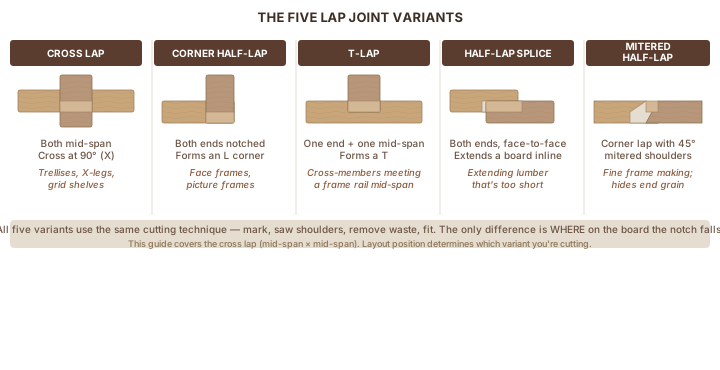
"Half-lap" is a family name. Beginners mix up the terms. Here's the full picture.
| Joint | Configuration | Common uses |
|---|---|---|
| Cross lap | Both pieces notched mid-span; cross at 90° forming an X | Trellises, X-legs, pergola rafters, grid shelves |
| Corner half-lap | Both pieces notched at their ends; forms an L corner | Face frames, picture frames, window screens |
| T-lap | One end notched, one mid-span notched; forms a T | Cross-members meeting a frame rail mid-span |
| Half-lap splice | Both pieces notched at ends, aligned face-to-face | Extending lumber that's too short |
| Mitered half-lap | Corner half-lap with 45° shoulders | Fine frame making; hides end grain |
This guide covers the cross lap — both pieces notched in the middle so they form an X. The cutting technique is identical for all five variants. The only difference is where on the board the notch falls.
For corner half-laps used in picture frames and face frames, see the miter joint guide for related frame-corner joinery.
Part 2: Why This Joint Works
Understanding the mechanics tells you why fit accuracy matters and which shortcuts will cost you.

Four shoulders, one plane
A cross lap has four contact surfaces: the floor of each notch (long-grain face — your primary glue surface) and two shoulders on each notch that lock the mating piece laterally. Those four shoulders surround the mating piece on all sides. Push the assembled frame sideways and a shoulder blocks it. That's racking resistance. A pocket-screw joint resists racking by bending the screws; the cross lap resists it through geometry.
According to Wikipedia's summary of woodworking research, a glued half-lap joint "exceeds even mortise and tenon and other commonly-known 'strong' joints" in shear resistance — but that claim requires a tight joint with good glue coverage. The fitting step isn't optional.
Long-grain to long-grain
The floor of each notch is face grain — the same surface you'd plane or sand. PVA bonds to face grain at maximum strength. A well-glued lap joint fails in the wood, not at the glue line. A glued butt joint fails differently: end grain soaks up glue before it can bond, leaving a starved, weak joint. Cross laps avoid end grain at the glue surfaces entirely.
What the joint doesn't resist
If you try to peel the two pieces apart perpendicular to the joint plane — imagine pulling them apart like a book cover — glue alone handles it. No mechanical interlock works in that direction. For structures where that force is likely, drive a screw through the face after gluing.
Part 3: The Numbers That Matter
Depth: half the actual thickness
Each notch goes exactly half the board's actual thickness. Both notches together equal one full board thickness. That's what makes the faces flush.
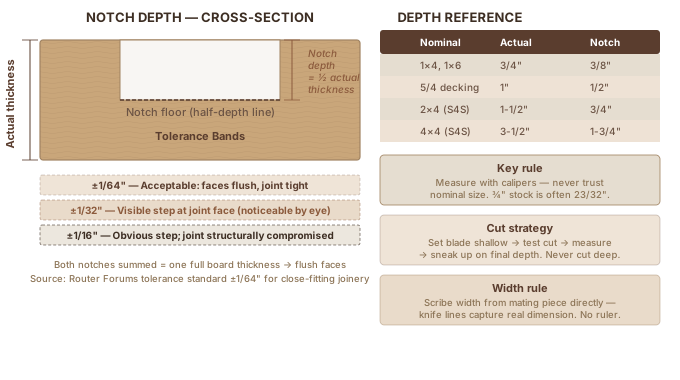
Measure your board with calipers or by scribing with a marking gauge from both faces — the two lines should land in exactly the same groove. Don't trust the nominal size. A "3/4-inch" board is usually between 23/32" and 25/32".
| Nominal size | Actual thickness | Notch depth each |
|---|---|---|
| 1×4, 1×6 (surfaced) | 3/4" | 3/8" |
| 5/4 decking | 1" | 1/2" |
| 2×4 (surfaced) | 1-1/2" | 3/4" |
| 4×4 (surfaced) | 3-1/2" | 1-3/4" |
Router forum community practice puts the acceptable tolerance at ±1/64" for close-fitting joinery cuts. At 1/32" off you'll see a slight step; at 1/16" the step is obvious. The method below — set shallow and sneak up — keeps you inside ±1/64" without any special skill.
Width: mark from the mating piece, not a ruler
The notch width equals the full width of the mating board. Don't measure it. Lay the mating piece directly on the workpiece at the crossing location and scribe both shoulders with a marking knife. Let the board mark itself. This eliminates measurement error entirely — if your 1×4 is actually 3-1/2" wide, the knife lines capture that dimension automatically.
Part 4: Five Things to Stop Believing Before You Start
"I need a table saw." The Honest Carpenter's cedar arbor project cuts every cross lap with a circular saw and a chisel. No table saw, no dado stack. The step-by-step below uses that same setup.
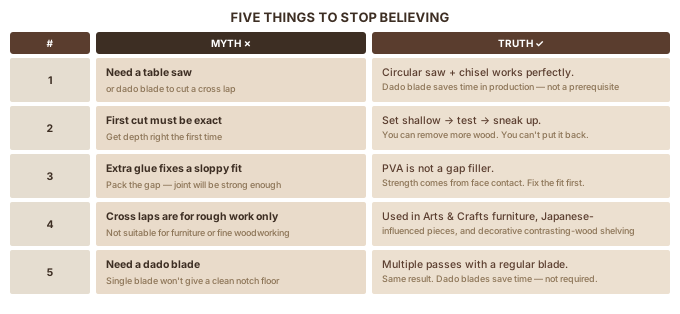
"Depth must be exactly right on the first cut." Set the blade shallow, cut a test piece, measure, and sneak up on the final depth. You can remove more wood. You can't put it back.
"Extra glue will fix a sloppy fit." PVA is not a gap filler. A joint with 1/8" gaps packed with extra glue is far weaker than a tight joint. The strength comes from face contact, not glue volume. Fix the fit.
"Cross laps are just for rough construction." They appear in Arts and Crafts furniture, Japanese-influenced modern pieces, and decorative shelving. A tight cross lap in contrasting woods — walnut crossing maple — is a deliberate design choice.
"I need a dado blade." Multiple passes with a regular circular saw blade give the same result. Dado blades save time in production; they're an upgrade, not a prerequisite.
Part 5: Tools to Get Started
For the circular saw method:
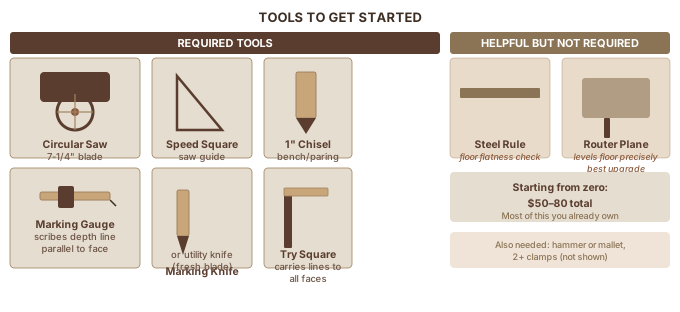
Required:
- 7-1/4" circular saw
- Speed square or combination square (saw guide)
- 1" bench chisel (a bench chisel is a wide, flat chisel used for paring wood surfaces)
- Hammer or mallet
- Marking gauge (a tool that scribes a line parallel to an edge at a set distance)
- Marking knife or fresh-bladed utility knife
- Try square (for carrying lines around the board)
- 2+ clamps
Helpful but not required:
- Steel straight rule (floor flatness check)
- Router plane (levels the notch floor precisely — the best upgrade for this joint)
Most of this you already own. Starting from zero: $50–80.
For the hand tool method, replace the circular saw with a backsaw or Japanese pull saw. A pull saw ($15–25) starts without wandering and cuts a narrower kerf — easier for a first joint.
Part 6: Cut a Cross Lap with a Circular Saw
Fourteen steps in four phases. The layout phase is where most errors start. Don't rush it.
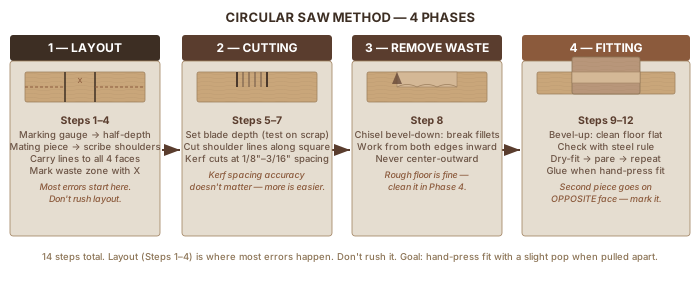
Phase 1 — Layout
Step 1 — Set the marking gauge.
Measure your board's actual thickness with calipers. Set the gauge to half that. Lock it. Test on scrap: scribe from one face, flip, scribe from the other. Both lines should land in exactly the same groove. If not, adjust.
Step 2 — Mark the shoulder lines from the mating piece.
Lay the mating piece on the workpiece at the crossing location. Press it flat and hold it firm. Scribe both edges with a marking knife — press hard enough to leave a visible groove, not just a pencil line. Mark the waste zone with a large X in pencil.
Step 3 — Carry the lines to all faces.
Using a try square, carry each shoulder line down both edges and across the opposite face with the marking knife. You now have knife lines on all four surfaces — references you can see from any direction while cutting.
Step 4 — Scribe the depth line on both edges.
Run the marking gauge along both edges of the board. This line is the floor of your notch. Every cut stops here.
Phase 2 — Cutting
Step 5 — Set the blade depth.
Unplug the saw. Hold it against the board edge at the depth line. Lower the blade until the lowest tooth just kisses the scribed line. Lock the depth stop. Cut a test piece of the same thickness, measure the depth, and adjust if needed. Skip this test and you'll often cut too deep.
Step 6 — Cut the shoulder lines.
Clamp a speed square to the board face so the blade falls just on the waste side of the shoulder knife line. The knife line stays on the "keep" side — the kerf removes only waste wood. Run the saw along the square, keeping the base flat throughout. Both edges should show the cut ending exactly at the scribed depth line. Repeat for the second shoulder.
Step 7 — Kerf cuts through the waste zone.
Between the two shoulder cuts, make parallel cuts at 1/8"–3/16" spacing, all to the same blade depth. No fence needed — accuracy here doesn't matter. The more cuts, the easier the next phase.
Phase 3 — Removing Waste
Step 8 — Break out the fillets.
The kerf cuts leave thin strips of wood standing on the floor. Place a wide chisel bevel-down against a fillet near one shoulder and tap with a mallet. Work from both edges toward the center — never center outward, or you'll blow out the shoulder. The floor will be rough. That's expected.
Phase 4 — Fitting
Step 9 — Clean the floor.
Flip the chisel bevel-up and hold it at a shallow angle. Make sweeping passes across the floor to shave off high spots. Lay a steel rule flat across the notch and check for rocking. Mark high spots in pencil and pare from those spots only.
Circular saw caveat: the blade's radius leaves a slight curve at each shoulder. Chisel it flat with 2–3 light passes.
Step 10 — Cut the second piece.
Repeat the entire sequence on the mating piece. The second notch goes on the opposite face from the first — when assembled, both face sides end up in the same plane. Mark face sides with a curl mark before starting. This is the most common error to prevent.
Step 11 — Dry assemble both pieces.
Put them together. Both faces should be flush — no step. Shoulder gaps should close. If a step exists, identify which notch is too shallow and pare its floor, 1/32" at a time, testing after each pass.
Step 12 — Glue up.
Apply a thin, even film of PVA to both notch floors and both sets of shoulder faces. Assemble, check flush, clamp with scrap cauls to distribute pressure. Handle after 30 minutes; don't load the joint for 24 hours.
Part 7: Cut by Hand with a Backsaw or Pull Saw
For stock up to 1-1/2" thick, or when the circular saw isn't available. This method also teaches how wood behaves under a chisel — worth doing at least once.
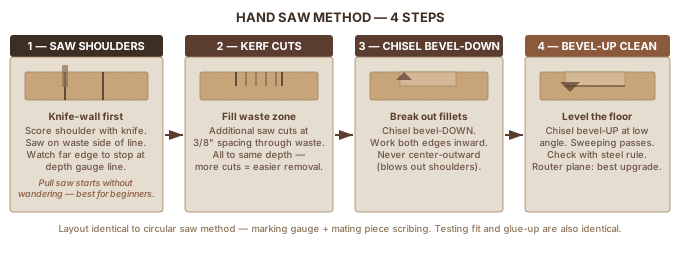
Layout is identical — marking gauge, mating piece scribing, carrying lines to all four faces. Do not skip it.
Clamp the work in a vise or against a bench hook. Place the saw on the waste side of the shoulder knife line. Start with a short pull stroke — the knife groove guides the saw immediately. Saw to the depth line, watching the far edge as a stop reference. Repeat for the second shoulder, then make additional kerf cuts in the waste zone, 3/8" apart.
Remove waste with the chisel bevel-down, working from both edges toward the center. Clean the floor bevel-up with light, sweeping strokes. Check flatness with the steel rule. Testing fit and glue-up are identical to the circular saw method.
Katz-Moses Tools' half-lap guide covers the hand-tool layout in detail, including the knife-wall technique for cleaner shoulders.
If you own a router plane, use it for the final floor pass. Set it to your half-thickness depth and take one pass across the full length. Nothing levels a notch floor more consistently. Not required, but the best upgrade for this joint once you're ready.
For batch production or furniture-quality work, see the router tables guide for the router fence method.
Part 8: Testing the Fit
The three states of fit
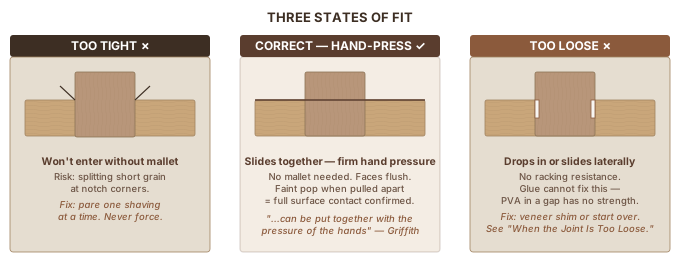
Too tight: The mating piece won't enter without a mallet. Risk: splitting the short grain at the notch corners. Fix: pare one shoulder face or the floor, one thin shaving at a time. Never force the joint.
Too loose: The mating piece drops in or slides laterally. No racking resistance. Fix: see the section below on loose joints.
Correct — the hand-press fit: The pieces slide together under firm two-handed pressure. No mallet. When pulled apart, they make a faint pop — air pressure releasing as the surfaces separate. That pop confirms full contact across the floor.
Masterwoodcrafters describes the standard: "The pieces should slide together with firm hand pressure and make a slight popping sound when pulled apart." Griffith's Woodwork for Beginners states it more plainly: "A well-made cross-lap joint is one in which the members can be put together with the pressure of the hands and which will not fall apart of their own weight."
Four diagnostic checks
Rocking: Place the mating piece in the notch and rock it front-to-back. If it rocks, the floor is uneven. Use the steel rule to find the high spot and pare from there.
Flush test: Run a fingertip across the joint. A 1/32" step is detectable by touch. A step means one notch is shallower than the other — determine which and pare its floor.
Shoulder gap: Look at the assembled joint from the side. Any gap between the shoulder face and the mating piece means the notch is too wide or the floor isn't flat.
Pop test: Assemble under hand pressure. Pull apart sharply. Slight resistance — the pop — means good surface contact. No resistance means poor contact; recheck the floor.
Part 9: Four Errors and Their Exact Fixes
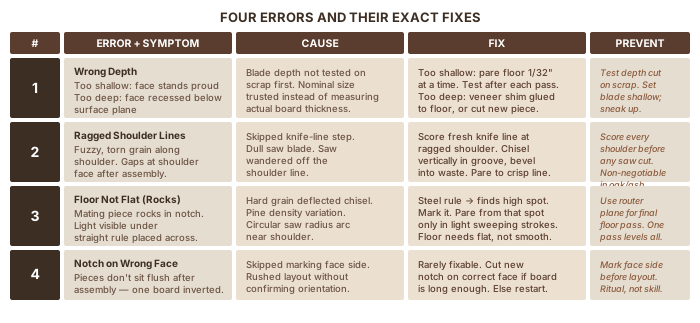
Error 1 — Wrong depth
Too shallow: Faces don't sit flush; one board stands proud at the joint. Too deep: Faces sit recessed below the surface plane.
Fix for too shallow: pare the floor deeper, 1/32" per pass, testing after each. A router plane makes this controlled work easy.
Fix for too deep: This is hard to undo. Options: glue a veneer strip of matching wood to the notch floor, mix fine sawdust with epoxy as cosmetic fill, or cut new pieces. For visible furniture, new pieces are usually the right call.
Prevention: test blade depth on scrap first. Set shallow; sneak up.
Error 2 — Ragged shoulder lines
Symptom: Fuzzy, torn grain along the shoulder. Gaps at the shoulder face.
Cause: Skipped the knife-line step; dull blade; saw wandered.
Fix: Score a fresh knife line at the ragged shoulder. Place the chisel vertically in the groove, bevel facing into the waste. Pare straight down in thin shavings to re-establish a crisp shoulder. Rockler's tearout guide explains why this works: "Scribing the line with a sharp blade severs the surface fibers and can practically eliminate tearout."
Prevention: Score every shoulder before any saw cut. On oak and ash, this step is non-negotiable.
Error 3 — Floor not flat (joint rocks)
Symptom: Mating piece rocks in the notch. Light visible under a straight rule.
Cause: Hard grain lines deflected the chisel; pine density variation left ridges; circular saw arc at the shoulder.
Fix: Set the steel rule across the floor — it rocks on the high spot. Mark the spot, pare from it only, in light sweeping strokes. Check again. Repeat until the rule sits flat.
The floor doesn't need to be smooth. It needs to be flat. Surface texture is fine for gluing.
Error 4 — Notch cut on the wrong face
Symptom: After assembly, one piece is inverted. Faces don't sit flush.
Cause: Skipped marking the face side; worked quickly without checking.
Fix: Rarely fixable. If the piece is long enough, you might cut a new notch on the correct face, abandoning the first. Otherwise, start over.
Prevention: mark face sides with a curl mark before any layout. Mark the X on the correct face. Before every saw cut, confirm: "Am I cutting from the face side, and is the X in the waste?" This error happens to experienced woodworkers too. Prevention is ritual, not skill.
Part 10: When the Joint Is Too Loose
Pick a fix before gluing:
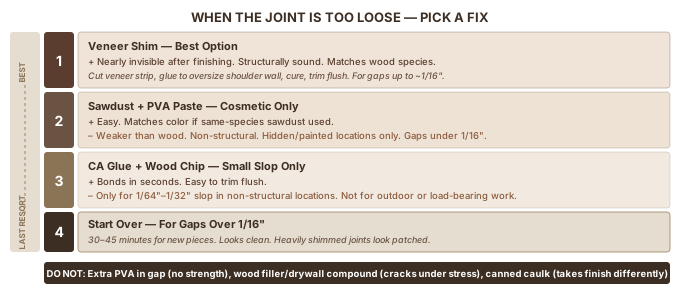
Veneer shim — best option. Cut a strip of veneer or a thin slice of matching wood and glue it to the oversize shoulder wall. Let it cure, trim flush with a chisel. Nearly invisible after finishing and structurally sound. woodgears.ca documents this method with step-by-step detail.
Sawdust + PVA paste — cosmetic only. Mix fine sawdust from the same species with PVA into a thick paste, pack into the gap, dry overnight, sand or chisel flat. Works for gaps under 1/16". The filler is weaker than wood — use only in non-structural, hidden, or painted locations.
CA glue + wood chip — small slop. Press a paper-thin wood chip glued with thick CA into the gap. Bonds in seconds, trim flush. For slop of 1/64" to 1/32" in non-structural locations.
Start over — for gaps over 1/16". A heavily shimmed joint looks patched. New pieces take 30–45 minutes and look clean.
What not to do: don't fill the gap with extra PVA. Wood glue in a gap thicker than a credit card has almost no strength. Don't use canned wood filler, drywall compound, or caulk — they crack under stress and take finish differently.
Part 11: Glue or Fasteners — Picking the Right Assembly
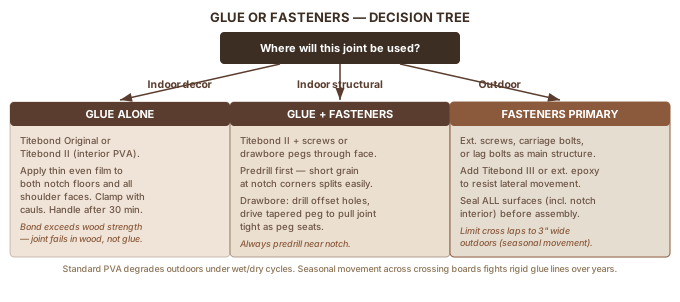
Indoor furniture and decorative work: Glue alone. A well-fitted cross lap glued with Titebond Original or Titebond II forms a bond stronger than the surrounding wood. Apply a thin, even film to both notch floors and both shoulder faces. Clamp with cauls; handle after 30 minutes.
Load-bearing indoor work: Glue plus fasteners. Predrill first — the short grain at notch corners splits easily. Drive a screw through the face, or use drawbore pegs (drill offset holes through the joint, drive a tapered wooden pin; the offset pulls the joint tight as the peg seats).
Outdoor structures: Glue alone fails. Standard PVA degrades under repeated wetting and drying cycles. Field testing on Sawmill Creek and Garage Journal forums confirms that exterior PVA joints eventually separate without mechanical fasteners as backup.
Two pieces crossing at 90° also move in opposite directions with seasonal humidity changes — one expands left-right while the other expands front-back. Over years, that seasonal fight cracks a rigid glue line. Rob Cosman recommends keeping lap joints no wider than 3" in outdoor applications to limit this differential movement.
For outdoor work: use exterior screws, carriage bolts, or lag bolts as the primary structural connection. Add Titebond III or exterior epoxy to resist lateral movement. Finish all surfaces — including inside the notch — with an exterior-rated sealer or paint before assembly.
For outdoor pergola and arbor projects, see the cedar pergola guide.
Part 12: Projects That Use This Joint
Cross laps show up everywhere once you recognize them:
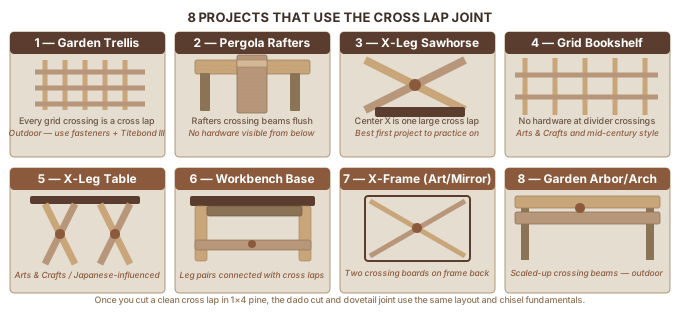
- Garden trellis or lattice panel — every grid crossing is a cross lap
- Pergola rafters — rafters crossing beams flush, without hardware showing
- X-leg sawhorse — the center X is a single large cross lap; one of the best first projects to practice on
- Grid bookshelf — mid-century and Arts and Crafts grid shelving holds rigid without hardware at every divider crossing
- Console table with crossed base legs — common in Arts and Crafts and Japanese-influenced furniture
- Workbench base — many beginner designs connect leg pairs with cross laps for rigidity without complex joinery; see the wooden workbench guide
- X-frame for wall art or mirrors — two crossing boards at the back of a frame
- Garden arbor or wedding arch — scaled-up crossing beams; the project in the Honest Carpenter guide
Once you can cut a clean cross lap in 1×4 pine, try the dado cut next — it shares the same layout and chisel technique but removes stock from one piece instead of two. After that, the dovetail joint is the natural progression toward more complex joinery. If precision hand joinery interests you, kumiko panels scale the same cross-lap grid down to 1/8" basswood strips — 175 interlocking pieces in a 6" panel, no glue.
Sources
Research for this guide drew on maker project documentation, hand-tool instruction sources, community tolerance standards, and classic hand-tool woodworking texts.
- The Honest Carpenter — Cross Lap Joints — circular saw method; cedar arbor project walkthrough
- Katz-Moses Tools — How to Cut a Half Lap — four-shoulder lock explanation; layout methodology
- Wikipedia — Lap Joint — joint taxonomy; shear strength research summary
- Masterwoodcrafters — Half-Lap Joints — fit standards; hand-press test
- Griffith, Woodwork for Beginners, Chapter 39 — classic quality standard; original hand-tool method
- Router Forums — Tolerances in Woodworking — 1/64" tolerance standard for close-fitting cuts
- Rob Cosman — Lap Joints Newsletter — outdoor width limit; joint hierarchy
- Rockler — Avoid Tearout by Reading the Grain — scoring technique; tearout prevention in hardwoods
- woodgears.ca — Filling Gaps in Wood — veneer shim method; loose joint fixes
- Wood Whisperer — Differences Between Titebond Glues — glue selection by application
- Dimensions.com — Wood Joint: Half-Lap Cross — standard dimensions and size ranges
Tagged
How We Research
We don't take affiliate revenue or accept review units. Picks come from multi-source research — manufacturer specs, OSHA / EPA / ASTM regs, and long-form practitioner threads — plus Ahmed's hands-on use where relevant. When we recommend something, we explain why.