
220 Grit Sandpaper at a Glance
220 grit is the standard final-sanding grit before applying finish to bare wood. It produces scratches roughly 66 micrometers deep. Fine enough for most clear finishes, coarse enough to give stain and topcoats something to grip. But 220 isn't always the right answer. For paint, stop at 150. For open-grain hardwoods before stain, 180 is often better.
| Particle size | ~66-68 micrometers (CAMI 220 and FEPA P220 are nearly identical) |
| Classification | Fine grit, at the boundary between prep sanding and finish sanding |
| Primary use | Final bare-wood sanding before clear finishes and penetrating oils |
| Best mineral | Aluminum oxide for bare wood; silicon carbide for between coats |
| Common mistake | Over-sanding past 220, which burnishes wood and blocks finish adhesion |
| Standard progression | ...120 > 150 > 180 > 220 |
In this guide:
- When to use 220 grit and when to stop earlier
- Grit progression: why you can't skip steps
- Choosing the right format and mineral
- Brands and what you're actually paying for
Part 1: What 220 Grit Means
Two grading systems coexist on sandpaper packaging. CAMI (Coated Abrasives Manufacturers Institute) is the North American standard. FEPA (Federation of European Producers of Abrasives) is the international standard, marked with a "P" prefix. Both measure particle size through calibrated sieves. FEPA sets tighter tolerances, capping the percentage of oversize particles that cause deep rogue scratches.
At 220 grit, the two systems are essentially identical:
| Grade | System | Particle Size |
|---|---|---|
| CAMI 220 | North American | ~66-68 micrometers |
| FEPA P220 | International | ~65-68 micrometers |
| FEPA P240 | International | ~58 micrometers |
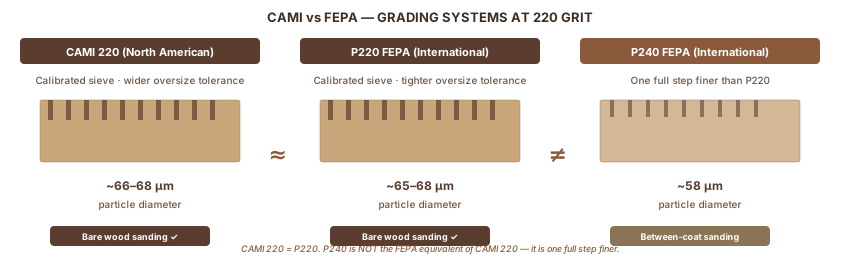
You'll see some conversion charts claiming "CAMI 220 equals P240." That's wrong. Klingspor's technical data and ISO standards both show CAMI 220 and P220 at nearly the same particle size. P240 is one full step finer. At 220 and below, you can grab either system's product interchangeably. Above 220, the systems diverge, so pick one and stick with it.
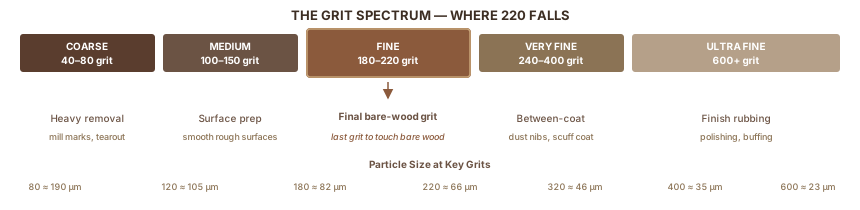
220 sits in the "fine" range on the grit spectrum. Below it: the medium grits (100-150) that do the heavy surface preparation. Above it: very fine grits (240-400) used primarily for between-coat sanding and finish rubbing. 220 is the last grit most woodworkers touch to bare wood.
Part 2: Grit Progression: Why You Can't Skip Steps
Each sandpaper grit cuts a field of tiny grooves into the wood surface. Coarser grits cut deeper grooves. The job of each successive grit is to erase the previous grit's grooves entirely and replace them with shallower ones.
Jump from 80 grit straight to 220 and the 220 paper levels the peaks between the 80-grit grooves but can't reach their floors. The surface feels smooth to your fingers because the peaks are gone. But those deep valleys remain as ghost scratches. Invisible on raw wood. Obvious the moment you apply stain or a glossy finish. The stain pools in the valleys and darkens them, mapping out the old scratch pattern under raking light.
The rule of thumb, per Uneeda's grit sequence guide: never increase grit by more than roughly 50% in one step.
Standard Progressions
| Starting Condition | Grit Sequence |
|---|---|
| Rough stock (mill marks, defects) | 80 > 120 > 150 > 180 > 220 |
| From planer or jointer | 120 > 180 > 220 |
| From hand plane | 180 > 220 (or just 220) |
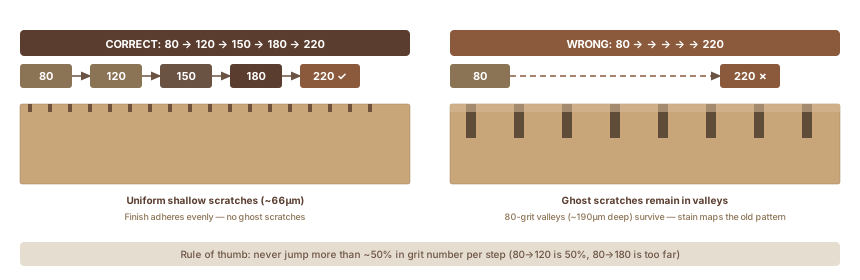
Can you skip 150 in the full sequence and go 120 to 180? Most experienced woodworkers say yes, that jump is small enough. Can you skip 120 and go 80 to 180? No. That 80-grit valley is too deep for 180 to reach.
The Pencil Grid Test
Before starting each grit, lightly scribble pencil marks across the entire surface. Sand until the marks disappear uniformly. If pencil remains in spots, those areas still carry scratches from the previous grit. This converts an invisible process into a binary visual check: mark gone or mark present.
Part 3: When to Use 220 Grit and When to Stop Earlier
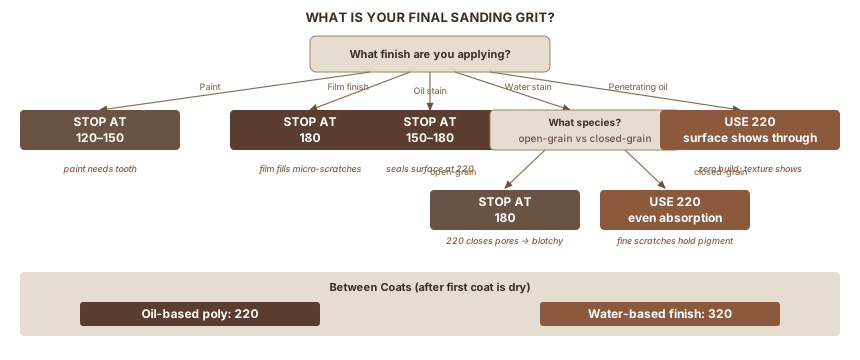
"Sand to 220" is common advice, but it's not a universal rule. Your final grit depends on what finish you're applying and what species you're working with.
Final Grit by Finish Type
| Finish | Wood Type | Final Grit | Why |
|---|---|---|---|
| Water-based stain | Closed-grain (cherry, maple, birch) | 220 | Fine scratches hold water-based pigment evenly |
| Water-based stain | Open-grain (oak, ash, mahogany) | 180 | 220 closes pores, causing blotchy absorption |
| Oil-based stain | Any | 150-180 | Finer than 180 seals the surface, reducing stain penetration |
| Film finish (polyurethane, lacquer, shellac) | Any | 180 | Film fills micro-scratches; 220 adds no visible benefit |
| Penetrating oil (Danish oil, tung oil) | Any | 220 | Oil has zero build; surface texture shows through directly |
| Paint | Any | 120-150 | Paint needs tooth for adhesion; 220 is too smooth |
| Between coats, oil-based poly | N/A | 220 | Knocks down dust nibs, provides mechanical tooth |
| Between coats, water-based finish | N/A | 320 | Water-based needs finer scuff |
These aren't arbitrary numbers. Bob Flexner, author of Understanding Wood Finishing, recommends 180 as the final grit before film finishes. Marc Spagnuolo (The Wood Whisperer) agrees: let the finish create the smooth surface, not the sanding. Jeff Jewitt tested six different final grits under both lacquer and linseed oil, as described in WoodBin's grit progression guide. Under film finishes, the visible difference between 150 and 220 was minimal. General Finishes publishes species-specific grit recommendations that match this table.
The Burnishing Warning
Sanding bare wood past 220, or over-sanding at 220 with a worn disc, can burnish the wood fibers. The surface looks polished and slightly shiny. Stain beads and absorbs unevenly. Film finishes may delaminate at edges.
As Flexner notes in Popular Woodworking, "burnishing" is technically the wrong word since sandpaper cuts rather than compresses. But the practical effect is real regardless of terminology: over-sanded wood resists finish penetration.
The fix is simple. Stop when the pencil marks are gone and the raking light test shows a uniform scratch pattern. Don't keep going "just to be sure."
Water-Based Finishes: The Grain Raise Problem
Sanding to 220 before a water-based finish doesn't prevent grain raise. Water-based products raise the grain on their first coat no matter how smooth the raw wood surface is.
The correct sequence: sand to 220, lightly mist the surface with water, let it dry completely, sand back at 220 to knock off the raised fibers, then apply your first coat of finish. Between subsequent coats of water-based finish, step up to 320-400.
Part 4: Choosing the Right Format and Mineral
At 220 grit, the mineral and format you choose affect the result more than at coarser grits. Different minerals work better for different applications.
Minerals at 220 Grit
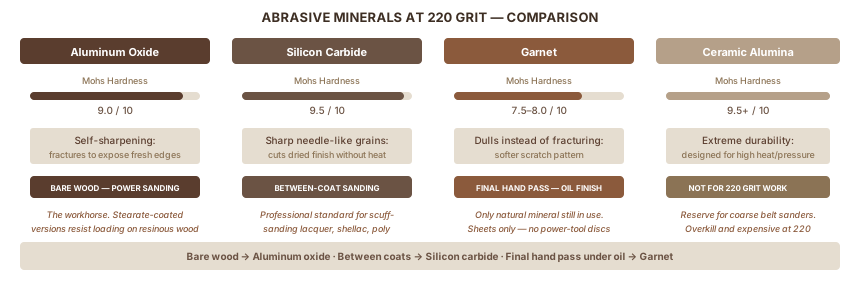
| Mineral | Mohs Hardness | Key Property | Best 220-Grit Use |
|---|---|---|---|
| Aluminum oxide | 9 | Fractures to expose fresh edges (self-sharpening) | Bare wood power sanding. The workhorse. |
| Silicon carbide | 9.5 | Extremely sharp, needle-like grain | Between-coat sanding. Cuts dried finish without loading. |
| Garnet | 7.5-8 | Dulls rather than fractures | Final hand pass on bare wood. Softer scratch pattern. |
| Ceramic alumina | 9.5+ | Extreme durability | Not appropriate at 220. Leave it for coarse-grit belt sanders. |
Aluminum oxide is the right choice for most bare-wood sanding. It fractures under pressure to expose fresh cutting edges, which extends its useful life. Stearate-coated versions resist loading on resinous woods and dense hardwoods.
Silicon carbide is the professional standard for between-coat sanding. Its sharp, needle-like geometry cuts dried finish efficiently without heat buildup. Fine Homebuilding's abrasive comparison describes silicon carbide as specifically suited for "finish work between coats, lacquer, and shellac rubbing."
Garnet is worth knowing about for final hand-sanding passes. It's the only natural mineral still widely used. Because it dulls rather than fractures, it leaves a softer scratch pattern that feels noticeably smoother under penetrating finishes. Woodworkers who hand-sand furniture before oil finishes often prefer garnet at 220 for the final pass. It's not available as power-tool discs.
Formats
| Format | Best For | Notes |
|---|---|---|
| Sheets (9x11) | Hand sanding flat surfaces | Tears into thirds; wrap around a sanding block. About $0.30-$1.50 each. |
| Discs (5" or 6") | Random orbit sanders | Hook-and-loop or PSA. Match the hole pattern to your sander. |
| Rolls | Custom lengths, drum sanders | Cut to any length. Wrap around dowels for profile sanding. |
| Sponges | Curves, moldings, contoured surfaces | Soften to roughly 400-grit equivalent with use. Rinse and reuse. |
| Mesh | Between-coat sanding | Passes dust through instead of around the edges. Resists loading. |
A note on sponges: General Finishes documents that 220-grit sponges soften quickly to roughly 400-grit equivalent during use. Useful for a gentler final pass, but know that it's happening. A 220-grit sponge doesn't stay at 220 for long.
Random Orbit Sanders and Swirl Marks
Random orbit sanders leave swirl marks by definition. Their orbital path crosses the grain on every rotation. WoodWeb's finish sanding guide explains that these "pigtails" are invisible on dry bare wood but show clearly under stain and raking light.
The fix: after finishing with your random orbit sander at your final grit, always do a final hand pass with the same grit, sanding with the grain. This aligns all the micro-scratches parallel to the grain, where they become invisible against the wood's natural pattern.
A common workflow: power-sand to 150 or 180 with the random orbit for speed, then hand-sand at 220 for the final pass.
Part 5: Brands and What You're Actually Paying For
At 220 grit, brand differences are real but specific. Three things vary between products.
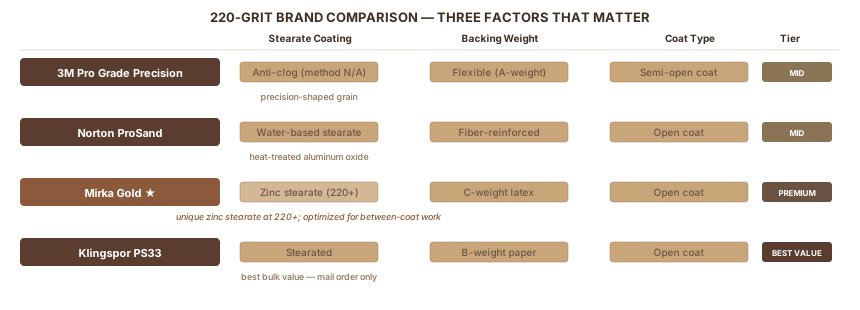
| Brand | Mineral | Stearate Coating | Backing (at 220) | Availability | Price Tier |
|---|---|---|---|---|---|
| 3M Pro Grade Precision | Aluminum oxide (precision-shaped) | Anti-clog (method unspecified) | Flexible | Home Depot, Amazon | Mid |
| Norton ProSand | Heat-treated aluminum oxide | Water-based, non-pigmented | Fiber-reinforced | Amazon, lumber yards | Mid |
| Mirka Gold | Aluminum oxide (extra-strong) | Zinc stearate (unique at 220+) | C-weight latex | Lee Valley, specialty suppliers | Premium |
| Klingspor PS33 | Aluminum oxide | Stearated | B-weight paper | Klingspor Mail Order | Best shop value |
The three factors that matter:
Stearate coating is the biggest factor. Stearate (a dry lubricant) prevents the wood dust from clogging the abrasive surface. At 220 grit, where the spaces between grains are small, anti-clog coating dramatically extends sheet life. Mirka Gold switches from calcium stearate (used at 80-180 grit) to zinc stearate at 220 and above, specifically optimized for reduced clogging on finished surfaces. No other major brand publishes a similar distinction.
Backing weight determines flexibility and tear resistance. Lighter backings (A-weight, B-weight) flex more easily around curves. Heavier backings (C-weight, D-weight) resist tearing and stay flat on a sanding block. At 220 grit, most brands use lighter backings because you're doing finish work, not aggressive stock removal.
Open coat vs. closed coat affects how fast the paper loads up. Open coat means the abrasive grains cover about 60-70% of the surface, leaving gaps for dust to escape. Closed coat covers 100% and cuts faster initially but clogs sooner. For woodworking at 220 grit, open or semi-open coat is standard.
If you want one recommendation: Norton ProSand (the successor to Norton 3X) offers the best balance of cutting speed, anti-clog performance, and price for most woodworkers. Klingspor PS33 is the best value if you buy in bulk through their mail-order catalog. Mirka Gold is worth the premium if you're doing between-coat sanding regularly or finishing water-based products.
Part 6: Sanding Technique at 220 Grit
At 220 grit, you're doing final surface preparation, not material removal. The scratches you leave are the scratches your finish reveals.
Hand Sanding Rules
Sand with the grain. This is non-negotiable on your final pass. Cross-grain scratches at 220 grit show as dark diagonal lines under stain. Even one stray cross-grain pass can leave a visible mark.
Use a sanding block. Your fingers concentrate pressure at the tips and reduce it at the palm. Over time, this creates subtle dips in the surface that aren't visible until finish application. A flat sanding block distributes pressure evenly. Cork-backed blocks add slight compliance for minor surface irregularities.
Light, even pressure. The paper does the cutting. Pushing harder loads the paper faster, creates heat, and at 220 grit can begin closing the grain surface. Think of it as firm, even contact, not active pressing.
Change paper when it dulls. Dull 220-grit paper drags instead of cutting. It requires more pressure to feel like it's working, which increases the risk of cross-grain scratches and burnishing. Fresh paper at 220 should cut easily with minimal pressure.
Three Ways to Check Your Work
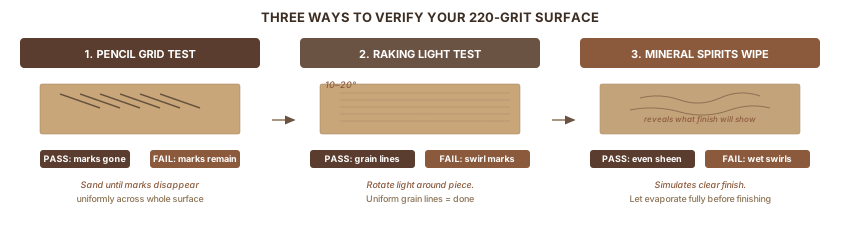
Pencil grid test: Scribble pencil marks across the surface before starting. Sand until they disappear uniformly. Remaining marks reveal areas that still carry previous-grit scratches.
Raking light test: Hold a strong light at a steep angle (10-20 degrees) across the surface. Rotate the light around the piece. Uniform parallel scratches with the grain means you're done. Circular swirl marks mean more hand sanding. Cross-grain lines or dark streaks from a previous grit mean you're not there yet.
Mineral spirits wipe: Wipe the surface with mineral spirits or naphtha and inspect under raking light while wet. This simulates what the surface will look like under a clear finish. Swirl marks, cross-grain scratches, and tearout that were invisible on dry wood show up immediately. Let it evaporate completely before applying finish.
Sources
This guide draws on manufacturer technical data, finishing experts' published recommendations, and practitioner testing across woodworking publications and forums.
- Klingspor Grit Grading Systems — CAMI vs FEPA particle sizes and grading tolerances
- Uneeda Grit Sequence Guide — grit progression rules and why skipping grits backfires
- Bob Flexner, Rules for Sanding Wood (Popular Woodworking) — final grit recommendations by finish type
- Bob Flexner, Fine Sanding Myths (Popular Woodworking) — burnishing misconceptions and finish adhesion
- Marc Spagnuolo, Sanding Too Much? (The Wood Whisperer) — why 180 is sufficient for film finishes
- WoodBin, Going Through the Grits — grit progression and Jeff Jewitt's grit comparison testing
- General Finishes, Prep Sanding Raw Wood — species-specific final grit recommendations
- General Finishes, Sanding Paper vs Pads — sponge softening behavior
- Fine Homebuilding, Aluminum Oxide vs Silicon Carbide vs Ceramic — mineral type properties and applications
- WoodWeb, Avoiding Swirl Marks in Finish Sanding — ROS swirl mark prevention
- Norton Abrasives, Bare Wood Sanding — manufacturer sanding recommendations
- Klingspor PS33 Product Page — PS33 specifications and pricing
Tagged