
Cherry Wood at a Glance
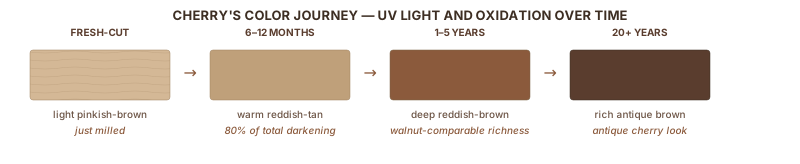
Cherry darkens dramatically from pale pink to deep red-brown over its first 6–12 months of UV exposure — no other furniture-grade hardwood transforms this much on its own. It runs Janka 950 lbf (between poplar and walnut on the hardness ladder) and sells for roughly $5–9 per board foot at FAS grade from online retailers. The species is Prunus serotina, American black cherry, and it machines cleanly but blotches under standard oil stain — skip the stain and let the patina do the work.
| Species | American black cherry (Prunus serotina) |
| Janka hardness | 950 lbf — harder than poplar (540), softer than walnut (1,010) |
| Weight | 35 lbs/ft³ (560 kg/m³) |
| Price range | $5–9/BF for FAS grade from online retailers (2026) |
| Best for | Fine furniture, cabinetry, cutting boards, turning, interior millwork |
| Watch out for | Blotches with oil-based stain; burns on the table saw if you feed too slowly |
In this guide:
- How cherry compares to walnut, maple, and oak
- How cherry darkens over time and whether you can control it
- How to finish cherry without blotching
- Where to buy cherry lumber and what you'll pay
Part 1: What Cherry Wood Is
When woodworkers say "cherry," they mean American black cherry (Prunus serotina), a hardwood in the rose family that grows across eastern North America. It's the only commercially valuable cherry species for woodworking.
The best cherry timber comes from the Allegheny Plateau in Pennsylvania, New York, and West Virginia. Trees reach 60–80 feet tall and 18–24 inches in diameter. According to AHEC's species data, growth exceeds harvest by a wide margin. Cherry is abundant, sustainable, and not threatened. FSC-certified cherry is readily available from Pennsylvania operations.
Watch the name. "Brazilian cherry" is jatoba (Hymenaea courbaril), a tropical legume 2.5 times harder than real cherry and unrelated to the Prunus genus. The name is a 1990s flooring-industry invention. If someone offers you Brazilian cherry for a furniture project, they're selling you a different wood.
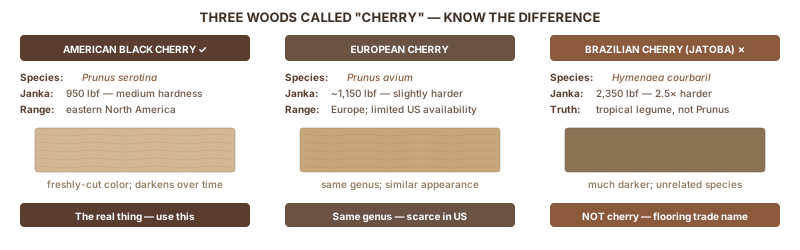
| Name | Species | Janka (lbf) | The truth |
|---|---|---|---|
| American Black Cherry | Prunus serotina | 950 | The real thing |
| European Cherry | Prunus avium | ~1,150 | Same genus, harder, limited supply |
| Brazilian Cherry (Jatoba) | Hymenaea courbaril | 2,350 | Not cherry. Different family, 2.5x harder |
Part 2: How Cherry Compares to Other Hardwoods
Cherry sits in the lower-middle of the common hardwood range. All property data below comes from the [USDA Forest Products Laboratory](https://www.fpl.fs.usda.gov/documnts/TechSheets/HardwoodNA/htmlDocs/prunusser.html). Cherry is slightly softer than walnut, roughly 35% softer than red oak, and about half the hardness of hard maple. That means it dents more easily than oak on a floor, but for furniture, cabinetry, and anything that isn't getting dragged across daily, it's plenty hard.
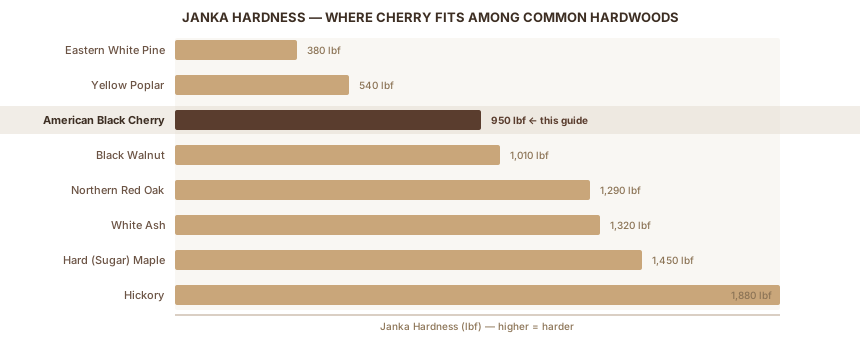
Janka Hardness Scale
| Species | Janka (lbf) |
|---|---|
| Eastern White Pine | 380 |
| Yellow Poplar | 540 |
| American Black Cherry | 950 |
| Black Walnut | 1,010 |
| Northern Red Oak | 1,290 |
| White Ash | 1,320 |
| Hard (Sugar) Maple | 1,450 |
| Hickory | 1,880 |
Physical Properties
| Property | Value |
|---|---|
| Janka Hardness | 950 lbf |
| Specific Gravity | 0.50 |
| Average Dry Weight | 35 lbs/ft³ |
| Modulus of Rupture | 12,300 psi |
| Modulus of Elasticity | 1,490,000 psi |
| Radial Shrinkage | 3.7% |
| Tangential Shrinkage | 7.1% |
| T/R Ratio | 1.9 |
The T/R ratio is worth understanding. A ratio below 2.0 means the wood shrinks evenly in both directions, which means less cupping and warping. Cherry at 1.9 is more dimensionally stable than many oaks (2.0+) and Douglas fir (2.6). That stability is one reason cherry has been a furniture-maker's wood for centuries.
Cherry vs. Walnut, Maple, and Oak
| Factor | Cherry | Walnut | Hard Maple | Red Oak |
|---|---|---|---|---|
| Janka (lbf) | 950 | 1,010 | 1,450 | 1,290 |
| Price (FAS 4/4) | $5–9/BF | $7–12/BF | $4–7/BF | $3–6/BF |
| Grain | Fine, closed, straight | Medium, dramatic | Fine, tight, pale | Bold, open, visible pores |
| Fresh color | Light pinkish-brown | Chocolate brown | Pale cream | Tan to pinkish-red |
| Aging | Darkens dramatically | Lightens gradually | Minimal change | Minimal change |
| Staining | Blotches badly | Takes stain evenly | Also blotches | Absorbs evenly |
| Best for | Fine furniture, cabinetry | Dark statement pieces | High-traffic surfaces | Flooring, craftsman furniture |
When to choose cherry over walnut: Budget. Cherry is cheaper right now and gives you comparable refinement. Cherry also gets richer with age while walnut lightens.
When to choose cherry over maple: When you want warmth. Maple is pale and stays pale. Cherry starts warm and gets warmer. Maple is the better choice for cutting boards and high-traffic surfaces where hardness matters more than color.
When to choose cherry over red oak: Aesthetic preference. Cherry reads formal and refined. Oak reads traditional and craftsman. Oak's open pores need filling for a perfectly smooth finish; cherry's closed pores don't.
Part 3: Grain, Color, and Appearance
Cherry's heartwood is light pinkish-brown when freshly milled. Surprisingly pale, almost like light maple. The sapwood is cream to pale yellow, typically 1–2 inches wide, and clearly distinct from the heartwood. The USDA tech sheet describes the heartwood as "brownish with a greenish tinge, darkening upon exposure to a deep reddish brown with a golden luster." Colonial craftsmen called cherry "New England Mahogany" for the deep reddish-brown it develops over time.
The grain runs straight with a fine, uniform texture and moderate luster. Cherry's pores are nearly invisible to the naked eye. Compare that to red oak, where you can see pores from arm's length. That closed-pore structure is why cherry finishes so smoothly without grain filler.
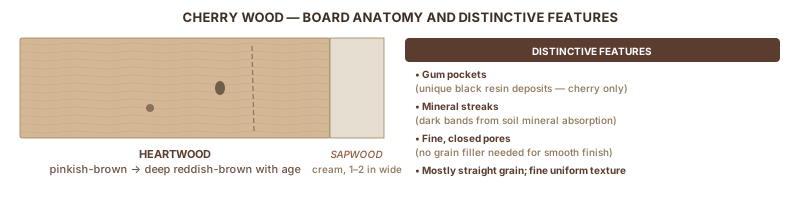
Distinctive features you'll find in cherry boards:
- Gum pockets: Short black streaks of hardened resin. Unique to cherry among North American hardwoods. These are natural character, not defects, though they can gum up plane irons and router-bit).
- Pin knots: Small brown circles under 3/16 inch. Add visual interest in character-grade lumber.
- Mineral streaks: Dark bands running with the grain from soil mineral absorption. Can't be removed. Structural integrity is unaffected.
Figured cherry exists but is less common than figured maple. Curly cherry shows a wavy, shimmering grain pattern. Crotch figure creates Y-shaped patterns from branch junctions, striking when bookmatched. Quartersawn cherry shows subtle ray fleck, less bold than oak's but with a satisfying satiny feel.
Part 4: How Cherry Darkens Over Time
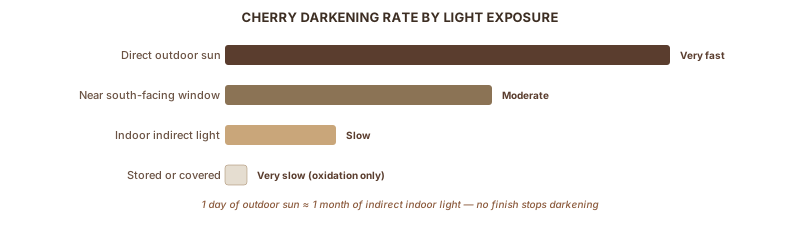
No other common workshop hardwood changes color as fast or as far as cherry.
Two processes drive it. UV light reacts with phenolic compounds in the wood, altering their molecular structure and shifting the reflected color toward deeper reds and browns. This happens fast, measurable in hours of direct sun. Oxidation from air exposure adds a slower shift that continues for years. Thos. Moser's documentation of cherry furniture aging over 50+ years provides the best visual evidence of this process.
No finish stops it. The wood darkens through any clear coat. People choose cherry because of this, not in spite of it.
Color Timeline
| Stage | Color | What to expect |
|---|---|---|
| Fresh-cut | Light salmon to tannish-pink | Surprisingly pale; often compared to light maple |
| 6–12 months | Warm reddish-brown | Most dramatic change — about 80% of total darkening happens here |
| 1–5 years | Deep reddish-brown | Slower rate; comparable in richness to walnut |
| 20+ years | Complex warm brown with red undertones | The "antique cherry" look — visible depth and grain character |
Cherry achieves in six months the patina that oak or maple acquires only after decades.
Speeding It Up
Direct outdoor sunlight develops cherry's color fastest. One day of direct sun roughly equals a month of indirect indoor light. Marc Spagnuolo at The Wood Whisperer documented a saw blade leaving a visible shadow impression on cherry plywood in 30 minutes of sun exposure.
If you want to pre-age cherry before finishing, lay the boards face-up in direct sun for two to three weeks. Rotate them daily for even exposure. Important: boards from different logs darken at different rates even under identical conditions. Select matched boards from the same flitch before starting.
Preventing Darkening
You can't. As Woodweb's finishing experts note, "UV absorbers typically will provide some protection to the finish, but will have little or no effect in the patinization of the wood itself." UV-blocking window film on nearby windows reduces the rate by roughly half. Water-based finishes slow darkening more than oil-based in the short term. But given enough time, cherry reaches the same destination regardless.
If a client wants cherry that stays light, recommend maple. Cherry darkens. That's the point.
Part 5: Finishing Cherry
Why Cherry Blotches
Cherry absorbs liquids unevenly. The grain varies in density and porosity across the board face. Porous areas soak up more stain, drying darker than the surrounding wood. Oil-based pigment stains are the worst offenders because their pigment particles pool in open-grained zones and can't penetrate tight-grained areas evenly.
You can preview blotch-prone areas before committing: wipe the surface with denatured alcohol. Areas that turn dramatically darker will do the same thing with stain.
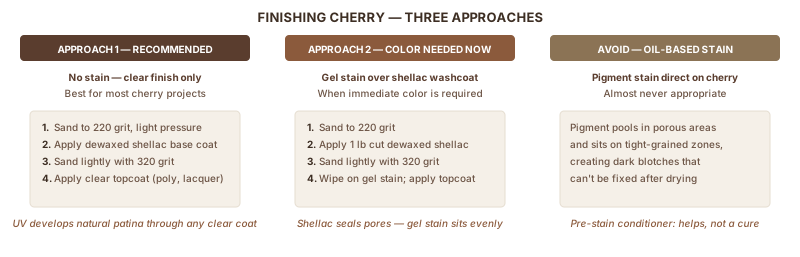
The Staining Decision
| Approach | When to use | How |
|---|---|---|
| Don't stain (recommended) | Most cherry projects | Apply a clear finish. Let UV and time develop the color naturally. |
| Gel stain over shellac washcoat | When you need color now | Apply a 1 lb cut of dewaxed shellac, sand lightly with 320, then wipe on gel stain. |
| Dye stain | For even coloring | TransTint concentrate in water/alcohol, sprayed on. Fades under UV. |
| Oil-based pigment stain | Almost never on cherry | Blotches badly. Pre-stain conditioner helps but doesn't solve it. |
Most experienced woodworkers say the same thing: don't stain cherry. Popular Woodworking's finishing guide puts it directly: the natural patina looks better than any stain can approximate, and staining locks in an artificial color that the wood keeps changing underneath. Under a clear finish, cherry reaches 80% of its eventual color within the first year.
If you do need to add color, gel stain over a dewaxed shellac washcoat (like Zinsser SealCoat) is the most reliable method. The Wood Whisperer's blotch-control guide walks through the full process. The shellac seals porous areas first, the gel stain sits on the surface rather than soaking in unevenly.
Recommended Finishes
| Finish | Best for | Notes |
|---|---|---|
| Dewaxed shellac + oil-based poly | Fine furniture | Shellac base controls blotching; poly adds durability. Proven combination. |
| General Finishes Arm-R-Seal | All-purpose furniture | Wipe-on oil/varnish. Crystal clear, easy to apply, repairable. |
| Lacquer (spray) | Production work | Fast drying, excellent clarity, minimal blotch risk. Requires spray setup. |
| Danish oil or tung oil blend | Casual furniture, small items | Deepens color immediately. Less durable. Some blotching risk. |
| Food-grade mineral oil | Cutting boards, kitchen items | FDA approved, non-toxic, won't go rancid. Reapply regularly. |
Oil-based finishes enhance cherry's reddish tones immediately and allow the patina to continue developing through the finish. Water-based finishes slow color development somewhat and stay clearer. No finish prevents darkening. For a full walkthrough on polyurethane application, see Applying Polyurethane.
Part 6: Working with Cherry
Cherry machines better than most domestic hardwoods. Its moderate hardness and fine, straight grain give you clean cuts, smooth surfaces, and crisp details. Two quirks are worth knowing about.
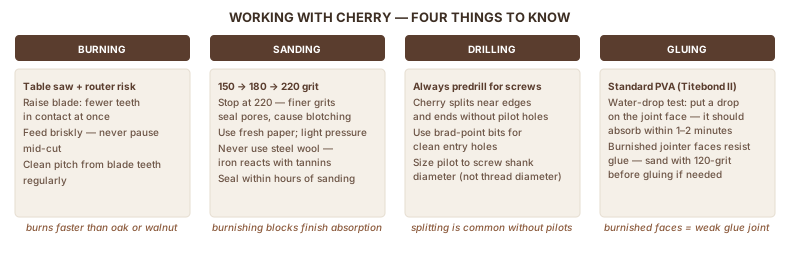
Burning. Cherry burns on the table saw and router more readily than oak, walnut, or poplar. Stumpy Nubs' guide to preventing scorching covers the main culprits. Raise the blade height so fewer teeth contact the wood at once, feed at a steady brisk pace, and never pause mid-cut. Keep blades clean. Pitch buildup on teeth is a major contributor. If you're getting burn marks, check feed rate and blade condition before blaming the wood.
Sanding. Cherry's tight grain burnishes if you sand with worn paper or heavy pressure. A burnished surface looks polished but won't absorb finish evenly, which amplifies blotching. Sand with fresh abrasive and light pressure: 150, then 180, then 220 grit. Stop at 220 for any penetrating finish. Finer grits close the surface too much. Never use steel wool on cherry. Iron particles react with the wood's tannins and leave dark stains that won't sand out. Seal within a few hours of final sanding. Freshly exposed cherry starts oxidizing immediately.
Drilling. Always predrill for screws. Cherry splits near ends and edges without pilot holes. Use brad-point bits and size the pilot to the screw shank diameter.
Gluing. Standard PVA glue (Titebond II) works well. The main trap, documented in Woodweb's cherry gluing guide: burnished surfaces from jointing at too slow a feed rate resist glue penetration. Put a water drop on the freshly jointed face. If it doesn't absorb within a minute or two, give the surface a quick pass with 120-grit sandpaper before gluing.
Part 7: Common Uses for Cherry Wood
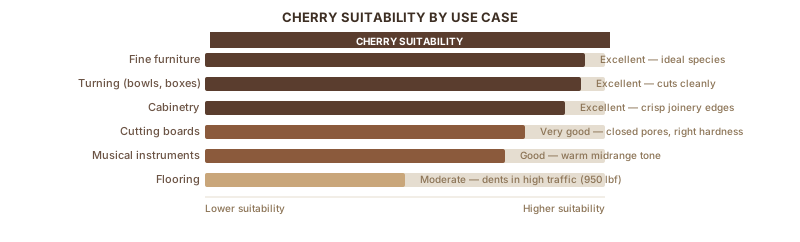
Fine furniture. Desks, dining tables, chairs, dressers, case pieces. Thomas Moser built his company around cherry furniture starting in the 1970s, when cherry was considered cheap lumber. He chose it for its workability and the way it develops character over decades. Cherry has deep roots in American furniture traditions. It was the premium domestic species in Shaker furniture and a common alternative to imported mahogany in Federal period pieces (1780–1820).
Cabinetry. Cherry machines cleanly for mortise work, routing, and panel doors. Its fine grain delivers crisp edges on joinery cuts. The warm tones suit both traditional and transitional kitchen designs.
Cutting boards. One of the three standard premium cutting board woods alongside hard maple and walnut. Cherry's 950 lbf Janka sits in the ideal zone: firm enough to resist deep gouging, soft enough not to dull knife edges. Its closed-pore structure resists bacterial absorption.
Turning. One of the best lathe woods. Cherry cuts cleanly, holds fine detail, and finishes to a silk-like surface. Common for bowls, vases, lidded boxes, and decorative forms.
Musical instruments. Used for acoustic guitar backs and sides, banjo necks, and drum shells. The tone sits between rosewood and mahogany: warm midrange emphasis with slightly tighter bass.
Flooring (with a caveat). Cherry flooring looks beautiful but dents more easily than oak (950 vs. 1,290 lbf Janka). It's best reserved for lower-traffic rooms — bedrooms, studies, formal dining rooms.
Part 8: Buying Cherry Lumber
Lumber Grades
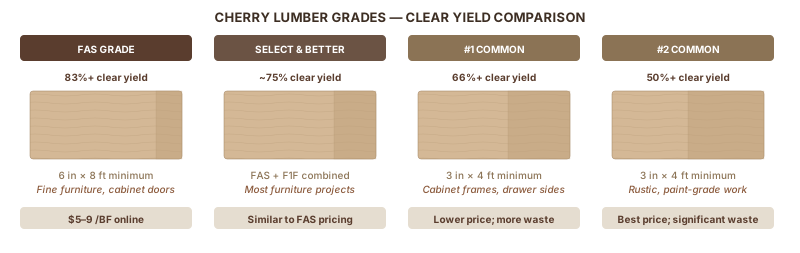
| Grade | Clear yield | Min. board size | Best for |
|---|---|---|---|
| FAS (Firsts & Seconds) | 83%+ | 6" x 8' | Fine furniture, cabinet doors, long clear pieces |
| Select & Better | FAS + F1F combined | 4" x 6' | Most furniture projects (one good face) |
| #1 Common | 66%+ | 3" x 4' | Cabinet frames, drawer sides, smaller parts |
| #2 Common | 50%+ | 3" x 4' | Rustic furniture, paint-grade work |
Standard [NHLA grades](https://www.buskirklumber.com/nhla-lumber-grading/) don't address heartwood content. Cherry distributors add color sorts: 90/70 Red means the better face is 90%+ heartwood and the back is 70%+ — this is the premium. 90/50 Red is the standard sort. Sappy boards have more cream-colored sapwood and cost less. A board can grade FAS and still be 20–30% sapwood, so specify a heartwood sort if color consistency matters for your project.
Current Pricing (2026)
| Source | FAS 4/4 price range | Notes |
|---|---|---|
| Northeast lumber yards (near PA mills) | $3–6/BF | Best prices; hand-select your boards |
| Online retailers (Bell Forest, Hearne, Woodworkers Source) | $5–9/BF | S2S or rough; volume discounts at 100+ BF |
| Local yards (Midwest/South) | $5–8/BF | Varies by distance from eastern mills |
| Western US retail | $9–14/BF | Freight premium from Appalachian production |
| Big box stores (S4S boards) | $10–13/BF equiv. | Very limited selection; accent pieces only |
| Direct from sawmill (green) | $2–4/BF | Requires 1–2 years air drying or kiln access |
All prices are per board foot. Cherry is at historically favorable pricing right now. When China was importing nearly 50% of US grade hardwood, cherry prices peaked. The 2018–2019 retaliatory tariffs collapsed that demand, and PA stumpage prices fell to roughly 20% of the 2007 peak. That correction has partly passed through to retail — $5–9/BF for furniture-grade cherry represents better value than woodworkers have seen in two decades.
Where to Buy
Local hardwood lumber yard: Your best bet for hand-selecting boards and getting competitive pricing. In the Northeast near Pennsylvania mills, expect $3–6/BF for FAS 4/4. Find a yard through the NHLA member directory or a local woodworking club.
Online retailers: Woodworkers Source, Bell Forest Products, Hearne Hardwoods, and Alderfer Lumber all ship cherry nationwide. Boards over 7 feet require truck freight, which is only economical at 100+ board feet. For smaller orders, buy shorter lengths or pre-packaged packs.
Big box stores: Home Depot and Lowe's carry S4S cherry boards — typically 3/4 inch thick in 6- or 8-inch widths, 8 feet long. Fine for small trim or accent pieces. Not a viable source for furniture projects. No grade transparency, and prices run 20–40% above specialty retailers per board foot.
Part 9: Common Problems and How to Fix Them
| Problem | Cause | Fix |
|---|---|---|
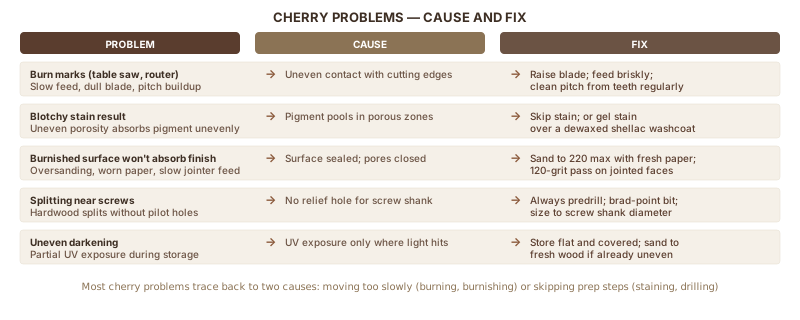
| Burn marks from table saw | Slow feed rate, dull blade, pitch buildup | Raise blade, feed briskly, clean teeth regularly |
| Blotchy stain | Uneven porosity absorbs pigment unevenly | Don't stain, or use gel stain over a shellac washcoat |
| Gum pockets (black streaks) | Natural resin deposits in the species | Fill with clear epoxy, or leave as character |
| Heartwood/sapwood contrast | Natural color difference that increases with age | Cull sapwood from show faces, or embrace as "rustic cherry" |
| Burnished surface won't absorb finish | Oversanding, worn paper, or dull jointer knives | Sand to 220 max with fresh paper; light 120-grit pass on jointed surfaces |
| Uneven darkening | Partial UV exposure during storage | Store flat and covered; sand to fresh wood if already uneven |
| Splitting near screws | No pilot holes in hardwood | Always predrill; size pilot hole to screw shank diameter |
Part 10: Where Cherry Fits in Your Shop
Cherry is easy to work, takes a beautiful finish, and improves with every year of use. Among the premium domestic hardwoods, it's the best value right now: cheaper than walnut, more interesting than maple, more refined than oak.
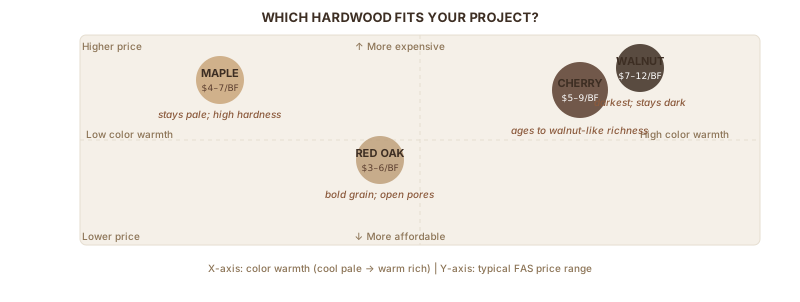
If you're choosing between cherry and walnut for a furniture project, cherry gives you comparable elegance at a lower price point, with a more dramatic aging story. If you need maximum durability for high-traffic surfaces, choose maple or oak instead. If your project will be painted, save your money and use poplar.
For your first cherry project, a cutting board is a low-risk way to learn how the wood machines and finishes. For a furniture project, start with something where you can appreciate the patina development — a small table, a jewelry box, or a set of shelves.
Frequently Asked Questions
What is the Janka hardness of cherry wood?
Cherry's Janka hardness is 950 lbf, per the USDA Forest Products Lab. That puts it just below black walnut (1,010 lbf) and well above poplar (540 lbf), but below the popular tabletop hardwoods like hard maple (1,450 lbf) and red oak (1,290 lbf). For furniture, cabinetry, and millwork, 950 is plenty. For high-traffic flooring or a workbench top, you'd want something harder.
Does cherry wood darken over time?
Yes, and more than any other furniture-grade hardwood. Fresh-milled cherry is pale pinkish-tan; within 6–12 months of UV exposure, it shifts to a warm reddish-brown that keeps deepening for years. Roughly 80% of the total color change happens in the first year. No finish stops the process — UV-blocking topcoats slow it slightly but never halt it. Most cherry owners consider the patina the wood's best feature, not a flaw.
Is cherry wood good for furniture?
Cherry is one of the best furniture hardwoods you can buy. It machines cleanly, glues well, takes a fine finish, and develops a patina that fans of Shaker and mid-century work prize. Its 950 Janka hardness handles normal household wear without dent issues. The main caveats: it blotches under oil-based stain, and it costs more than oak or poplar — though it's still cheaper than walnut for comparable furniture-grade material.
How do you finish cherry wood without blotching?
Skip pigment stains entirely — they pool in cherry's uneven density and produce muddy splotches. The standard fix is a thin shellac washcoat (1-pound cut, sprayed or wiped on) before any stain or dye, which evens out absorption. Better still: don't stain at all. A clear finish like wipe-on poly, oil-and-wax, or shellac lets cherry's natural color come through, and the patina that develops over the first year does the darkening work for you.
How does cherry compare to walnut and maple?
Cherry sits between the two. Walnut (Janka 1,010, ~$7–12/bf) is darker out of the gate and stays dark; cherry starts pale and ages into walnut-comparable richness for $2–3 less per board foot. Maple (Janka 1,450, ~$4–7/bf) is harder, paler, and stays pale — better for high-wear surfaces or modern designs where color stability matters. If you want warmth and patina without paying walnut prices, cherry wins.
Sources
This guide draws on USDA research data, lumber industry references, finishing experts, and practitioner forums.
- USDA Forest Products Laboratory — Cherry Tech Sheet — all mechanical properties and shrinkage data
- AHEC — American Cherry — sustainability, harvest data, commercial statistics
- Thos. Moser — Cherry's Beauty Over Time — patina documentation, 50+ years of cherry furniture
- The Wood Whisperer — The Power of the Sun — UV darkening experiments
- The Wood Whisperer — Blotch Control — shellac washcoat technique
- Popular Woodworking — Cherry Without Blotching — finishing strategy
- Woodweb — Aging of Cherry — UV science and prevention limits
- Woodweb — Getting a Good Glue Joint with Cherry — burnishing and glue adhesion
- Stumpy Nubs — Wood Scorching — table saw burn prevention
- Clark Wood Products — What Is Gummy Cherry — gum pockets explained
- Buskirk Lumber — NHLA Grading Rules — lumber grade definitions
- Metropolitan Museum of Art — Shaker Furniture — cherry in American furniture traditions
- The Timberland Investor — PA Stumpage Prices — market pricing history
- American Farm Bureau — Tariff Impact on Hardwoods — 2018–2019 trade war effect on cherry pricing
How We Research
We don't take affiliate revenue or accept review units. Picks come from multi-source research — manufacturer specs, OSHA / EPA / ASTM regs, and long-form practitioner threads — plus Ahmed's hands-on use where relevant. When we recommend something, we explain why.
Up Next
Choosing an Acacia Butcher Block Countertop
WOOD & MATERIALS · Beginner