
How to Use This Guide
A floating desk has no legs. The wall carries the load, which means the build is simpler than it looks and the result is cleaner than anything you'll find flat-packed in a box. This guide covers a 48" × 22" desk with one drawer, using a French cleat mount and pocket hole joinery (angled screw pockets that hide fasteners inside the joint). No table saw required for the carcass. You need a circular saw, a drill, and a stud finder.
Tools you'll need: Drill/driver, circular saw, stud finder, 4-foot level, tape measure, speed square, 4 clamps, sanding block or random orbital. A pocket hole jig (Kreg R3, about $25) is optional but strongly recommended.
If you're still deciding on design: Start with Part 1.
If you have your measurements and need the cut list: Jump to Part 2.
If you're building and want the assembly sequence: Parts 3 through 5 walk through carcass, mounting, and drawers in order.
If you're at the finish line: Part 6 covers sanding, finishing, and hardware.
Floating Desk With Drawers at a Glance
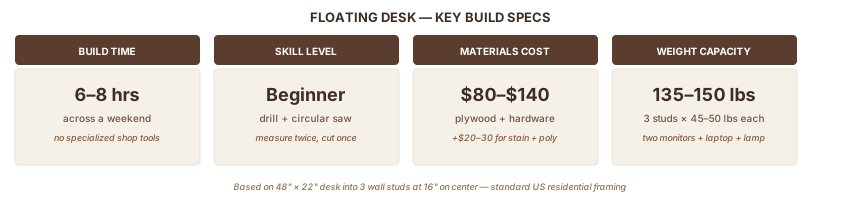
A floating desk anchors to wall studs with no legs touching the floor. According to Shelfology's load capacity guide, a properly mounted bracket holds roughly 45 to 50 lbs per stud. A 48" desk into three studs holds 135 to 150 lbs, enough for two monitors, a laptop, and a lamp. This guide builds a 48" × 22" desk with one drawer using a French cleat: the strongest beginner-friendly mount, and the only one that lets you adjust height without patching new holes.
| Build time | 6 to 8 hours across a weekend |
| Skill level | Beginner: drilling, basic saw cuts, measuring |
| Materials cost | $80 to $140 (plywood, hardware, slides) |
| Desk height | 28 to 30" from floor (set to your elbow height) |
| Desk depth | 22" recommended (18 to 24" works) |
| Weight capacity | 45 to 50 lbs per wall stud |
In this guide:
- Planning: dimensions and mounting method
- Materials and cut list for a 48" × 22" desk with one drawer
- Building the desk carcass
- Mounting the desk to the wall
- Building and installing the drawer
- Sanding, finishing, and hardware
Part 1: Planning Your Floating Desk
What "Floating" Actually Means
A floating desk has no legs. Your wall studs (the 2×4 or 2×6 framing members behind the drywall) carry all the weight. Drive your mounting hardware into them and the desk is as solid as the house. Rely on drywall alone and the desk will pull out of the wall. There is no middle ground.
Keep depth at 24" or less. Beyond that, the lever force on the wall attachment exceeds what most home walls handle comfortably. A 30"-deep workspace needs a front support leg or corbel bracket.
Dimensions to Decide Before You Cut Anything
Height: Standard desk height runs 28 to 30" from the floor. Your number is your elbow height when seated in your actual chair. Sit down, relax your shoulders, and measure from the floor to your elbow. Mount the desk there.
Depth: 22" works for most home setups. According to Houzz's home office measurements guide, a desk needs at least 22 to 24" of depth to position a monitor at a safe viewing distance of 20 to 28" while keeping keyboard clearance at the front. Shallower than 18" forces you too close to the screen.
Width: 48" fits two monitors with one drawer on the right or left. For two drawers, size up to 60"+ so the drawer carcasses don't eat your usable workspace.
| Dimension | Standard Range | Recommended Start |
|---|---|---|
| Height from floor | 28 to 30" | Measure your elbow height seated |
| Depth (front-to-back) | 18 to 24" | 22" |
| Width | 36 to 72" | 48" (two monitors, one drawer) |
French Cleat vs. Ledger Board
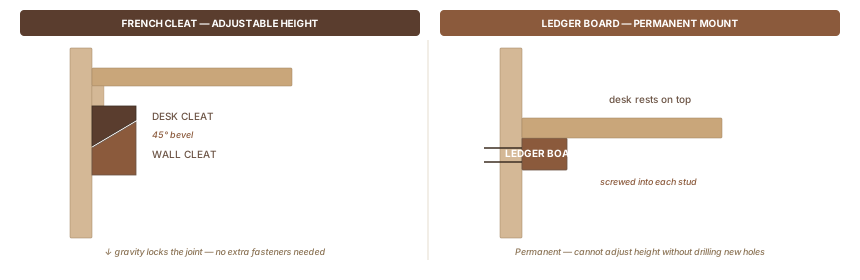
French cleat is two boards with matching 45° beveled edges. The wall piece hooks onto studs with the bevel pointing up. The desk piece attaches to the back of the carcass (the box assembly) with the bevel pointing down. When they meet, gravity locks them. This guide uses a French cleat.
French cleats are adjustable: raise or lower the desk by lifting it off the wall cleat and rehooking it without drilling new holes. They also distribute load across the full cleat length instead of concentrating it at bracket points.
Ledger board is simpler: a 2×4 screwed horizontally into studs, with the desk surface resting on top. Fewer cuts, but permanent. Suited for a closet conversion you'll never rearrange.
For this build: French cleat. The 45° cuts look harder than they are. A circular saw with a fence clamped to the workpiece cuts them cleanly. See the French cleat shelf guide for the cutting technique in detail.
Part 2: Materials and Cut List
Shopping List
Everything you need for a 48" × 22" desk with one drawer:
| Material | Qty | Notes |
|---|---|---|
| 3/4" birch plywood | 1 full sheet (4×8) | Desk top, bottom panel, sides, false drawer front, cleats |
| 1/2" birch plywood | Half sheet | Drawer box sides, front, and back |
| 1/4" birch plywood | Quarter sheet | Drawer bottom + carcass back panel |
| 2" coarse pocket screws | 1 box (50 ct) | For assembling carcass panels |
| 3" construction screws | 6 to 8 | For driving into studs through wall cleat |
| 1-1/4" coarse pocket screws | 1 box (50 ct) | For attaching small parts and drawer cleat |
| Wood glue | 1 bottle | Titebond II or equivalent |
| 16" full-extension side-mount drawer slides | 1 pair | Everbilt soft-close, about $14 at Home Depot |
| Drawer pull | 1 | Bar pull with 3" or 5" hole spacing |
| Sandpaper | 120, 180, 220 grit | For prep and between-coat sanding |
| Wood filler | 1 small container | Covers pocket holes before painting |
| Primer + paint or stain + poly | Per finish choice | See Part 6 |
Total materials for a basic paint finish: $80 to $105. Stain plus polyurethane adds $20 to $30.
For a second drawer, buy another half sheet of 1/2" ply and another pair of slides. The top and bottom stay the same; you add a divider panel and repeat the drawer steps.
Cut List
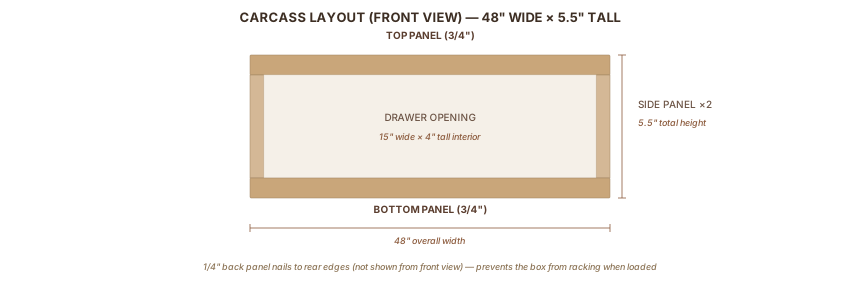
For a 48" wide × 22" deep carcass with a 5.5" total height (enough for one standard desk drawer):
| Part | Qty | Thickness | Width | Length |
|---|---|---|---|---|
| Desk top | 1 | 3/4" | 22" | 48" |
| Bottom panel | 1 | 3/4" | 22" | 48" |
| Left side | 1 | 3/4" | 22" | 4" |
| Right side | 1 | 3/4" | 22" | 4" |
| Carcass back | 1 | 1/4" | 4" | 46.5" |
| Drawer box side | 2 | 1/2" | 3.25" | 15" |
| Drawer box front/back | 2 | 1/2" | 3.25" | 13" |
| Drawer box bottom | 1 | 1/4" | 13.5" | 14.5" |
| False drawer front | 1 | 3/4" | 4.25" | 14.5" |
| Wall cleat | 1 | 3/4" | 3.5" | 48" (45° bevel on one edge) |
| Desk cleat | 1 | 3/4" | 3.5" | 46" (45° bevel, opposite face) |
The numbers behind the list:
Per WoodShop Diaries' drawer slide installation guide, size your drawer box to opening width minus 1" (1/2" clearance per side for the slides). The formulas:
- Drawer box width (14") = 15" opening width minus 1"
- Drawer box depth (15") = 16" slide length minus 1"
- Carcass inner height (4") + 3/4" top + 3/4" bottom = 5.5" total carcass height
- Carcass back (46.5") = 48" overall minus 3/4" left side minus 3/4" right side
Need different dimensions? Scale the sides, back, and drawer parts proportionally. The top and bottom stay at your chosen width.
For help breaking down a full plywood sheet before making cuts, the sheet goods for cabinets guide covers safe techniques with a circular saw.
Part 3: Building the Desk Carcass
Build the carcass before cutting the cleats. Fitting the cleat to the finished box is easier than building the box to a cleat dimension.
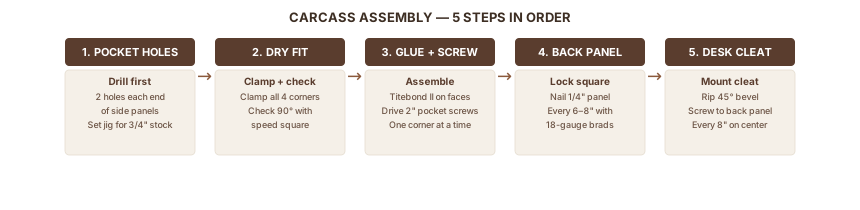
Step 1: Drill pocket holes. On the inside face of the left side panel, drill two pocket holes on the top edge and two on the bottom edge. Repeat for the right side panel. Pocket holes are angled bores drilled through one board at a steep angle so a screw passes through it and into the adjoining board, hidden on the interior face. A Kreg R3 jig handles this for about $25. Set it for 3/4" stock and use 2" coarse pocket screws.
Step 2: Dry-fit the box. Clamp the top and bottom panels to the left and right sides. Check every corner with a speed square. Adjust before driving any screws.
Step 3: Glue and assemble. Apply a thin bead of Titebond II or equivalent wood glue to each mating surface. Drive 2" pocket screws through the sides into the top and bottom, one corner at a time. Check square after each corner. Let the glue tack for 20 minutes before releasing clamps.
Step 4: Install the back panel. Nail the 1/4" back panel to the back edges of the assembled carcass using 18-gauge brads every 6 to 8 inches, or 1" screws. This step is critical. Without a back panel, the carcass racks: it flexes diagonally when you lean on it or pull a drawer open. The back converts an open rectangle into a rigid box. Do not skip it.
Step 5: Attach the desk-side cleat. Rip the desk cleat at 45° on one edge (see how to cut French cleats for the circular saw technique). The bevel faces downward and outward when the cleat is on the back of the carcass. Screw it to the inside face of the back panel, centered vertically, using 1-1/4" screws every 8 inches.
RELATED: Sheet Goods for Cabinets How to break down a full sheet of plywood safely. Read this before your first cuts.
Part 4: Mounting the Desk
Find the Studs
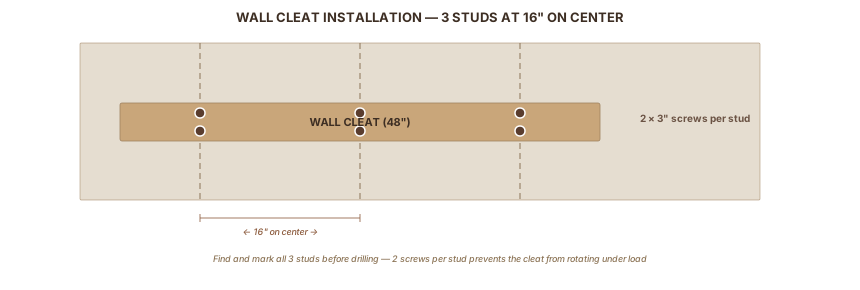
Calibrate your stud finder on open wall space, then sweep it slowly across the mounting area. Mark both edges of each stud, then mark the center. For a 48" desk, expect 3 studs at 16" on center (standard US residential framing). Verify with a finish nail driven just above your pencil mark: if it hits something solid at 1" depth, you're in the stud. If it sinks to your knuckle, move an inch and try again.
Mount the Wall Cleat
- Mark your mount height with a level line across the full 48" span. Use a 4-foot level. A 2-foot level gives too little reference across that distance.
- Hold the wall cleat to the line with its bevel pointing upward and toward the wall.
- Drive two 3" construction screws into each stud. Pre-drill first to prevent splitting the cleat and to keep the screws tracking straight.
- Check level again after screwing into the first stud. Correcting the angle before the second and third studs are locked is much easier.
Get a helper for this step. Holding a 4-foot board level and drilling at the same time is two separate jobs.
RELATED: French Cleat Shelf The same mounting system works for floating shelves. Worth reading if you plan to add shelves above or beside the desk.
Hang the Carcass
Lift the assembled carcass and hook the desk-side cleat over the wall cleat. The two 45° faces mesh and gravity holds everything. For extra security, drive two screws up through the underside of the bottom panel into the studs at the back. This prevents forward tipping under heavy front loading.
Set a level on the desk top after hanging. If it reads slightly off, shim the back of the wall cleat at one end with thin cardboard until the desk reads true.
Part 5: Building and Installing the Drawer
Which Slides to Buy
Three types of drawer slides exist: center-mount (weak, skip it), side-mount, and undermount. Undermount slides look the cleanest because the hardware hides under the drawer, but they cost $25 to $45 per pair and require more precise fitting. See the [Blum undermount drawer slides guide](/guides/blum-undermount-drawer-slides) when you're ready to go that route.
For this build: Everbilt 16" soft-close full-extension side-mount slides (about $14 per pair at Home Depot). Per Firgelli Auto's capacity guide, standard ball-bearing side-mount slides carry 75 to 100 lbs per pair. A desk drawer holds paper and pens. The soft-close feature stops the drawer from slamming and costs $2 to $3 extra. Worth it.
Building the Drawer Box
The drawer box rides on the slides. A false front (a separate face panel) attaches to it and covers the opening. The box itself stays hidden, so it only needs to be square, not pretty.
Step 1: Cut the parts. Use the dimensions from the cut list: 1/2" ply for sides and front/back, 1/4" ply for the bottom.
Step 2: Assemble the box. Drill pocket holes on the inside faces of the front and back pieces. Apply glue and drive 1-1/4" pocket screws through the front and back into the sides. Measure diagonals: equal diagonals mean the box is square. If they differ, clamp across the longer diagonal until the glue sets.
Step 3: Attach the bottom. Nail the 1/4" bottom to the bottom edges of the box using 18-gauge brads or 1" screws. Recheck square before the nails go in.
Installing the Slides
Per Popular Science's drawer slide installation guide, start with the cabinet-side half of each slide.
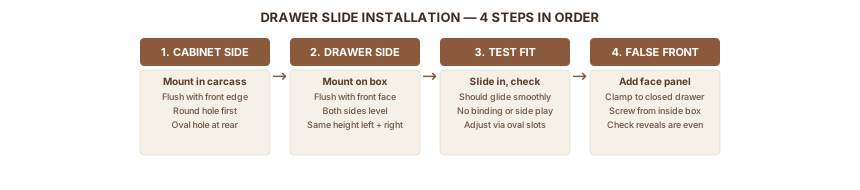
Cabinet side first. Separate the two halves. Hold the cabinet-side half flush with the front edge of the drawer opening, level, at the same height on left and right. Mark the screw holes, pre-drill, and drive the screws. Most slides have one round hole at the front (fixed position) and oval holes at the rear (adjustable). Drive the round hole first.
Drawer side second. Hold the drawer-side half flush with the front edge of the drawer box at the same height. Screw in place the same way.
Test the fit. Slide the drawer box in. It should glide without binding or side play. If it's tight, use the oval rear holes to nudge the cabinet half in or out by 1/16" at a time.
Add the false front. Close the drawer box fully. Clamp the false front to the box with its face flush with the carcass front. Drive two screws from inside the box into the back of the false front. Open the drawer and check the reveal (the gap between the false front and the carcass). Equal reveals on all four sides means centered. Adjust while the screws are loose, then tighten fully.
For joinery variations and drawer bottom options, see the how to build drawers guide.
Part 6: Finishing and Hardware
Fill, Sand, Prime
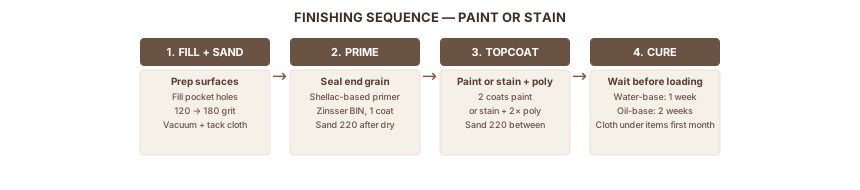
Fill all pocket holes on visible surfaces with wood filler. Apply it slightly proud of the surface, let it dry completely, then sand flush with 120 grit. Sand all surfaces in sequence: 120 grit to remove mill marks and filler ridges, then 180 grit for smoothness. Vacuum every surface and wipe with a tack cloth. Dust in the finish sands out badly. Surface roughness sands out fine.
Paint Route (Recommended for Beginners)
Plywood end grain absorbs paint differently than face grain and bleeds through water-based primers. One coat of shellac-based primer (Zinsser BIN, about $20 per quart) seals both in 45 minutes. Sand lightly with 220 grit after the primer dries. Apply two coats of satin latex or alkyd cabinet paint. Cabinet paint holds up to daily contact better than standard wall paint, and it's worth the extra $5 per quart.
Stain Plus Clear Coat
Sand to 180. Apply wood conditioner to prevent blotching on birch (Minwax Pre-Stain or General Finishes Wood Conditioner). Wipe on your stain and remove excess within 5 minutes. Finish with two coats of wipe-on polyurethane, sanding with 220 between coats. The desk surface gets daily contact: do not skip the topcoat over stain.
See the woodworking sanders guide for tool options if you don't have a random orbital sander yet.
Installing the Drawer Pull
Measure the hole spacing on your pull (center-to-center distance). Mark that measurement at the center of the drawer face. Drill through from the front. Thread the pull bolts in from inside the drawer box. Snug them down: over-tightening strips the wood.
The desk is usable after the finish cures. Water-based paint reaches full hardness in about 1 week. Oil-based takes 2 weeks. Keep a soft cloth under anything heavy for the first month.
Sources
Research for this guide drew on community forum discussions, manufacturer installation specs, and DIY build documentation covering French cleat mechanics, drawer slide selection, weight capacity for wall-mounted work surfaces, and standard desk ergonomics.
- Shelfology — How Much Weight Can a Floating Shelf Hold? — per-stud weight capacity data
- FloatingWoodShelf.com — Understanding Load Capacity — wall-mount load ratings
- WoodShop Diaries — How to Install Drawers with Side Mount Slides — slide installation steps and sizing formula
- Popular Science — How to Install Drawer Slides — installation technique
- Home Depot — Everbilt 16" Soft-Close Side Mount Slides — product specs and pricing
- Kreg Tool — How to Countersink a Screw — pocket hole technique
- WithinTheGrove — DIY Floating Desk — build approach reference with real dimensions
- Houzz — Key Measurements for the Perfect Home Office — ergonomic dimension standards
- Eureka Ergonomic — Ergonomic Floating Desk Guide — depth and height ergonomics
- WoodTalk Online — Floating Desk Supported by French Cleat — community build discussion
- Firgelli Auto — Drawer Slide Weight Capacity Guide — slide load ratings
- NestForgey — DIY Floating Desk Installation Guide — beginner installation overview
Tools Used
Also Referenced
How We Research
We don't take affiliate revenue or accept review units. Picks come from multi-source research — manufacturer specs, OSHA / EPA / ASTM regs, and long-form practitioner threads — plus Ahmed's hands-on use where relevant. When we recommend something, we explain why.
Up Next
Choosing and Installing Blum Tandem Slides
CABINETMAKING · Beginner