
Coffee Table With Drawer at a Glance
A coffee table with drawer is one of the best first furniture projects. The drawer teaches you something you'll use in every cabinet and case piece you build after this: how to size a box precisely, fit it with metal slides, and make it work the first time. The frame comes together in a weekend. The drawer takes most of a second weekend, but it's the part that turns you from someone who builds shelves into someone who builds furniture.
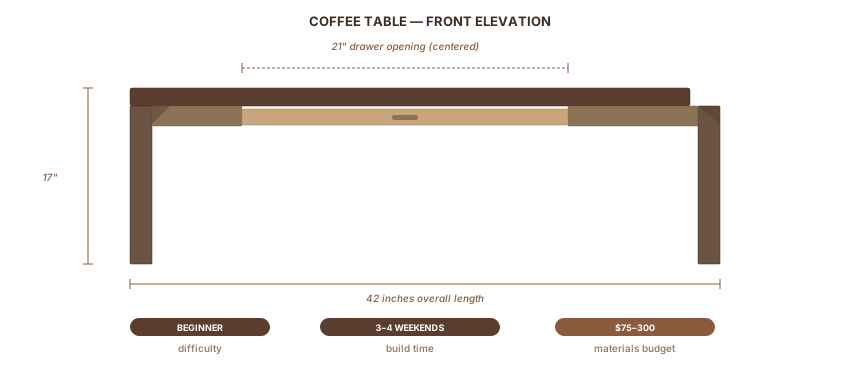
| Difficulty | Beginner (with pocket hole jig) |
| Build time | 3–4 weekends |
| Materials cost | $75–150 for pine; $150–300+ for hardwood |
| Key skill you'll learn | Drawer box tolerances and metal slide installation |
| Recommended dimensions | 42" L × 20" D × 17" H |
| Drawer clearance rule | Drawer box width = opening width − 1" (for standard side-mount slides) |
In this guide:
- Is this project right for you?
- Why drawer tolerances matter — read this before you measure anything
- Designing your coffee table
- Building the frame with pocket holes
- Building and installing the drawer
- Finishing the table
- Troubleshooting
Part 1: Is This Project Right for You?
You need three things before you start: a saw (circular saw, miter saw, or table saw), a drill, and a pocket hole jig. No joinery experience required. If you can cut a straight line and drill a pocket hole, you can build this table.
What you'll learn:
- Drawer box construction — sizing a box to fit a specific opening within precise tolerances
- Metal slide installation — the same technique used in every kitchen cabinet
- Frame joinery with pocket holes — strong enough for furniture, fast enough for a weekend
- Furniture-grade finishing — the sanding sequence and topcoat schedule that makes a table look like it cost $400
Time investment:
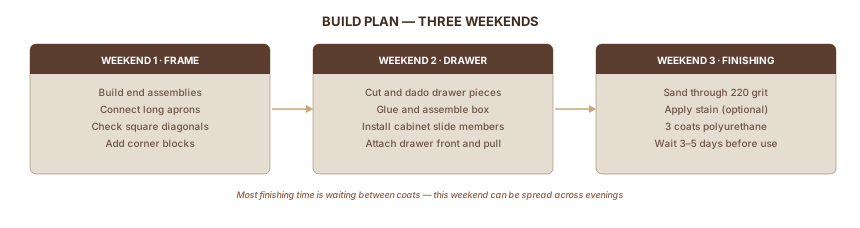
3–4 weekends for most builders. Weekend 1: build the frame. Weekend 2: build the drawer box and install hardware. Weekend 3: finishing (can be spread across evenings — most time is waiting for coats to dry).
Budget:
A pine build runs $75–150 in materials. If you upgrade to poplar or oak) for the visible parts, budget $150–300+. The drawer box uses Baltic birch plywood regardless of species. It's the right material whether your frame is pine or walnut.
Prerequisites:
Familiarity with pocket hole joinery will save you time in the frame step, but you can learn the basics in 20 minutes before starting. For finishing, how to apply polyurethane covers the topcoat step in depth if you want more detail than this guide provides.
Part 2: Why Drawer Tolerances Matter
Most beginner drawer builds fail before they're finished. Not because the builder did anything wrong. Because they didn't know one number: the clearance their drawer slides require.
A coffee table drawer that binds isn't a finishing problem or a woodworking skill problem. It's a math problem. Build the drawer 1/4" too wide and it won't slide. Build it 1/2" too wide and it won't fit in the opening. Get the math right and the drawer works the first time you push it in.
How drawer slides work:
A metal drawer slide consists of two interlocking pieces: the cabinet member, which screws to the inside wall of your frame, and the drawer member, which screws to the side of your drawer box. Ball bearings between the two allow smooth, full-extension movement. The gap between the drawer box and the opening is what the slide hardware occupies. Too little gap: the hardware is pinched and the drawer binds. Too much: the drawer rocks from side to side.
The clearance rule:
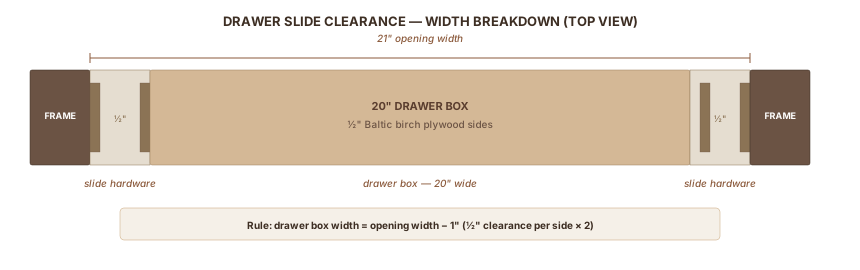
Standard side-mount slides (the type at every hardware store) require 1/2" of clearance on each side of the drawer. Total: the drawer box must be 1" narrower than the opening.
Drawer box width = Opening width − 1"
If your opening is 21" wide, your drawer box is 20" wide. That's it. 1/2" on each side is taken up by the slide hardware.
The most important rule in this guide:
Buy your drawer slides before you cut your drawer box. Slide manufacturers print the clearance requirement on the package. Most standard slides need 1/2" per side. Some premium slides ([Blum Tandem undermount](/guides/blum-undermount-drawer-slides), Accuride undermount) have different requirements — the formula changes. Read the spec before you build.
Full drawer box dimension formula:
| Dimension | Formula | Example (21" × 5.5" opening, 14" slides) |
|---|---|---|
| Width | Opening width − 1" | 20" |
| Height | Opening height − 1/8" | 5-3/8" |
| Depth | Slide length − 1" | 13" |
The 1/8" height clearance keeps the box from catching at the top of the opening. The 1" depth reduction gives the slides room to mount without the back of the drawer box hitting the back of the frame.
Why plywood beats solid wood for drawer boxes:
Solid wood expands and contracts as humidity changes. A drawer box built from solid pine in July may bind in October when the wood swells. Baltic birch plywood doesn't do this. The alternating grain directions cancel each other out. The drawer fits the same in January as it does in August. Use 1/2" Baltic birch for the sides, front, and back of every drawer box you build, regardless of what the rest of the piece is made from.
Part 3: Designing Your Coffee Table With Drawer
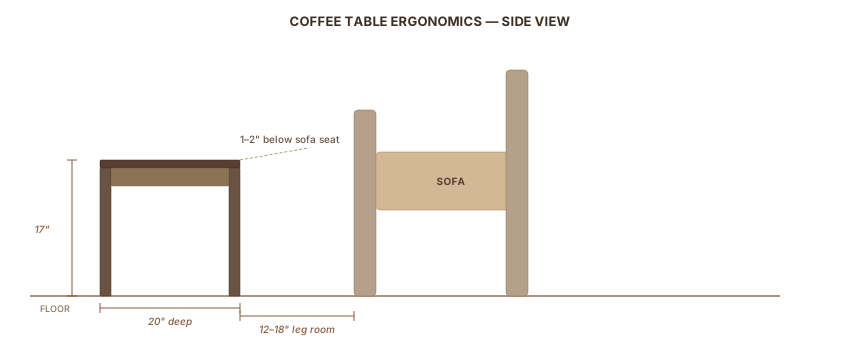
The standard dimensions for a coffee table exist for ergonomic reasons, not aesthetic ones. Get them right and the table works with your sofa. Get them wrong and you're either reaching for your coffee or kicking the table every time you sit down.
Dimension guidelines:
The Wayfair Coffee Table Size Guide and James & James Furniture converge on the same numbers:
| Dimension | Standard Range | Rule |
|---|---|---|
| Height | 16–18" | 1–2" below sofa cushion height |
| Length | 36–56" | 2/3 of sofa length |
| Depth | 18–24" | 18" minimum practical |
| Gap from sofa | 12–18" | Leg room and reach clearance |
For a first build, 42" × 20" × 17" hits the sweet spot for most living rooms with standard sofas. Long enough to hold a drink at each end, deep enough for a tray, and sized so a single sheet of 3/4" plywood cuts the top without waste.
Drawer placement:
A single centered drawer is the right call for a first build. The geometry is simple: you're replacing one section of a long apron with a framed opening. The drawer sits in the front face, below the tabletop. Leave at least 3" of apron on each side of the opening for structural integrity; wider aprons on the sides look better and give you more room to work.
For a 42" table with 1.5" legs on each end:
- Total frame length (inside): ~39"
- Drawer opening: 21" centered
- Apron on each side of opening: 9" each
Material choices by component:
Build the visible parts in whatever species fits your budget and finish plan. Build the drawer box from 1/2" Baltic birch plywood no matter what.
| Component | Budget (pine) | Mid-range | Premium |
|---|---|---|---|
| Legs | 4×4 pine, 17" | Turned pine legs | Turned white oak |
| Aprons | 1×4 #2 pine | 1×4 poplar | 4/4 white oak |
| Top | 3/4" plywood + 1×2 edge banding | Glued-up 1×6 pine | Glued-up hardwood |
| Drawer box | 1/2" Baltic birch | 1/2" Baltic birch | 1/2" Baltic birch |
| Drawer bottom | 1/4" plywood | 1/4" plywood | 1/4" plywood |
The drawer box is the same material at every price point. Not a cost-cutting decision. Baltic birch is the technically correct choice — the frame and top are what guests see, and the drawer box just needs to fit and slide without binding in August or January.
Cut list for a 42" × 20" × 17" pine build with single drawer:
| Part | Qty | Material | Cut Dimensions |
|---|---|---|---|
| Legs | 4 | 4×4 pine | 16-1/4" (leaves 3/4" for top) |
| Short aprons | 2 | 1×4 pine | 17" (fits 20" depth with 1.5" legs each side) |
| Back long apron | 1 | 1×4 pine | 39" (fits 42" length with 1.5" legs each side) |
| Drawer apron (left) | 1 | 1×4 pine | 9" |
| Drawer apron (right) | 1 | 1×4 pine | 9" |
| Tabletop | 1 | 3/4" plywood | 42" × 20" (or glued-up boards) |
| Drawer box sides | 2 | 1/2" Baltic birch | 13" × 5-3/8" |
| Drawer box front/back | 2 | 1/2" Baltic birch | 20" × 5-3/8" |
| Drawer bottom | 1 | 1/4" plywood | 19-1/2" × 12-1/2" (floats in dado) |
| Drawer face | 1 | 3/4" solid wood or plywood | 22-3/4" × 5-3/4" (3/8" reveal all around) |
Total lumber for a pine build: approximately 14–18 board feet of 1×4 pine, one 4×4 post at 6 feet, and a half-sheet each of 3/4" and 1/2" plywood.
Part 4: Building the Frame With Pocket Holes
The frame for a coffee table with drawer is a rectangle with a gap in one long apron. The gap becomes the drawer opening. The challenge is making that gap square, strong, and the right size for your drawer.
Frame anatomy:
- 4 legs
- 2 short aprons (connect front and back across the width)
- 2 long apron sections on the back and drawer side — the drawer side is divided into two pieces flanking the opening
- Corner blocks: triangular pieces pocket-screwed into the inside corners of each apron-to-leg joint
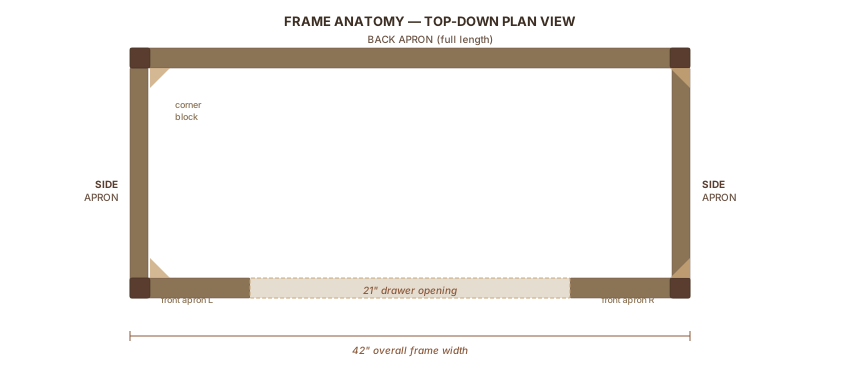
The legs sit at the corners. The short aprons span the 20" depth. The long aprons span the 42" length — except the front apron is split into two pieces with the drawer opening between them.
Setting apron height:
Set aprons 3/4" below the top of the legs. This creates a ledge for tabletop-attachment hardware (figure-8 fasteners or Z-clips) and keeps the aprons from showing above the tabletop. Mark all four legs at 3/4" from the top before drilling any pocket holes.
Pocket hole settings:
According to Kreg's screw selection guide:
| Material | Jig Setting | Screw Length | Thread Type |
|---|---|---|---|
| 3/4" apron (1×4 nominal) | 3/4" | 1-1/4" | Coarse (pine/soft) |
| 1-1/2" leg face | 1-1/2" | 2-1/2" | Coarse (pine/soft) |
Drill two pocket holes at each end of every apron piece, on the inside face. Keep the holes at least 3/4" from the edge to avoid blowout.
Assembly sequence:
Build in stages — don't try to assemble the whole frame at once.
- Two end assemblies first: Attach one short apron to two legs (one end of the table). Check square. Let dry. Repeat for the other end.
- Connect with long aprons: Join the two end assemblies with the back long apron and the two front apron pieces flanking the drawer opening.
- Check square immediately: Measure diagonally from corner to corner in both directions. Equal = square. If one diagonal is longer, clamp across it and re-measure.
- Add corner blocks: Cut eight triangular scrap blocks (roughly 3" × 3" × 4") and pocket-screw one into each inside corner of each apron-to-leg joint. These blocks transform a wobbly frame into a rigid one.
Squaring the frame:
This step takes 2 minutes and prevents the biggest frustration in table building. Lay the frame on a flat surface. Measure diagonally from the top-left leg to the bottom-right leg, then from the top-right to the bottom-left. Both measurements must match within 1/16". If they don't, the frame will rack and your drawer opening won't be square.
Clamp across the longer diagonal — gently, pulling it in — until the measurements match. Hold it clamped while the glue sets.
Part 5: Building and Installing the Drawer
Most plans give the drawer two paragraphs. That's not enough. The details below prevent the failure modes that send first-time builders back to the lumber yard.
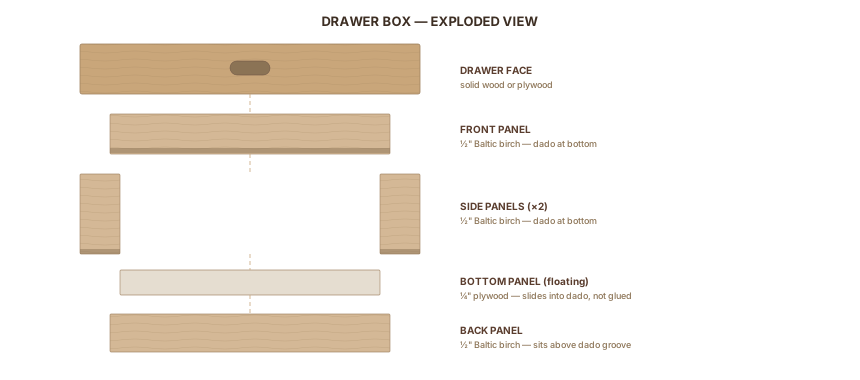
Build the Drawer Box
Step 1 — Verify the opening, not the plan.
Before you cut anything, measure your actual drawer opening in the built frame. Not what the plan says — what the tape measure says. Measure width at the top, middle, and bottom. Take the smallest measurement. That's your opening width. An opening that's 21-1/16" at the top and 20-15/16" at the bottom is effectively 20-15/16". Build to the smallest dimension.
Step 2 — Calculate dimensions.
Use the formula:
- Box width = Smallest measured width − 1"
- Box height = Opening height − 1/8"
- Box depth = Your slide length − 1"
Write these down. This is the only place in the whole build where being wrong by 1/16" causes a problem you can't fix without rebuilding.
Step 3 — Cut the drawer pieces.
From 1/2" Baltic birch plywood:
- 2 sides (depth × height)
- 1 front (width × height)
- 1 back (same as front)
From 1/4" plywood:
- 1 bottom (width × depth, sized to fit the dado groove)
Step 4 — Cut the dado grooves.
A dado groove is a channel cut into the inside face of the drawer sides and front, 1/4" from the bottom edge. The groove is 1/4" wide and 1/4" deep. The bottom panel slides into this groove.
Cut the groove with a router and straight bit, a table saw dado stack, or multiple passes with a straight bit. The groove runs the full length of the sides and across the inside face of the front. The back sits above the groove — the bottom panel slides under it from the back.
Step 5 — Dry fit and verify.
Assemble without glue first. Check that the box would be the right width (hold it up to the opening and verify the 1/2" gap on each side). Check that the bottom panel fits the groove without forcing. Check that everything is square.
Step 6 — Glue and assemble.
Glue the front, sides, and back together. The Wood Shop Diaries guide on building drawer boxes walks through this in detail. Clamp carefully and check square immediately — diagonal measurements of the box face must match. Let cure 24 hours.
Step 7 — Install the bottom.
Slide the 1/4" plywood bottom into the dado grooves from the back. Don't glue it. Drive one screw through the back into the bottom edge to prevent rattle — the bottom floats but won't move.
Install the Drawer Slides
Buy slides before building the box, as noted above. This section assumes standard 14" or 16" full-extension side-mount slides, the kind sold at any hardware store.
According to Accuride's installation guide and CabinetParts.com's step-by-step with photos:
Step 1 — Separate the slides. Each slide separates into two pieces. Do this before installation.
Step 2 — Make a spacer block. Cut a scrap block to the exact height from the bottom of the opening to your desired slide height. Setting both slides at the same height is the single most important step in the installation. A spacer block guarantees it.
For a 5.5" opening with a 5-3/8" box, center the slide at 2-3/4" from the bottom of the opening. Cut your spacer block to 2-3/4".
Step 3 — Install the cabinet members. Rest each cabinet member on the spacer block. The front edge should be flush with the face of the frame (or 1/16" back). Drive screws through the center oval holes first — these allow adjustment later. Check that both sides are at the same height.
Step 4 — Install the drawer members. Mount drawer members on the sides of the drawer box. The front edge of the drawer member sits flush with the front of the box. Center the member vertically on the drawer side.
Step 5 — Insert and test. Slide the drawer into the cabinet members. You'll feel it click into place. Open and close 5-10 times. It should glide freely without binding or side-to-side wobble.
Step 6 — Adjust if needed. The oval mounting holes allow front-to-back and up-down adjustment. Loosen the screws, shift the slide, retighten. Most first installs need minor adjustment.
Attach the Drawer Front
The drawer front — the decorative panel that faces you — attaches to the drawer box from the inside.
Cut the front from solid wood or plywood to match the opening width plus 1-3/4" (for a 7/8" overlay on each side, giving you a 3/8" reveal around the opening). Alternatively, size it for a flush inset with a 1/16" reveal all around.
Position the front in the opening. The simplest method: use double-sided tape to temporarily hold it in position, open the drawer from behind, drive 2-3 screws through the drawer box front into the back of the decorative front. Remove the tape.
Drill a centered hole for the pull. A 3" to 4" pull works for this size drawer front. Attach with machine screws from the back.
Part 6: Finishing the Coffee Table
A coffee table gets used every day. The finish takes most of the abuse. Family Handyman's table top finishing guide and Harp Design Co's poly tutorial both recommend three coats of oil-based polyurethane for furniture that sees daily use. That's the protocol here.
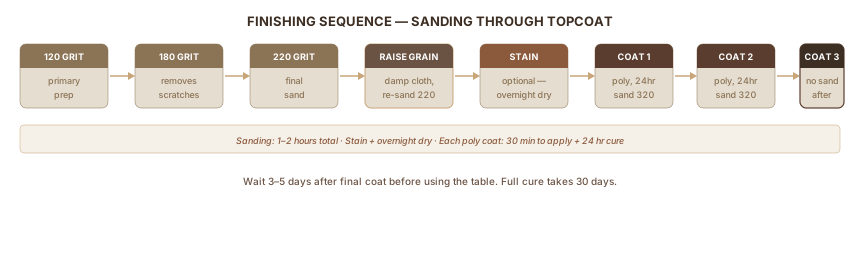
Sanding sequence:
Work through the grits in order. Each grit removes the scratches left by the previous one.
- 80 grit — only if the lumber has mill marks or rough spots
- 120 grit — primary surface preparation
- 180 grit — removes 120-grit scratches
- 220 grit — final prep
- Raise grain — wipe with a damp cloth, let dry completely, sand again with 220
- Remove dust — tack cloth, then blow off with air if available
If you're using pine: Apply pre-stain wood conditioner after the final sanding, let it sit 15 minutes, then wipe off. This prevents blotching. Pine absorbs stain unevenly, leaving dark splotchy patches where the grain is more porous. Conditioner pre-fills those fibers so the stain absorbs uniformly.
Finish options:
| Finish | Look | Durability | Best For |
|---|---|---|---|
| Stain + oil-based poly | Warm, traditional | Excellent | Any species, high-use |
| Stain + water-based poly | Lighter, less amber | Very good | Light wood species |
| Paint + polycrylic | Modern; hides plywood edges | Very good | Pine, mixed materials |
| Hardwax oil | Natural, matte | Good | Hardwood, lower-use tables |
Stain + oil-based poly sequence (most common):
- Apply stain with rag or foam brush; let sit 5–15 minutes; wipe off excess with clean rag
- Let dry overnight (or per can directions — minimum 4 hours)
- First poly coat: brush on, work with the grain, thin even passes
- Let dry 24 hours; sand lightly with 320 grit to knock down dust nibs
- Second coat; repeat sand
- Third coat on tabletop (optional but worth it for the highest-wear surface)
- Final coat: no sanding after
- Wait 3–5 days before use. Full cure takes 30 days, but the table is usable lightly at 3–5 days.
Tip for the drawer box and inside surfaces: You don't need to finish the inside of the drawer box to the same standard as the outside. One coat of shellac or a light wipe-on poly seals the wood and prevents moisture absorption, which keeps the box dimensionally stable.
Part 7: Troubleshooting: When the Drawer Doesn't Work
Most drawer problems have one of four causes. Diagnose before you fix.
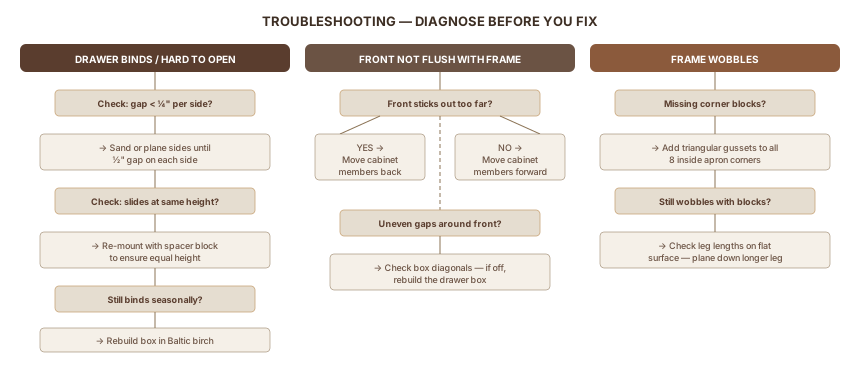
Drawer binds — hard to open or gets stuck:
First, check the width. Measure the drawer box against the opening. If the gap on one side is less than 1/4", the box is too wide. Sand or plane the sides until you have 1/2" clearance per side.
If the width is right, check slide height. Pull the drawer out completely and look at where the cabinet members sit relative to each other. If one is higher than the other by even 1/16", the drawer will rock and bind. Re-mount the higher slide using the spacer block method.
If both width and height are correct, the problem is likely seasonal wood movement from a solid wood drawer box. Replace with a plywood box.
For debris or friction: clean slides with a dry cloth and apply dry silicone lubricant to the slide surfaces. Avoid WD-40 and oil-based lubricants — they attract sawdust and make the problem worse over time, as noted by Wurth LAC's drawer maintenance guide.
Drawer front not flush with frame:
If the front sticks out too far, the cabinet members are set too far from the face of the frame. Re-mount, moving the front edge of the slide closer to the frame face.
If the front is recessed too far, the opposite problem.
Uneven gaps around the drawer front usually mean the drawer box isn't square. Check diagonal measurements on the box. If it's off, the box needs rebuilding — the gaps can't be shimmed into alignment reliably.
Frame wobbles:
Missing corner blocks. Add triangular gussets to all four inside corners (or all eight if you have two sets of aprons). This is the fastest fix for any racking in a pocket-hole frame.
If the frame wobbles even with corner blocks, check that all four legs are the same length. Lay the frame on a flat surface and look for rocking. The longer leg is obvious; plane or sand it down.
Part 8: What You've Built and Where to Go Next
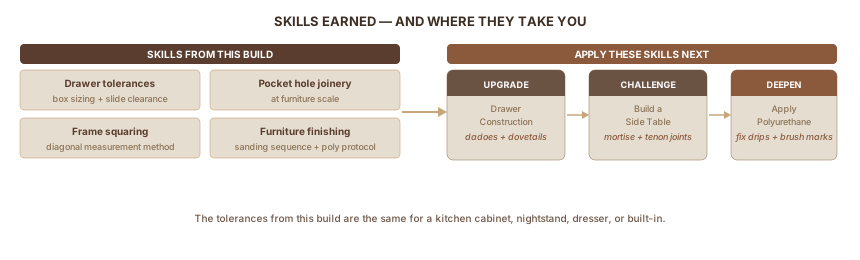
After this project, you know how to build a drawer. Not just this drawer. The tolerances are the same for a kitchen cabinet, a nightstand, a dresser, or a built-in. The slide installation is identical. You've learned the repeatable skill, not just the steps for this one piece.
Skills you've built:
- Drawer box sizing and construction with metal slides
- Pocket hole frame joinery at furniture scale
- Frame squaring technique (works for every box or cabinet frame)
- Furniture-grade sanding and finishing sequence
Where to go next:
- Drawer Construction — the deeper technical guide on drawer box joinery options (dadoes, through-dovetails, lock miters) for when you want to upgrade beyond pocket holes
- Build a Side Table — the same frame skills applied to a smaller piece with mortise-and-tenon joinery
- How to Apply Polyurethane — deeper coverage of the finishing step, including how to fix drips and brush marks
Sources
Research for this guide drew from hardware manufacturer specifications, professional woodworking publications, and documented DIY builds.
- Eagle Woodworking: How to Measure Drawer Slides — slide measurement, clearance requirements
- Engineer Fix: How Much Space to Leave for Drawer Slides — clearance guidelines by slide type
- Accuride: How to Install a Drawer Slide in Five Steps — manufacturer installation guide
- CabinetParts.com: How to Install Side Mount Drawer Slides — step-by-step with photos
- Wood Shop Diaries: How to Build a Drawer Box — drawer box construction
- Wood Shop Diaries: How to Install Drawers with Side Mount Slides — slide installation guide
- Cutting Edge Inc: Birch Plywood vs Solid Wood Drawer Boxes — material comparison
- Kreg Tool: Coffee Table With Storage Plans — pocket hole dimensions, build plans
- Kreg Tool: Screw Selection Guide — pocket screw settings by material
- Wayfair: Coffee Table Size Guide — standard dimensions and ergonomics
- James & James: Coffee Table Size Guide — sofa-to-table proportions
- Family Handyman: How to Finish a Table Top — sanding sequence and polyurethane application
- Harp Design Co: How to Finish Your Table With Poly — poly tutorial for furniture
- Wurth LAC: How to Fix Drawer Slides — troubleshooting and maintenance
Also Referenced
How We Research
We don't take affiliate revenue or accept review units. Picks come from multi-source research — manufacturer specs, OSHA / EPA / ASTM regs, and long-form practitioner threads — plus Ahmed's hands-on use where relevant. When we recommend something, we explain why.
Up Next
How to Build Drawers
CABINETMAKING · Beginner