
How to Use This Guide
Skill level: Beginner | Prerequisites: You can mill flat, square stock on a table saw. A router table is helpful but not required — the table saw method in Part 4 gets you the same result.
Beginners routinely crack their first raised panel doors. Not because the technique is hard, but because nobody explained why the panel has to float. Read Part 1 before you touch the router table.
If you have a router table: follow the cope-and-stick setup in Part 3, then the router table method in Part 4.
If you only have a table saw: the table saw method in Part 4 produces a clean beveled profile — no router table, no panel raising bit.
Raised Panel Cabinet Doors at a Glance
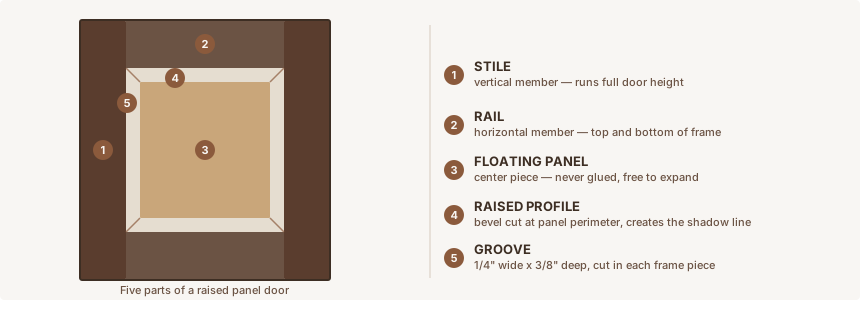
Four solid wood frame pieces surround a center panel that's profiled at its perimeter and seated in a groove. The panel is never glued. It floats to absorb seasonal wood movement. Glue it, and it cracks. Leave it free, and it lasts decades.
| Frame stock thickness | 3/4" |
|---|---|
| Stile and rail width | 2" (standard residential) |
| Groove dimensions | 1/4" wide × 3/8" deep |
| Panel clearance in groove | 5/16" per side |
| Max RPM for 3"+ panel raising bits | 10,000 RPM |
| Panel gluing | Never — panel must float |
In this guide:
- How frame-and-panel doors work
- Sizing your frame and calculating the panel
- Cope-and-stick: the frame profiles
- Raising the panel — router table and table saw methods
- Assembly, finishing, and the floating panel rules
- Common mistakes and how to avoid them
Part 1: How Frame-and-Panel Doors Work
A raised panel door has five pieces: two stiles (vertical members that run the full door height), two rails (horizontal top and bottom pieces), and a center panel. Each frame member has a groove cut along its inside edge. The panel sits in that groove.
The panel is not glued. That fact is the entire design.
Wood expands and contracts across the grain as humidity shifts — seasonally, and any time your kitchen climate changes. A 14-inch wide solid wood panel can move 3/16" between summer and winter. Glue the panel in place, and that movement has nowhere to go. The panel or the frame cracks. Seat the panel in the groove with clearance on each side, let it move freely, and the door survives decades.
"Raised" describes the profile cut around the panel's perimeter. The face sits roughly flush with the frame, but a beveled or coved border drops down to a thin tongue that fits the groove. That step creates the shadow line and the three-dimensional quality that separates raised panel from flat-panel (Shaker) doors.
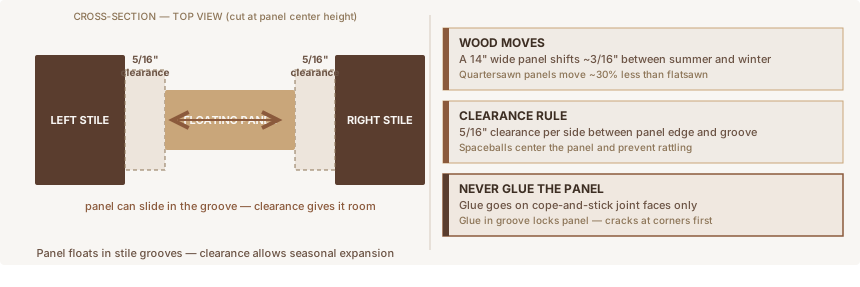
Terminology you'll use throughout:
- Stiles — vertical frame members; run the full door height
- Rails — horizontal frame members; span between stiles at top and bottom
- Sticking (sticking cut) — the profile and groove cut along the long grain of all four frame members, fence-guided on the router table
- Cope (cope cut) — the matching profile cut on the end grain of each rail end, made with a sled or miter gauge
- Tongue — the thin 1/4" lip at the panel perimeter that seats in the groove
- Floating panel — the center piece, not glued, free to expand and contract
What tools do you need?
Primary path: a router table, a cope-and-stick bit set, and a raised panel bit. A $150 benchtop router table handles door making. You don't need a full-size shop cabinet.
Alternative: a table saw can raise panels and cut the frame grooves with a dado stack. Part 4 covers both paths.
Part 2: Sizing Your Frame and Calculating the Panel
Get the numbers right before you cut anything. A door that's 1/4" too wide wastes a day of work.
Standard frame dimensions
Woodweb's stile and rail sizes reference puts 2" as the production standard for residential cabinet frames, with 2.25"–3" for formal or custom work:
| Frame piece | Dimension |
|---|---|
| Stock thickness | 3/4" |
| Stile width | 2" (most common; 2.25"–3" for larger or custom doors) |
| Rail width | 2" (match the stiles) |
| Groove width | 1/4" |
| Groove depth | 3/8" |
| Panel tongue thickness | 1/4" (fits into groove) |
Most cope-and-stick bit sets cut for 3/4" stock. If you use thicker stock, verify your bits accommodate it.
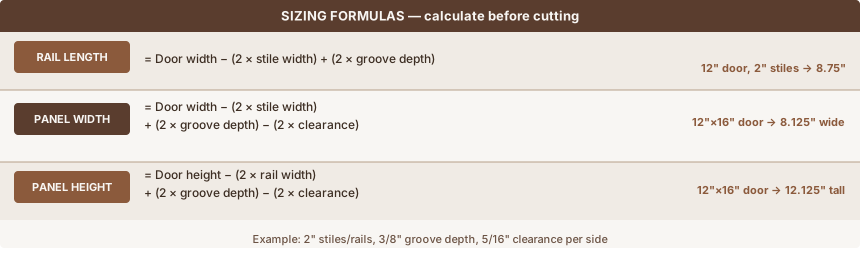
Rail length formula
Each rail end receives a cope cut — a short tongue that seats into the stile's groove. That tongue adds length back to the rail. Per the [Freud 2+2 Raised Panel Bit Set instructions](https://www.ptreeusa.com/PDF/RPD%20Instructions.pdf):
Rail length = Door width − (2 × stile width) + (2 × groove depth)
Example — a 12" wide door with 2" stiles:
- 12" − 4" + 0.75" = 8.75" rails
Panel size formula
The panel must fit inside the frame grooves with room to expand. Per spaceball manufacturer specifications, use 5/16" clearance per side:
Panel width = Door width − (2 × stile width) + (2 × groove depth) − (2 × clearance)
Panel height = Door height − (2 × rail width) + (2 × groove depth) − (2 × clearance)
Example — 12" × 16" door with 2" stiles/rails and 5/16" clearance per side:
- Panel width = 12" − 4" + 0.75" − 0.625" = 8.125"
- Panel height = 16" − 4" + 0.75" − 0.625" = 12.125"
Wood movement and panel choice
A 16"–18" wide solid wood panel moves roughly 1/4" between summer and winter. Quartersawn panels move about 30% less than flatsawn — worth seeking for wide kitchen cabinet doors. An MDF panel eliminates the movement problem entirely: MDF doesn't expand or contract, so you can set clearance to 3/16" (just enough to prevent rattling) and skip the expansion calculation.
Part 3: Cope-and-Stick — The Frame Profiles
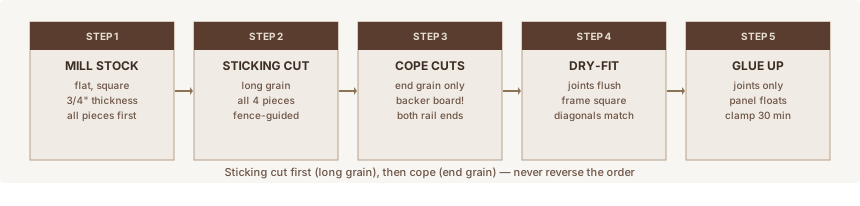
Two cuts, four frame pieces: a sticking cut on the long grain, a cope cut on the rail ends. They interlock to build the frame joint.
Choose your wood
Pick your species before milling. TaylorCraft Cabinet Door Company breaks this down cleanly:
For painted doors:
- Hard maple — smooth grain, hard, doesn't telegraph grain through paint; the cabinet industry standard
- Soft maple — nearly identical paintability at slightly lower cost
- Poplar — budget pick; takes paint well with a good primer; softer and more prone to denting
For stained or natural-finish doors:
- Cherry — smooth grain, rich color, darkens over time; classic for formal kitchens
- Red oak — prominent grain, open pores; looks excellent with stain; avoid for painted finish (grain shows through paint)
- Walnut — rich dark color, open grain; premium price
- White oak — stable, medium grain, popular in contemporary designs
Pine with knots bleeds resin through paint over time. Avoid it for painted doors.
Milling sequence
Mill all stock flat and square before cutting any profiles. You can't joint a profiled edge.
- Face-joint one face flat
- Plane to 3/4" final thickness
- Edge-joint one edge square to the face
- Rip to final width (2" for stiles and rails; panel width per your formula)
- Cross-cut to length (stiles at full door height; rails slightly long — trim after coping)
Run your sticking profile on long boards first, then cross-cut stiles and rails to length from the profiled stock. One router table pass covers all four pieces instead of four separate setups.
Sticking cut setup (long-grain profile)
The sticking cut runs along the inside long edges of all four frame members, cutting the decorative profile and the groove in one pass. Woodsmith's guide to making doors with rail and stile bits covers the setup sequence in detail — the steps below follow the same logic:
- Install the sticking bit
- Set bit height using your manufacturer's spec as the starting point. CMT specifies the top edge of the carbide roughly 7/8" above the router table surface. Adjust with test cuts until the groove is correctly positioned in the face of the stock.
- Set the fence flush with the bit bearing
- Run 2–3 test cuts on scrap of the same thickness
- Run sticking on all inside long edges of all four frame pieces
Cope cut setup (end-grain profile)
The cope cut creates the short tongue on each rail end that mates with the stile's groove.
- Switch to the cope bit (or reconfigure a combo set)
- Use a freshly cut rail piece to set the cope bit height. The coped end must mate with the sticking profile flush with no step. Adjust until the joint closes completely flat.
- Always clamp a backer board behind the rail when making cope cuts. It prevents end-grain blowout on the back face and keeps the rail square to the fence.
- Run 2–3 test cuts on scrap. The coped lip should be about 3/32" thick.
- Run cope cuts on both ends of each rail
Dry-fit check: assemble the frame by hand after cutting. Joints should close completely flush with hand pressure. Any step at the joint means the cope height is wrong. Don't glue until the fit is flush.
Cutting sequence summary
- Run sticking on all four frame pieces (long grain, fence-guided)
- Cut stiles to final length
- Run cope on both ends of each rail (end grain, backer board behind rail)
- Trim rails to final length
- Dry-fit: all joints flush, frame corners square
Part 4: Raising the Panel
Panel raising removes material from the panel perimeter to create the bevel and the 1/4" tongue that seats in the groove.
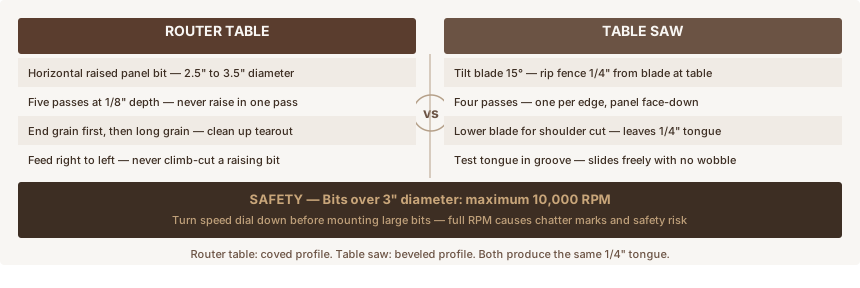
Router table method
Bit selection:
- Horizontal raised panel bit (2.5"–3.5" diameter) — stable, straightforward setup, consistent results. The right choice for most beginners.
- Vertical raised panel bit — smaller and less expensive; requires a tall fence extension. Works well but demands more precision in setup.
RPM matters for safety and surface quality
Rockler's guide to routing cabinet doors and practitioners on Woodworking Talk agree: bits over 3" diameter need to run at 10,000 RPM or slower. A 3" bit at 18,000 RPM — a typical router's maximum — causes chatter, rough surfaces, and real safety risk. Turn the router speed dial down before mounting large bits.
| Bit diameter | Maximum RPM |
|---|---|
| Over 3" | 10,000 RPM |
| 2.5"–3" | 12,000–14,000 RPM |
| Under 2.5" | Up to 18,000 RPM |
Multiple passes
Five passes at 1/8" depth per pass is the standard. Don't try to raise a panel in one or two passes. Set a depth stop and increment it after each pass.
Cut end grain first
- Make the two end-grain passes first (cross the short panel dimension)
- Then make the two long-grain passes (run the long edges)
End-grain passes produce tearout at the exit edge. The long-grain passes clean it up. Reverse the order and the tearout is permanent. This is the single most important technique point in this step.
Feed direction: right to left for standard cuts. Never climb-cut a panel raising bit.
Table saw method (no router table required)
The table saw produces a clean beveled profile. Simpler than the coved router bit profile but professional-looking. If you're new to table saw work or setting up a hybrid saw for the first time, Grizzly Table Saw covers blade selection, alignment, and safe ripping before you make these cuts. Fine Homebuilding and iBuildit.ca both document this method in detail.
- Tilt the blade to 15°
- Set the rip fence 1/4" from the blade, measured at the table surface
- Make four passes — one per panel edge, panel face-down
- Lower the blade (or install a dado stack) to remove the shoulder, leaving a flat 1/4" tongue
- Test the tongue in your frame groove: it should slide freely with no wobble
A 12° blade angle creates a gentler bevel; 18° creates a steeper one.
Sanding the raised panel
The profiled perimeter may have mill marks after raising. Use a sanding block angled to match the bevel — 100 grit to remove marks, 150 to smooth. Sand the flat face to 150–180 grit. Don't sand through the profile edge; that crisp line matters visually.
Part 5: Assembly and Finishing
Pre-finish the panel before glue-up
Solid wood panels shrink in winter. When one slides partially out of the groove, it exposes the panel edge. On a stained or clear-finished door, raw wood shows as a strip along the panel perimeter every dry season. Fine Woodworking's finishing raised panels discussion calls this the most common complaint after the first winter.
Apply stain (if using) and at least one coat of clear finish to all panel surfaces — face, back, and all four edges including the tongue — before assembly. For painted doors, prime or shellac the panel edges. Let it dry completely.
Dried finish on the tongue also prevents glue adhesion if squeeze-out reaches the groove — a useful secondary benefit.
For painted doors where appearance matters less than durability, pre-finishing the panel edges is still worth doing.
The floating panel rules
Apply glue to: the cope-and-stick joint surfaces — the flat mating faces of the coped rail ends and the corresponding stile profiles. A thin, even coat.
Never apply glue to: the groove, the panel tongue, or the panel edges.
Use less glue than you think you need near the inside edge of the joint. Excess glue runs into the groove. Per Woodweb's knowledge base on panel cracking, glue locking the panel corner is the most common cause of panel cracking — the corner bonds while the rest of the panel continues to move.
Chamfer or round the panel corners slightly on a sander before assembly. Less contact area at the corners means less chance of squeeze-out catching the panel tongue.
Assembly sequence
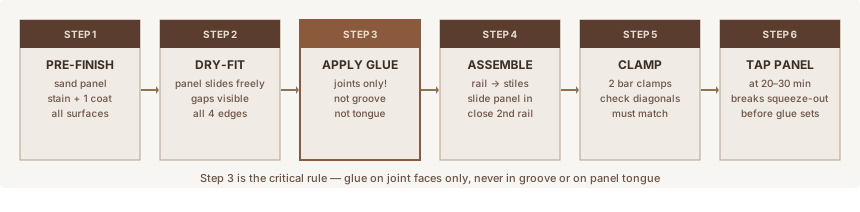
- Sand all frame pieces and the panel face and back to 180 grit
- Pre-finish the panel (stain and first coat of clear finish, or primer for painted doors)
- Let finish dry completely
- Dry-fit the door — panel should slide freely with visible gaps at all four perimeter edges
- Apply glue to cope-and-stick joint faces only
- Assemble one rail into both stiles
- Slide the panel into the stile grooves
- Seat the second rail, closing cope joints and capturing the panel
- Apply two bar clamps parallel to the rails
- Measure diagonals immediately: corner to corner, both ways. Numbers must match.
- If racked: apply light angled clamp pressure from the longer diagonal corners while loosening the straight clamps
- At 20–30 minutes: tap the panel gently sideways — breaks any accidental squeeze-out bond before glue sets
- Leave clamps on for 30 minutes minimum; full glue strength in 24 hours
Space balls — small rubber spheres about 3/8" in diameter, dropped into the groove before assembly — center the floating panel and stop it from rattling. One per side on larger doors.
Finishing the assembled door
Sand the door face lightly (180–220 grit) once the glue cures. Three coats of oil-based polyurethane or four coats of water-based poly are standard for kitchen cabinets. Sand lightly between coats with 320 grit. For the full application sequence, see the polyurethane guide.
Once you can build cabinet doors to this standard, you have the foundation skills for drawer boxes, face frames, and built-in cabinetry. The floating panel principle applies anywhere you join wood with different grain directions.
For a different challenge in cabinetmaking, Roll-Up Cabinet Doors uses canvas assembly and groove routing instead of frame-and-panel joinery — the tambour mechanism behind appliance garages and roll-top desks.
Part 6: Common Mistakes
The three most damaging mistakes — and why they happen:
Gluing the panel. The panel can't move, so it cracks — usually at a corner where grain direction changes at the cope-and-stick intersection. No clean repair exists. If you catch it immediately, disassemble and clean the groove before the glue sets. If not, drill a small relief hole through the panel corner to give it somewhere to flex.
Glue squeeze-out catching the panel corner. A small glue bond at the corner locks the panel while the rest of it moves. The panel cracks at the bond point. Prevention: less glue near the inside edge, chamfered panel corners, and tap the panel side to side at 20–30 minutes.
Not pre-finishing the panel edges. The problem appears the first winter. A raw wood strip emerges at the panel perimeter each dry season. Forcing finish into the gap afterward with a small brush works, but it's tedious. Pre-finish before assembly.
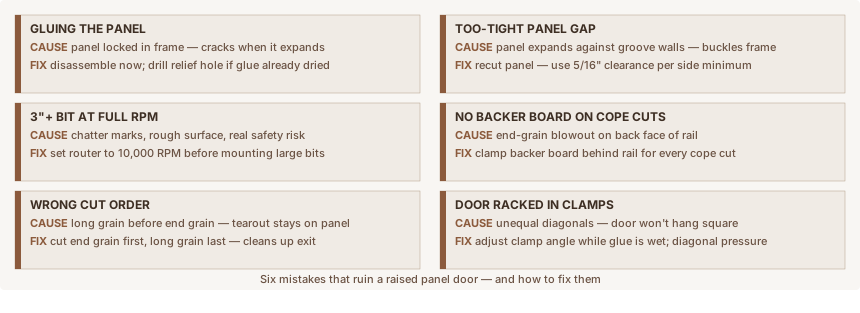
| Mistake | What happens | Fix |
|---|---|---|
| Too-tight panel gap | Panel expands, buckles frame or cracks | Recut panel smaller; use 5/16" clearance per side |
| 3"+ bit at full RPM | Chatter marks, rough surface, safety risk | Set router to 10,000 RPM before mounting large bits |
| Cope cuts without backer board | End-grain blowout on rail back face | Clamp backer board behind rail for every cope cut |
| Long grain before end grain | Tearout on panel perimeter stays | Cut end grain first, then long grain |
| Door racked in clamps | Diagonals unequal; door won't hang square | Adjust clamp angle while glue is wet |
| Sanding after profiling | Crisp profile edges gone | Sand flat stock before running cope and stick |
Sources
Manufacturer instructions, craft publication build guides, and practitioner forums — cited at the point of each specific claim above.
- Freud 2+2 Raised Panel Bit Set Instructions — rail length formula and bit dimensions
- TaylorCraft Cabinet Door Company — Best Material for Painted Cabinet Doors — wood species for paint-grade doors
- Woodsmith — Making Doors With Rail & Stile Bits — cope-and-stick bit setup sequence
- Rockler — Eight Tips for Routing Cabinet Doors — router setup and RPM guidance
- Woodworking Talk — Router Speed for Raised Panels — RPM guidance from practitioners
- Fine Homebuilding — Making Raised-Panel Doors on a Tablesaw — table saw method in detail
- iBuildit.ca — Raised Panel Doors on the Table Saw — step-by-step table saw walkthrough
- Fine Woodworking — Finishing Raised Panels — pre-finishing and seasonal wood movement
- Woodweb — Cracking at Door Panel Corners — panel cracking causes and prevention
- Woodweb — Stile and Rail Sizes for Doors and Drawer Faces — dimension standards from production cabinet builders
How We Research
We don't take affiliate revenue or accept review units. Picks come from multi-source research — manufacturer specs, OSHA / EPA / ASTM regs, and long-form practitioner threads — plus Ahmed's hands-on use where relevant. When we recommend something, we explain why.
Up Next
Locks for Cabinets
CABINETMAKING · Beginner