
Cabinet Building at a Glance
A cabinet is a plywood box with a solid wood frame on the front, doors on hinges, and drawers on slides. Face-frame construction with full overlay doors is the most forgiving method for a first build. The frame hides imperfect cuts, adds rigidity, and gives you mounting points for hardware. You don't need a table saw. A circular saw with guide tracks, a pocket hole jig, and a drill will build an entire kitchen.
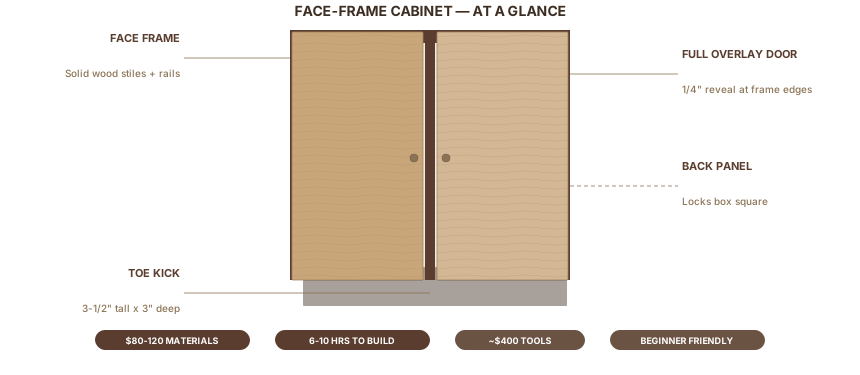
| Best method for beginners | Face-frame with full overlay doors |
| Core material | 3/4" birch plywood (painted) or hardwood-veneered plywood (stained) |
| Minimum tool investment | ~$400-500 |
| Material cost per cabinet | ~$80-120 (not including doors or paint) |
| Time per cabinet | 6-10 hours (first build) |
| Standard base cabinet height | 34-1/2" (36" with countertop) |
In this guide:
- What's inside a cabinet and which method to build first
- Materials, dimensions, and planning your layout
- Step-by-step build sequence for a face-frame cabinet
- Doors, drawers, hardware, and finishing
- Tools you actually need and honest cost comparison
- Common mistakes and how to avoid them
Part 1: Anatomy of a Cabinet
Every cabinet has the same basic parts. Know the vocabulary first, and the build process follows.
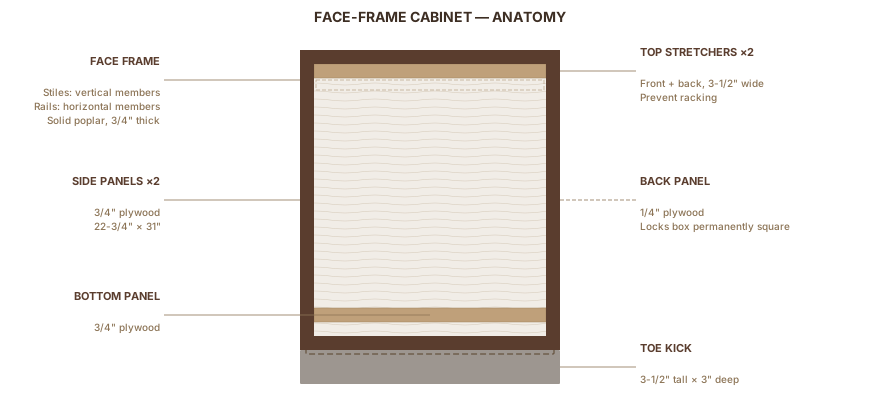
The box (carcase). Two side panels, a bottom, and top stretchers form the structural shell. The sides carry the weight. The bottom holds what you store. The top stretchers keep the box from racking (twisting out of square) and provide a surface to attach the countertop. Most boxes are 3/4" plywood. VT Furniture Works has a good visual breakdown of all the parts.
The face frame. A grid of solid wood glued and nailed to the front of the box. Vertical pieces are stiles. Horizontal pieces are rails. Typically 1-1/2" wide and 3/4" thick. The face frame adds rigidity, provides mounting points for hinges and drawer slides, and covers the raw plywood edges. Sweetwood Cabinets explains the structural difference well.
The back panel. A sheet of 1/4" plywood attached to the rear of the box. As Popular Woodworking puts it, the back panel locks the entire box square. Skip it and you have a floppy parallelogram. Glue it and nail it in, and the box stays rigid.
Doors. Hung on concealed European hinges that allow three-axis adjustment after installation. You can correct alignment problems without removing the door.
Drawers. A small box that rides on slides mounted to the cabinet sides. Most ball-bearing slides need 1/2" clearance on each side, so the drawer box is built 1" narrower than the opening.
Shelves. Fixed or adjustable. Adjustable shelves rest on small pins inserted into pre-drilled holes spaced 32mm apart. A $25 shelf pin jig from Kreg makes drilling these holes fast and accurate.
Toe kick. The recessed space at the bottom of base cabinets. Standard: 3-1/2" tall, 3" deep. The Handyman's Daughter recommends building a separate platform and setting the cabinet on top. This simplifies leveling on uneven floors.
Three Construction Methods
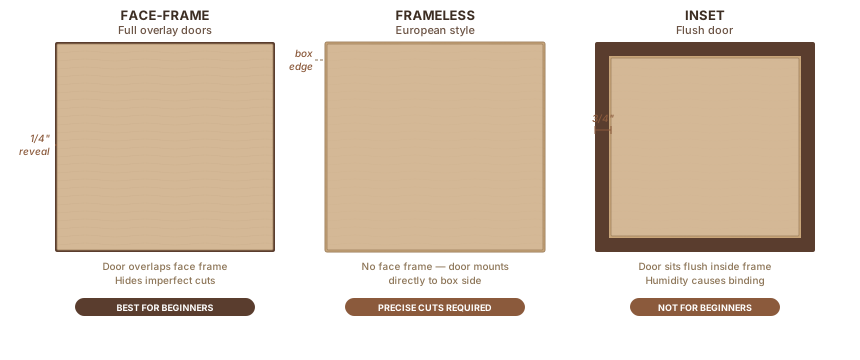
Face-frame (start here). A plywood box with a solid wood face frame on the front. The most forgiving method for beginners because the frame hides imperfect cuts and adds rigidity. Pair with full overlay doors (covered below) for maximum forgiveness.
Frameless (European). No face frame. Doors mount directly to the box sides and cover nearly the entire front. Modern look with full access to the interior. Per Cabinets.com, the trade-off is that the box must be perfectly square because there's no frame to hide errors. Not recommended for a first build.
Inset. A sub-type of face-frame where the door sits flush inside the frame opening. Requires a uniform 1/16" gap on all sides. iCabinetry Direct notes that humidity changes cause the door to swell and bind, and inset construction costs 15-20% more. Build face-frame cabinets with full overlay doors first.
Build face-frame with full overlay doors. Full overlay covers most of the face frame, so small imperfections in frame placement or door sizing disappear behind the door.
Part 2: Materials, Dimensions, and Planning
Choosing Your Plywood
Your cabinet boxes should be 3/4" plywood. Not MDF. Not particleboard. Not 1/2" plywood.
Plywood's cross-grain construction (each layer runs perpendicular to the last) resists warping and holds screws well for hinges, slides, and mounting hardware. Per Toulmin Cabinetry, MDF swells when wet and strips out at edges. Particleboard is worse on both counts.
For painted cabinets: Sanded birch plywood (A or B grade face). Birch resists dents better than generic sanded pine plywood and takes paint cleanly. A 4x8 sheet runs $60-90 at home centers.
For stained cabinets: Hardwood-veneered plywood (maple or oak face). More expensive but the grain shows through the finish.
For cabinet backs: 1/4" luan or birch plywood, $15-25 per 4x8 sheet.
Face frame material: 1x2 poplar for painted cabinets (straight grain, paints well, affordable). Oak or maple for stained cabinets. Buy as dimensional lumber at the home center.
| Grade | Face Quality | Use |
|---|---|---|
| A | Smooth, sanded, minimal defects | Visible cabinet surfaces, door panels |
| B | Minor knots, small repairs | Non-primary visible surfaces |
| C | Knotholes, splits repaired | Structural use only |
| D | Unfixed defects | Never for cabinets |
Standard Kitchen Cabinet Dimensions
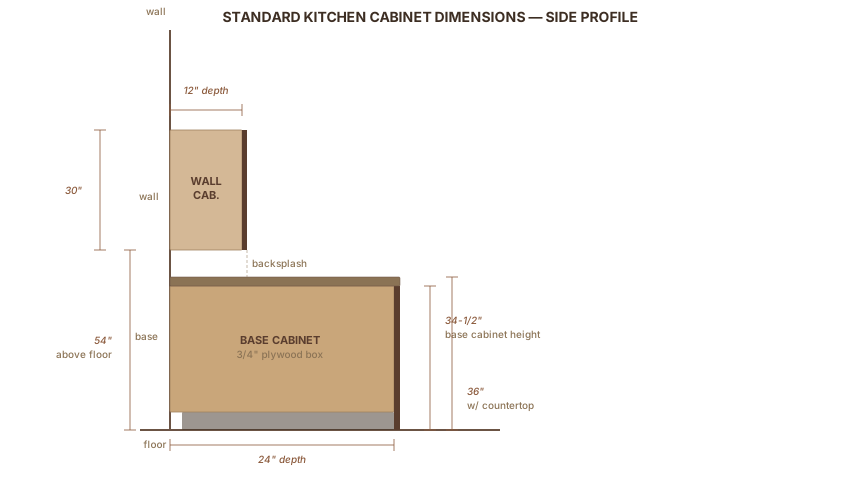
These dimensions match human ergonomics and standard appliance sizes. KraftMaid and Kitchen Cabinet Kings publish the full specs. Deviate and your countertops won't meet your stove, your dishwasher won't fit, and your upper cabinets will look wrong.
Base Cabinets
| Dimension | Standard | Why |
|---|---|---|
| Height | 34-1/2" (36" with countertop) | Ergonomic working height |
| Depth | 24" (25-26" with counter overhang) | Reachable without leaning |
| Width | 9" to 48" in 3" increments | Appliance and filler compatibility |
| Toe kick height | 3-1/2" | Room for toes at counter |
| Toe kick depth | 3" | Comfortable standing position |
Wall Cabinets
| Dimension | Standard | Why |
|---|---|---|
| Height | 30", 36", or 42" | Matched to ceiling height |
| Depth | 12" | Prevents head-bumping |
| Width | 9" to 48" in 3" increments | Matches base cabinet widths below |
| Bottom of cabinet | 54" from floor | Clearance for backsplash and small appliances |
Tall/Pantry Cabinets
| Dimension | Standard | Why |
|---|---|---|
| Height | 84", 90", or 96" | Matched to wall cabinet top height |
| Depth | 12" or 24" | Lines up with wall or base cabinets |
| Width | 9" to 36" | Based on available space |
Planning Before You Cut
Planning takes longer than building. A cabinet built to the wrong dimensions is scrap wood.
Measure the space. Measure wall-to-wall, floor-to-ceiling, and every window, door, outlet, and plumbing location. 10% Cabinetry recommends measuring in three places (left, center, right) because walls are rarely straight. Use the smallest measurement. Check floor level at multiple points.
Plan the layout. The work triangle (sink, stove, refrigerator) drives kitchen layout. Each leg should be 4-9 feet. Leave at least 36" of clear floor space between opposing cabinet runs. Measure your actual appliances before sizing cabinets. Modern appliances are larger than what was standard 20 years ago.
Create a cabinet list. List every cabinet by type, width, and position. A typical small kitchen: 2x 36" base cabinets, 1x 30" sink base, 2x 36" wall cabinets, 1x 30" wall cabinet.
Generate a cut list. For each cabinet, list every part with exact dimensions. A cut list for a single 36" base cabinet has 8-12 parts. For a full kitchen, use Ana White's free cabinet configurator or a spreadsheet.
Optimize sheet layout. Plan how parts lay out on 4x8 plywood sheets to minimize waste. Group similar-width parts and cut them from the same rip. A 10-cabinet kitchen typically requires 8-12 sheets of 3/4" plywood and 2-3 sheets of 1/4" plywood.
Part 3: Build a Face-Frame Cabinet Step by Step
Follow this order. Each step depends on the one before it.
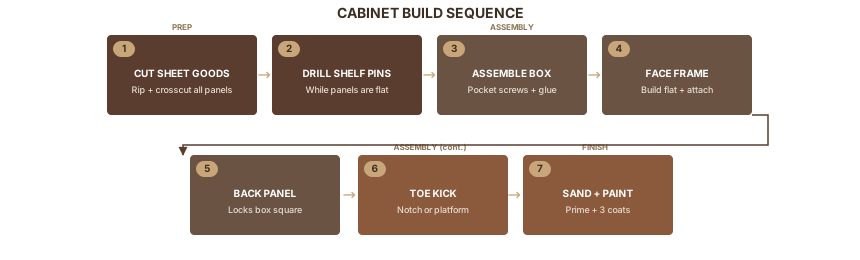
1. Cut All Sheet Goods
Rip your 4x8 plywood sheets into strips using a circular saw with a rip guide (~$50). For base cabinets, you need 22-3/4" wide strips for sides and bottoms. Crosscut strips to final length using a crosscut guide or a miter saw. Cut all parts for all cabinets at once. Batching saves time and improves consistency.
2. Drill Shelf Pin Holes
Do this now, while the side panels are flat on your work surface. Clamp a shelf pin jig to the panel, drill the holes (use a depth stop or tape on the bit), reposition, and repeat. This is much harder to do after the box is assembled.
3. Assemble the Cabinet Box
Join the bottom panel to the side panels using pocket screws and glue. If you have a router or table saw, dado joints are stronger for shelf support. Pocket screws work well for a first build.
Add top stretchers (3-1/2" wide strips) at the front and back. These prevent racking and provide a surface for countertop attachment.
Check for square. Measure both diagonals. Equal diagonals mean a square box. If they differ by more than 1/16", clamp across the longer diagonal and pull the box into square before the glue sets. WoodWorkers Guild of America walks through this technique. Every problem downstream, doors that won't hang right, drawers that bind, traces back to a box that isn't square.
4. Build and Attach the Face Frame
Cut stiles and rails from 1x2 hardwood. Assemble the face frame flat on your work surface using pocket screws and glue. Best face of each board faces out. Dry-fit first to verify dimensions match the box.
The stiles run the full height. The rails fit between the stiles. The face frame's outer dimensions should match the cabinet box width and height exactly. Sawdust Girl has a detailed visual walkthrough. For the full face frame process — standard stile/rail dimensions, Kreg jig settings, joinery methods, and how to handle multiple cabinet runs — see Face Frame Cabinets.
Apply a thin bead of wood glue to the front edges of the cabinet box. Position the face frame flush with the outside edges. Secure with 2" brad nails every 6-8" while the glue dries. A brad nailer speeds this up, but you can use clamps and let the glue dry if you don't have one.
5. Install the Back Panel
Cut 1/4" plywood to fit the back of the cabinet. Apply glue to the back edges and brad-nail every 4-6". The back panel locks the box permanently square. If you cut a rabbet (a notch along the inside back edge) before assembly, the back sits flush. If not, nailing it directly to the back edges works fine.
6. Build the Toe Kick
Two options. Notch method: cut a 3-1/2" x 3" notch out of the bottom front of each side panel before assembly. Platform method: build a separate rectangular frame from 2x4 or plywood strips, level it on the floor, and set the cabinet on top.
The platform method is simpler and makes leveling easier. Use it for your first build.
7. Sand, Prime, and Paint
Sand all surfaces: 120 grit to remove tool marks, 150 grit to smooth, 220 grit before paint. Prime all surfaces with a shellac-based primer (Zinsser BIN gives the best adhesion). Apply 2-3 coats of paint, sanding lightly with 220 grit between coats.
Use an acrylic-alkyd hybrid paint: Benjamin Moore Advance or Sherwin-Williams Emerald Urethane Trim Enamel. Both self-level (brush marks flatten as the paint dries) and cure hard. They cost more per gallon than basic latex. The finish quality justifies it.
Apply paint with a 4-6" micro-foam roller for flat surfaces and a quality 2" angled brush for edges. Finish doors and drawer fronts flat on a work surface, not hanging vertically. This prevents drips.
For stained cabinets, apply polyurethane instead. Oil-based adds warmth; water-based stays clear.
Part 4: Doors, Drawers, and Finishing
Door Overlay Types
Full overlay (recommended). Door covers nearly all of the face frame, leaving only a 1/4" reveal. Modern look. Most forgiving for beginners because small variations in frame placement hide behind the door.
Partial overlay. Door covers about half the frame. Traditional look. Requires more consistent frame sizing because the visible frame acts as a visual grid.
Inset. Door sits flush inside the frame opening. 1/16" gap on all sides. Humidity causes binding. Not for beginners.
Hanging Doors with Concealed Hinges
Concealed (European) hinges hide when the door is closed and adjust in three dimensions after installation.
What you need:
- 35mm Forstner bit (~$15)
- Hinge jig for consistent placement (~$20-30)
- Concealed hinges with mounting plates (Blum, ~$3-5 each)
Installation:
- Mark hinge cup position: 7/8" from door edge, 3-1/2" from top and bottom edges
- Drill 35mm hole, 1/2" deep, with the Forstner bit (use tape as a depth stop)
- Press hinge cup into hole, drill pilot holes, secure with screws
- Mount base plate on cabinet frame: 2-1/4" from edge
- Clip hinge arm onto base plate with door in the open position
- Close door and adjust: front screw (left/right), rear screw (in/out), vertical screw (up/down)
Cabinetdoors.com has a detailed photo walkthrough. Plan 30 minutes per door. The first two will take longer. By the fourth door, you'll have a rhythm.
Building and Installing Drawers
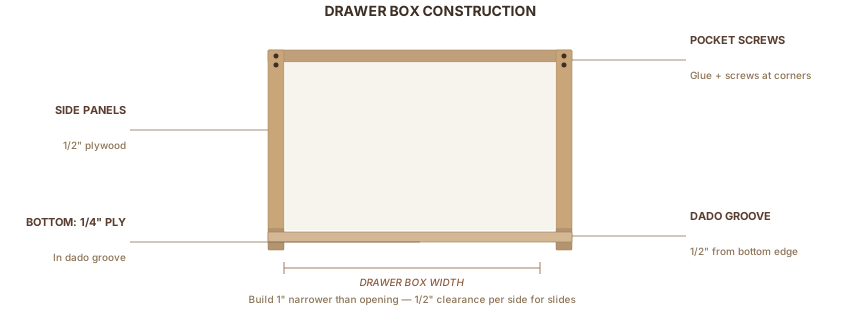
Build drawer boxes from 1/2" plywood. Four sides joined with pocket screws and glue. The bottom panel (1/4" plywood) sits in a dado groove cut 1/2" up from the bottom edge. Per Houseful of Handmade, the drawer box must be 1" narrower than the cabinet opening (1/2" clearance per side for slides).
For beginners, use side-mount ball-bearing slides:
- Separate inner and outer slide members (press the release tab)
- Draw a level line on the cabinet side where the slide bottom will rest
- Screw outer member to cabinet side using a spacer block for consistent height
- Screw inner member to drawer box side, 3/8" above the bottom, front edge flush
- Slide drawer in, test, adjust
A drawer slide jig ($20-30) eliminates guesswork. Worth the money if you're installing more than four drawers.
Hardware Quality Matters
Budget hinges sag within a year. Cheap slides jam and derail. Per Fine Woodworking's forum, Blum hinges are tested to 50,000+ open/close cycles. Blum Tandem Plus BLUMOTION undermount slides run smooth for decades, hide all hardware when open, and let you dial in the drawer front gap after the cabinet is assembled. Quality hardware adds $200-400 to a full kitchen. It's the best $400 you'll spend.
For kitchen cabinets, buy Blum. For garage or utility cabinets, budget hardware is fine.
Part 5: Tools and Cost Reality Check
Minimum Tool List (~$400-500)
You can build face-frame kitchen cabinets with these tools. Nothing on this list costs more than $150.
Cutting:
- Circular saw (
$50-60) with a 60-tooth finish blade ($20) - Circular saw rip guide (~$50) for consistent plywood rips
- Crosscut guide (~$50) for straight crosscuts across panels
Assembly:
- Drill/driver (~$50-80), cordless 18V or 20V
- Pocket hole jig (~$100), the core assembly tool
- Clamps: 2 bar clamps + 2 right-angle clamps (~$40-60)
Measuring and squaring:
- Tape measure ($10)
- Speed square ($8)
- Carpenter's square ($10)
Finishing:
- Orbital sander (~$40-50)
- 35mm Forstner bit for hinge cups (~$15)
You don't need a table saw. A circular saw with guide tracks makes every cut a cabinet requires. It's slower per cut but costs a fraction of a decent table saw ($50-100 vs. $300-600). Houseful of Handmade built an entire custom kitchen without one. If you already own a table saw, it'll speed things up. If you don't, don't let that stop you.
Cost Comparison: A 10x10 Kitchen
A 10x10 kitchen has roughly 20 linear feet of cabinets (12-15 individual cabinets).
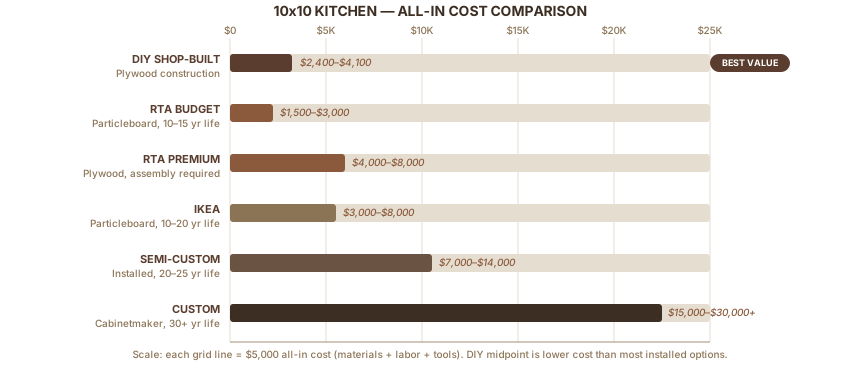
| Option | Material Cost | Labor/Time | All-In Cost | Expected Life |
|---|---|---|---|---|
| DIY shop-built | $2,000-3,500 | 150-250 hrs + $400-600 tools | $2,400-4,100 | 25-30+ years |
| RTA budget (particleboard) | $1,500-3,000 | 30-50 hrs DIY assembly | $1,500-3,000 | 10-15 years |
| RTA premium (plywood) | $4,000-8,000 | 30-50 hrs DIY assembly | $4,000-8,000 | 15-25 years |
| IKEA | $3,000-8,000 | 30-60 hrs DIY assembly | $3,000-8,000 | 10-20 years |
| Semi-custom (installed) | — | — | $7,000-14,000 | 20-25 years |
| Custom cabinetmaker | — | — | $15,000-30,000+ | 30+ years |
Per HomeGuide, DIY costs about the same as budget RTA but gets you plywood construction that lasts 2-3x longer, in sizes that fit your space. The trade-off: 150-250 hours spread over weekends, or about 2-4 months.
For a "forever kitchen" in a house you own, building your own makes sense. For a rental renovation, buy RTA.
Part 6: Common Mistakes and How to Avoid Them
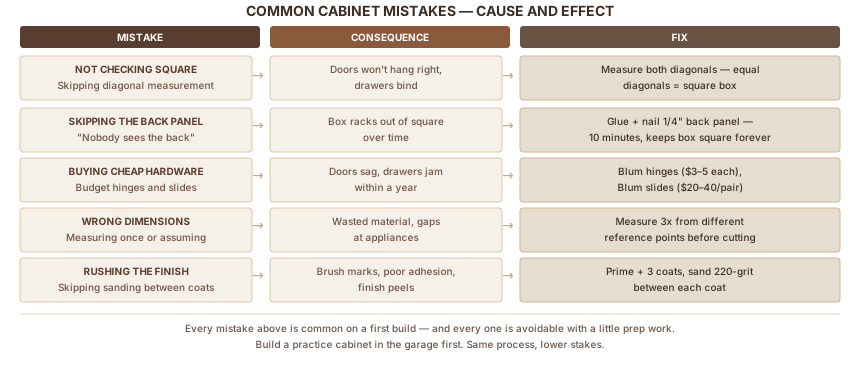
Inaccurate measurements. The biggest cause of wasted material. Measure the same dimension three times from different reference points. If you get three different numbers, figure out which is right before cutting.
Not checking for square. You glue and screw the box, it looks fine, then the doors won't hang right and the drawers bind. Measure diagonals on every box. If they differ by more than 1/16", fix it before the glue sets.
Assuming floors are level and walls are plumb. They're not. Especially in older homes. Floors slope. Walls bow. Corners aren't 90 degrees. Shim base cabinets level. Check with a 4-foot level across the entire run.
Cheap hardware. Budget hinges sag within a year. Cheap slides jam. Blum hinges: $3-5 each. Blum slides: $20-40 per pair. Adds $200-400 to a kitchen. Worth it.
Not checking appliance dimensions. Your new refrigerator might be 2" wider than the old one. Measure actual appliances (or spec sheets for appliances you plan to buy) before committing to cabinet sizes.
Skipping the back panel. "It's just the back, nobody sees it." The back is what keeps the box from racking. Glue and nail the back on. It takes 10 minutes and makes everything else work.
Rushing the finish. Each coat needs to dry fully. Sand between coats. The difference between a one-coat job and a three-coat sanded finish is the difference between "I can tell those are DIY" and "who was your cabinetmaker?"
Starting with the full kitchen. Build a garage cabinet first. Same materials, same methods, lower stakes. If it comes out square and solid, you're ready. If it doesn't, you learned on a $60 project instead of a $3,000 one.
Part 7: Where to Go from Here
Start Small, Build Up
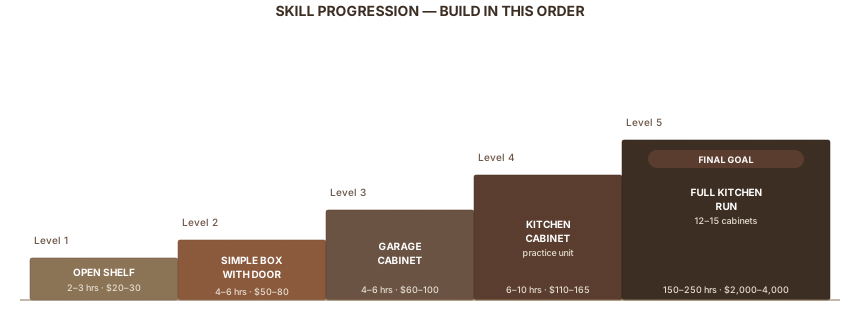
| Level | Project | Time | Cost |
|---|---|---|---|
| 1 | Open shelf (wall-mounted) | 2-3 hrs | $20-30 |
| 2 | Simple box with door (bathroom, laundry) | 4-6 hrs | $50-80 |
| 3 | Garage/shop base cabinet | 4-6 hrs | $60-100 |
| 4 | Single kitchen base cabinet (practice unit) | 6-10 hrs | $110-165 |
| 5 | Full kitchen run | 150-250 hrs | $2,000-4,000 |
Start at level 2 or 3. Build one or two practice cabinets for the garage or laundry room. When those come out square and the doors work, you're ready for the kitchen.
Cut List: Standard 36" Base Cabinet
Complete cut list for one 36"-wide face-frame base cabinet with full overlay doors.
3/4" Plywood (cabinet box):
| Part | Qty | Width | Length |
|---|---|---|---|
| Side panels | 2 | 22-3/4" | 31" |
| Bottom panel | 1 | 22-3/4" | 31-1/4" |
| Top stretcher (front) | 1 | 3-1/2" | 31-1/4" |
| Top stretcher (back) | 1 | 3-1/2" | 31-1/4" |
1/4" Plywood (back):
| Part | Qty | Width | Height |
|---|---|---|---|
| Back panel | 1 | 34-1/2" | 31" |
Face frame (3/4" x 1-1/2" poplar):
| Part | Qty | Width | Length |
|---|---|---|---|
| Stiles | 2 | 1-1/2" | 31" |
| Top rail | 1 | 1-1/2" | 33" |
| Bottom rail | 1 | 1-1/2" | 33" |
Materials cost for one cabinet: ~$80-120 (not including doors or paint).
Related Guides
- Applying Polyurethane for clear finish on stained cabinets
- What Is MDF to understand why plywood is the better choice for cabinet boxes
- Nominal Wood Sizes for understanding lumber dimensions when buying face frame stock
FAQ
How much does it cost to build your own kitchen cabinets?
Material cost runs $80-120 per cabinet (not including doors or paint) using 3/4" birch plywood and poplar face frame stock. A 10x10 kitchen with 12-15 cabinets typically costs $2,000-3,500 in materials plus $400-600 for tools — $2,400-4,100 all-in. That's roughly the same as budget RTA cabinets but with plywood construction that lasts 25-30 years instead of 10-15.
Do I need a table saw to build cabinets?
No. A circular saw with a rip guide ($50) and a crosscut guide ($50) makes every cut a cabinet requires. It's slower per cut but a fraction of the cost of a table saw ($50-100 vs. $300-600). Many builders complete entire custom kitchens without one. If you already own a table saw it'll speed things up, but the absence of one is not a reason to stop.
What plywood should I use for cabinet boxes?
Use 3/4" sanded birch plywood for painted cabinets — A or B grade face. Birch resists dents, holds screws well, and takes paint cleanly. A 4x8 sheet runs $60-90 at home centers. For the back panel, use 1/4" luan or birch plywood ($15-25 per sheet). Avoid MDF and particleboard: both swell when wet and strip out at edges under hardware loads.
How long does it take to build kitchen cabinets?
A single base cabinet takes 6-10 hours from cutting to painted. A full 10x10 kitchen with 12-15 cabinets runs 150-250 hours total, spread over 2-4 months of weekends. Build your first cabinet in the garage — same process, lower stakes. When it comes out square and the door swings cleanly, you're ready for the kitchen.
What's the difference between face-frame and frameless cabinets?
Face-frame cabinets have a solid wood border glued to the front of the plywood box. The frame hides imperfect cuts, adds rigidity, and provides mounting points for hinges. Frameless (European-style) cabinets mount doors directly to the box sides with no frame. They look more modern and give fuller interior access, but require precise cuts because there's no frame to cover errors. Build face-frame first.
Sources
This guide draws on manufacturer documentation, professional cabinetmaker forums, and documented DIY kitchen builds.
- VT Furniture Works — cabinet anatomy and component overview
- Sweetwood Cabinets — face-frame vs. frameless construction comparison
- Popular Woodworking — back panel importance for squareness
- Kreg Tool — shelf pin jig and 32mm system
- The Handyman's Daughter — toe kick construction methods
- Cabinets.com — frameless vs. face-frame pros and cons
- iCabinetry Direct — inset cabinet construction and cost
- Toulmin Cabinetry — plywood vs. MDF vs. particleboard for cabinet boxes
- KraftMaid — standard kitchen cabinet dimensions
- Kitchen Cabinet Kings — cabinet size reference
- 10% Cabinetry — measurement and planning mistakes
- Ana White — free cabinet configurator and plans
- WoodWorkers Guild of America — squaring technique
- Sawdust Girl — face frame construction and attachment
- Cabinetdoors.com — concealed hinge installation
- Houseful of Handmade — full kitchen build without a table saw
- Fine Woodworking Forum — hardware quality and recommendations
- HomeGuide — kitchen cabinet cost data
Also Referenced
How We Research
We don't take affiliate revenue or accept review units. Picks come from multi-source research — manufacturer specs, OSHA / EPA / ASTM regs, and long-form practitioner threads — plus Ahmed's hands-on use where relevant. When we recommend something, we explain why.
Up Next
How to Build a Room Divider Bookshelf
CABINETMAKING · Beginner