
French Cleat Shelves at a Glance
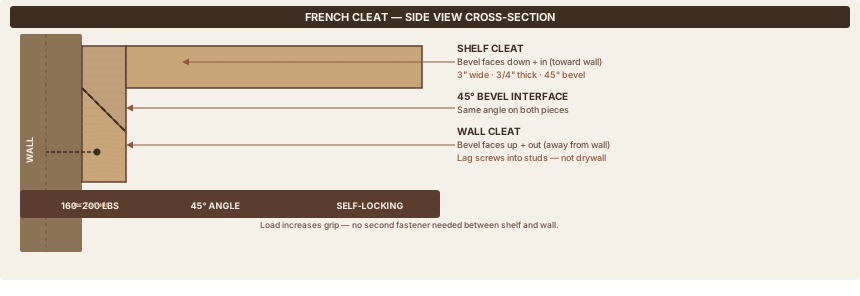
A french cleat is two interlocking beveled strips: one screwed to the wall, one attached to your shelf. Both are cut at 45°. Gravity does the rest: the heavier the load, the tighter they lock. You don't need a table saw or joinery experience. You need a circular saw, a drill, a level, and a stud finder.
| Skill level | Beginner — no prior woodworking experience required |
| Material | 3/4" hardwood plywood (birch) or poplar |
| Angle | 45° bevel on both pieces |
| Weight capacity | 160–200 lbs typical (2 lag screws per stud, 2 studs minimum) |
| Row spacing (tool wall) | 8" on center |
| Minimum tools | Circular saw, drill, 48" level, stud finder |
| What it replaces | Fixed shelf brackets — but repositionable anywhere |
In this guide:
- How the bevel locks under load — and what actually fails
- What to buy, and why MDF will let you down
- Cutting and installing the wall cleat — with or without a table saw
- Building the shelf and hanging it
- The six mistakes that bring shelves down
Part 1: How a French Cleat Works
The system has two parts. The wall cleat is a strip of wood, 3" wide and 3/4" thick, with one edge cut at a 45° bevel (an angled cut along the length of the board). It mounts to the wall with the angled edge pointing up and out, like a ramp facing you. The shelf cleat is the mirror: same 45° bevel, mounted on the back of your shelf with the angle pointing down and in, toward the wall.
When you tip the shelf back and hook the shelf cleat over the wall cleat, the two beveled faces press together. As the shelf gets heavier, the angled geometry pushes the pieces harder into each other. More load means more grip. The system is self-locking by design.
French cleats work for tool walls holding 200 lbs, for full cabinets, for anything you'd normally bolt to a stud.
What the 45° angle does
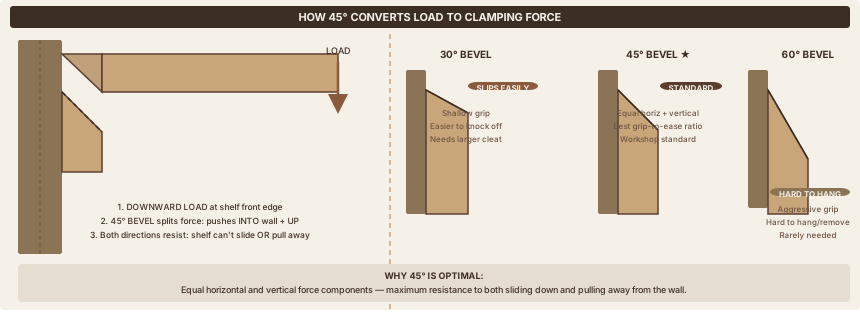
A flat ledge (90° shelf bracket) resists downward force but does nothing to stop the shelf from swinging away from the wall. Add enough weight at the front edge and the bracket pops out.
The 45° bevel resists both directions at once: it prevents the shelf from sliding down and from pulling away from the wall. That's why a french cleat doesn't need a second fastener connecting the shelf to the wall. The geometry holds it.
45° is the standard because it produces equal resistance in both directions. 30° is flatter: the shelf sits lower on the wall cleat and is easier to knock off. 60° is steeper with a more aggressive grip, but the shelf is harder to hang and remove. Stick with 45°.
What fails — and it's not the wood
The wood cleat almost never fails. The fasteners do. Specifically: fasteners driven into drywall instead of studs.
A standard wall stud carries 80–100 lbs per screw. Two lag screws (heavy-duty threaded fasteners designed for wood-to-wood connections) through a wall cleat into a stud: 160–200 lbs of capacity at that stud. Hit two studs with two screws each: 300–400 lbs theoretical capacity for the system. Neat French Cleat's pull tests confirm properly anchored wooden cleats rarely fail. The wall gives out before the wood does.
Drywall anchors max out at 20–50 lbs. That sounds adequate until you add four years of tools plus vibration from a nearby compressor, and they pull out.
| Configuration | Typical Capacity |
|---|---|
| Light shelf (drywall anchors — not recommended for loads) | 20–50 lbs max |
| Single cleat into 2 studs, 1 lag screw each | 160–200 lbs |
| Single cleat into 2 studs, 2 screws each | 300–400 lbs |
| Commercial aluminum Z-bar pair, 45" | 375 lbs rated |
The moment arm: a shelf that sticks 12" out from the wall doesn't only press down on the screws. It also tries to rotate the whole assembly outward. The farther the load from the wall, the more torque on the fasteners. Run the shelf's back panel flush to the wall. That contact point creates a pivot that absorbs the rotation. This is why workshop holders (close to the wall) are more stable than long-reach floating shelves.
Part 2: Materials and Tools
What to buy
3/4" hardwood plywood is the right material for wall cleats. Katz-Moses Tools recommends 5/8"–3/4" thickness and 2.5"–3" wide cleats for most shop applications. Birch plywood is the most common choice: it's stable, cuts cleanly, and the cross-grain layers resist screw pullout at the 45° face. One 4'×8' sheet runs $60–$80 at a home center and gives you 10+ linear feet of cleats. That covers a full workshop wall.
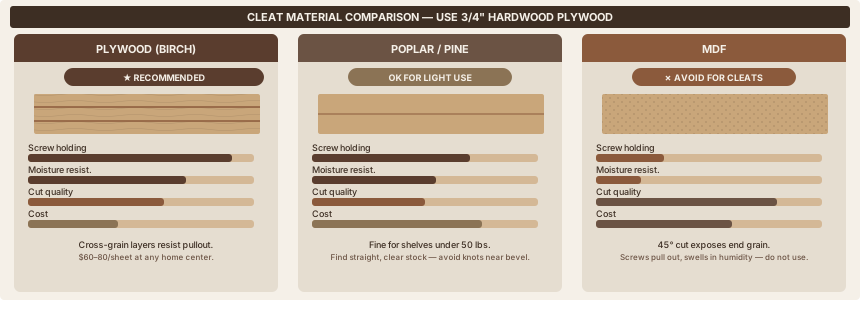
For the shelf itself: 1×10 or 1×12 pine boards from any home center. Cheap, available everywhere, and strong enough for most loads. For the shelf's mating cleat, poplar is the best budget pick: cheapest hardwood, cuts cleanly, holds screws well.
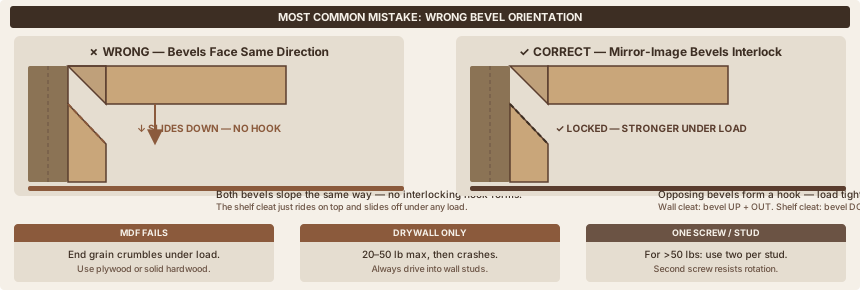
Do not use MDF. The 45° bevel cut exposes end grain (the cross-section of the wood fibers, not the face or edge). End grain in MDF holds screws poorly; they pull out under moderate load. MDF also swells with garage humidity. It looks fine when empty and fails when loaded.
Dimensional pine (1×4 or 1×6) works as a substitute for plywood if you can find straight, clear stock. It's soft enough to compress under very heavy loads, but for shelves under 50 lbs it's fine.
Tool list
You don't need a table saw. Here's what you need:
| Tool | What It Does | Substitute |
|---|---|---|
| Circular saw with bevel adjustment | Cuts the 45° bevel | Track saw, table saw |
| Drill + driver bits | Attaches cleats to wall and shelf | Hammer drill if doing concrete |
| 48" level | Keeps cleats level | 24" level (check at each end) |
| Stud finder | Locates wall studs | Tap the wall + probe with finish nail |
| Measuring tape + pencil | Layout | Nothing to substitute here |
| Straight edge guide | Guides the circular saw cut | Factory edge of scrap plywood |
For a full tool wall with multiple rows, add a chalk line. It snaps level lines across the wall faster than a pencil and level.
Part 3: Building and Installing the Wall Cleat
Step 1: Find and mark your studs
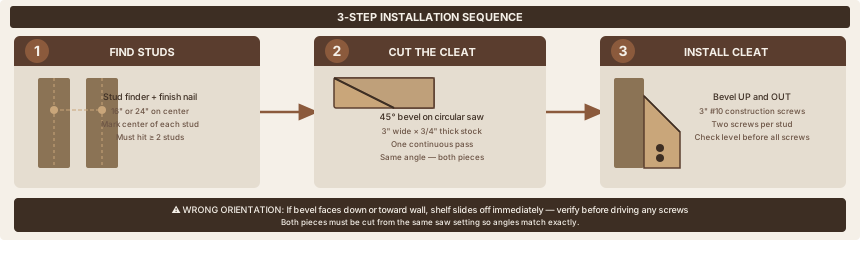
Run an electronic stud finder across the wall and mark both edges of each stud. Mark the center and tape it. Cover every stud in your planned work area.
Verify the marks. Stud finders false-positive on pipes, wiring, and drywall seams. Drive a small finish nail at your marked center point: it should meet solid resistance after passing through the drywall. If it hits air, move 1/2" left or right and probe again. Thirty seconds now saves a pulled-out cleat later.
Standard stud spacing is 16" on center. Some garages and newer construction use 24" on center. If you're at 24", plan your cleat length to hit at least two studs. A loaded shelf needs a minimum of two stud connections.
Step 2: Cut the wall cleat
With a table saw:
- Set the fence and rip a strip 6" wide (square cut)
- Set the blade to 45°
- Rip the 6" strip down the center. You get two 3" cleats, each with a flat edge and a 45° edge
Lock the blade angle before you start. Don't touch it until all your cleat stock is cut. Pieces cut at 45.0° won't interlock cleanly with pieces cut at 45.3°.
Without a table saw — the circular saw method:
Instructables documents this in four steps, and MellowPine covers five no-table-saw methods. The circular saw approach is the most accessible:
- Mark the cut line along the length of your board
- Clamp a straight edge guide parallel to the cut line. The distance from the guide to the cut line equals the distance from your saw's blade to the edge of its base plate (measure this on your saw before clamping)
- Set the circular saw blade to 45° bevel
- Make one continuous pass. Don't stop mid-cut: a restart creates a bump at the restart point
- Use a sharp blade. A dull blade wanders and produces a wavy bevel that won't seat cleanly
Score the plywood face with a marking knife before cutting to prevent tearout.
The angle doesn't have to be exactly 45°. It just has to be consistent. Both pieces come from the same saw setting, so they'll always match each other.
Step 3: Install the wall cleat
Family Handyman's full build tutorial has detailed photos of this sequence if you want a visual reference.
Draw a level line on the wall where the bottom edge of the first cleat will sit. A chalk line is fastest for long runs; a pencil and level work fine for single shelves.
Position the cleat against the wall: the 45° bevel faces up and away from the wall. The angled surface opens toward you, like a ramp. Wrong orientation is the most common installation error. Double-check before driving any screws.
Drill pilot holes through the cleat at each stud location. Drive 3" #10 construction screws (or 3" lag screws for heavy loads) through the cleat and drywall into each stud. Do not use drywall screws. They're brittle and snap under shear load.
Drive one screw per stud loosely, check level, adjust, then drive all remaining screws. For loads over 100 lbs, drive two screws per stud crossing.
For a full tool wall: Install rows 8" apart (measured from top of one cleat to bottom of the next). Cut spacer blocks from scrap, exactly 8" long, and rest each new cleat on top of them. You get consistent spacing without re-measuring every row.
Adapting for other wall types
Concrete or masonry walls (basement, detached garage): Use Tapcon concrete screws (blue, coarse-threaded). Fine Woodworking's wall anchor guide covers the fastener options in detail. Drill a pilot hole with a hammer drill and a concrete bit matching the Tapcon specs. A standard drill won't penetrate concrete reliably. Drive the Tapcon into solid block, not mortar. Mortar is softer and holds less. For hollow concrete block, use toggle anchors. Tapcons don't grip in voids.
Plaster walls (older homes): Same stud method as drywall. Pre-drill through the plaster layer before driving screws. Plaster is brittle. Drilling slowly prevents cracking.
Part 4: Building the Shelf
The standard floating shelf
Cut your shelf board to the desired width and depth. A 1×10 gives you 9-1/4" of usable depth; a 1×12 gives 11-1/4". Both are fine for books, plants, and household items.
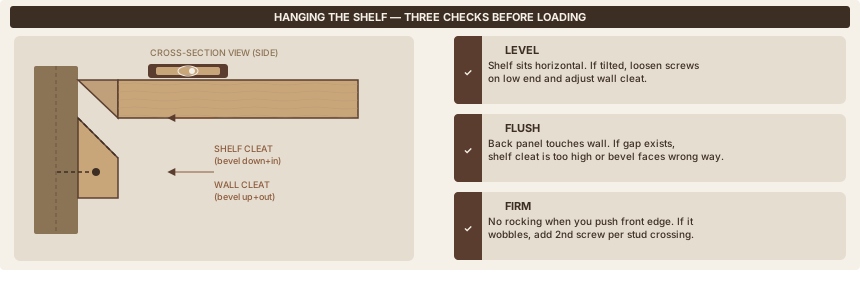
Cut the mating cleat the same way you cut the wall cleat: 3" wide, 3/4" thick, 45° bevel. The difference is orientation: the shelf cleat mounts with the bevel pointing down and in, toward the wall when hung. Mirror image of the wall cleat.
Attach the shelf cleat flush with the top back edge of the shelf using 1-1/4" screws. Run the back panel to the wall. That contact point resists rotation under load. If the back panel hangs 2" from the wall, the screws handle both the downward load and the rotational force on their own. Let the wood help.
Hanging the shelf
Tip the shelf back at an angle, hook the mating cleat over the wall cleat, and lower it down. The bevels engage and the shelf settles flat.
Check three things:
- Level: the shelf should sit level. If it tilts side to side, the wall cleat isn't level. Loosen the screws on the low end and adjust.
- Flush: the back panel should touch the wall. If it gaps, the shelf cleat is positioned too high on the shelf, or the wall cleat bevel is oriented wrong.
- Firm: push down on the front edge. No rocking or flex. If it wobbles, add a second screw into the studs where you have one.
Shelf styles
The same principle scales to any holder:
| Style | How to Build | Best For |
|---|---|---|
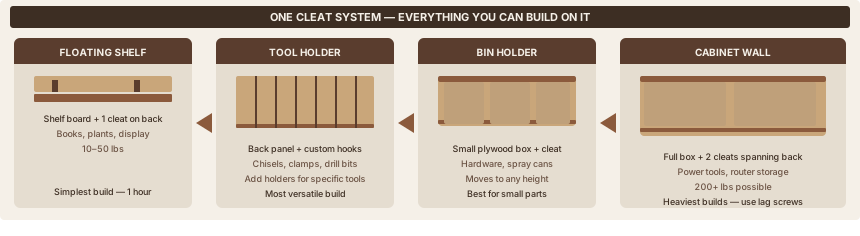
| Floating shelf | Shelf board + one cleat on back | Books, plants, display |
| Tool wall holder | Back panel + custom tool holders | Chisels, clamps, drill bits |
| Bin holder | Small plywood box + cleat on back | Hardware, spray cans, supplies |
| Pegboard base | 1/4" pegboard sheet + cleat | Flexible small-item storage |
| Heavy cabinet | Full box + two cleats spanning the back | Power tools, router storage |
For the workshop tool wall: build a back panel from 3/4" plywood, attach a cleat across the top back, and add whatever you want to the front. Hooks, slots, dowels, holders for specific tools. The cleat lets you move the whole holder to any height in seconds.
Part 5: Common Mistakes and How to Fix Them
Screwing into drywall only
This is the number one failure mode. Neat French Cleat's mistakes guide documents real-world anchors tearing out under load. Drywall holds 20–30 lbs and fails quietly at 60 lbs. One day you hear a crash. No warning. The anchor just tears out.
Always drive into studs for anything you'll load. If your studs are 24" apart and the cleat doesn't hit two, use a longer cleat.
Wrong bevel orientation
If the shelf slides off immediately, one cleat is mounted upside down. Both bevels need to oppose each other: one faces up and out (wall cleat), the other faces down and in (shelf cleat). Same direction means they slide apart.
Before building ten shelves, hang one test piece and confirm it sits correctly.
Using MDF
MDF looks fine until it's loaded. The 45° cut face is end grain. End grain in MDF holds screws for a few weeks under light load, then they creep. Under heavier loads or vibration, they pull out. Once the screw hole fails in MDF, it's done. There's no repairing it. Use plywood or hardwood.
Cantilevered load without wall contact
A shelf sticking 12" out from the wall with no back panel contact applies torque to the screws — the farther the load from the wall, the higher the force. The farther the load from the wall, the more rotation force. You don't need to shorten the shelf. Just make sure the back panel sits flush against the wall. That one contact point handles the rotation.
Not checking level before driving all screws
A cleat 1/4" out of level across 48" is visible from across the room. Every shelf on it hangs crooked. Drive one screw loosely, level the cleat, then drive the rest. Thirty extra seconds. Not checking takes 30 minutes to redo.
One screw per stud
For shelves under 50 lbs, one screw per stud is fine. For a workshop load (a shelf holding a router, a sander, a pile of clamps), use two screws per stud crossing. The second screw helps the cleat resist rotation around the first.
Where This Fits
No prerequisites. If you can run a circular saw and drive a screw, you can build a french cleat system. The only thing that trips people up is not confirming the studs, and now you know how to do that.
Once the wall cleat is up, every holder you build uses the same principle — a floating shelf, a clamp rack, a fold-down workbench, a full cabinet wall. The system stays the same. Only what hangs on it changes.
Related guides:
- Screw Sizes Chart — pilot holes, gauge selection, and the 2/3 penetration rule for any screw joint
- How to Build a Cabinet — for enclosed storage alongside open cleat walls
- Epoxy Resin for Wood — void filling technique that shows up when you're working rough lumber for cleat stock
Sources
Research drew on woodworking publications, tested weight data, engineering resources, community forums, and practitioner tutorials. Sources are ordered by first appearance in the guide.
- Neat French Cleat — Weight Test — tested pull-out data for wooden cleats into studs
- Katz-Moses Tools — French Cleat Basics — cleat dimensions, build sequence, and best practices
- Instructables — Cutting French Cleat With Circular Saw — step-by-step circular saw method
- MellowPine — How to Make a French Cleat Without a Table Saw — five alternative cutting methods
- Family Handyman — French Cleat Tool Storage Wall — full installation photo guide
- Fine Woodworking — Choosing the Right Wall Anchors — fastener selection for drywall, concrete, and masonry
- Neat French Cleat — French Cleat Mistakes — documented failure modes with fixes
Tools Used
Also Referenced
How We Research
We don't take affiliate revenue or accept review units. Picks come from multi-source research — manufacturer specs, OSHA / EPA / ASTM regs, and long-form practitioner threads — plus Ahmed's hands-on use where relevant. When we recommend something, we explain why.