
Drawers at a Glance
Building a drawer is math plus assembly. The box is five pieces of plywood. The only tricky part is getting the width right for your slide type. Subtract 1" from the opening for side-mount slides. A circular saw, a drill, and a pocket hole jig get you there without a table saw.
| Box width (side-mount slides) | Opening width − 1" |
| Box height | Opening height − 1" |
| Box depth | Equals the slide length (18", 22", or 24") |
| Bottom material | 1/4" plywood, floating in a 3/8"-deep dado groove |
| Joinery (beginner) | Pocket holes, 1-1/4" pocket screws |
| Slide clearance (side-mount) | 1/2" per side |
In this guide:
- What a drawer is made of and how it works
- Sizing the box for your slide type
- Building the box step by step
- Installing slides and attaching the face
- Troubleshooting sticking, binding, and gaps
Part 1: How a Drawer Works
The five pieces
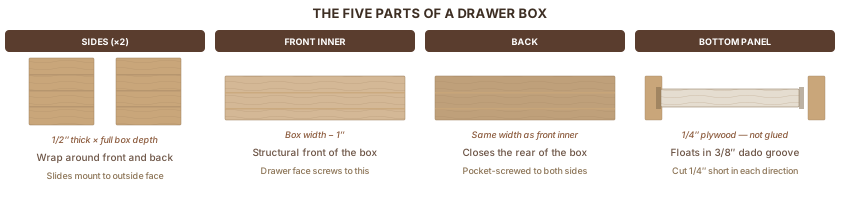
Every drawer box has the same five parts:
- Two sides — run the full depth of the drawer
- Front inner — the structural face at the front of the box (not the decorative panel you see when the drawer closes)
- Back — same width as the front inner, sits at the rear
- Bottom panel — sits in a groove (dado) cut near the bottom of all four pieces; it floats, not glued
The drawer face is the decorative panel you see when the drawer closes. It's a separate piece. It attaches to the front of the box after the box is installed and running on its slides.
| Drawer Box | Drawer Face | |
|---|---|---|
| Function | Structure and slide mount | Appearance |
| Material | 1/2" plywood | Solid wood, plywood, or MDF |
| Attachment | Rides on metal slides | Screwed to box front from inside |
| Sizing | Opening minus clearance | Opening plus overlap |
Keeping box and face separate makes installation forgiving. If the face goes on crooked, you adjust it without rebuilding the box.
Why slide type controls the width
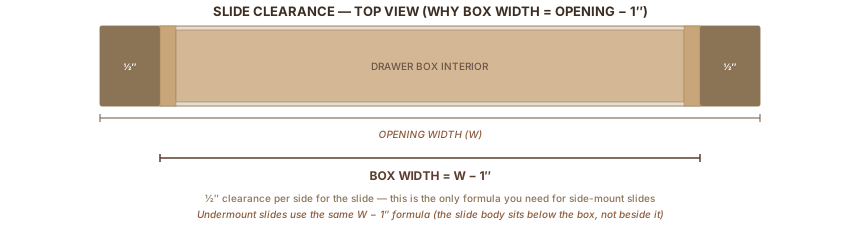
The slide hardware takes up space on the sides of the drawer. How much space depends on the slide type. Get this number wrong and the box either won't fit into the opening or rattles around with too much play.
Part 2: Sizing the Drawer Box
What to measure
Three numbers drive every dimension on your cut list:
- Opening width (W) — inside edge to inside edge of the face frame (the solid wood border on the cabinet front) or the cabinet interior walls for frameless builds
- Opening height (H) — top edge of opening to bottom edge
- Opening depth (D) — front to back inside the cabinet
Measure width and height at both the front and back of the opening. Cabinets rack. Verify both.
Side-mount slides (start here)
Side-mount ball-bearing slides are the right choice for most beginner projects. They're available at any home center, install without special jigs, and tolerate small alignment errors better than undermount slides.
According to Accuride's slide installation specifications, side-mount slides need 1/2" of clearance on each side (1" total). That's the only formula to memorize:
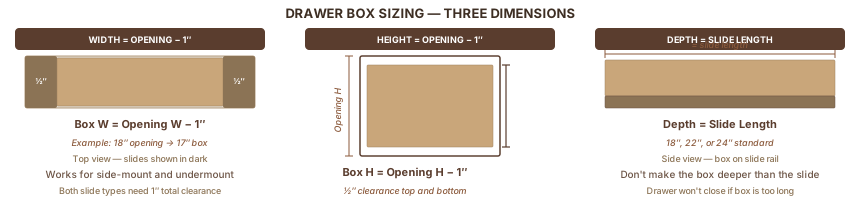
Box width = W − 1"
The other dimensions follow from the box width:
| Part | Formula | Example (W=18", H=6", D=22") |
|---|---|---|
| Box width | W − 1" | 17" |
| Box height | H − 1" | 5" |
| Box depth | Slide length (18", 22", or 24") | 22" |
| Side length | = Box depth | 22" |
| Front inner length | Box width − 1" (1/2" sides × 2) | 16" |
| Back length | Same as front inner | 16" |
| Bottom width | Box width − 1/4" | 16-3/4" |
| Bottom depth | Box depth − 1/4" | 21-3/4" |
Box depth equals the slide length. Don't make the box longer than your slides. The drawer won't close if you do.
The front inner and back are 1" shorter than the box width because the 1/2"-thick sides wrap around them. The bottom is cut 1/4" undersized in each direction to float in 3/8"-deep dadoes on all four pieces.
RELATED: How to Build a Cabinet The carcass goes up before the drawers. If you haven't built the cabinet yet, start there.
Undermount slides (Blum TANDEM and similar)
Undermount slides mount below the drawer box rather than beside it. The box sits on top of the slides, so there's no side clearance requirement. They cost more ($30–80 per pair vs. $15–40 for side-mount) but the slides are invisible when the drawer opens.
For face-frame cabinet installs, Blum TANDEM undermount slides use the same formula: Box width = W − 1". Per the Blum TANDEM planning guide, the slide body needs 1/2" clearance below the box floor.
The cut list
Write this out before you pick up the saw. Fill in your actual measurements:
| Part | Qty | Thickness | Width | Length |
|---|---|---|---|---|
| Sides | 2 | 1/2" | Box height | Box depth |
| Front inner | 1 | 1/2" | Box height | Box width − 1" |
| Back | 1 | 1/2" | Box height | Box width − 1" |
| Bottom | 1 | 1/4" | Box width − 1/4" | Box depth − 1/4" |
Part 3: Building the Box
Materials
Sides, front inner, back: 1/2" Baltic birch plywood. Baltic birch has a void-free core, so screws grip cleanly and don't pull through. It's consistently flat and glues well. Available at hardwood dealers in 5×5 sheets; some home centers carry it.
Bottom: 1/4" Baltic birch plywood. Stiff, light, and stable. One 5×5 sheet of 1/2" BB yields sides for several drawers (see the sheet goods guide for buying tips).
Avoid MDF. It's heavy, swells with moisture, and the edges strip out under repeated screw stress.
Tools
- Circular saw + straight-edge clamp guide (or table saw if you have one)
- Drill + driver bits
- Pocket hole jig (Kreg R3 at ~$30 or K4 at ~$80)
- 1-1/4" pocket screws for 1/2" material (per the Kreg Jig Learning Center)
- Wood glue
- 4 bar clamps minimum
- Tape measure, combination square, pencil
Joinery: pick one
Pocket holes are the right call for a first drawer. Fast, affordable, and strong enough for every household load short of a tool chest.
| Joinery | Tools required | Load rating | Best when |
|---|---|---|---|
| Pocket holes | Pocket hole jig + drill | 75–100 lb | First builds, most household drawers |
| Butt joints + glue/nails | Drill or nail gun | 40–60 lb | Very light-duty (linen closet, craft storage) |
| Dado/rabbet joints | Table saw or router | 100–150 lb | You want more strength and have the tools |
| Box joints | Table saw + jig | 150+ lb | Shop drawers, decorative builds |
| Half-blind dovetails | Router jig or hand tools | 150+ lb | Fine furniture — see dovetail joint guide |
Step 1: Cut the parts
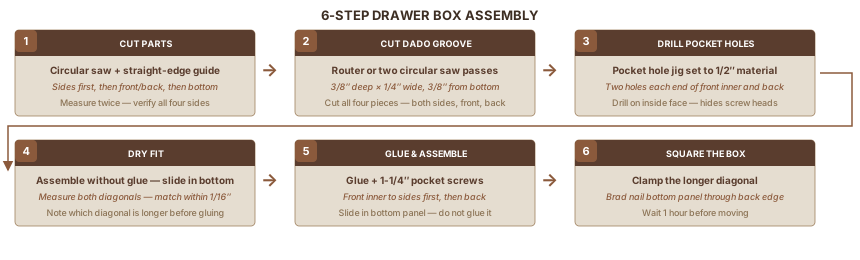
Cut in order: sides first, then front inner and back, then the bottom panel. A straight-edge clamp guide clamped to the plywood acts as an accurate fence for the circular saw.
Measure twice on each piece before cutting.
Step 2: Cut the dado for the bottom panel
This groove holds the bottom panel and lets it float. Set a router to 1/4" wide and 3/8" deep. Cut the groove 3/8" up from the bottom inside edge of all four pieces: both sides, the front inner, and the back.
No router or table saw: run two passes with a standard circular saw blade set to 3/8" depth, spaced 1/4" apart, then clean the waste with a chisel. Or skip the dado entirely and attach the bottom from below with 3/4" staples or brad nails after assembly. The box will be slightly less rigid but functional for light-duty use.
Step 3: Drill pocket holes
Set the pocket hole jig to the 1/2" material setting. Drill two holes in each end of the front inner piece and two in each end of the back piece. Drill on the inside face so the screw heads are hidden inside the assembled box.
Step 4: Dry fit
Assemble without glue. Slide the bottom panel into the dados. Measure both diagonals (corner to corner). They should match within 1/16". If they don't, note which diagonal is longer before you glue.
Step 5: Glue and assemble
Apply a thin bead of glue to each mating surface. Attach the front inner to both sides first, then the back to both sides. Drive 1-1/4" pocket screws at each joint.
Slide the bottom panel into its dadoes.
Do not glue a solid wood bottom. Solid wood expands and contracts with seasonal humidity changes. A glued bottom will crack or blow the box apart. If you're using 1/4" Baltic birch plywood for the bottom, gluing it is fine. Plywood is dimensionally stable.
Step 6: Square the box
Measure the diagonals again. If they don't match, clamp corner-to-corner on the longer diagonal with gentle pressure until they do. Drive one 1" brad nail through the bottom edge of the back piece into the rear edge of the bottom panel. This locks the box in square while the glue cures. Wait at least an hour before moving the box.
Part 4: Installing Slides and the Drawer Face
Mounting the slides
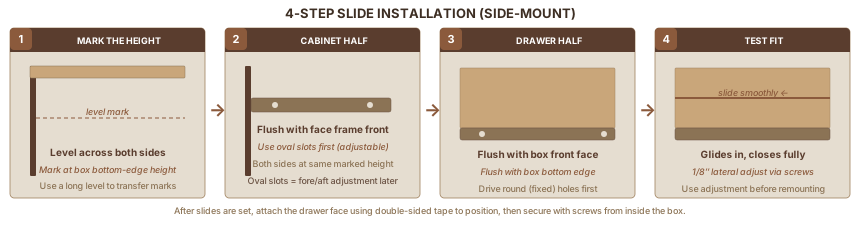
Step 1: Mark the height on both cabinet sides. For side-mount slides, mount the cabinet half so its top surface sits at the height of the drawer box's bottom edge. Mark this position on both interior cabinet sides at the same height. Use a level to transfer the mark from one side to the other.
Step 2: Attach the cabinet half. Drive screws through the factory slots. For face-frame cabinets, align the front of the slide flush with the inside face of the face frame. Use the oval (adjustable) slots for the first installation. They let you shift the slide fore/aft if the drawer face ends up misaligned.
Step 3: Attach the drawer half to the box. Mount it flush with the front face of the drawer box and flush with the bottom edge. Drive screws through the round (fixed) holes first.
Step 4: Test fit. Slide the drawer in. It should glide smoothly and close fully. Most modern slides have 1/8" of built-in lateral adjustment via the mounting screws. Use this before remounting the slide in a different position.
Slide types at a glance
| Slide type | Clearance per side | Box width formula | Approx. cost per pair |
|---|---|---|---|
| Side-mount, 3/4 extension | 1/2" | Opening − 1" | $10–20 |
| Side-mount, full extension | 1/2" | Opening − 1" | $15–40 |
| Side-mount, soft-close | 1/2" | Opening − 1" | $20–60 |
| Undermount (Blum TANDEM) | None (mounts below) | Opening − 1" | $30–80 |
Full-extension slides are worth the extra few dollars. They let the drawer open completely so you can reach the back. Soft-close adds a built-in damper that slows the drawer for the last inch of travel. Worth it for kitchen cabinets or anywhere slamming is a problem.
Attaching the drawer face
- Drill two 1/4" holes through the drawer box's front inner piece. These are your adjustment holes.
- Apply double-sided tape to the back of the drawer face.
- With the drawer closed, hold the face in position against the cabinet. Standard overlay: 3/8" of face overhanging the opening on all four sides. Inset: 1/16" gap on all four sides.
- Open the drawer slowly. The tape holds the face in the correct position.
- Drive two screws from inside the drawer box through the 1/4" holes and into the face.
- Check the reveals, adjust if needed, then add the remaining screws.
Part 5: Troubleshooting
Most drawer problems trace back to one of three causes: wrong box dimensions, slides mounted out of level, or a box that came out of square during assembly.
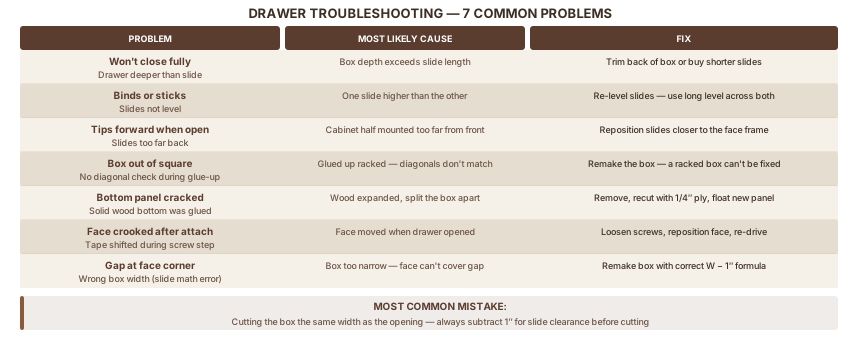
| Problem | Most likely cause | Fix |
|---|---|---|
| Drawer won't close fully | Box deeper than slide length | Trim the back of the box; buy shorter slides |
| Drawer binds or sticks | Slides not level | Adjust slide height; use a long level across both sides |
| Drawer tips forward when open | Slides positioned too far back | Reposition slides closer to the front |
| Box came out of square | Glued up without checking diagonals | Remake the box — a racked box won't align the face |
| Bottom panel cracked | Solid wood bottom was glued | Remove, recut, float the new panel |
| Drawer face crooked after attachment | Tape shifted during the screw step | Loosen screws, re-position face, re-drive |
| Gap at one corner of drawer face | Box too narrow (wrong slide math) | Remake the box with correct width |
The mistake that happens most often
Forgetting to subtract the slide clearance. A drawer box cut to the exact width of the opening won't go in. The slides take up 1" total. Verify your width calculation before cutting.
If you're partway through and realize the width is wrong: the box sides can be shimmed with thin hardwood strips glued on, or you can rip the cabinet sides back and add a filler strip. Easier to get it right from the measurement.
What building drawers unlocks
Once you can build a consistent drawer box, most casework projects are within reach. Desks, nightstands, dressers, kitchen cabinets, tool chests: they all use the same five-part box on the same slides. The math changes slightly with each opening, but the process stays identical.
A coffee table with a drawer is a natural next project: one drawer, simple joinery, and you control the design.
Quick Reference
| Parameter | Side-mount slides | Undermount (Blum) |
|---|---|---|
| Box width | Opening − 1" | Opening − 1" |
| Box height | Opening − 1" | Opening − 1" |
| Box depth | = Slide length | = Slide length |
| Slide clearance | 1/2" per side | None (below box) |
| Cost per pair | $15–40 | $30–80 |
| Soft-close option | Add $5–20 | Usually included |
Sources
This guide draws on manufacturer installation specifications, cabinetmaking references, and technique documentation from woodworking educators.
- Accuride slide specifications — side-mount clearance requirements (1/2" per side)
- Blum TANDEM Planning Guide — undermount slide installation specs and drawer box sizing formulas
- Kreg Jig Learning Center — pocket hole drawer construction, screw sizing by material thickness
- Knape & Vogt product guides — slide types and installation clearances
- Fine Woodworking — joinery strength comparisons and drawer construction techniques
Tools Used
Also Referenced
Tagged
How We Research
We don't take affiliate revenue or accept review units. Picks come from multi-source research — manufacturer specs, OSHA / EPA / ASTM regs, and long-form practitioner threads — plus Ahmed's hands-on use where relevant. When we recommend something, we explain why.
Up Next
Building a Floating Desk With Drawers
CABINETMAKING · Beginner