
How to Use This Guide
A room divider bookshelf is not a wall bookshelf moved into the middle of the room. At 12 inches deep and 72–78 inches tall, it has two requirements that change how you build it: it must stand without leaning on a wall, and every surface (front, back, sides, edges) is visible to someone in the room.
This guide covers the full build: dimensions that work, how to prevent racking and tipping, which materials and joinery to use, the correct build sequence, and how to finish a piece that has no hidden side.
- Skill level: Beginner to intermediate. You need a drill and either a circular saw or table saw. A router makes dado joints easier, but pocket screws work for a first build.
- Prerequisites: Basic measuring and straight cutting. If you're new to dado joints, read the dado cut guide before starting.
- If you want dimensions fast: Jump to Part 1.
- If your unit is wobbling: Jump to Part 2.
- If you're about to finish: Jump to Part 5.
Bookshelves for Room Dividers at a Glance
A room divider bookshelf works when it's stable, the right depth, and finished on every face. Three things separate a successful build from a frustrating one: fix at least two shelves in dadoes (not just pins), add anti-tip hardware, and finish all surfaces before assembly.
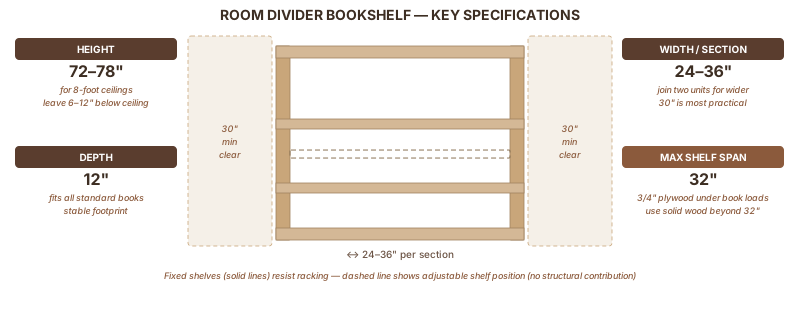
| Recommended depth | 12 inches |
| Recommended height | 72–78 inches |
| Max span (3/4" plywood shelf) | 32 inches unsupported |
| Traffic clearance needed | 30 inches minimum on each side |
| Best material | 3/4" hardwood plywood + solid wood edge banding |
| Anti-tip method | Furniture strap to wall stud |
In this guide:
- Plan your dimensions — height, width, depth, clearance
- Build for stability — stop racking and tipping
- Choose materials and joinery
- Follow the build sequence step by step
- Finish every surface correctly
Part 1: Planning Your Dimensions
The dimensions that work for a wall bookshelf aren't automatically right for a room divider. Two requirements change the math: the unit must be stable on its own, and your chosen depth affects how much floor space it consumes on both sides.
What makes this different from a wall shelf
A wall bookshelf gets its lateral stability from the wall behind it. A room divider gets that stability from its own structure. Every design choice has a structural consequence: depth, width, back panel, fixed versus adjustable shelves.
The second difference is finish. On a wall shelf, the back faces a wall. On a room divider, the back faces a living room, bedroom, or hallway. Every surface is a show surface.
Height
Build to 72 to 78 inches for a standard 8-foot ceiling. A 72-inch unit sits at about eye level for most adults, creating a clear visual separation without closing off the space. A 78-inch unit reads as intentional and architectural.
Leave 6 to 12 inches below the ceiling. Build to exactly floor-to-ceiling height and any small measurement error makes the unit impossible to tip into place.
Account for baseboard trim at the floor, typically 3.5 to 5.5 inches tall. Your unit will either sit against the baseboard (so the bottom shelf clears it) or you'll notch the base to fit over it.
Width per section
Keep individual sections 24 to 36 inches wide. Wider than 36 inches and 3/4" plywood shelves will sag under a typical book load. To build a 60-inch room divider, make two 30-inch units and join them side by side. Two narrower units are structurally stronger than one wide unit and much easier to move.
30 inches is the most practical single-unit width. It fits most shelf-pin jig spacings, keeps weight manageable, and leaves room for design details on either side.
Depth
12 inches is right for a room divider. That depth fits all standard books (paperbacks need 10 inches, most hardcovers need 11 to 12 inches), doesn't dominate floor space, and gives enough footprint to resist tipping.
A 10-inch depth feels narrow and unstable. Anything over 14 inches starts to look heavy and cuts aggressively into usable space on both sides. Stay at 12 inches unless you have a specific reason to go deeper.
Traffic clearance
Leave at least 30 inches on each side of the unit. A standard interior door is 32 inches wide. You'll want at least that much clearance to move furniture past the unit later, and comfortable passage day-to-day.
The math: your unit is 12 inches deep. Add 30 inches of clearance on each side. A single unit consumes about 42 inches from the nearest wall to its far edge. Factor this into your room layout before cutting wood.
Shelf spacing
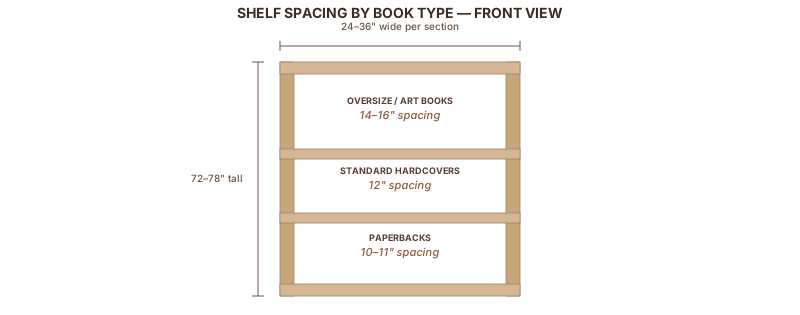
Mix shelf heights for visual interest and function:
| Book type | Shelf spacing |
|---|---|
| Paperbacks | 10–11 inches |
| Standard hardcovers | 12 inches |
| Oversize / art books | 14–16 inches |
A room divider with all shelves equidistant looks like a ladder. Vary one or two bays and the unit looks designed rather than just assembled.
Part 2: Building for Stability
The two failure modes for a tall freestanding bookshelf are racking (side-to-side lean or wobble) and tipping (forward or backward topple). Both are predictable and both have direct fixes.
Racking: the rectangle problem
A rectangular frame with no diagonal elements is a parallelogram in waiting. Books are heavy at 20 to 30 pounds per linear foot, and that cumulative horizontal load can push a poorly-built carcass into a lean over time.
A triangle cannot be deformed without changing the length of one of its sides. A rectangle can. Every anti-racking method works by adding triangulation.
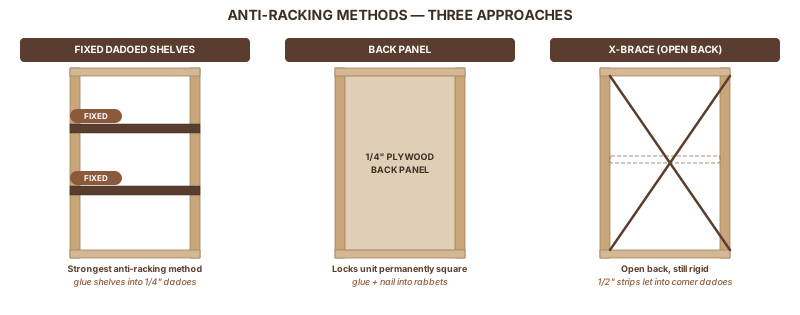
Method 1: Fixed dadoed shelves
This is your first line of defense. Fix at least the top shelf, the bottom shelf, and one middle shelf in dadoes cut into the side panels. A shelf sitting in a 1/4-inch dado has mechanical resistance on three sides and cannot rack. Adjustable shelves, sitting only on shelf pins, contribute zero anti-racking strength.
Cut the dado to 1/4 inch deep (one-third of 3/4-inch material thickness). Glue the shelf into the dado at assembly. No screws needed. With proper glue and clamping, this joint is stronger than the wood around it.
Rule: no more than 5 feet between fixed shelves. A 78-inch unit needs the top, bottom, and at least one shelf in the middle.
Method 2: Back panel
A 1/4-inch plywood back, glued and nailed into rabbets along the inside back edge of all four sides, triangulates the entire carcass. Strongest option. For a room divider, the back panel is fully visible from one side, so finish it on both faces. Use pre-sanded hardwood plywood (one good face on each side) or finish the panel before assembly.
Method 3: X-brace (for open-back designs)
Two 1/2-inch by 1-inch strips crossing diagonally across the back opening, let into shallow dadoes at all four corners where they meet the frame. This keeps the back open for light and visibility while adding the triangulation that prevents racking. According to FineWoodworking's guide to adding diagonal bracing, an X-brace provides the same in-plane rigidity as a solid panel. It reads as a design element, not just structure.
Method 4: Corner gussets
3/4-inch plywood triangles, approximately 6 inches per side, glued into the back corners at top and bottom. These sit inside the unit and are nearly invisible from normal viewing angles. They add meaningful anti-racking strength without a back panel or visible brace.
For a first build: use Method 1 (fixed dadoed shelves) plus a wall strap (see below). That combination is structurally adequate, easiest to build, and keeps the back fully open.
Tipping: the center of gravity problem
A unit tips when its center of gravity moves outside the footprint of its base. The taller the unit and the more top-heavy the loading, the easier it tips. The CPSC recommends anchoring all bookshelves over 30 inches tall to prevent tip-overs, especially in homes with children or pets.
Option 1: Furniture strap (recommended)
A furniture strap ($15 to $40 at any hardware store) screws into the back of the unit and through drywall into a wall stud. Nearly invisible. Handles the entire tip load. This is the right answer for most situations.
Option 2: Ceiling pressure post (for rentals)
Cut a 2x4 to floor-to-ceiling height minus unit height. Screw through the top of the unit up into the post. The post bears against the ceiling and floor using compression. No wall penetration required. Strong, reversible, and works in any room.
Option 3: Extended base
Add a plywood plinth extending 3 to 4 inches past the unit sides on the floor. A wider footprint lowers the effective tip-over point. This works, but requires deliberate design to look intentional rather than awkward.
Keep heavy books on the bottom two shelves. Distribute weight evenly left to right. Add adjustable levelers at the base corners so the unit sits flat on an uneven floor.
| Anti-racking method | Tools needed | Works open-back? | Beginner-friendly? |
|---|---|---|---|
| Fixed dadoed shelves | Router or table saw | Yes | Yes, with practice |
| Back panel (1/4" plywood) | Saw + nail gun | No (closes off back) | Yes |
| X-brace | Router + chisel | Yes | Intermediate |
| Corner gussets | Saw + clamps | Yes | Yes |
Part 3: Materials and Joinery
What to build with
3/4" hardwood plywood (maple or birch veneer, A1 or A2 grade) is the right starting material for the carcass: sides, top, and bottom. It's dimensionally stable (it resists the warping that solid wood can develop with seasonal moisture change), lighter than equivalent solid wood, and takes a clean paint or stain finish.
The tradeoff: all plywood edges need treatment. Raw plywood edge shows the lamination layers and looks cheap. Cover every visible edge with iron-on hardwood edge tape or glue on a 3/4-inch solid wood strip.
3/4" solid hardwood is the better choice for the shelves. Woodweb's technical comparison of plywood versus solid wood puts solid hardwood at roughly twice the rigidity of plywood for the same cross-section. Solid shelves also show natural grain on all four edges, no edge banding required. Shelves visible from both sides also benefit from solid wood: natural grain on all four edges and no edge banding required.
For a light, airy room divider, choose maple, ash, or white oak. These species have pale grain that reads as open and bright. Dark walnut looks beautiful but reads as visually heavy in a room divider. The opacity works against the transparent feel you're building toward.
Avoid MDF for structural members of a freestanding unit. It's heavy, absorbs moisture at cut edges, and holds screws poorly perpendicular to the face. Fine for painted wall shelves. Wrong here.
See sheet goods for cabinets for a full breakdown of plywood grades and what to look for at the lumber yard.
Recommended materials for a 30" x 12" x 78" unit:
- 2 sheets of 3/4" hardwood plywood (maple or birch veneer) — sides, top, bottom
- 4 to 6 boards of 3/4" solid hardwood (1x12, S4S) — fixed and adjustable shelves
- Solid hardwood edge banding, 3/4" wide — all plywood edges
- 1/4" hardwood plywood panel (optional back, pre-sanded) — if using a closed back
Shelf sag: the span limit
Standard 3/4" plywood has a practical span limit of 32 inches unsupported under typical book loads. Beyond that, the shelf deflects enough to be visually obvious. The engineering standard for residential shelving is L/360 deflection: a 36-inch shelf should not sag more than 0.1 inches.
The Woodbin Sagulator, the standard shelf-deflection calculator used by woodworkers, shows that a 3/4" birch plywood shelf at 36 inches under 30 lbs per linear foot approaches that limit. The same calculation for solid maple shows about twice the stiffness.
If your unit is wider than 32 inches between uprights, do one of three things:
- Add a vertical divider at center
- Use solid hardwood shelves instead of plywood
- Glue a 3/4" x 1.5" solid hardwood strip to the front edge of each plywood shelf. Popular Woodworking's shelf stiffness research shows this adds 30 to 50 percent stiffness.
Don't substitute 1/2" plywood for shelves to save material. Its span limit is 24 inches under book loads — you'll have visible sag within months on a 30-inch unit.
Joinery
Pocket screws + glue is the fastest method and works fine for a first build. A Kreg jig costs $30 to $60. Use 1-1/4" pocket screws for 3/4" material. The limitation: screw pockets are visible on interior surfaces and the joint is slightly less rigid than a dado. Best for painted finishes where you'll fill the pockets.
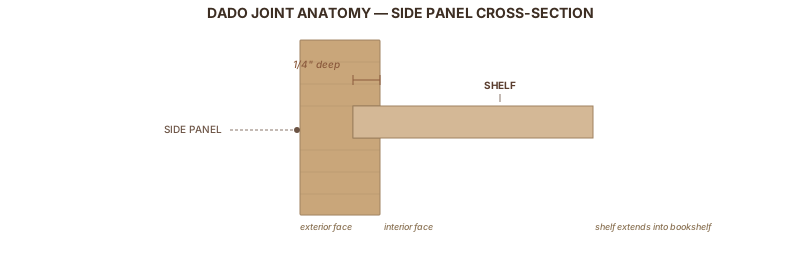
Dados + rabbets is the right method for a room divider. A dado is a channel cut across the grain of the side panel; the shelf sits in it. This joint is stronger than a screw connection, contributes directly to anti-racking, and leaves no visible hardware. The cut is simple with a router and a 3/4" straight bit, or a table saw with a dado stack.
Dado depth: 1/4 inch, or one-third of 3/4" material thickness. This is the standard rule. Too shallow and the shelf doesn't seat. Too deep and you weaken the side panel.
See dado joints with a table saw for technique if this is your first time cutting dadoes.
Shelf pin holes for adjustable shelves: Drill 1/4-inch holes in two rows down each side panel, at 32mm spacing (the European cabinet industry standard). Use a pegboard jig or a commercial shelf-pin jig to keep all four rows aligned. Misaligned holes mean tilted shelves. Position both rows 1 inch from the front edge and 1 inch from the back edge of each side panel.
Part 4: The Build Sequence
Cut list for a 30" wide x 12" deep x 78" tall unit
| Part | Material | Quantity | Dimensions |
|---|---|---|---|
| Sides | 3/4" hardwood plywood | 2 | 12" x 78" |
| Top | 3/4" hardwood plywood | 1 | 12" x 28.5" |
| Bottom | 3/4" hardwood plywood | 1 | 12" x 28.5" |
| Fixed shelves | 3/4" solid hardwood | 2 | 11.25" x 28.5" |
| Adjustable shelves | 3/4" solid hardwood | 4–5 | 11.25" x 28.5" |
| Back panel (optional) | 1/4" hardwood plywood | 1 | 28.5" x 77.5" |
| Edge banding | 3/4" solid hardwood | — | All exposed plywood edges |
Shelf width = unit interior width = unit total width minus two side thicknesses (2 x 3/4" = 1.5"). Shelf depth = unit depth minus back panel thickness if using one (12" minus 0.25" = 11.75").
Scale all dimensions proportionally for different heights and widths. The formulas hold.
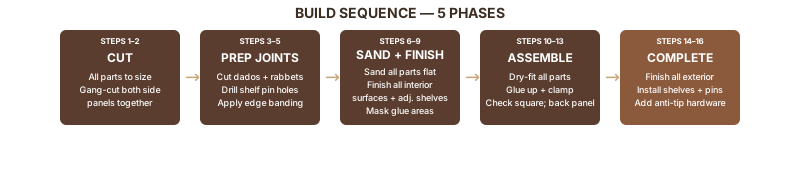
Step-by-step
1. Cut all parts to final dimension. Cut both side panels together. Stack them or gang-cut them so they're identical length. Any difference between the two sides makes the unit non-square and unrecoverable after glue-up.
2. Lay out dado locations. Use the actual fixed shelf as your reference for the dado width. Don't assume 3/4" plywood is exactly 3/4". It's often 23/32". Clamp the two side panels face-to-face and mark dado locations across both at once. This ensures your fixed shelves sit level.
3. Cut dados for fixed shelves. Use a router with a 3/4" straight bit and a fence jig (a scrap board clamped square to the workpiece). Set depth to 1/4 inch. Cut both panels with the same setup.
4. Cut rabbets for the back panel (if using). A 3/8"-deep by 1/4"-wide rabbet along the inside back edge of all four frame pieces (sides, top, bottom). This creates the recess for the back panel.
5. Drill shelf pin holes. Use your pegboard or commercial jig. Drill all four rows (two per side panel) before any assembly. Check one finished panel against the other to confirm the holes are in the same relative positions.
6. Apply edge banding to all plywood edges. Iron-on hardwood edge tape (clothes iron on cotton setting, then trim flush) or glue on solid strips. Do this before finishing. The banding needs sanding flush before a finish coat.
7. Sand all parts to 180 grit. Sand now, while everything is flat. Interior surfaces are nearly impossible to reach after assembly, especially corners. Use a random orbital sander for flat faces. Hand sand with a block for edges.
8. Finish all interior surfaces. Apply your full finish system to every surface that will be inside the assembled carcass. Mask all dado faces and glue surfaces with painter's tape. Let the finish cure fully before assembly: at minimum 24 hours for oil-based, 4 hours for water-based.
9. Pre-finish all adjustable shelves. Finish both faces and all four edges of each shelf. These are flat and easy to handle. Once the unit is assembled, shelves are still accessible but finishing them flat is faster and cleaner.
10. Dry-fit before glue. Assemble the carcass without glue. Confirm all joints fit cleanly, the fixed shelves slide fully into their dadoes, and the back panel (if using) drops into its rabbets. Fix tight joints now.
11. Glue up. Apply wood glue to the dadoes and fixed shelf ends. Assemble sides, fixed shelves, top, and bottom. Clamp across the width with bar clamps, padding the plywood faces with scrap wood cauls. Work quickly. PVA glue open time is 5 to 10 minutes.
12. Check square immediately. Measure diagonals corner to corner. Both measurements must match. If they don't, apply one bar clamp diagonally across the longer measurement. This pulls the long diagonal shorter and brings the carcass to square. Check again. Set aside to cure.
13. Install the back panel (if using). Run a bead of glue in the rabbets. Set the back panel in place. Secure with 1" brad nails or 1/2" staples every 8 inches around the perimeter. Measure diagonals again. The back panel locks the carcass permanently square.
14. Finish exterior surfaces. Apply the same finish to all exterior surfaces: outside faces of both sides, top, bottom, and all four edges of the assembled unit. See Part 5 for the complete sequence.
15. Install shelf pins and adjustable shelves.
16. Install anti-tip hardware. Attach a furniture strap to the back top of the unit and into wall studs. If using a ceiling pressure post, cut to fit and screw up into the top of the unit.
Part 5: Finishing All Surfaces
Why every surface needs finish
Wood exchanges moisture with the air. A finished surface slows that exchange. An unfinished surface runs free. When one face of a panel is finished and the other is bare, the bare side gains and loses moisture faster. It expands and contracts more than the finished face. The panel cups toward the wetter side.
For a room divider, cupping matters twice: structurally (wide panels on side panels will warp over years) and visually (every surface is seen). There is no "back" to skip.
The sequence
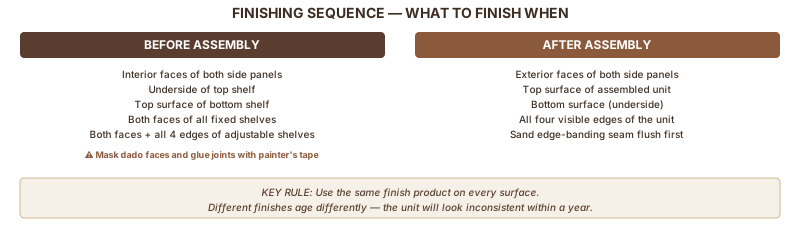
Before assembly: Finish all interior surfaces: inside faces of the sides, underside of the top, top of the bottom, and both faces of fixed shelves. Mask glue surfaces (dado faces, joint areas) with painter's tape so glue bonds properly later.
After assembly: Finish all exterior surfaces: outside faces of both sides, top of the unit, bottom, and every visible edge. Sand the assembly seam between edge banding and panel face flush before applying this coat.
Adjustable shelves: Finish both faces and all four edges before installing. Easier to handle when flat.
How to finish both sides in one session
Rest each piece on finish pyramids (plastic standoffs, about $10 for a set) or finish nails tapped partway into a sacrificial board. This elevates the piece just enough so wet finish on the bottom face doesn't contact the work surface.
Finish one face, let it tack off (15 to 30 minutes for oil-based, 5 to 10 minutes for water-based), then flip and finish the other face in the same session. Both faces cure together. No moisture imbalance develops between them.
Use the same finish product on every surface. Family Handyman's finishing tips specifically call out the pyramid technique for finishing panels that need both faces done. A different topcoat on "front" versus "back" means different sheen, different color development as the finish ages, and different durability. The unit will look inconsistent within a year.
What finish to use
Oil-based polyurethane in satin sheen is the right choice for furniture that will be touched, used, and seen from all angles. Apply two to three coats, sanding with 220-grit between coats using a random orbital sander or a folded sanding sheet.
Satin, not gloss, for a room divider. Gloss finish on five visible surfaces in a living room creates too much reflection. Satin reads as furniture; gloss reads as a lacquered kitchen cabinet.
RELATED: Applying Polyurethane Full guide to brush technique, coat schedules, between-coat sanding, and troubleshooting runs and drips.
Quick Reference
| Parameter | Recommendation | Notes |
|---|---|---|
| Height | 72–78 inches | 8' ceiling; leave 6–12" clearance |
| Width per section | 24–36 inches | Join two units for longer dividers |
| Depth | 12 inches | Fits books; stable footprint |
| Traffic clearance | 30 inches minimum | Each side of unit |
| Max shelf span (3/4" plywood) | 32 inches | Add edge band or use solid wood beyond this |
| Fixed shelf spacing | Top + bottom + at least 1 middle | Anti-racking requirement |
| Shelf pin hole spacing | 32mm (1-1/4") centers | European cabinet industry standard |
| Shelf pin hole size | 1/4" | Standard steel shelf pin |
| Anti-tip | Furniture strap to wall stud | Or ceiling pressure post for rentals |
| Finish sheen | Satin or matte | Appropriate for multi-sided furniture |
| Finish sequence | Interior before assembly; exterior after | Prevents cupping |
Sources
This guide is based on woodworking forums, furniture engineering references, CPSC safety guidelines, and material data from professional cabinetmaking sources.
- Woodbin Sagulator — shelf deflection calculator for any material, span, and load
- Woodbin Shelf Sag Measurements — sag data tables by material and span
- Popular Woodworking — Build Stronger, Sag-Proof Shelves — edge banding stiffness data showing 30–50% strength increase
- Woodweb — Span Limits for Plywood Shelving — professional cabinet shop span guidelines
- CPSC Tip-Over Prevention — government guidance on anchoring bookshelves over 30"
- FineWoodworking — Adding Diagonal Bracing — structural diagonal bracing principles and rigidity comparison
- Sawmill Creek — Open Back Shelves — anti-racking methods for open-back shelf designs
- This Old House — Best Wood for Bookshelves — material selection and species guidance
- Woodweb — Plywood vs. Solid Wood — rigidity comparison: solid hardwood vs. plywood
- WoodworkingTalk — Finishing Both Sides at Once — technique discussion for panel finishing
- Family Handyman — Wood Finishing Tips — finishing pyramid standoff technique
- Dimensions.com — V Bookcase Room Divider — standard room divider dimensions reference
- Sawmill Creek — Bookcase Carcass Joints — joinery options for casework
- Sawmill Creek — Attaching Shelves in Bookcases — shelf pin and dado comparison
How We Research
We don't take affiliate revenue or accept review units. Picks come from multi-source research — manufacturer specs, OSHA / EPA / ASTM regs, and long-form practitioner threads — plus Ahmed's hands-on use where relevant. When we recommend something, we explain why.
Up Next
How to Build a Face Frame
CABINETMAKING · Intermediate