
1/2 Inch Plywood at a Glance
If you've been typing "1 2 plywood" or "half inch plywood" into the search bar, you're in the right place. The sheet labeled "1/2 inch" actually measures 15/32" (0.469"). Mill sanding removes 1/32" during manufacturing. That gap matters for dado joinery but not for sheathing or shelving decisions.
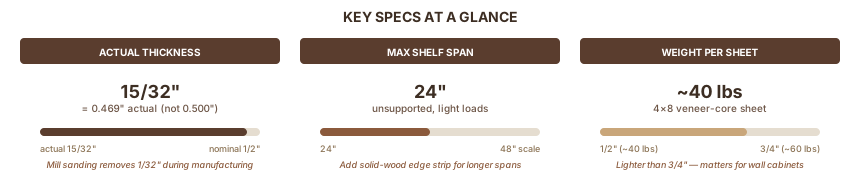
| Actual thickness | 15/32" (0.469") — not 0.500" |
| Weight per 4×8 sheet | ~40 lbs (veneer-core) |
| Max unsupported shelf span | 24 inches |
| Best cabinet grade at big-box | PureBond birch (C-3) |
| Structural span rating | 32/16 (CDX/Rated Sheathing) |
| Typical price range | $30–65/sheet depending on grade |
In this guide:
- What "1 2 plywood" means, and actual thickness
- Grade systems decoded: CDX, C/3, A/B birch
- Cabinets, drawers, shelves: what 1/2" is right for
- When to use 3/4" instead
- Where to buy and what to check in the store
Part 1: What You're Actually Buying
The notation confusion
If you typed "1 2 plywood" or "1 2 inch plywood" and wondered if you spelled it wrong, you didn't. "1 2 plywood," "1/2 inch plywood," "15/32 plywood," and "half inch plywood" all describe the same sheet. The slash gets dropped in casual searches because typing fractions is awkward. The label at the store will say "1/2 in." or "15/32." They're the same product.
The "4x8" part means a sheet that's 4 feet wide by 8 feet long (48" × 96"). That measurement is accurate. Only the thickness is nominal.
Actual thickness: 15/32" (0.469")
According to Vinawood's plywood sizing guide, the actual thickness of nominal 1/2" plywood is 15/32" (0.469 inches, or about 11.9mm). The mill sanding process removes roughly 1/32" from each panel.
For most applications, this doesn't matter. Building codes treat 15/32" and 1/2" as equivalent for wall sheathing, roof sheathing, and subfloor use. No inspector will reject a 15/32" panel where 1/2" is specified.
For dado joinery, it matters. A dado routed to exactly 0.500" will leave a slightly loose fit on a 15/32" panel. Always measure the actual sheet with calipers before cutting dadoes. Don't assume 0.500".
One exception: Sande plywood (SANDEPLY) at Home Depot is sold as 12mm (0.472"), slightly thicker than 15/32". If you're cutting dadoes for multiple panel types in the same project, measure each one.
Core types
The veneer on the face is only part of what you're buying. The core determines weight, stiffness, and how well it holds screws:
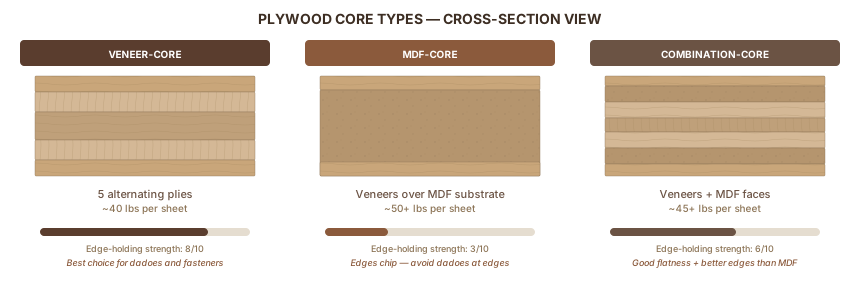
Veneer-core (most common). Five alternating plies, each running perpendicular to the next. Cross-graining prevents warping. Weighs about 40 lbs per sheet. Best screw-holding in the face, decent at edges. This is the standard choice for furniture and cabinetry.
MDF-core. Face veneers over an MDF substrate. Very flat. If you're painting a large panel, this produces the smoothest result. It's heavier (50+ lbs) and holds screws poorly at edges. Avoid MDF-core if you're cutting dadoes or dovetailing the edges. The MDF chips and crumbles.
Combination-core. Veneer layers sandwiched with MDF faces. Combines the flatness of MDF with better edge strength. Costs more. Worth it for premium painted cabinet boxes where flatness is the priority.
RELATED: 15/32 Plywood: What It Is and When to Use It The industry designation for half-inch structural panels, and when it's safely interchangeable with 1/2".
Part 2: How Plywood Grades Work
Plywood uses two separate grading systems depending on whether it's hardwood (for furniture and cabinets) or softwood (for construction). You'll see both at the store.
HPVA: hardwood plywood grades
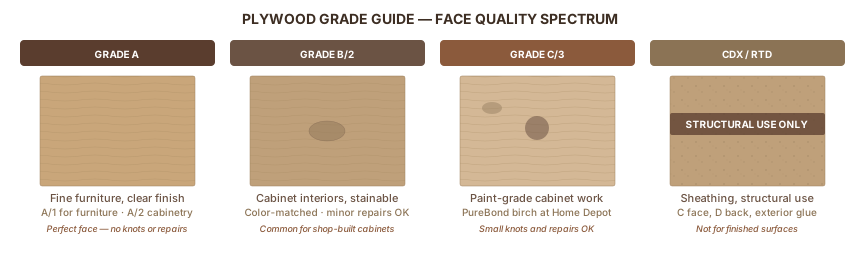
HPVA (Hardwood Plywood and Veneer Association) grades hardwood plywood by face and back appearance. The grade is written as a letter (face) and a number (back), such as A/2 or C/3.
Face grades:
| Grade | Surface Quality | Best Use |
|---|---|---|
| A | Matched grain and color, no knots, no repairs | Clear finish furniture and cabinetry |
| B | Color-matched, minor repairs and tight knots allowed | Exposed cabinet interiors, stainable |
| C | Small knots and repairs OK — surface must be smooth | Paint-grade cabinet work |
| D | More defects allowed, rough veneer OK | Concealed surfaces only |
Back grades:
| Grade | What It Allows |
|---|---|
| 1 | Tight knots ≤ 3/8", no repairs |
| 2 | Knots up to 3/4", repairs allowed |
| 4 | Reject-grade — concealed areas only |
The grades you'll actually see on the shelf:
| Grade | What You Get | Good For |
|---|---|---|
| A/1 | Perfect face, near-perfect back | Fine furniture, clear finish |
| A/2 | Perfect face, decent back | Quality cabinetry |
| B/2 | Good face, serviceable back | Cabinet interiors, stainable |
| C/3 (PureBond birch) | Decent face, rough back | Cabinet backs, shop projects |
Columbia Forest Products' PureBond birch is the standard birch plywood at Home Depot, sold in C-3 grade. It's formaldehyde-free, which matters for enclosed cabinet interiors. The face isn't flawless, but it sands and paints well.
APA: softwood structural grades
The APA (The Engineered Wood Association) grades softwood panels for construction. You'll see CDX, BCX, and "Rated Sheathing" stamped on panels at the big-box store.
CDX: C face, D back, exterior glue ("X"). The glue is waterproof, so the panel survives rain during construction without delaminating. The face is rough with visible repairs. CDX is for sheathing and structural use, not for finished surfaces.
Rated Sheathing with span rating 32/16: The most common stamp on 1/2" structural panels. The first number (32) is the maximum roof span in inches; the second (16) is the maximum floor/subfloor span. For wall sheathing, 32/16-rated panels work at 16"OC stud spacing and often at 24"OC depending on panel orientation. Your local building code has the final word.
If the stamp says "Exposure 1," the panel can get wet during construction but isn't designed for permanent exterior exposure without protection. "Exterior" means fully waterproof. Use that for exterior plywood applications.
Part 3: What 1/2 Inch Plywood Is Good For
Cabinet construction
Half-inch plywood is standard for several cabinet components. Where it falls short, 3/4" takes over. See Part 4 for the decision rules.
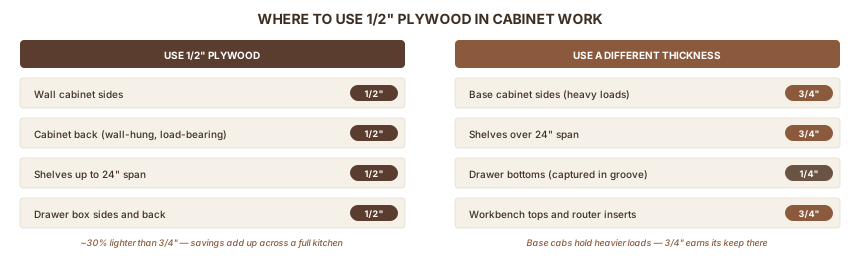
| Cabinet Component | Use 1/2"? | Notes |
|---|---|---|
| Wall cabinet sides | Yes | Lighter than 3/4" — reduces weight for wall mounting |
| Base cabinet sides | Sometimes | 3/4" is more common; 1/2" if weight is a concern |
| Cabinet back (wall-hung) | Yes | Required when screwing through to wall studs |
| Cabinet back (non-structural) | No | Use 1/4" — 1/2" is overkill and adds weight |
| Shelves ≤ 24" span | Yes | Handles light to moderate loads |
| Shelves > 24" span | No | See shelving section below |
| Drawer box sides | Yes | Industry standard for quality drawer boxes |
| Drawer bottoms | No | Use 1/4" captured in a groove |
The cabinet back is worth explaining. When you mount a wall cabinet directly to the wall, the screws go through the cabinet back into the studs. That back panel takes the full weight of the cabinet and everything in it. Per industry practice, 1/2" is the minimum for a load-bearing cabinet back. Quarter-inch backs are fine when a separate hanging rail handles the load.
Drawer boxes
Standard drawer box construction in quality cabinetry uses 1/2" sides, front, and back, with a 1/4" bottom captured in a groove cut near the base of each side. According to Fine Woodworking's forum discussion on cabinet construction, 1/2" drawer sides are the near-universal choice for production cabinetmakers because the weight savings add up across an entire kitchen's worth of drawers.
For premium drawer boxes, Baltic birch is the first choice. The all-birch plies have no voids, hold staples and screws well, and the exposed edges look clean. You get a visible stripe pattern instead of the dark gaps common in domestic plywood.
RELATED: How to Build Drawers Dimensions, joinery options, and assembly sequence for plywood drawer boxes.
Shelving spans
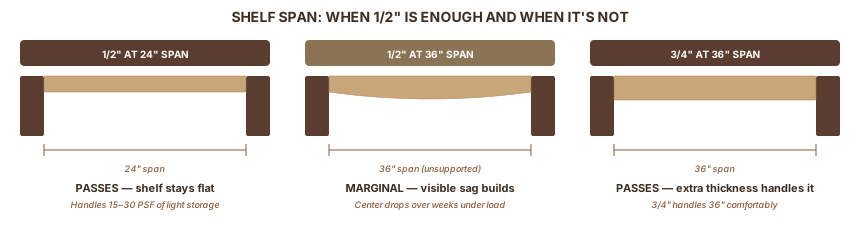
The practical limit for 1/2" plywood shelving is 24 inches between supports. According to Woodweb's span limits reference, a 1/2" veneer-core shelf at 24" handles 15–30 PSF. That covers paperbacks, small items, and light storage.
Past 24", expect visible sag under moderate loads. Not immediate. The shelf won't collapse. But over months of holding books, tools, or stored goods, the center drops.
Solutions for longer spans:
- Add a solid-wood front edge: glue a 3/4" × 3/4" strip of hardwood to the front edge. This acts like a mini I-beam and dramatically stiffens the shelf.
- Add a center support: a single support at 36" turns a 72" span into two 36" spans.
- Switch to 3/4" plywood for anything spanning more than 32" without support.
If you're building a full bookshelf unit rather than a single shelf, bookshelves for room dividers covers span decisions, anti-racking methods, and the complete carcass build sequence.
Construction and sheathing
For wall sheathing, roof sheathing, and subfloor underlayment, 1/2" is the right call. CDX or Rated Sheathing panels with a 32/16 span rating handle typical residential framing. Check APA's rated sheathing datasheet for span ratings and species group requirements if your project needs engineering documentation.
1/2" also works as an underlayment layer over an existing subfloor, to level a surface before hardwood or tile installation. It's not a primary structural subfloor. That's typically 3/4".
Part 4: When to Use 3/4 Inch Instead
Half-inch is right for a specific set of applications. When those applications involve heavier loads, longer spans, or thicker dadoes, 3/4" is the call.
| Project Component | Use 1/2" | Use 3/4" |
|---|---|---|
| Wall cabinet sides | ✓ | |
| Base cabinet sides | ✓ | |
| Drawer box sides | ✓ | |
| Cabinet back (wall-hung) | ✓ | |
| Shelves ≤ 24" span | ✓ | |
| Shelves > 24" span | ✓ | |
| Workbench tops | ✓ | |
| Router table inserts/tops | ✓ | |
| Face-frame plywood backs | ✓ or 1/4" |
Three upper cabinets in 3/4" birch versus 1/2" birch adds roughly 12–18 lbs to what you're mounting to the wall. Manageable either way, but the weight savings from 1/2" are real. Take them when the application allows.
For dado joints, 3/4" leaves more material on either side of the groove. Stronger shoulders, better glue surface. For base cabinets holding 50 lbs of cast iron, the extra thickness earns its keep.
For a deeper comparison, see 3/4 Plywood: Types, Grades, and How to Choose.
Part 5: Buying Guide
What to buy and where
The right sheet depends on what you're building.
For cabinet boxes (painted or stained):
- At Home Depot: PureBond birch C-3 or Sande plywood (SANDEPLY 12mm). PureBond is the better call for stained work. The birch face takes stain more evenly than Sande.
- At a lumber yard: A/B birch for stained work, or B/2 domestic hardwood veneer.
For drawer boxes:
- Baltic birch B/BB from a specialty dealer. The all-birch voids-free construction and thicker veneers make it worth the trip.
For wall sheathing or rough construction:
- Any big-box CDX or RTD 1/2". No need to pay for birch face quality when it's going behind drywall.
For shop jigs and fixtures:
- Sande plywood (cheap, smooth, easy to cut) or leftover CDX. No need for hardwood grades.
Price ranges (approximate 2025)
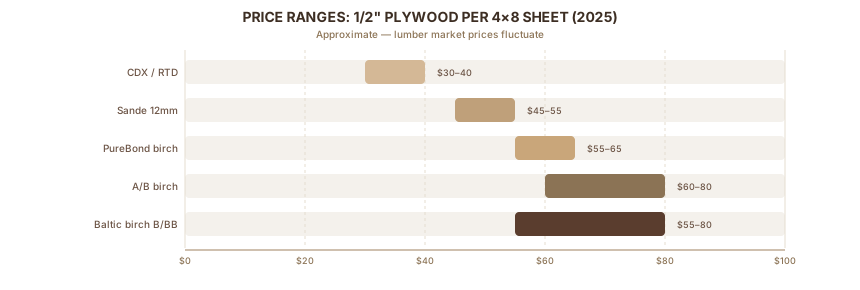
| Product | Grade | Price Range |
|---|---|---|
| CDX / RTD | C/D structural | $30–40/sheet |
| Sanded utility plywood | C/D sanded | $35–50/sheet |
| Sande (SANDEPLY 12mm) | Smooth tropical face | $45–55/sheet |
| PureBond birch | C-3 domestic | $55–65/sheet |
| A/B birch (lumber yard) | A face, B back | $60–80/sheet |
| Baltic birch B/BB | All-birch | $55–80/sheet |
Prices fluctuate with lumber markets. The premium for good birch over CDX is real, and so is the difference in quality when you're finishing a cabinet interior.
Quality checks at the store
Per Popular Woodworking's plywood selection guide, what you see at the edge of the sheet tells you more than what you see on the face:
- Pull from the middle of the stack. Edge sheets take the most handling damage: bowed edges, dented corners.
- Stand the sheet on its long edge and sight down it. More than 1/8" of bow in 8 feet is trouble.
- Check the panel edge. Count the plies. Look for voids (dark gaps between layers), especially in the center plies.
- Side-light the face. Hold a flashlight parallel to the surface. Ripples and waves (telegraphing from the core) disappear from straight-on but show clearly with raking light.
- Check veneer thickness. Run your fingernail along the panel edge. If the face veneer is barely visible, it's too thin to sand without blowing through.
The veneer thickness test matters for birch panels from big-box stores. Domestic birch often has face veneers under 1mm. Fine for painting, risky for sanding. Baltic birch has thicker veneers (about 1.5mm on B-grade faces), which gives you room to sand out light imperfections.
Sources
Research for this guide drew on industry grading standards, cabinetmaking forums, and product specifications.
- APA Rated Sheathing Product Guide — structural panel span ratings and exposure classifications
- Vinawood — 1/2 Plywood Actual Size — actual thickness, weight, and uses
- HPVA Grading Standards (via IKE Trading) — face and back grade definitions
- Anderson Plywood — Grading Information — practical grade explanations
- Woodweb — Span Limits for Plywood Shelving — PSF load limits by thickness
- cutr.com — Plywood Thickness Explained — core types and selection
- Woodworkers Source — Baltic Birch Guide — Baltic birch properties and uses
- Popular Woodworking — Choose the Right Plywood — grade selection and store tips
- Woodshop Diaries — Cabinet Plywood Guide — cabinet component thickness
Up Next
15/32 Plywood: What It Is and When to Use It
WOOD & MATERIALS · Beginner