
Dado Joint With Table Saw at a Glance
This is the technique deep-dive. If you're new to dadoes and just want to know what one is and your three cutting options (router / table saw / circular saw), start with the concept page: Dado Cut: What It Is and How to Cut One. This page assumes you've decided on the table-saw method and need the setup, plywood-fit math, and troubleshooting.
A dado stack turns your table saw into the fastest dado-cutting machine in your shop. Stack blades and chippers on the arbor, set the height to 1/4", and you can cut a clean 23/32" dado for undersized plywood in one pass. From opening the box to accurate dadoes across two cabinet side panels — here's everything you need.
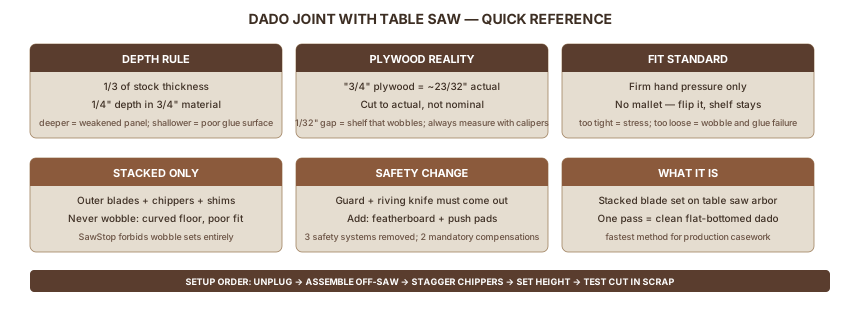
| What a dado stack is | Outer blades + chippers + shims stacked on the table saw arbor |
| Stacked vs. wobble | Stacked only — wobble dados cut curved bottoms, not flat ones |
| Depth rule | 1/3 of stock thickness (1/4" in 3/4" material) |
| Plywood reality | "3/4" plywood = ~23/32" actual — cut to actual, not nominal |
| Safety change | Guard and riving knife must come out; featherboard + push pads are mandatory |
| Fit standard | Firm hand pressure, no mallet — flip it, the shelf stays put |
In this guide:
- How a dado stack works
- Full 14-step setup sequence
- Dialing in width for undersized plywood
- Cutting technique and feed rate
- Stopped dadoes on the table saw
- Safety: what changes with a dado stack
- Troubleshooting the eight most common problems
Part 1: Why the Table Saw Is the Right Tool for Dadoes
Skill level: Beginner with a table saw. Prerequisite: Read Dado Cut: What It Is and How to Cut One first — this guide assumes you understand what a dado joint is and why it's used.
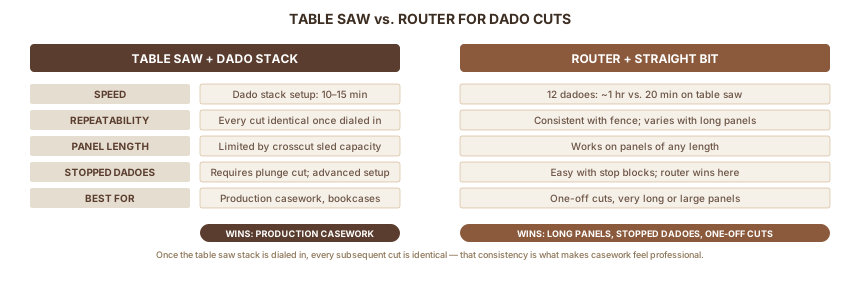
A router with a straight bit produces excellent dadoes. But a dado stack on a table saw is faster, more repeatable, and better for production work — a bookcase with 12 dadoes takes 20 minutes with a dado stack versus an hour with a router. Once you've set up the stack and cut a test dado that fits, every subsequent cut is identical. That consistency is what makes casework feel professional.
The router wins when you have one odd dado to cut or need a stopped dado on a panel too long to push across the saw. The table saw wins for everything else.
Part 2: How a Dado Stack Works
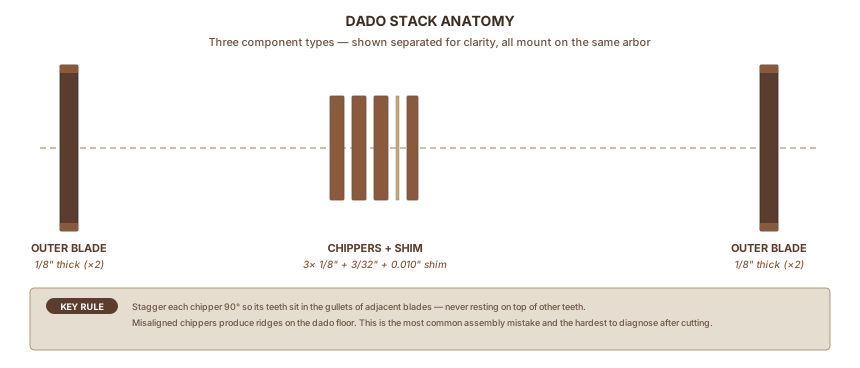
A dado stack replaces your standard table saw blade and uses three components working together to cut a flat-bottomed channel in a single pass.
Outer blades (two): Look like conventional saw blades — typically 1/8" thick each. The outer blades cut the dado's shoulders (the vertical walls). Look for 24 teeth per outer blade with a negative hook angle of 5° or greater. The negative hook reduces chipout on plywood face veneers.
Chippers: Small-diameter blades with two to four teeth each. They sit between the outer blades and remove the material between the shoulder cuts. More teeth means a flatter, cleaner dado floor — four-tooth chippers are meaningfully better than two-tooth. Chippers come in standard thicknesses: 1/8", 3/32", and 1/16". You combine them to reach the width you need.
Shims: Very thin discs — 0.005", 0.010", 0.015", 0.020" — for micro-adjusting the total stack width. Magnetic shims are worth the extra cost. They cling to the blades during assembly and won't fall into the arbor threads.
The key to a flat dado bottom is chipper alignment. Each chipper's teeth must sit in the gullets (the spaces between teeth) of the adjacent blades. Never rest them on top of other teeth. When correctly staggered, the chippers and outer blades cut at exactly the same depth. Misaligned chippers produce ridges on the dado floor. This is the single most important assembly rule.
| Component | Typical thickness | Function |
|---|---|---|
| Outer blade (×2) | 1/8" each | Cut dado shoulders |
| 1/8" chipper | 1/8" | Primary width increment |
| 3/32" chipper | 3/32" | Fine-tuning, undersized plywood |
| 1/16" chipper | 1/16" | Narrow adjustments |
| Shim (various) | 0.005"–0.020" | Final width micro-adjustment |
Stacked dado vs. wobble dado
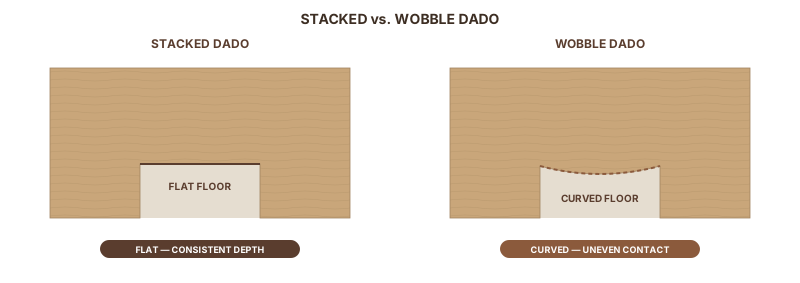
Never buy a wobble dado for furniture or cabinet work. A wobble dado is a single blade mounted on an adjustable offset cam. It oscillates side-to-side as it spins and technically creates a wider kerf, but the bottom is curved, not flat. Three experienced woodworkers — Rob Johnstone, Rick White, and Ian Kirby — are all quoted in Woodworkers Journal comparing stacked vs. wobble dado sets and reach the same conclusion. Kirby's verdict: "difficult to set accurately and gives a very poor result."
SawStop explicitly prohibits wobble and Dial-A-Width dado sets with their safety brake cartridges.
Buy a stacked dado set.
Part 3: Choosing a Dado Stack: Size and Brand
6" vs. 8"
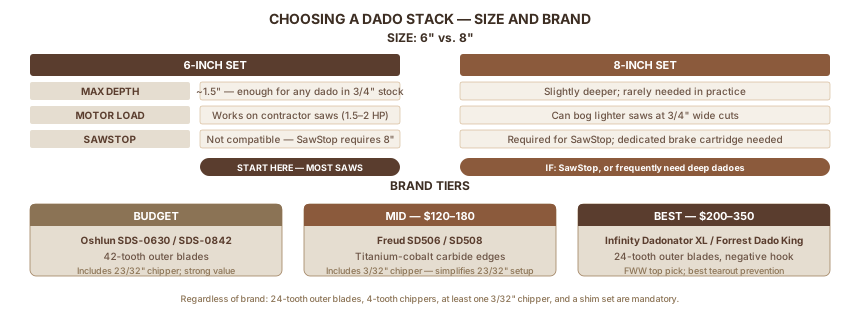
Most beginners and intermediate woodworkers should start with a 6" set. A 6" dado stack gives approximately 1.5" of maximum cut depth, more than enough for any dado in 3/4" material. As Marc Spagnuolo of The Wood Whisperer puts it: he has "never used more than the top 1" of my dado stack" in the vast majority of projects.
The 8" set demands more power from your motor. On a contractor saw (1.5–2 HP), an 8" dado stack running 3/4" wide can bog the motor. The 6" set is the better choice for lighter saws.
One exception: SawStop requires 8" dado sets and dedicated brake cartridges. Check your saw manual before buying.
Brand recommendations
Best beginner value: Oshlun SDS-0842 (8") or SDS-0630 (6") Clean cuts, 42-tooth outer blades, includes a chipper sized for undersized plywood. The price is substantially lower than Freud. Community reviews consistently rate it competitive with pricier sets.
Best intermediate choice: Freud SD508 (8") or SD506 (6") Titanium-cobalt carbide holds an edge longer. Includes the 3/32" chipper that makes hitting 23/32" plywood widths much simpler without heavy shimming. $120–180.
Best quality: Infinity Dadonator XL or Forrest Dado King Fine Woodworking gave the Infinity Dadonator XL its top recommendation in their 2023 dado stack review: "all cuts clean and splinter-free, dadoes square and snug." The Forrest Dado King uses 24 teeth per outer blade (double the standard) and a negative hook on all teeth. The best tearout prevention available. $200–350.
What to look for regardless of budget:
- 24-tooth outer blades with negative hook angle (5° or greater)
- Four-tooth chippers (not two-tooth)
- At least one 3/32" chipper in the set
- Shim set included (or plan to buy separately)
Part 4: Setting Up the Dado Stack Step by Step
What you need before you start
- The dado stack set
- Arbor wrench
- Dial calipers (for measuring actual plywood thickness)
- Dado-specific throat plate (buy a blank for your saw model, or plan to make one)
- Push pads and featherboard
- Scrap of the same plywood you'll be using in your project
The 14-step sequence
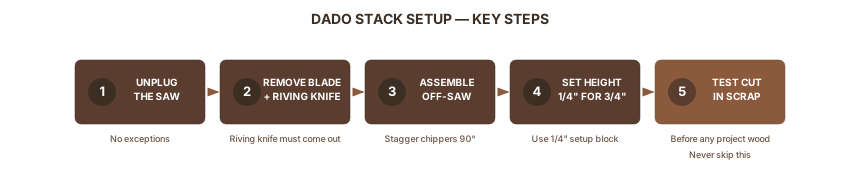
1. Unplug the saw. No exceptions, even if the switch is off.
2. Clear the table.
3. Remove the standard throat plate.
4. Remove the riving knife. The dado stack doesn't cut through the workpiece. The riving knife is designed to ride in the saw kerf and prevent pinch-back, but in a dado cut it would sit in the channel and bind against the wood. It must come out. Safety implications are covered in full below.
5. Remove the standard blade.
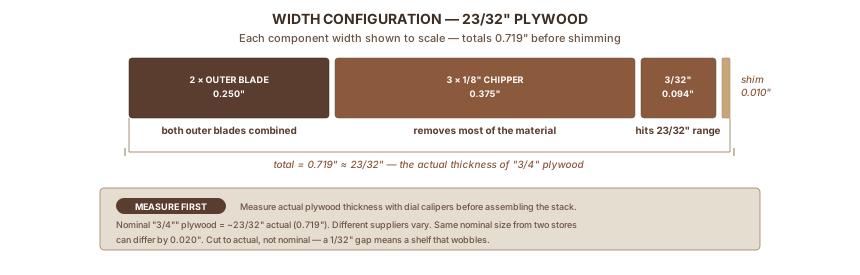
6. Measure your plywood. Before touching the dado set, put your actual project plywood on the table and measure its thickness with dial calipers. Write down the number. "3/4" plywood from most suppliers measures approximately 23/32" (0.71875"), as documented in Woodweb's plywood thickness reference. Cutting a nominal 3/4" (0.750") dado for 23/32" plywood leaves a 1/32" gap. The shelf wobbles. Glue can't bridge it.
7. Assemble the dado stack off the saw. Most beginners skip this step. Don't. Lay one outer blade on the workbench, teeth up, logo facing out. Stack chippers on top, staggering each chipper 90° so its teeth sit in the gullets of adjacent blades. Add the second outer blade on top, logo out. Visually confirm: no carbide tooth is touching any other tooth or blade body.
8. Transfer the stack to the arbor. Remove the arbor flange/washer from the arbor. Slide the first outer blade onto the arbor (logo out, toward you). Add the chippers and shims in the same configuration you built off the saw. Slide the second outer blade on.
9. Check arbor thread engagement. Per Grizzly's dado installation guide, the minimum is 2–3 full threads visible past the assembled stack before you install the nut. If you have fewer: (a) try removing the arbor washer — most manufacturers allow this for dado use on widths over ~3/8"; (b) reduce stack width by removing a shim; (c) check your saw manual for maximum dado capacity. Never run a dado stack with fewer than 2 threads of engagement.
10. Install the arbor washer and nut. Tighten firmly with the arbor wrench. The thread direction self-tightens during operation but must be properly seated first.
11. Install the dado throat plate. A standard throat plate won't fit over the dado stack. Buy a dado-specific blank for your saw model, or make a zero-clearance insert. To make one: lower the dado stack below the table, install the blank, hold it down with the rip fence, turn on the saw, and slowly raise the stack through the blank to full cutting height. The result is a throat plate that supports the wood fiber right at the cut line. It's the single biggest improvement for reducing tearout in plywood.
12. Set blade height. 1/4" for 3/4" material. Use a 1/4" setup block or ruler to dial in the height while the saw is still unplugged.
13. Plug in and turn on. Listen. A properly assembled dado stack sounds like a deeper, heavier version of your regular blade — a smooth, confident hum. Any rattling, vibration, or unusual noise: shut down immediately and investigate. Disassemble, check chipper alignment, and reassemble.
14. Cut a test dado in scrap before touching any project wood.
Part 5: Dialing In Width for Undersized Plywood
The problem
Nominal plywood thicknesses are advertising, not measurements. Woodweb's plywood thickness reference documents what experienced builders know: "3/4" plywood from most suppliers measures approximately 23/32" (0.71875"). "1/2" plywood measures approximately 15/32"."
A 0.750" nominal dado for 23/32" actual plywood leaves 1/32" of gap. Measure every batch of plywood before you cut — different suppliers vary, and the same nominal size from two different stores can differ by 0.020".
The right approach: assemble off the saw
The fastest reliable method for beginners is to assemble the stack to just barely over your measured thickness, then check the fit with a test dado.
For 23/32" plywood using a Freud SD508 — two outer blades (0.250" each = 0.250" pair) plus three 1/8" chippers (0.375") plus one 3/32" chipper (0.094") equals approximately 0.719". Add 0.005"–0.010" in shims for glue clearance. That gets you to 0.724"–0.729" — a hand-pressure fit for 0.71875" plywood.
The 3/32" chipper is the critical piece. Without it, the jump from 5/8" (two 1/8" chippers) to 3/4" (three 1/8" chippers) skips over the 23/32" range entirely.
| Target dado width | Outer blades | Chippers | Shims | Approximate result |
|---|---|---|---|---|
| 1/4" | 2 | — | — | 0.250" |
| 3/8" | 2 | 1×1/8" | — | 0.375" |
| 1/2" | 2 | 2×1/8" | — | 0.500" |
| 23/32" (actual 3/4" ply) | 2 | 3×1/8" + 1×3/32" | +0.005"–0.010" | 0.719"–0.729" |
| 3/4" (nominal) | 2 | 3×1/8" | +0.020"–0.030" | 0.750" |
The reference board method
Fine Woodworking's dado stack setup guide describes a method that pays for itself the second time you use a dado stack: cut a series of test dadoes in a long piece of scrap, starting just under 23/32" and adding one 0.005" shim between each dado. Label each dado with its configuration. Store the board with your dado set.
Next project: pull out the board, slide your plywood into each dado until you find the one that requires firm hand pressure, then copy that configuration for your actual setup. You nail it on the first try every time.
The right fit
Firm, sustained hand pressure. No tap, no shove, no mallet. When you flip the assembled joint, the shelf stays put without glue. That's the target.
Part 6: Cutting the Dado: Technique and Feed Rate
Fence or miter gauge?
Cross-grain dadoes (shelves into side panels): Use a miter gauge with an auxiliary fence attached, or a crosscut sled. See Building a Crosscut Sled — a sled makes every dado cut more controlled and repeatable.
You can also use the rip fence as a position locator: set the fence to place the dado correctly, then push the panel across with the miter gauge. The fence controls position; the miter gauge controls direction. This is the standard production approach. Never freehand across the dado stack — the resistance is significant.
With-grain grooves: Use the rip fence only.
The cut
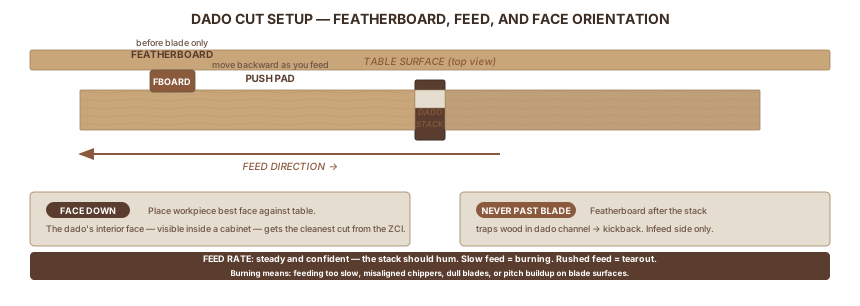
- Set the featherboard on the table surface, positioned directly in front of the dado stack — never past it. A featherboard positioned after the blade traps the material in the dado and can cause kickback.
- Place the workpiece face-down. The cleanest face goes against the table, where it matters for the dado's appearance inside your cabinet or bookcase.
- Hold the panel firmly against the miter gauge fence or sled fence with consistent pressure throughout.
- Place a push pad on top of the workpiece to maintain downward pressure. Slide the push pad backward as you advance — never hold it stationary directly over the spinning stack.
- Feed at a steady, confident pace. The stack should hum as it cuts. Not a hesitant crawl, not a rush.
What burning tells you
Scorch marks on the dado walls or bottom mean you're feeding too slowly. The teeth are passing over the same fibers more than once. Feed more steadily. Burning also happens when chippers are misaligned, when blades are dull, or when there's pitch and resin buildup. Clean blades with a dedicated pitch remover — don't use water.
Preventing tearout in plywood face veneer
Ranked by effectiveness:
- Zero-clearance throat plate (the biggest single improvement)
- Light scoring pass at 1/32" depth, then full-depth pass
- Blue painter's tape along both cut lines before the pass
- Marking knife scored on both shoulder lines
- Sacrificial backer board held against the back face of the panel at exit
Part 7: Matching Dadoes Across Two Cabinet Panels
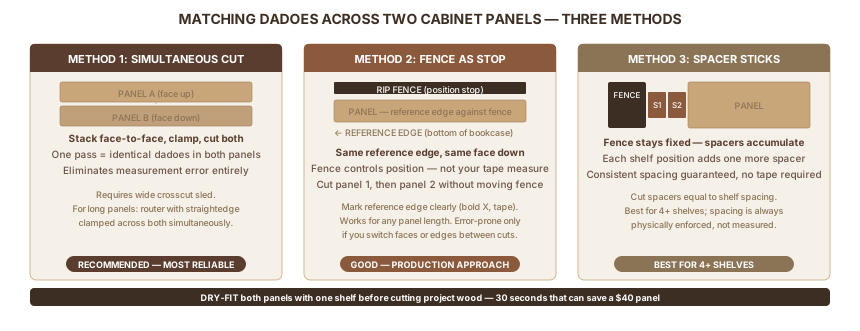
A bookcase needs dadoes at exactly the same positions in both side panels. Individual measurement of each panel is unreliable — small errors compound, and two panels measured separately rarely match exactly.
Method 1: Cut both panels simultaneously (recommended)
Stack the two side panels face-to-face, edges and ends perfectly flush, and clamp them together. Run the dado cut across both panels at once. One cut produces physically identical dadoes in both panels. Move the fence or stop block to the next shelf position and repeat. This eliminates measurement error entirely — there's nothing to match because it's the same cut.
Works with a wide crosscut sled. For very long panels, use a router with a straight-edge jig clamped across both panels simultaneously.
Method 2: Fence-as-stop, one reference edge
Mark one edge on both panels as the reference edge (the bottom of the bookcase). Mark it clearly — bold X, tape. Set the rip fence to position the first dado from that reference edge. Cut the first dado in panel one with the reference edge against the fence. Without moving the fence, cut panel two the same way.
The key rule: Always use the same reference edge, always with the same face down. The fence is doing the measuring — you never measure both panels separately.
Method 3: Spacer sticks (for four or more shelves)
Rip spacer sticks from scrap equal to the spacing between shelves. After cutting the first dado position in all panels, place one spacer stick between the fence and the reference edge before the next cut. Place two spacers for the position after that. The fence never moves — only the spacer stack grows. Consistent spacing guaranteed.
Before cutting project wood
Dry-fit both side panels with one shelf to confirm positions match. Takes 30 seconds and can save a panel worth $40.
Part 8: Stopped Dadoes on the Table Saw
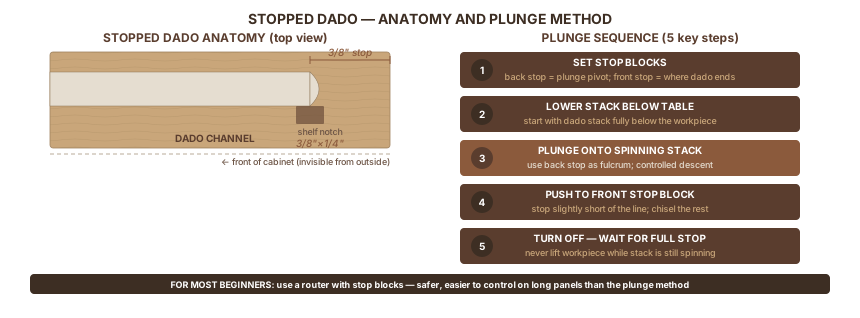
A stopped dado ends before it reaches the front edge of the panel. From the front of a bookcase or cabinet, the joint is invisible. The shelf needs a small square notch at its front corner to clear the stopped end and seat fully.
For most beginners, a router is the better tool for stopped dadoes. Clamp stop blocks to the router fence, rout normally, stop at the blocks, chisel the round end square. Safer than the plunge method below, and easier to control.
On the table saw, a stopped dado requires a plunge cut onto a spinning dado stack. Done carefully with stop blocks, it's reliable. Done carelessly, it isn't.
Plunge method (stop blocks required)
- Set up the dado stack, throat plate, and fence position normally.
- Mark the stop point on the workpiece: where the dado ends (typically 3/8" from the front edge).
- Lower the dado stack below the table.
- Set a stop block at the back of the table — this is your pivot point for the plunge.
- Set a stop block at the front — this is where the dado ends.
- Turn on the saw.
- Hold the workpiece against the fence, positioned against the back stop block, with the stack still below the workpiece.
- Lower the workpiece onto the spinning dado stack slowly, using the back stop as a fulcrum. Control the descent. Don't drop it.
- Push forward steadily to the front stop block.
- Turn off the saw. Wait for the stack to stop completely before lifting the workpiece.
- Chisel the stopped end square. The dado stack leaves a curved semicircular end that must be chiseled flat.
As Fine Woodworking's stopped dado guide advises: stop slightly short of your mark and chisel the end clean rather than pushing to the exact line. The chisel gives control the blade doesn't.
The notch on the mating shelf: if the dado stops 3/8" from the front edge, the notch is 3/8" wide × 1/4" deep. Cut it on the bandsaw or with a handsaw and chisel.
Part 9: Safety: What Changes When You Install a Dado Stack
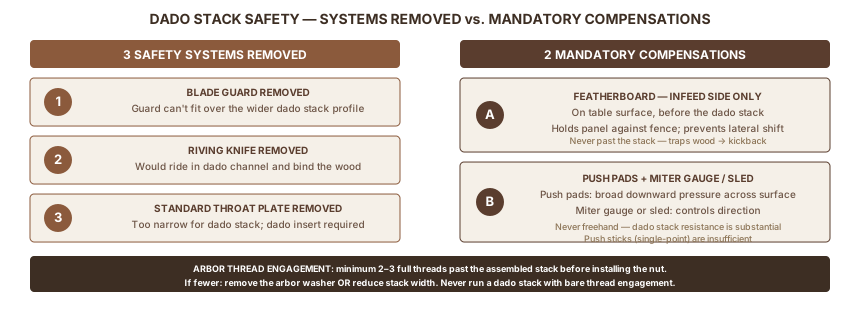
Installing a dado stack removes three safety systems from your table saw simultaneously:
- Blade guard — can't fit over the wider dado stack
- Riving knife — must come out; it would ride in the dado and bind against the wood
- Standard throat plate — must be replaced with a dado-specific insert
Three safeguards removed at once. The compensations below are mandatory.
Mandatory compensations
Featherboard before the blade. Position the featherboard on the table surface directly in front of the dado stack, pressing the panel against the fence. Never position a featherboard after the dado stack — a featherboard past the blade traps the material in the dado channel and can cause kickback. As Katz-Moses explains in their kickback prevention guide: the featherboard belongs only on the infeed side.
Push pads, not push sticks. Push sticks apply downward pressure at a single point. Push pads maintain broad downward pressure across the panel surface throughout the cut — critical for keeping the panel flat against the table when the guard is gone.
Miter gauge or crosscut sled. Never freehand across a dado stack. The resistance from a wide cut is substantial, and a freehand cut with no guide will drift.
Arbor thread engagement
Never skip checking this. A minimum of 2–3 full threads past the assembled stack is required before installing the nut. If your saw's arbor is too short: removing the arbor washer is acceptable on most saws for dado widths over approximately 3/8" — check your manual. Never run a dado stack where the nut is barely threaded on.
Kickback risk
The dado stack removes more material per pass than a standard blade. More material means more friction against the workpiece sides, more rotational inertia in the heavier stack, and higher kickback energy if the panel lifts mid-cut. Keep the panel flat against the table throughout the cut.
SawStop users
SawStop requires dedicated dado brake cartridges and 8" dado sets only. Wobble dados and Dial-A-Width sets are not compatible with the SawStop brake system. Check the SawStop compatibility list before buying any dado set for your saw.
Check your saw's capacity
Not all table saws accept dado stacks. Job-site compact saws often have short arbors by design. Some saws specify a maximum dado width. Check your manual before buying a set.
Part 10: Troubleshooting Dado Stack Problems
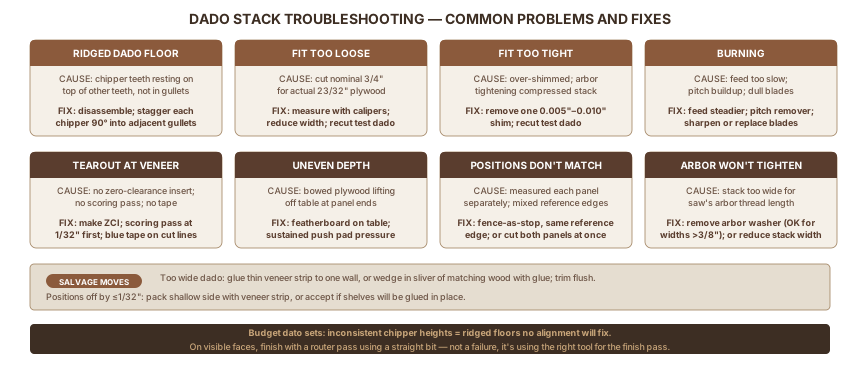
| Problem | Most likely cause | Fix |
|---|---|---|
| Ridged or uneven dado bottom | Chipper teeth on top of other teeth instead of in gullets | Disassemble; stagger each chipper 90° so teeth sit in gullets of adjacent blades |
| Fit too loose (shelf wobbles) | Cut to nominal 3/4" for actual 23/32" plywood | Measure with calipers; reduce stack width; recut test dado |
| Fit too tight (needs a mallet) | Over-shimmed, or arbor tightening compressed stack more than expected | Remove one 0.005"–0.010" shim; recut test dado |
| Burning on walls or bottom | Feed rate too slow; pitch buildup; dull blades | Feed more steadily; clean blades with pitch remover; sharpen if needed |
| Tearout at face veneer | No zero-clearance insert; no scoring | Make ZCI; add 1/32" scoring pass before full depth; tape cut lines |
| Depth inconsistent across panel length | Bowed plywood lifting off table at ends | Featherboard on table; sustained push pad pressure; switch to handheld router for severely bowed panels |
| Dado positions don't match between panels | Measured each panel separately | Use fence-as-stop with same reference edge; or cut both panels simultaneously |
| Arbor nut won't tighten — not enough thread | Stack too wide for saw's arbor | Remove arbor washer (acceptable on most saws for widths over ~3/8"); reduce stack width if still insufficient |
Two salvage moves when a dado is already cut wrong:
- Too wide: Glue a thin strip of veneer to one dado wall, or tap in a wedge-shaped sliver of matching wood with glue and trim flush when dry.
- Positions don't match between panels (small mismatch): If the difference is 1/32" or less, pack the shallow dado side with a thin veneer strip, or accept it if the shelves will be fixed with glue rather than floating.
One note from Woodworkers Journal on uneven dado cuts: budget dado sets with inconsistent chipper heights produce bottoms that no amount of alignment will fully fix. On visible interior faces, a final router pass with a straight bit levels the floor. It's not a failure. It's using the right tool for the finish pass.
Part 11: What You Can Build With This Skill
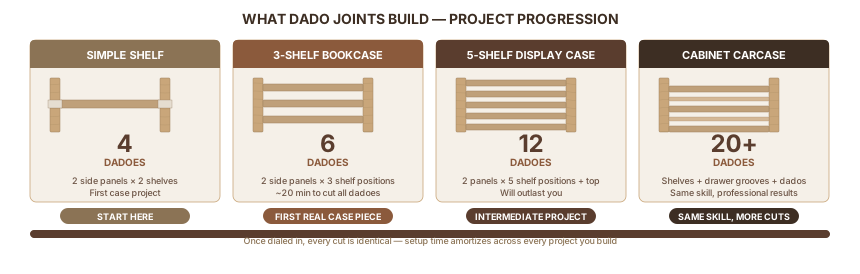
Six dadoes in two side panels. That's a three-shelf bookcase. Twelve dadoes and you have a five-shelf display case that will outlast you.
Dado joints are the structure of case furniture. Every bookcase, entertainment center, and cabinet carcase in professional shops is built around them. Once your dado stack setup is dialed in — test cut fits, reference board on the shelf, spacer sticks cut — the actual cutting is the fastest part of building a cabinet.
Build this next:
- Build a Simple Shelf — four to six dadoes, your first case piece
- Drawer Construction — grooves for drawer bottoms use the same dado stack
Related techniques:
- Dados, Rabbets, and Grooves — the complete guide to all three related joints
- Dado Cut: What It Is and How to Cut One — the concept guide and three-method overview
- Half-Lap Joints — the next joinery step; also cut on the table saw
Sources
This guide draws on manufacturer specifications, expert woodworking publications, and practitioner forums.
- Woodworkers Journal: Stacked vs. Wobble Dado Blades — expert consensus on wobble vs. stacked sets
- The Wood Whisperer: 6 vs. 8 Dado Stacks — motor load, cut depth, practical advice
- Fine Woodworking: Dado Stack Review — Infinity Dadonator XL — 2023 best recommendation
- Grizzly Support: How to Properly Stack Dado Blades — official stacking sequence
- Woodweb: Plywood Thicknesses and Dado Widths — actual vs. nominal plywood sizing
- Fine Woodworking: Dialing In a Dado Stack on the First Try — reference board method
- Fine Woodworking: How to Cut Stopped Dadoes on the Tablesaw — plunge method with stop blocks
- Katz-Moses: Kickback Prevention — featherboard placement rules
- SawStop FAQ: Dado Compatibility — SawStop dado requirements
- Woodworkers Journal: What Causes Uneven Dado Cuts — causes and fixes
- Rockler: How to Install a Dado Stack — installation steps
- Woodsmith: Choosing a Stack Dado Blade — tooth count and hook angle guidance
Tools Used
How We Research
We don't take affiliate revenue or accept review units. Picks come from multi-source research — manufacturer specs, OSHA / EPA / ASTM regs, and long-form practitioner threads — plus Ahmed's hands-on use where relevant. When we recommend something, we explain why.
Up Next
Choosing a Dado Stack for Your Table Saw
JOINERY · Beginner