
1¼" Wood Screws at a Glance
1¼" is the pocket-hole length. If you're building face frames, joining ¾" stock with a Kreg jig, or attaching drawer fronts, this is the screw the chart calls for — not 1½", not 1". Use 1¼" for pocket holes in ¾" and ½" material. Skip the pocket holes and drive straight through one board into another? Use 1½" instead. A 1-pound box runs about $7 at Home Depot and holds roughly 240 #8 × 1.25 inch screws — typically enough for one beginner cabinet build.
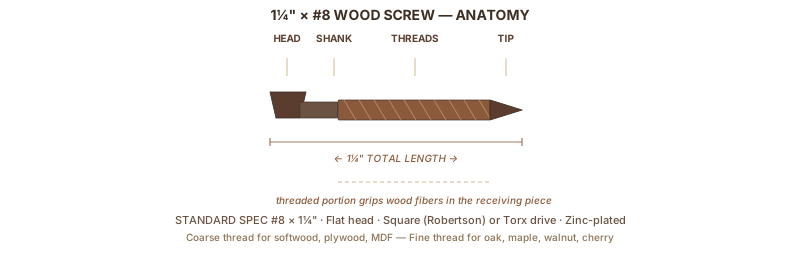
| Most common gauge | #8 (0.164" diameter) — face frames, pocket holes, drawer fronts |
| Best drive type | Square (Robertson) — zero cam-out, standard on Kreg screws |
| Pocket holes, ¾" material | 1¼" (Kreg official — not 1½") |
| Pocket holes, ½" material | 1¼" (same Kreg recommendation) |
| Coarse thread | Pine, poplar, plywood, MDF, cedar, fir |
| Fine thread | Oak, maple, walnut, cherry, ash, birch |
In this guide:
- Reading the label — gauge, head, and drive type
- Why 1¼" and not 1" or 1½"
- Where these screws belong
- Stopping the split
Part 1: Reading the Label
Same length, twelve different boxes. Here's what the numbers mean.
Gauge — the number that tells you diameter
Gauge is diameter. Higher number means thicker screw. Three gauges show up in 1¼" wood screws:
#6 (0.138"): Light hardware — hinges, drawer slides, cabinet knobs on ¾" material. Rarely the right call for structural joinery.
#8 (0.164"): The all-purpose size. Strong enough for face frames, pocket holes, and drawer fronts. Available everywhere. This is the one to buy for most projects. AFT Fasteners' wood screw specs put the #10 at 34% more cross-sectional area than #8 — meaningful for heavy structural work, overkill for cabinets.
#10 (0.190"): Heavier assembly where you need more bite — workbench construction, structural joints in thick hardwood. You won't reach for this often at 1¼" length.
Thread pitch matters for how the screw grips the wood:
- Coarse pitch (6–8 threads per inch): cuts aggressively into softwood fibers. Fast to drive, excellent grip in pine, cedar, poplar, and all sheet goods.
- Fine pitch (10–14 TPI): smaller bites, more thread contact per inch. The right choice for hardwoods like oak, maple, and walnut — coarse threads tear dense grain and cause splitting.
Most big-box boxes default to coarse. Check the label if you're working in hardwood.
Head types
Flat head (countersunk): Tapers to a point and seats flush or below the surface. This is the standard for woodworking. Buy flat heads for face frames, pocket holes, and furniture.
Pan head: Rounded top, flat underneath. Sits proud of the surface. Kreg pocket-hole screws use a washer-head variant of this — designed for the angled pocket geometry.
Bugle head: The drywall screw shape. Not for furniture. If you grab these by mistake, the curved underside tears wood fibers instead of seating cleanly.
Drive types
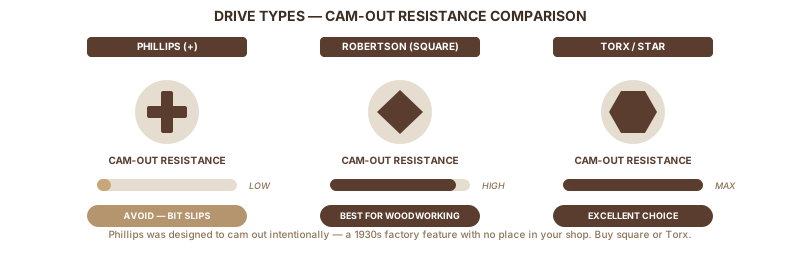
| Drive | Cam-out | One-handed? | Verdict |
|---|---|---|---|
| Phillips (+) | Frequent | No | Frustrating — bit slips under pressure |
| Square/Robertson (□) | Virtually none | Yes | Best for most woodworking |
| Torx/Star (✦) | None | Yes | Excellent — standard on construction-grade wood screws |
Buy square-drive or Torx. The bit seats and stays. You can hold the workpiece with one hand and drive with the other. Phillips was designed to cam out intentionally — a 1930s assembly-line feature that has no place in your shop.
What to buy
For general woodworking: #8 × 1¼" flat-head, square or Torx drive, zinc-plated. Generic hardware-store screws (Hillman, etc.) run $2–4 per 100 and work fine for most indoor projects.
For pocket holes specifically: Kreg SML-C125 (coarse-thread, for softwood and plywood) or Kreg SML-F125 (fine-thread, for hardwood). Square drive, pan head with washer, engineered for the pocket-hole angle.
For better driving in hardwood: Grip-Rite 114GCS5 (#8 × 1¼" T25 Torx drive, gold-coated) is a mid-range step up from generic zinc-plated screws. The Torx machining is better and the drives don't strip.
Part 2: Why 1¼" and Not 1" or 1½"
The two-thirds rule
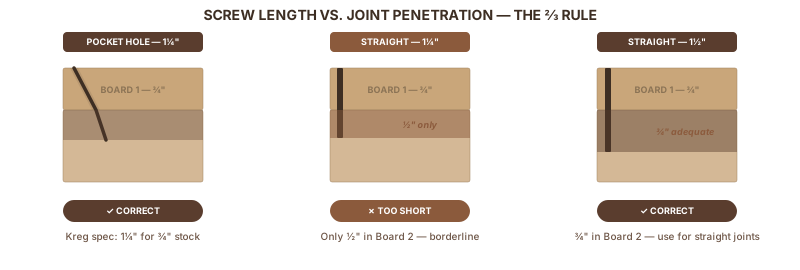
The holding power of a screw depends on how far it penetrates the receiving piece (the second board, not the first). The rule: the screw should penetrate the receiving piece by at least ⅔ of its total length.
That's the math that governs length selection. 1¼" gives you about ⅚" of thread in the receiving piece when you're going straight through ½" of material. For pocket holes, the angled geometry changes the calculation — the screw travels farther through both pieces at 15°, and 1¼" fills that path exactly.
When to use each length
Per Kreg's pocket-screw selector, 1¼" is the correct length for ¾" and ½" material — the angled pocket geometry gives full thread engagement at this length.
| Situation | Best length | Why |
|---|---|---|
| Pocket holes, ¾" material | 1¼" | Kreg's official specification — don't second-guess the chart |
| Pocket holes, ½" material | 1¼" | Same Kreg recommendation |
| Through ¾" into ¾" (straight screw) | 1½" | Need ½"+ penetration; 1¼" is too short here |
| Attaching ¼" back panel to ¾" cabinet box | 1" | 1¼" risks poking through the face |
| Light hardware (hinges, slides) on ¾" material | 1" | Shallow mortises only need an inch |
The exception to know before you start
If a face frame piece has a rabbet or groove cut near its back edge — for a glass panel, a frame back, or an inset door — don't use 1¼" pocket screws. The screw tip exits through the groove wall. Use 1" screws instead, and confirm clearance before driving. Woodweb's face frame fastening KB covers this case specifically.
Why 1¼" is wrong for straight-through joints
You're building a shelf and want to screw through a ¾" rail into a ¾" support. Don't use 1¼". It leaves just ½" of thread in the support — borderline holding power. Use 1½". The pocket-hole math doesn't apply when the screw is driving straight through.
See 1½" Wood Screws for that application.
Part 3: Where These Screws Belong
Pocket-hole joinery in ¾" stock
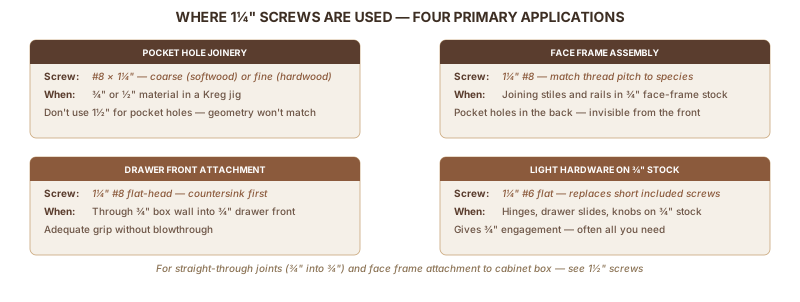
This is the primary job. Pocket-hole joinery drills an angled pilot hole in one board, then drives a screw through it at roughly 15° into the adjacent board. The angled path means 1¼" provides full thread engagement even though ¾" sounds like it should need more.
Thread selection matters here:
- Pine, poplar, plywood, MDF: use coarse-thread (Kreg SML-C125)
- Oak, maple, walnut, cherry: use fine-thread (Kreg SML-F125)
Poplar is technically a hardwood but Kreg classifies it as coarse-thread territory. Still drill pilot holes near edges — poplar splits more easily than its softness suggests.
Always use actual material thickness, not nominal. That ¾" plywood often measures 23/32". Still use 1¼" screws.
Face frame assembly
A face frame is the solid-wood front of a cabinet box — rails (horizontal) and stiles (vertical), typically from ¾" stock. Joining them with pocket holes is industry standard. The screw goes through one piece and into the other. 1¼" is the right length.
After you assemble the face frame, attaching it to the plywood cabinet box is different — now you're going through ¾" face frame into ¾" plywood. Use 1½" or 2" for that step, not 1¼".
See Face Frame Cabinet Construction for the full sequence.
Drawer front attachment
Drawer fronts are typically attached by driving screws from inside the drawer box outward through the ¾" box wall and into the ¾" drawer front. A 1¼" #8 flat-head screw works here — ¾" through the box wall, then ½" into the drawer front. That's adequate grip without blowthrough.
See Drawer Construction.
Light hardware on ¾" material
#6 × 1¼" screws replace stripped or short hardware screws on hinges, drawer slides, and cabinet knobs when the included screws don't grip. They give ¾" of engagement in ¾" stock, which is often all you need.
Part 4: Stopping the Split
Face frame stiles split when you drive pocket screws into the end of a narrow board, especially poplar. A pilot hole and a changed driving technique fix it.
Why wood splits
A screw drives through wood by displacing fibers outward. Near the end of a narrow stile, those fibers have nowhere to go. They split along the grain.
Five things make it worse:
- No pilot hole — the screw pushes fibers aside instead of cutting through them
- Too close to the end — less than ½" from the board end in softwood; less than ¾" in hardwood
- Coarse thread in hardwood — aggressive bite = high lateral force in dense grain
- Continuous driving — one unbroken pull builds pressure faster than the wood yields
- Grain alignment — when the screw path lines up with a grain line, it follows it and splits
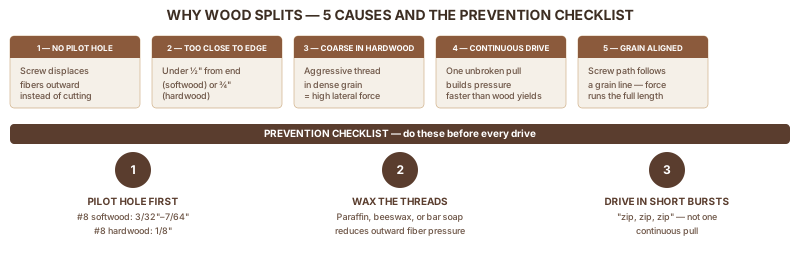
Poplar is the most common offender. It's a hardwood with soft, straight grain that runs easily. The grain path and the screw path can align perfectly — and when they do, the stile splits down the face.
The prevention checklist
Before you drive:
- Drill a pilot hole. For #8 in softwood (including poplar): 3/32" to 7/64" bit. In hardwood: 1/8" bit.
- Stay at least ½" from any edge. In hardwood, give yourself ¾". Maden.co's splitting guide explains why: grain runs toward the edge and there's nowhere for the displaced fiber to go.
- Wax the screw threads. Paraffin wax, beeswax, or a bar of soap. Wax reduces friction between threads and wood fibers. Less friction means less outward pressure on the grain.
- Clamp the pieces. A Kreg face clamp or a bar clamp directly over the joint compresses the wood fibers before the screw arrives.
While you drive:
- Use short trigger bursts — "zip, zip, zip" — not one continuous pull. Short bursts give the wood a half-second to settle between each pulse. Continuous pressure doesn't. Woodweb's pocket-screw splitting KB reports this cadence rarely causes splits when other techniques fail.
- Keep the bit straight. Any angle shifts force to one side of the hole.
- Set your drill clutch to slip before the wood splits, not after.
For pocket holes specifically:
- Place the pocket holes as far from the stile ends as the jig allows.
- In narrow stiles (under 2"), use the inner hole positions on the Kreg jig — the outer positions put the holes too close to the edge.
- Don't skip the Kreg face clamp. An unsupported stile will split under load; clamped it won't.
Pilot hole sizes
| Gauge | Softwood (incl. poplar) | Hardwood |
|---|---|---|
| #6 | 5/64" | 3/32" |
| #8 | 3/32"–7/64" | 1/8" |
| #10 | 7/64" | 9/64" |
Sources: McFeely's drilling chart and Bolt Depot pilot hole reference.
Field test: hold the bit next to the screw shank. You should see the threads clearly on both sides. If you barely see threads, the bit is right.
Quick Reference
Bookmark this before the hardware store run.
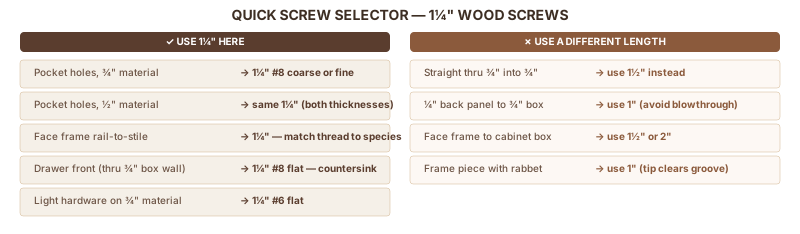
| Situation | Screw | Pilot hole? | Notes |
|---|---|---|---|
| Pocket holes, ¾" material (softwood/plywood) | 1¼" Kreg coarse #8 pan | No (jig does it) | SML-C125 |
| Pocket holes, ¾" material (hardwood) | 1¼" Kreg fine #8 pan | No | SML-F125 |
| Face frame rail-to-stile (pocket hole) | 1¼" Kreg coarse or fine | No | Match thread to wood species |
| Drawer front through ¾" box | 1¼" #8 flat square | Yes (softwood: 7/64"; hardwood: 1/8") | Countersink first |
| Light hardware on ¾" material | 1¼" #6 flat | Yes | Replaces short included screws |
| Straight through ¾" into ¾" | Use 1½" instead | Yes | See 1½" screws guide |
Part 5: What to Learn Next
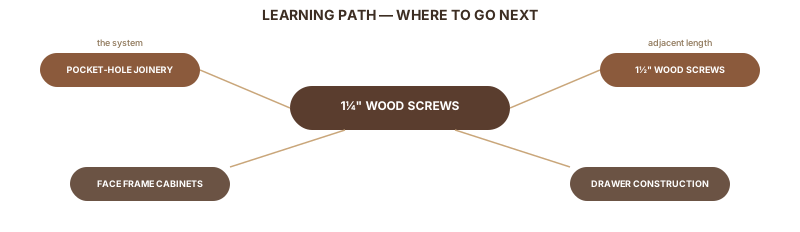
The system these screws are part of:
- Pocket-Hole Joinery — jig setup, clamping, and the joints these screws make
Where you'll use them:
- Face Frame Cabinet Construction — first cabinet project
- Drawer Construction — drawer box assembly
The adjacent length:
- 1½" Wood Screws — when you need more penetration than 1¼" gives you
Fastening knowledge that rounds this out:
- Glue and Adhesives — when screws alone aren't enough
FAQ
Why does Kreg recommend 1¼" screws for ¾" pocket holes — not 1½"?
The Kreg jig drills the pocket at a 15° angle, which lengthens the effective travel of the screw inside the joint. A 1½" screw at 15° pushes about 1.45" of straight-line penetration through ¾" stock — that's enough to break out the back face on the mating piece. The 1¼" screw lands roughly 1.20" of penetration and stops cleanly inside the second board. Kreg's official chart matches this geometry.
Can I use 1¼" wood screws for face frames without a pocket-hole jig?
Yes, but only if you're driving through edge grain into edge grain — for example, attaching a face-frame stile to a cabinet box side panel. For face-frame stile-to-rail joints (where one piece's end grain meets the other's edge grain), pocket-hole joinery is far stronger. A 1¼" screw alone in end grain holds about half the load that the same screw holds in edge grain.
What's the difference between coarse and fine thread 1¼" screws?
Coarse thread (6–8 TPI) is for softwood, plywood, and MDF. The wider thread spacing bites into soft fibers without stripping. Fine thread (10–14 TPI) is for hardwood — oak, maple, walnut, cherry. The narrower threads make smaller bites, which prevents the dense grain from splitting around the screw. If you grab the wrong one, hardwood projects split and softwood projects strip. Both packs cost roughly the same.
Do I need pilot holes for 1¼" screws in pocket-hole joinery?
No. The Kreg jig drills both the pocket and the pilot hole in one step — the stepped drill bit cuts the larger pocket on top and the narrower pilot on the bottom. That's the entire point of a pocket-hole jig versus driving by hand. For non-pocket-hole work in hardwood, yes — pre-drill a 9/64 inch pilot for #8 screws. In softwood, modern self-tapping screws drive without a pilot.
How many 1¼" screws does a typical face frame use?
A small face frame for a 30-inch base cabinet uses 8–12 screws — two at each stile-to-rail joint. A full kitchen with 8 base cabinets and 6 wall cabinets runs through roughly 200–250 1¼" Kreg screws. One $20 box of 250 screws covers the whole kitchen with a small reserve. Stock more if your project includes tall pantry cabinets, which double the joint count.
Sources
Sources consulted include manufacturer specifications, professional cabinet-making references, and practitioner forums.
- AFT Fasteners — Wood Screw Dimensions and Mechanical Specs — gauge diameters and cross-sectional area data
- Kreg Tool — How to Select the Right Pocket-Hole Screw — official screw length chart by material thickness, thread type guidance
- Maden.co — How to Prevent Wood Splitting When Screwing — edge distance guidelines, pilot hole guidance, lubrication
- Woodweb — Splitting Stiles with Pocket Screws — practitioner-sourced technique for preventing stile splits, the "zip" driving cadence
- Woodweb — Face Frame Dimensions and Fastening Issues — groove exception case for screw length
- Woodweb — Pocket Hole Joinery for Face Frames — professional cabinetmaker screw specifications
- McFeely's — Pilot Hole Drilling Size Chart — pilot hole sizes by gauge and wood type
- Bolt Depot — Pilot Hole Sizes for Wood Screws — pilot hole size reference
How We Research
We don't take affiliate revenue or accept review units. Picks come from multi-source research — manufacturer specs, OSHA / EPA / ASTM regs, and long-form practitioner threads — plus Ahmed's hands-on use where relevant. When we recommend something, we explain why.
Up Next
18 Gauge Brad Nails: Uses, Holding Power, and vs 16 Gauge
WOOD & MATERIALS · Beginner