
Dovetail Joints at a Glance
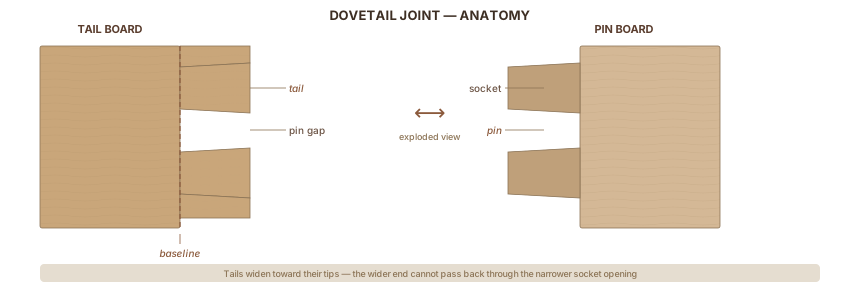
A dovetail joint is an interlocking wood connection where wedge-shaped tails on one board mesh with matching pins on another, converting tensile pull into compression across angled wood faces — a geometry that has anchored drawer construction for over 5,000 years. That mechanical interlock means the joint resists racking and pulling apart without relying on glue alone. Dovetails excel specifically against tensile stress, not every load type, and they require solid wood; plywood's cross-grain layers cause the angled shoulders to blow out under cutting pressure.
| What it is | Interlocking wedge-shaped joint with tails on one board, pins on the other |
| Strength | Resists tensile pull (pulling apart); no special advantage in shear or compression |
| Best for | Drawer construction, box corners, case joints in solid wood |
| Not for | Plywood, MDF, frame joinery (use mortise-and-tenon instead) |
| Angle range | 7°–15° (1:8 for hardwood, 1:6 for softwood, anything in range works) |
| History | Ancient Egypt (~3100 BCE) through today; pre-dates reliable adhesives |
In this guide:
- How the geometry creates a mechanical lock
- Five types of dovetail joints and when to use each
- Choosing a dovetail vs. other joints
- Proportions, angles, and what actually affects strength
Part 1: How a Dovetail Works
A wedge wider at one end can't be pulled through a slot narrower than that wide end. That's the entire principle.
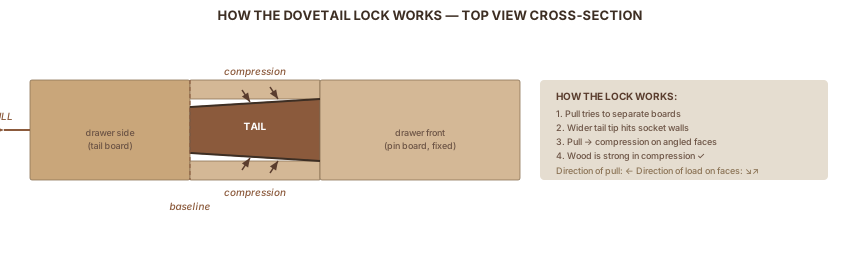
Pull a drawer open. The force tries to separate the drawer front from the drawer side. Each tail's angled face bears against the adjacent pin's angled face. The wider end of each tail can't pass through the gap between the pins. Pulling force converts to compression across those angled bearing surfaces, and wood is strong in compression. The load spreads across every tail-and-pin pair in the joint.
Once glued, a dovetail is stronger than the wood around it. The wood next to the joint will fracture before the joint itself fails.
Why Drawers Are the Canonical Example
A kitchen drawer gets pulled open thousands of times over its life. Every pull is pure tensile load along one axis. This is why dovetails have been the default drawer joint since ancient Egypt and remain the mark of quality in modern cabinetwork.
The joint resists force in only one direction. It has no advantage against racking (wobbling side-to-side) or shear (forces sliding along the joint line). A dovetailed table apron would wobble. A dovetailed drawer holds firm. Right joint, right place.
In Konukcu's tensile strength research at Mississippi State University (2018), two variables matter most: the angle of the tails and the depth of the joint (how far the tails extend into the pin board). Tail width has no significant effect. Red oak dovetails tested at roughly twice the tensile strength of southern yellow pine. Species matters more than most woodworkers expect.
The Glue Surface Bonus
When tails and pins come together, the angled contact surfaces create long-grain-to-long-grain glue bonds. That's the strongest type of wood glue joint. A butt joint puts end grain against face grain, which holds at roughly one-tenth the strength.
Before reliable adhesives existed, the geometry alone held furniture together. Ancient Egyptian craftsmen built chests using only the mechanical lock. Those chests have survived millennia. Glue was optional.
Part 2: Five Types of Dovetail Joints
Five types of dovetails solve different problems in furniture construction.
| Type | End Grain Visible? | Common Use | Complexity |
|---|---|---|---|
| Through | Both faces | Boxes, chests, visible carcass work | Standard |
| Half-blind (lapped) | Hidden from front | Drawer fronts to sides | Most common in furniture |
| Full-blind (secret mitered) | Hidden from all faces | Finest cabinetwork | Very difficult |
| Sliding | N/A (mid-field joint) | Shelves to case sides, battens | Often router-cut |
| Secret double-lapped | Minimal | High-end boxes | Rare |
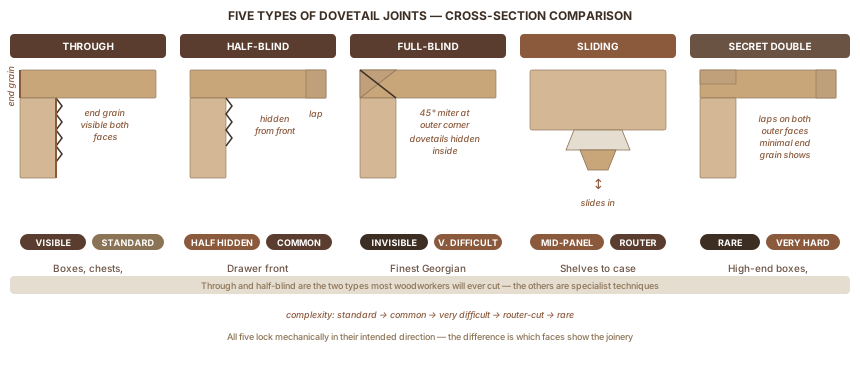
Through dovetails are the showpiece. Tails and pins cut all the way through both boards, end grain visible on both exterior faces. The dovetails you admire on a handmade box or chest are through dovetails.
Half-blind dovetails are the workhorse of cabinetmaking. The tails fit into sockets that stop short of the pin board's face, leaving a thin lap of wood covering the joint from the front. This hides the joinery. Nearly every quality drawer uses half-blind dovetails to attach the sides to the front.
Full-blind (secret mitered) dovetails hide the joint on all faces. Both outer edges meet at 45° while the interlocking dovetails sit inside. Labor-intensive. You'll find them on the finest Georgian and Federal period furniture, where no end grain shows anywhere.
Sliding dovetails work differently. A dovetail-shaped tongue on one board slides into a matching groove in the other, joining boards mid-surface rather than at a corner. Common for attaching shelves to case sides, tabletop battens, and drawer runners. The angled groove walls keep the shelf from pulling away even without glue. Most woodworkers cut these with a router and dovetail bit.
Part 3: A Joint Older Than Glue
The earliest confirmed examples come from ancient Egyptian tombs of the First Dynasty, around 3100 BCE. A gable-topped linen chest from the New Kingdom (roughly 1473 BCE) has three small tails per side on boards one centimeter thick. Bronze tools. No modern adhesives. The geometry alone held the joint.
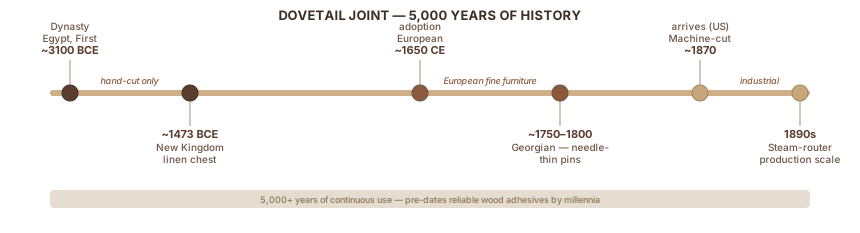
European furniture makers didn't adopt dovetails until the mid-1600s. By the late Georgian period in England, pins had been refined to needle-thin proportions. American furniture of the same era showed regional character: Pennsylvania makers cut rough but functional dovetails; New England work was finer.
Machine-cut dovetails arrived around 1870 in America. By the 1890s, steam-powered routers produced them at industrial scale. European hand-cutting persisted into the 1930s.
Researchers examining authentic 18th-century furniture at Winterthur Museum found that gaps in handmade dovetails were common. Large gaps. Wedges hammered in to close them. Out-of-square cuts. The "perfect" handmade dovetail is a modern standard, not a historical one. If your first dovetails have gaps, you're in company with every cabinetmaker who came before you.
Part 4: Dovetail vs. Other Joints
Dovetails are the strongest joint for one loading condition: pulling apart. For everything else, other joints do the job better.
| Joint | Best For | Key Advantage | When to Choose |
|---|---|---|---|
| Dovetail | Tensile pull (drawers, boxes) | Mechanical lock resists pulling apart | Solid wood corners under repeated pull |
| Box/finger joint | Same uses, works in plywood too | ~1.4× stronger in some tests | Machine-cut production; sheet goods |
| Mortise-and-tenon | Racking resistance (tables, chairs) | Deep tenon resists twist and wobble | Frame construction, apron-to-leg joints |
| Dado/rabbet | Shelves, case backs | Simple, strong vertical load support | Hidden joints, speed |
| Pocket screws | Fast assembly, hidden | Quick; screw shear strength | Utility projects, face frames |
| Miter | Clean corners hiding end grain | Aesthetic; shows continuous grain | Trim, frames, decorative boxes |
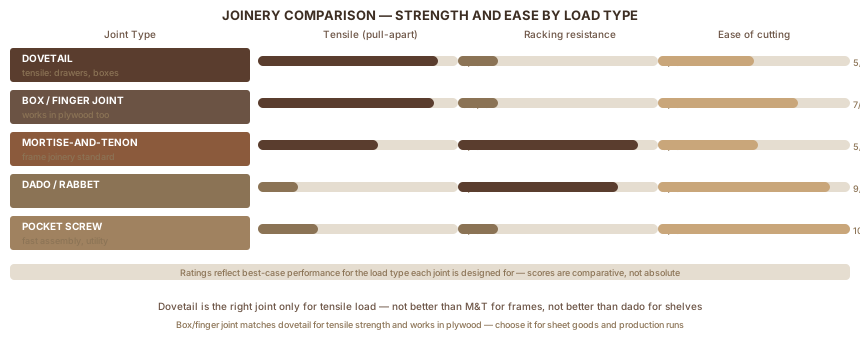
In Matthias Wandel's breaking tests, dovetail joints broke at roughly 162 pounds of force. Fine box joints broke at about 145 pounds, but when adjusted for cross-section, box joints tested about 1.4 times stronger. With modern glue, both joints fail by fracturing the surrounding wood, not the joint itself. "Dovetails are the strongest joint" is a half-truth.
When NOT to Use a Dovetail
Sheet goods. MDF pins snap off. Plywood delaminates at the joint faces. Use dado, rabbet, or box joints for engineered materials.
Frame joinery. Table apron-to-leg, chair joints, door frames. These need to resist racking (wobbling side-to-side). A dovetail in an apron-to-leg connection doesn't provide the racking resistance of a proper mortise-and-tenon. Wrong joint for the load.
Hidden joints where speed matters. If nobody will see it and you have ten more to cut, pocket screws or a dado are faster and perfectly adequate.
Thin or brittle stock. Pins narrower than 3/16 inch at their narrowest point risk short-grain breakage. Very brittle exotics can fracture regardless of proportions.
Part 5: Proportions That Matter
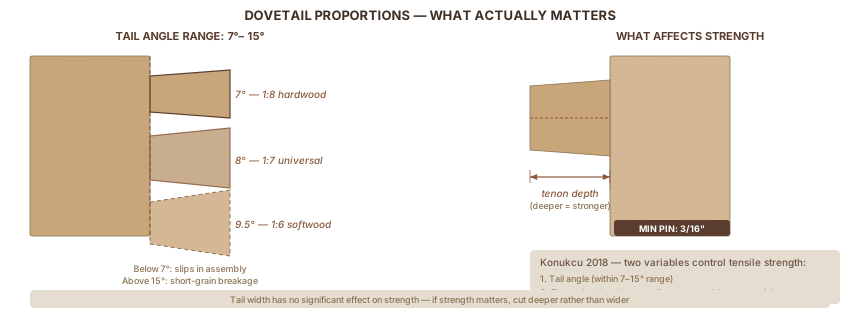
The conventional wisdom says 1:6 for softwoods (~9.5°), 1:8 for hardwoods (~7.1°). The reality is more forgiving than that.
| Material | Traditional Ratio | Angle | Why |
|---|---|---|---|
| Softwood | 1:6 | ~9.5° | Steeper angle compensates for fragile fibers |
| Hardwood | 1:8 | ~7.1° | Shallower angle OK; steeper risks short-grain breakage |
| Compromise | 1:7 | ~8° | Works for everything — common single-angle approach |
Expert opinions vary more than the rule suggests. Frank Klausz eyeballs somewhere between 10° and 15°. Rob Cosman specifies 10° for softwood, 8.5° for hardwood. Chris Schwarz tested multiple angles and settled on 14° because he liked the look. Heartwood Tools examined historical furniture and found angles "all over the place, sometimes on the same tail or pin."
Any angle between 7° and 15° works with modern adhesives. Below 7°, the joint slips during assembly. Above 15°, short grain at the narrow end of each tail risks breaking. Pick what looks good to your eye and stick with it.
What Actually Affects Strength
Konukcu's research identified the two variables that matter most for tensile strength:
- Tail angle (within the 7°–15° range)
- Tenon length (how deep the tails extend into the pin board)
Tenon width (how wide each individual tail is) showed no significant effect. If strength matters, cut deeper tails rather than wider ones.
The other critical dimension: minimum pin width. Keep the narrowest point of any pin at least 3/16 inch. Thinner pins look refined but fail in brittle or open-grained wood. Needle-thin pins (the late Georgian aesthetic) require dense, long-grained hardwoods to survive.
Spacing and size of the tails matter more than the exact angle. More tails means more interlocking surfaces and more glue area. But once the elements get narrow enough, short-grain fragility outweighs additional bonding surface.
Part 6: Three Ways to Cut Dovetails
This guide covers the "what and why." For the step-by-step technique, see Half-Blind Dovetails. Below is a quick comparison of the three cutting methods.
| Method | Setup | Per-Joint Speed | Investment | Design Freedom |
|---|---|---|---|---|
| Hand tools | Minutes | Moderate | $200–400 | Total — any proportion, any spacing |
| Router jig | 30–90 min first time | Fast once dialed in | $400–1,000+ | Limited by jig template |
| Table/CNC | Hours | Very fast | $1,000+ | Configurable |
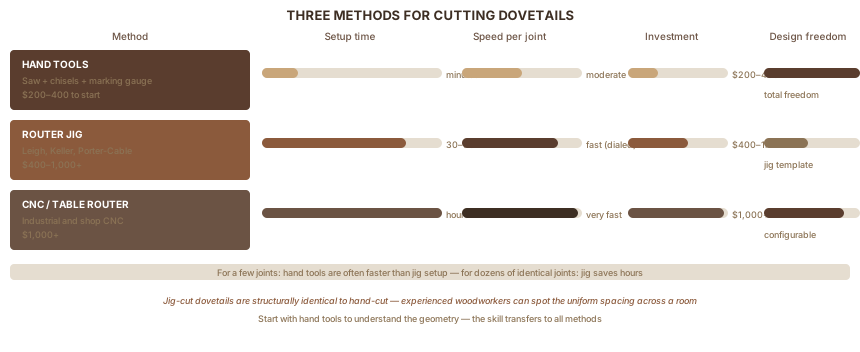
Hand tools (dovetail saw, chisels, marking gauge) give you complete control over proportions and spacing. Frank Klausz cuts a complete set in about three minutes. Paul Sellers demonstrates a two-minute dovetail. You won't be that fast starting out, but hand-cut dovetails don't have to be slow. Best for heirloom work, skill development, and small quantities.
Router jigs (Leigh, Keller, Porter-Cable) produce consistent, identical joints once set up. See Dovetail Jig for a buying guide and setup walkthrough. The uniform spacing is a tell. The bit itself — a dovetail bit with a specific angle — determines the joint's proportions; see Router Bits for Wood for bit quality and shank selection. Experienced woodworkers can spot jig-cut dovetails across a room. Structurally identical to hand-cut. Best for production work, multiple identical drawers, or when hand-tool skill hasn't been developed yet.
For a few joints, hand-cutting is often faster than setting up a jig. For dozens of identical joints, a jig saves hours.
Before Your First Dovetail
You need four skills before dovetails make sense:
- Sawing to a line. Dovetails require cutting straight in two planes at once. If your saw wanders, practice on scrap first. See Measuring and Marking.
- Chisel control. You'll pare waste from between the tails and pins. A chisel that slips past the line ruins the fit. See Chisel Fundamentals.
- Sharpening. Dull tools crush and tear wood instead of cutting cleanly. Non-negotiable. See How to Sharpen Chisels and Plane Blades.
- Layout accuracy. A marking gauge and marking knife (not a pencil) set the reference lines that determine whether the joint fits.
For your first attempt, use poplar or cherry in 1/2-inch to 3/4-inch stock. Pine saws nicely but tears under a chisel. Avoid it. Avoid very hard or brittle woods too. Expect your first five to ten joints to be learning exercises, not keepers. That's normal.
Part 7: Where Dovetails Fit in Your Learning Path
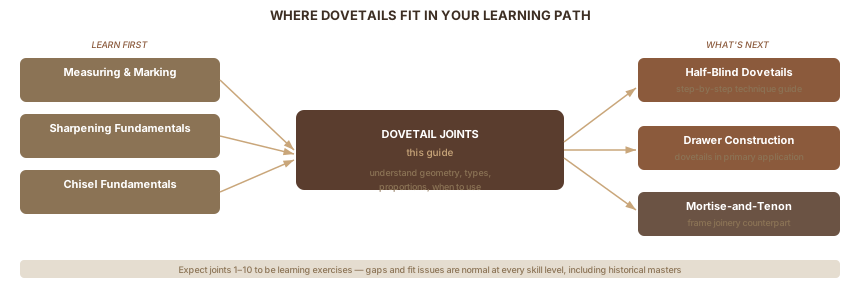
Learn these first:
- Measuring and Marking — layout accuracy determines dovetail fit
- How to Sharpen Chisels and Plane Blades — sharp tools are non-negotiable
- Chisel Fundamentals — you'll pare between tails and pins
Related guides:
- Mortise and Tenon — the joint for frame construction (tables, chairs, doors)
- Miter Joints — another corner joint with different trade-offs
- Glue and Adhesives — understanding what bonds dovetails together
- Wood Movement in Practice — why cases with dovetails need movement planning
- Drawer Construction — dovetails in their primary application
What's next:
- Half-Blind Dovetails — the step-by-step technique guide for cutting them
- Edge Joints and Panel Glue-Ups — another foundational joinery skill
Sources
This guide draws on academic research, physical testing data, historical scholarship, and expert practitioner content.
- Konukcu, Mississippi State University — tensile strength research on dovetail joints: tail angle, tenon length, and species effects
- Matthias Wandel, woodgears.ca — physical breaking tests comparing dovetail vs. box joint strength
- Working by Hand — archaeological evidence of dovetails in ancient Egyptian furniture
- Harp Gallery — timeline of dovetail evolution from hand-cut to machine-cut
- Popular Woodworking — Winterthur Museum research on gaps in historical dovetails
- Popular Woodworking — Frank Klausz's dovetail method and teaching approach
- Lost Art Press — Chris Schwarz's angle testing and historical angle survey
- Heartwood Tools — challenges conventional dovetail ratio rules with historical evidence
- Wikipedia — general dovetail joint reference and type descriptions
- Engineer Fix — mechanical explanation of dovetail geometry and strength
How We Research
We don't take affiliate revenue or accept review units. Picks come from multi-source research — manufacturer specs, OSHA / EPA / ASTM regs, and long-form practitioner threads — plus Ahmed's hands-on use where relevant. When we recommend something, we explain why.
Up Next
Choosing a Dovetail Jig
JOINERY · Beginner