
Router Bits at a Glance
A router bit is the shaped cutter that mounts in a router collet — it spins at 18,000 to 25,000 RPM to cut profiles, joinery, and edge details in wood. Bits come in three families (profile, joinery, and template) with dozens of variants, but five bits cover 90% of furniture and cabinet work: a straight bit, roundover, flush-trim, rabbeting set, and chamfer. Start there. Quality matters more than quantity. One $25 Freud bit cuts cleaner than a $60 ten-piece set from an unknown brand.
| Bit families | Straight-cutting, edge-forming, joinery |
| Starter kit | Straight, roundover, flush-trim, rabbeting set, chamfer |
| Shank to buy | 1/2" for anything over 3/8" diameter |
| Safe RPM for 2"+ bits | 16,000 max; variable-speed router required |
| Quality threshold | C3 carbide, starts ~$20/bit (Freud) |
| Best brands | Mid-range: Freud, CMT · Premium: Whiteside, Amana |
In this guide:
- The first five bits: what to buy and why
- What every common profile cuts: quick-reference table
- Safe RPM by diameter: the chart before you run big bits
- Cheap vs. expensive: four quality differences that matter
Part 1: The First Five Bits to Buy
Buy five bits. You'll use them on every project. Everything else can wait until a specific cut demands it. If you want the shortest possible starting point, the beginner router bit short list cuts to four bits with specific brand and budget advice.

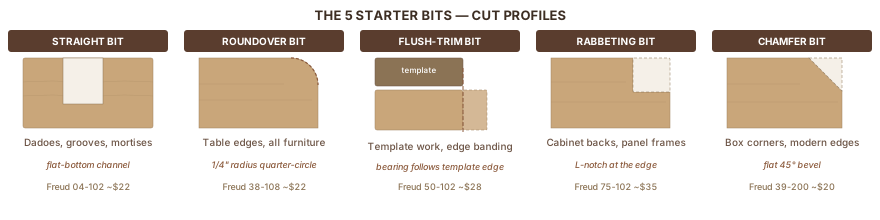
1. Straight bit (1/2" diameter, 1/2" shank)
A straight bit cuts flat-bottomed channels: dadoes (grooves that cross the grain) for shelf pins, grooves for drawer bottoms, mortises for loose-tenon joinery, pockets for inlays and hardware. If you only buy one bit, make it this.
Get it in 1/2" diameter with a 1/2" shank. That size handles the most common structural work and stays stable in hardwoods without chatter.
| Budget | Mid-range | Premium |
|---|---|---|
| MLCS 1/2" Straight (~$10) | Freud 04-102 Up-Spiral (~$22) | Whiteside 1083 Upspiral (~$35) |
| Serviceable carbide, softwood and MDF | Cleaner bottom, better in hardwoods | The bit you keep for 10 years |
2. Roundover bit (1/4" radius, 1/2" shank)
The highest-use bit in most shops. A roundover softens sharp edges on every project: tables, shelves, cabinet doors, cutting boards. A 1/4" radius is the right starting size. You'll eventually want a 3/8" radius too, but not yet.
The bearing rides the workpiece edge and controls depth automatically. Adjust to show just the curved portion, or leave a small fillet shoulder for a different look.
| Budget | Mid-range | Premium |
|---|---|---|
| Bosch 85454 1/4" Roundover (~$12) | Freud 38-108 1/4" Roundover (~$22) | Whiteside 2101 1/4" Roundover (~$32) |
| Acceptable for occasional work | Cleaner cut, longer lasting | Best edge quality available |
3. Flush-trim bit (1/2" shank)
A flush-trim bit carries a bearing the same diameter as the cutter. Run the bearing against a template or existing edge and the cutter shaves whatever's proud of it perfectly flush.
This bit makes template work possible. Once you can route to a template, you produce ten identical curved parts in the time it takes to hand-shape one. It's also essential for trimming solid-wood edge banding flush with plywood.
| Mid-range | Premium |
|---|---|
| Freud 50-102 Flush Trim (~$28) | Whiteside 3002 Flush Trim (~$38) |
| Solid bearing, clean cut | The reference standard for template routing |
4. Rabbeting bit with interchangeable bearing set (1/2" shank)
A rabbeting bit cuts an L-shaped notch (a rabbet) along the edge of a board. Cabinet backs drop into rabbets. Box lids fit over them. Panel frames use them to hold glass or inset panels.
Get one with multiple interchangeable bearings. A single bit body gives you different rabbet depths (1/4", 3/8", 1/2") by swapping the bearing. One body, four uses.
| Mid-range | Premium |
|---|---|
| Freud 75-102 Rabbeting Set (~$35) | Whiteside 3060 Rabbeting Set (~$52) |
| Includes five bearings, all common depths | Finest edge quality, longest bearing life |
5. Chamfer bit (45°, 1/2" shank)
A chamfer cuts a flat bevel along the edge. 45° is the most common angle. It reads sharper and more modern than a roundover. Good for cutting boards, boxes, and contemporary furniture.
A chamfer bit also works as a joinery tool on the router table: cut a 45° bevel along two panel edges and glue them together for a clean, invisible corner joint.
| Budget | Mid-range | Premium |
|---|---|---|
| Bosch 85457 45° Chamfer (~$12) | Freud 39-200 45° Chamfer (~$20) | Whiteside 1502 45° Chamfer (~$30) |
| Good for occasional decorative work | Clean bevel, anti-kickback body | Sharpest out-of-box bevel quality |
Part 2: What Every Bit Profile Does
These ten profiles cover nearly all woodworking tasks. Keep this as a reference when you're at the router and not sure which bit to reach for.
| Bit | What it cuts | Most common uses |
|---|---|---|
| Straight | Flat-bottomed channel | Dadoes, grooves, mortises, pockets |
| Spiral upcut | Flat bottom, chips exit upward | Deep mortises in hardwood, cleaner bottom |
| Spiral downcut | Flat bottom, chips pressed down | Plywood top faces, veneer (cleaner entry) |
| Flush-trim | Edge flush to a bearing surface | Template routing, laminate trimming |
| Roundover | Convex quarter-circle | Furniture edges, softening all corners |
| Cove | Concave quarter-circle | Decorative molding, shelf undersides |
| Chamfer | Flat angled bevel | Decorative edges, miter prep, box corners |
| Roman ogee | S-curve profile | Cabinet door edges, furniture borders |
| Rabbeting | L-shaped notch at edge | Cabinet backs, box lids, panel frames |
| Dovetail (14°) | Angled undercut channel | Sliding dovetails, drawer fronts |
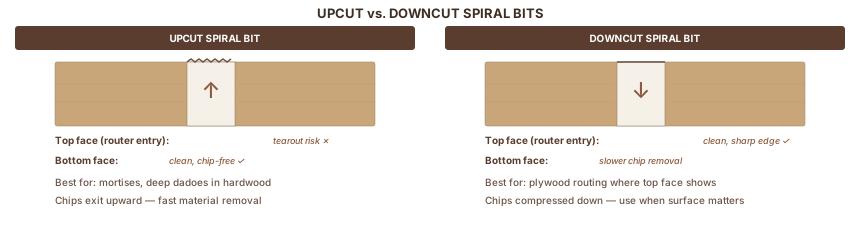
Upcut vs. downcut spiral bits. Both look like straight bits with helical flutes. Katz-Moses Tools' spiral router bit guide puts the distinction plainly: upcut bits pull chips up and out of the cut. Fast, clean bottom, but prone to tearout on the top face. Downcut bits push chips down. Slower chip removal, but cleaner entry on the top surface. Use upcut for mortises and dado joinery. Use downcut when routing through plywood and the top face appearance matters.
What "1-1/4 router bit" means. Searches for "1 1/4 router bit" usually mean one of two things: a bit with 1-1/4" cutting length (common for through-mortises in thick stock), or a 1-1/4" diameter profile bit (dish carving, large-radius roundovers). At that diameter, use a 1/2" shank. Per Fine Woodworking's shank-size forum discussion, any profile bit with an outer diameter over 5/8" and profile depth over 3/16" needs a 1/2" shank for stability.
Part 3: Safe Router Bit Speeds by Diameter
Most router problems with large bits trace back to one mistake: running them at full speed.
The issue is rim speed, not RPM. A 3" panel-raising bit at 22,000 RPM reaches a cutting-edge speed over 17,000 feet per minute. The WoodWorkers Guild of America's speed guide puts the safe rim speed range at 8,000–12,000 FPM. Exceed that and the bit vibrates, burns, and can shatter.
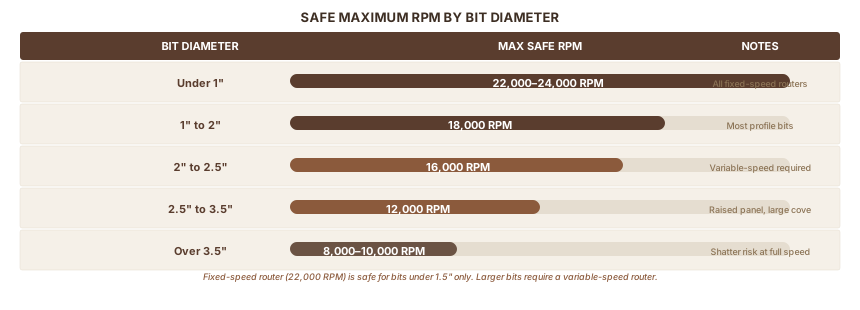
| Bit Diameter | Max Safe RPM |
|---|---|
| Up to 1" | 22,000–24,000 |
| 1" to 2" | 18,000 |
| 2" to 2.5" | 16,000 |
| 2.5" to 3.5" | 12,000 |
| Over 3.5" | 8,000–10,000 |
A fixed-speed router running 22,000 RPM is safe for every bit under 1.5". For larger bits (panel-raising bits, large cove bits, raised-panel sets) you need a variable-speed router. Running a 3" panel-raiser at full speed can shatter the bit. Pro Tool Reviews' RPM chart is the clearest visual reference for dialing in the right speed.
Part 4: What Separates a $10 Bit from a $40 Bit
Four things explain the difference.
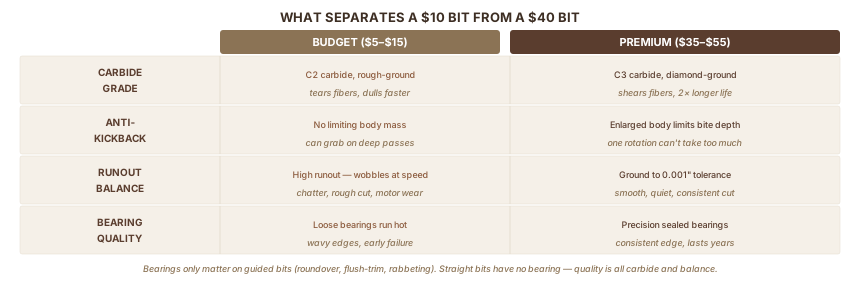
Carbide grade. Premium bits use C3 carbide (ISO K10/K20 equivalent), ground with 600–800 grit diamond wheels. Budget bits use C2 carbide, rough-ground. The Woodworking Network explains it well: grind quality is everything. A rough edge tears wood fibers; a polished edge shears them. C3 stays sharp about twice as long as C2 in hardwoods and allows 3–5 resharpenings before the bit is spent.
Anti-kickback geometry. Quality bits (Freud, Whiteside, CMT) have a slightly enlarged body between the cutting edges. That body mass limits how much material the bit removes per rotation. No single bite gets deep enough to grab. Budget bits lack this. On a router table feed, missing anti-kickback geometry is how a bit grabs a workpiece.
Runout (balance). Whiteside machines their bits from solid bar stock, balanced to 0.001". More runout means the bit wobbles at speed: chatter, rough cuts, faster bearing wear, harder on the router motor. You can't measure runout at the store, but you feel it. A good bit in a running router is smooth; a cheap one buzzes.
Bearing quality. On bearing-guided bits (roundover, flush-trim, rabbeting), cheap bearings run loose or run hot. Precision sealed bearings last years. Loose bearings produce wavy edges because the cutter drifts.
Brand tiers
| Tier | Brands | Per-bit cost | When to buy |
|---|---|---|---|
| Budget | MLCS, Katana | $5–$15 | Profiles you'll use twice a year |
| Mid-range | Freud, CMT | $20–$35 | Your starter kit and everyday bits |
| Premium | Whiteside, Amana | $35–$55 | Bits you reach for every week |
Start with Freud for your first five bits. The Freud 91-100 13-piece set runs about $14 per bit and includes all five starter kit bits plus several useful additions. Upgrade your most-used bits (roundover, flush-trim) to Whiteside when they need replacement.
Part 5: How to Use Router Bits Without Burning Wood
Most burning and tearout problems come from two things: wrong feed direction or too much depth per pass.
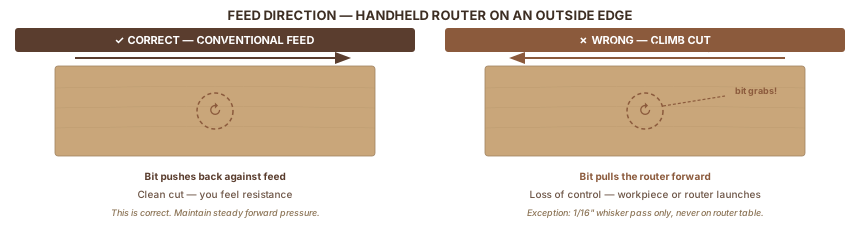
Feed direction
Move the router against the bit's rotation. For a handheld router routing an outside edge: feed left to right. On a router table: feed right to left. The bit creates resistance. You're fighting it slightly. If the router pulls forward on its own, you're climb-cutting and need to stop.
Climb cutting moves the router with the bit's rotation. It can eliminate tearout on difficult grain, but the bit grabs and pulls the tool ahead. The Wood Whisperer's guide to climb cutting describes its legitimate use: a final whisker pass (1/16" maximum depth) to clean up a tearout edge. That's the only time for it. Never climb-cut on a router table as a first pass.
Depth per pass
Never remove more than half the bit's diameter in a single pass.
- 1/2" straight bit: max 1/4" per pass
- Profile bits (roundover, chamfer, ogee): take the full profile in two passes minimum. Half depth first, full depth second.
Multiple passes produce cleaner surfaces too. The final light pass shears the fibers rather than mashing through them.
Collet rules
Insert the bit fully, then pull it back 1/16" to 1/8" before tightening. This prevents the shank end from bottoming out and heat-seizing. At minimum, 3/4" of the shank must be inside the collet. Per ToolGuyd's collet guide, bottoming out the shank is the most common cause of bit ejection. The shank expands from heat and gets locked at full depth, straining the collet nut.
Let the router reach full speed before contacting the wood. Never start with the bit against the workpiece.
Part 6: When Your Router Bit Is Done
Dull bits cause most router problems. Here's when a bit needs attention.
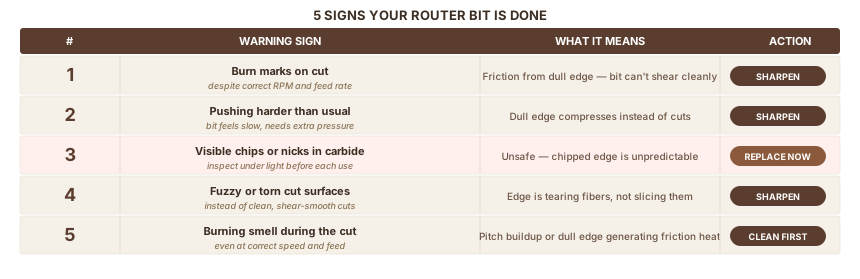
Replace or sharpen when you see:
- Burn marks on the cut despite correct RPM and consistent feed rate
- You're pushing harder than usual to keep moving
- Visible chips or nicks in the carbide (stop immediately; unsafe to continue)
- Cut surfaces are fuzzy or torn instead of shear-clean
- Burning smell during the cut
Cleaning extends bit life. Pitch (the black gummy resin that builds up on bits over time) insulates heat and behaves like a dull edge. Canadian Woodworking's bit care guide recommends cleaning after every session with a dedicated cleaner (Rockler Bit & Blade Cleaner, CMT Formula 2050, or Simple Green) and a brass wire brush. Avoid steel wire brushes; they scratch the carbide. Avoid oven cleaner entirely: Freud's research shows it corrodes the silver brazing that bonds carbide to the body.
Honing. Use a small diamond paddle (600 grit) on the flat face of the cutting edge only. Light strokes. You're removing the wire edge, not reshaping the bit. Never touch the curved face; you'll throw off the profile geometry. Professional resharpening is worth considering for bits over $40. Most basic bits are cheaper to replace.
Storage. Bits must not contact each other. Touching bits chip each other's edges. A foam-lined case, hanging strip, or drilled block works. Composite bit holders from Rockler or Lee Valley are the most practical wall-mounted option.
Where This Fits

Before this guide: Any trim router or full-size router with 1/2" and 1/4" collets handles the starter kit above. You don't need a router table for any of these bits, though a table unlocks more consistent results.
After this guide:
- Router table setup: feed direction, fence work, and the bits that only make sense on a table
- Dovetail router bits: the dovetail bit and a jig make drawer joints repeatable
- Router circle jig: cut perfect circles in tabletops, lazy susans, and panel arcs
- Frame-and-panel doors: the rail-and-stile matched bit set and how to dial in the fit
Sources
Router bit guidance here draws from manufacturer technical resources, professional woodworking educators, and the woodworking community.
- Rockler: Beginner's Guide to Router Bits — bit types, shank guidance, starter kit overview
- ToolsToday: Router Bit Types and Profiles — detailed profile descriptions
- ToolsToday: 11 Bits Every Woodworker Should Own — essential kit reasoning
- Infinity Tools: 6 Most-Used Bits in the Shop — professional kit perspective
- Pro Tool Reviews: Router Bit Speed Chart — RPM by diameter table
- WoodWorkers Guild of America: Router Bit Speeds — rim speed explanation
- Fine Woodworking: Safe Speeds for Big Router Bits — large-bit safety data
- Fine Woodworking: Climb-Cutting — feed direction nuance
- The Wood Whisperer: Router Climb-Cutting — expert climb-cut guidance
- Woodworking Network: What Makes Quality Router Bits — carbide grade, anti-kickback, runout
- Carbide Processors: Choosing the Right Router Bit — C2/C3 carbide grades
- Katz-Moses Tools: Spiral Router Bits Explained — upcut vs. downcut comparison
- Canadian Woodworking: Router & Bit Care — cleaning and storage
- Highland Woodworking: Care and Sharpening of Router Bits — honing specifics
- ToolGuyd: How to Insert a Router Bit into a Collet — collet safety rules
- Fine Woodworking Forum: 1/2" vs 1/4" Shank — shank size guidance
Tools Used
Also Referenced
How We Research
We don't take affiliate revenue or accept review units. Picks come from multi-source research — manufacturer specs, OSHA / EPA / ASTM regs, and long-form practitioner threads — plus Ahmed's hands-on use where relevant. When we recommend something, we explain why.
Up Next
Router Feed Direction: Which Way to Move (and Remember It)
POWER TOOLS · Beginner