
How to Use This Guide
Kumiko rewards patience and penalizes shortcuts. This guide builds the asanoha (hemp leaf) pattern — the most recognized kumiko design — in a 6" × 6" panel. That's the right scope for a first project: enough pieces to learn the technique, small enough that error doesn't compound into frustration.
If you're new to kumiko entirely: Read Part 1 first. The geometry is counterintuitive until you see it laid out.
If you've built a plain grid before: Jump to Part 5: Fitting the Asanoha Infill.
If something isn't fitting right: Go to Common Mistakes before you force anything.
Kumiko Panel at a Glance
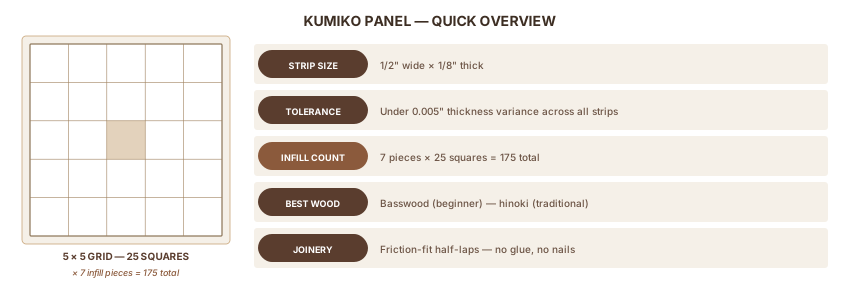
A kumiko panel is a Japanese geometric lattice where thin wood strips interlock through friction — no glue, no nails. The asanoha pattern (hemp leaf) is built from a square grid filled with angled pieces at 22.5°, 45°, and 67.5°. The whole technique depends on one thing: every strip must be the same thickness.
| Origin | Japan, Asuka period (538–710 CE) |
| Panel size (first project) | 6" × 6" square |
| Strip dimensions | 1/2" wide × 1/8" thick |
| Best beginner wood | Basswood (traditional: hinoki) |
| Fasteners | None — press-fit friction joints |
| Infill count | 7 pieces per grid square |
In this guide:
- What makes kumiko work — the geometry
- Choosing your wood
- Milling consistent strips
- Building the foundation grid
- Fitting the asanoha pattern
- Finishing options
Part 1: What Makes Kumiko Work
Kumiko joints hold because thin wood compresses slightly at contact surfaces. Press two 1/8"-thick strips together with notched intersections and the wood fibers at the joint compress just enough to create friction — enough to hold under normal handling, firm enough to resist accidental disassembly. No adhesive, no mechanical fastener.
What makes this possible: every joint in the panel acts together. The multi-directional interlocking means no single joint carries load alone. Pull on one piece and every surrounding piece resists. The assembly becomes stronger as it gets larger — the opposite of a single glue joint, which is only as strong as its glue line.
The critical requirement: every strip in the panel must be the same thickness. A variance of 1/64" (0.015") is enough to create joints that won't seat or sit sloppy. That's the bar.
Why the asanoha angles are what they are
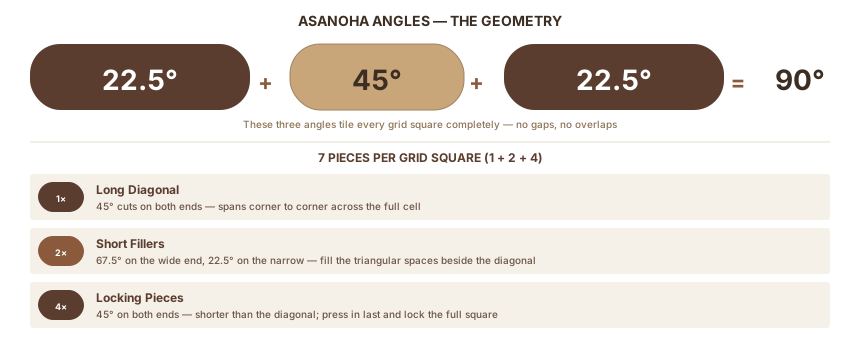
The asanoha pattern starts as a square grid. Each grid square gets subdivided by a diagonal running corner to corner (45°). That diagonal gets bisected again: 45° ÷ 2 = 22.5°. The angle complementary to 22.5° within 90° is 67.5°.
So: 22.5° + 45° + 22.5° = 90°. The three angles tile the grid square perfectly, with no gaps and no overlap. That's why these specific numbers — they're not arbitrary tradition, they're geometry.
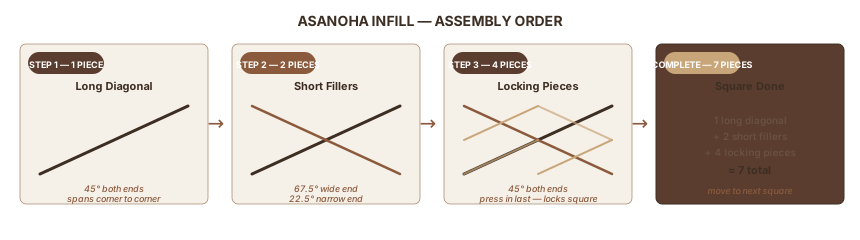
Each grid square in the finished asanoha panel requires 7 infill pieces:
- 1 long diagonal (45° on both ends)
- 2 short fillers (67.5° on one end, 22.5° on the other)
- 4 tiny locking pieces (45° on both ends, shorter than the long diagonal)
For a 6" panel with 1" grid spacing: 5 × 5 = 25 squares × 7 pieces = 175 infill pieces. Count before you start — it helps set realistic expectations for how long the infill phase takes.
Part 2: Choosing Your Wood
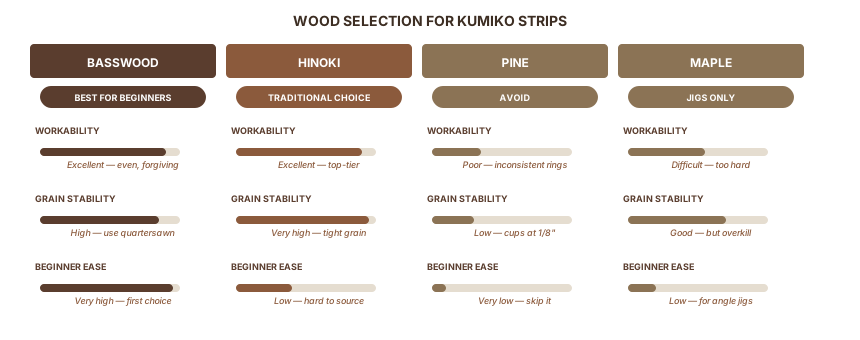
Use basswood. It's the right material for a first kumiko project and the consensus recommendation among English-speaking practitioners.
MEK Woodworks' kumiko guide uses basswood exclusively and explains why: small, even pores produce a smooth planed surface; consistent density means no hard/soft alternation like pine's growth rings; it compresses at joints just enough for reliable friction fit without crumbling. It's also inexpensive and available at Rockler, Woodcraft, and most lumber yards.
Traditional Japanese kumiko uses hinoki (Japanese cypress) and sugi (Japanese cedar). Both have tight, straight grain and exceptional dimensional stability. They're available through specialty importers in the US at 4–6× the price of basswood. Worth it eventually — not worth it for learning the technique.
Grain orientation is non-negotiable
Use quartersawn or riftsawn stock. Check the end grain: growth rings should run perpendicular to the face (not parallel to it). At 1/8" thickness, flat-sawn strips cup unpredictably as humidity changes. Joints that were tight when you cut them go loose when the strip edges lift. Big Sand Woodworking's strip-making guide calls this out specifically: "rift or quarter sawn" stock is essential, with "straight even grain so that the kumiko being ripped from the blanks will likewise have nice straight quiet grain."
What to avoid
| Wood | Why to avoid |
|---|---|
| Pine | Inconsistent density — soft early wood and hard late wood plane and pare differently |
| Oak or walnut | Too hard for hand-fitting thin cross-grain infill cuts; splits risk on short-grain ends |
| Mixed species | Different expansion rates loosen joints seasonally |
One species per panel. Mixing basswood with something contrasting might look attractive in theory — in practice, the differential wood movement works against the friction fit.
Wood comparison
| Wood | Availability | Workability | Cost | Verdict |
|---|---|---|---|---|
| Basswood | Wide | Excellent | Low | Best for beginners |
| Hinoki | Specialty importers | Excellent | High | Traditional; worth it later |
| Pine | Wide | Poor | Low | Avoid — inconsistent |
| Maple | Wide | Difficult | Medium | Good for jigs, not strips |
Part 3: Milling Your Strips
Every problem in kumiko traces back here. Strips that vary in thickness create joints that either won't seat or sit loose. Get this phase right and the rest follows.
Target dimensions:
- Width: 1/2" (12–13mm)
- Thickness: 1/8" (3mm)
- Length: cut slightly over your panel dimension; trim to exact length with a stop block later
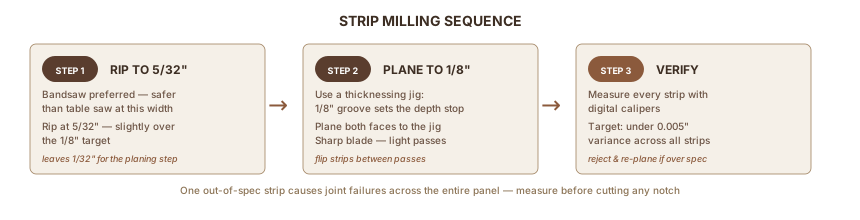
Acceptable thickness variance: under 0.005". Check with digital calipers. Reject anything outside that band before you cut a single notch.
Ripping your strips
Use a bandsaw rather than a table saw. At 1/8" thickness, thin strips on a table saw are a kickback risk. The bandsaw leaves a rougher surface (which you'll plane away) but wastes less wood and handles narrow stock more safely. Rip at 5/32" — slightly over your 1/8" target — to leave material for the planing step.
Thicknessing the strips
Make a simple thicknessing jig: rout a 1/8"-deep groove in a scrap of stable MDF or dense hardwood. The groove width matches your strip width (1/2"). Lay strips in the groove and plane the face flush to the jig surface — the groove acts as a depth stop.
Big Sand Woodworking describes the sequence: start with a coarser plane setting to remove the bandsaw marks quickly, then switch to a fine setting for the finished surface. Flip strips 180° between passes so you're planing both faces to the same reference.
A Japanese hand plane (kanna) produces a better surface than a Western bench plane for this work — the blade geometry is better suited to end-grain-adjacent cuts on thin stock. A sharp, well-tuned Western plane also works. The key is sharp: a dull blade on 1/8" stock causes tearout that's hard to recover from.
Part 4: Building the Foundation Grid
The grid is the structural skeleton. Every infill piece sits in a grid square, so if the grid is out of square or has inconsistent spacing, the infill won't fit regardless of how precisely you cut it.
How the three-layer system works
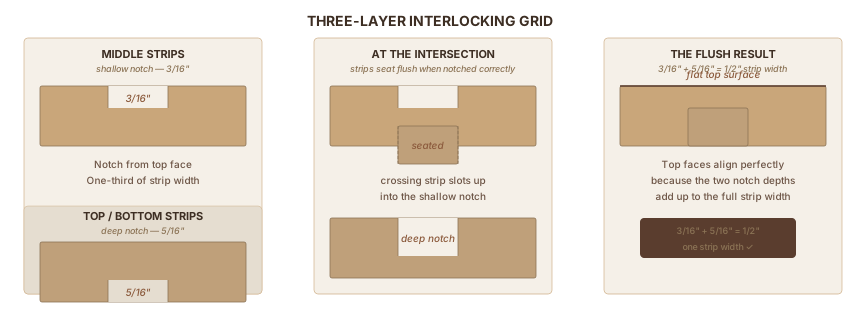
A kumiko grid isn't simply two directions of strips crossing. It's a three-layer interlock: bottom strips, middle strips, and top strips all in the same plane. The bottom and top strips have deep notches (2/3 of the strip width); the middle strips have shallow notches (1/3 of the width). When assembled, the three layers sit flush to each other, creating a flat grid.
From Jim Guilford's detailed build notes, the notch proportions for 1/2"-wide strips:
| Strip type | Notch depth | Why |
|---|---|---|
| Middle strips | ~3/16" (just over 1/3 of 1/2") | Shallow — lets top/bottom strips pass over |
| Top/Bottom strips | ~5/16" (just over 2/3 of 1/2") | Deep — locks middle strips in place |
The "just over" matters: wood compresses when the joint seats, so cutting to exactly 1/3 or 2/3 often results in joints that spring back slightly loose. Leave the extra thousandths and test-fit.
Cutting the notches
With a table saw crosscut sled: Use a stop block to position every notch identically. The blade kerf width becomes the tenon width — full-kerf (1/8") and thin-kerf (3/32") blades both work; be consistent within a panel.
By hand: Mark with a sharp marking knife and square. A Japanese dozuki saw gives the cleanest kerf. Pare cheeks with a sharp 1/4" chisel to final fit.
Test-fit pairs of strips as you cut — don't cut all the notches in all the strips before checking fit. One misset stop block ruins your whole blank.
Assembling the grid
Dry-fit everything first. Lay out all strips, press them together, check for square with diagonal measurements (diagonals must be equal). The grid should hold its shape under light handling before you commit. If it's sloppy, the problem is strip thickness — go back and re-measure.
For a display panel with no frame: press-fit only, no glue. The friction holds. For a panel that will get handled often, tiny dabs of glue at intersections add permanence without changing the technique.
RELATED: Mortise and Tenon Joinery The half-lap grid uses the same principle as mortise-and-tenon: wood-to-wood contact, consistent thickness, clean mating surfaces.
Part 5: Fitting the Asanoha Infill
This is where kumiko earns its reputation for patience. Work one grid square at a time, in sequence. Don't batch-cut all the infill pieces before you've tested the first square.
Your angle jigs
You need three guide angles: 22.5°, 45°, and 67.5°. Make these from dense hardwood (maple or oak) or buy commercial blocks from Lee Valley, KumikoLab, or RBT Tools.
From RBT Tools: jig blocks measure roughly 50mm × 45mm with a central groove 8mm deep × 12mm wide — matching your strip dimensions. For efficiency, make two blocks: Block A with 45° on one face and 67.5° on the other; Block B with 22.5° on one face and 67.5° on the other. This covers all four required cuts.
The seven pieces
Per grid square, in order of assembly:
- Long diagonal (1 piece): 45° cuts on both ends, length = square diagonal
- Short fillers (2 pieces): 67.5° on the wide end, 22.5° on the narrow end
- Locking pieces (4 pieces): 45° on both ends, shorter than the long diagonal
Fitting sequence
Work each square completely before moving to the next:
Long diagonal first. Cut slightly long. Test in the grid square. If it won't seat, pare the angled end with a sharp chisel — take off a few thousandths at a time. The piece should slide in with firm, even finger pressure. A mallet means the piece is too long.
Short fillers next. Use the 67.5°/22.5° jig. The narrow end (22.5°) is the fragile end — pare carefully from the wide end to avoid breaking the tip. Test each piece before cutting the pair.
Locking pieces last. These press into the remaining triangular spaces and lock the entire square's assembly. When a locking piece seats correctly, the surrounding pieces stop moving. That's the tell.
When nothing will seat: Check that the long diagonals are genuinely crossing at their centers — they should share a half-lap of their own at mid-length. If they're not sitting flat on each other, the grid squares may not be sized consistently.
When the grid warps as you press infill: The piece is too tight. Pare it slightly rather than forcing it. Forcing propagates stress through the whole panel.
Part 6: Finishing Your Panel
Traditional kumiko is unfinished. Japanese masters let hinoki develop its own patina over years of handling. The pale wood, the shadow lines in the pattern, the crisp tool marks — the finish is the wood itself.
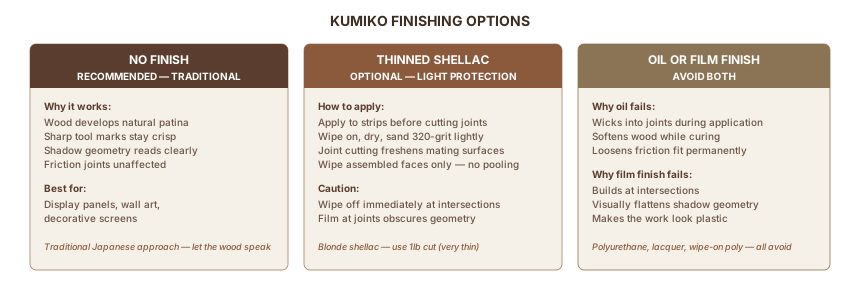
If you want light protection on a basswood panel, use thinned blonde shellac. Apply it to the strips before cutting the joints — wipe it on, let it dry, sand lightly with 320-grit. The joint-cutting that follows freshens the mating surfaces, so the friction fit isn't affected. After assembly, a second very light wipe on the faces only. Wipe off any shellac that pools at intersections immediately — film buildup in the joints obscures the geometry.
Avoid oil. Oil wicks into joints and takes a long time to cure. During curing, it softens the wood slightly — enough to loosen the friction fit on a panel that was perfectly tuned before finishing.
Avoid film finishes (polyurethane, lacquer). They build up at intersections and visually flatten the crisp shadow geometry that makes kumiko worth making.
Part 7: Common Mistakes
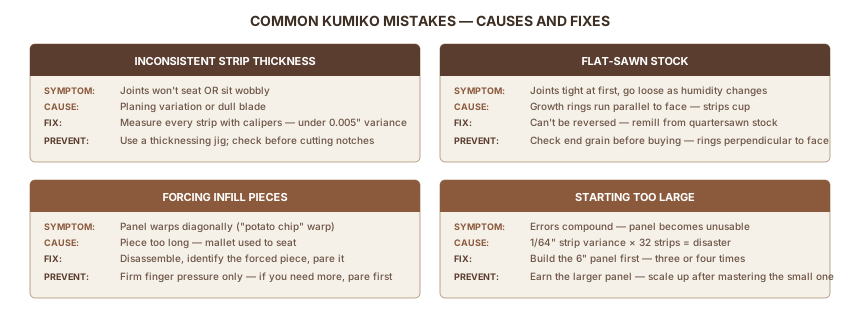
Inconsistent strip thickness. The most common problem by far. Joints that refuse to seat or sit wobbly almost always trace back here. Measure every strip with calipers before cutting a single notch. Variance over 0.005" means re-planing or rejecting that strip.
Flat-sawn stock. Strips cup across their width as humidity changes. Joints that were tight go loose as the edges lift. Buy quartersawn material, or select quartersawn sections from wide flat-sawn boards and rip from there.
Forcing infill pieces. This causes the "potato chip" warp that Jim Guilford's build notes describe — the panel twists diagonally as compressed wood pushes the grid out of plane. Infill pieces should seat with firm finger pressure. If you need more force than that, the piece needs a little more paring.
Starting too large. Dimensional error compounds. A 1/64" inconsistency in strip thickness is barely noticeable on a 6" panel; it's a disaster on a 16" panel where that variance accumulates across 32 strips. Build the 6" panel. Build three or four of them. Then scale up.
Part 8: Variations and Next Steps
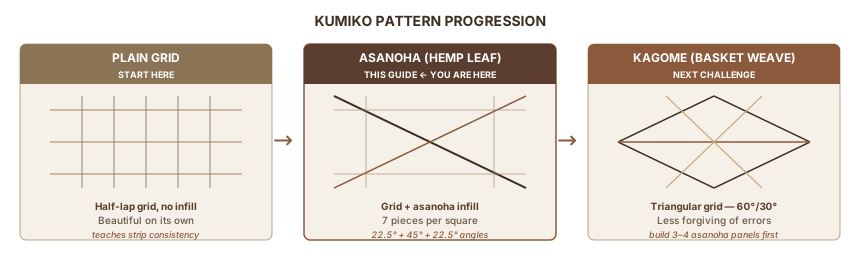
Start smaller: the plain grid panel
Before attempting the asanoha infill, build the grid alone. The half-lap grid with no infill is beautiful on its own — shadow lines at every intersection, the pattern of negative space. It's also a complete project that teaches strip consistency and notch cutting without the added precision demands of infill fitting.
Next pattern: kagome
The kagome (basket weave) pattern uses a triangular grid at 60°/30° angles instead of the 45°-based asanoha system. Same technique, different angle set. Build three or four asanoha panels before attempting it — the triangular geometry is less forgiving of inconsistency.
Frame options
A simple rabbeted frame in cherry or walnut makes the panel display-ready. The rabbet depth matches your strip thickness (1/8"); the frame depth should be at least 3/4" for visual weight. Cherry against pale basswood is a classic combination. Build the panel first; measure it; fit the frame to the finished panel, not the other way around.
RELATED: Dovetail Joint Dovetail joinery shares kumiko's demand for consistent layout and clean mating surfaces — skills that transfer directly.
Sources
Research for this guide draws on practitioner accounts, detailed build notes from woodworkers who've documented their process, commercial resource guides, and historical sources on Japanese joinery.
- Big Sand Woodworking — Making Kumiko — strip milling process, grain orientation, thicknessing jig design
- MEK Woodworks — Getting Started with Kumiko — basswood-only recommendation and reasoning, Matt Kenney book reference
- Jim Guilford — Making Kumiko at the Tablesaw — notch depth proportions, potato chip warp failure analysis
- Kumiko For Beginners — Asanoha Pattern — pattern geometry and infill piece description
- Instructables — How to Make Asanoha Kumiko — 6" panel, step-by-step infill assembly
- Lee Valley Kumiko Starter Kit — commercial kit specifications (7-3/4" panel)
- RBT Tools — Kumiko Jigs — angle block dimensions and configuration
- Smithsonian Magazine — Kumiko at the Smithsonian Craft Show — historical origin and craft context
- Suigenkyo — Kumiko Nail-Free Art — joinery mechanics, traditional context
- Kumiko For Beginners — Resource Hub — learning resources, Desmond King book series
- Tanihata Kumiko — Pattern Designs — pattern catalog and historical context
- Fine Woodworking Forum — Kumiko Finishing — shellac and wax finishing options
Tools Used
Wood Species
Also Referenced