
Dovetail Jigs at a Glance
A dovetail jig is a router guide that cuts interlocking dovetail joints without requiring the hand skills to saw to a line. Clamp your boards in, run a router along the template, and the geometry comes out right every time. Two types exist: fixed-template jigs produce uniform, evenly spaced joints; variable-finger jigs let you adjust the spacing to match hand-cut proportions. If you're cutting fewer than five joints, skip the jig and cut by hand. For anything more, a jig is faster.
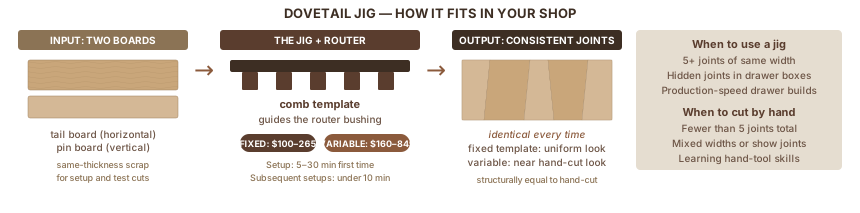
| What it is | Router template guide for repeatable dovetail joints |
| Two types | Fixed-template (uniform) vs. variable-finger (adjustable) |
| Entry option | Leigh TD330 — ~$159, through dovetails only |
| Mid-range | Porter-Cable 4216 Combo Kit — ~$230–265, through + half-blind + box joints |
| Premium | Leigh D4R Pro 24" — ~$769–849, all joint types, variable spacing |
| Router needed | 1.5–2.25 HP, 1/2" collet, fixed base preferred |
In this guide:
- Fixed-template vs. variable-finger: which type fits your work
- When a jig beats hand-cutting, and when it doesn't
- Three tiers of jigs with specific model recommendations
- Setup steps that get you good joints on day one
Part 1: What a Dovetail Jig Does
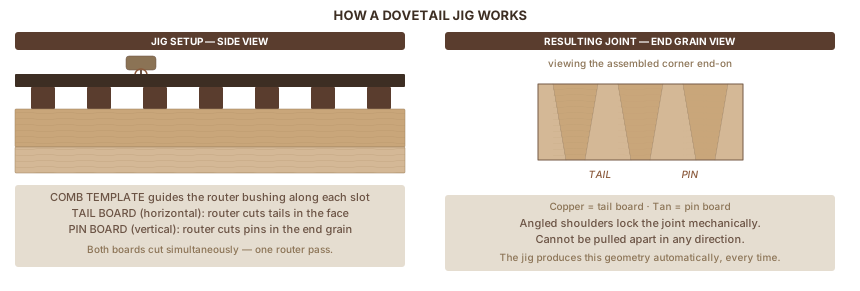
A dovetail jig is a template-routing setup. The jig clamps your two workpieces in position (pin board vertical, tail board horizontal) and a comb-shaped template guides your router in a fixed pattern. The router follows a guide bushing that rides along the template edges. Run the router through and you cut both boards at once: tails on one, pins on the other. You get an interlocking joint that fits without any hand layout, hand sawing, or paring.
The benefit is consistency. Every joint comes out the same. If you're building a set of six drawers, all twelve drawer corners look identical. That consistency is what you're paying for.
Before buying anything, ask one question: how many joints are you cutting?
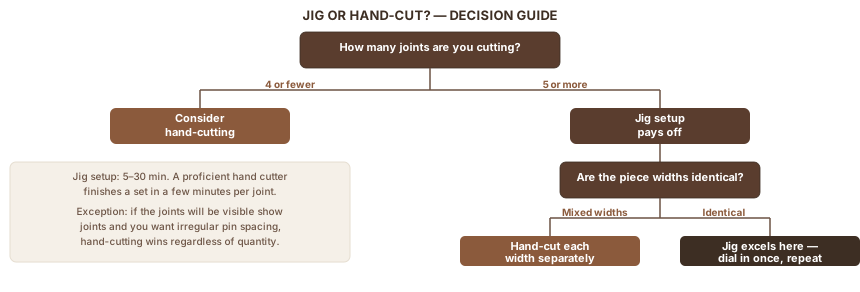
For a handful of joints on a single project, jig setup takes longer than the hand cuts themselves. A proficient hand cutter finishes a dovetail set in a few minutes. Jig setup alone takes 5 to 30 minutes, depending on the jig. For one box, cut by hand. For a chest of drawers with identical-width sides, the jig pays off by the third drawer.
If you're learning joinery from scratch and don't want to invest in hand-tool skills yet, a jig is a valid entry point. The technique is different. It's routing, not sawing and paring. The joints are structurally solid either way.
Part 2: Two Types: Fixed-Template and Variable-Finger
Every router dovetail jig falls into one of two categories. The choice between them determines what your joints look like and what you'll spend.
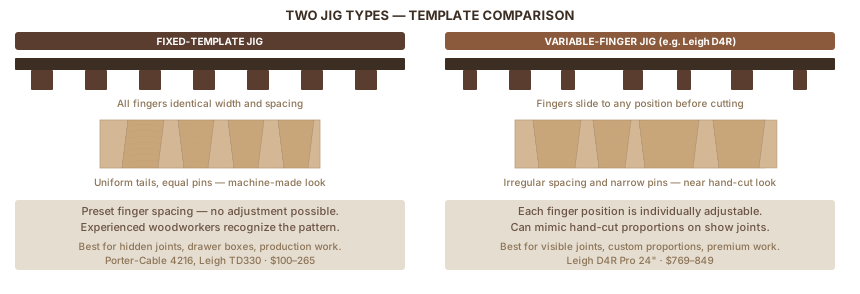
Fixed-template jigs have a permanent comb with set spacing. You can't change how wide the tails are or how far apart they sit. Every joint looks the same: uniform, evenly spaced tails with pins of equal size between them. Canadian Woodworking's dovetail jig roundup notes that this uniform spacing is the clear visual tell that separates jig-cut joints from hand-cut ones. Experienced woodworkers spot it immediately. For joints hidden inside a drawer box, this doesn't matter. For the show face of a chest, it does.
Variable-finger jigs (primarily the Leigh line) have fingers that move independently. You set each finger's position before cutting, so you can mimic the irregular spacing and narrow pins characteristic of hand-cut work. In Fine Woodworking's comprehensive tool test, the Leigh D4R Pro was the only jig to hit 0.002-inch gap tolerances on maple across all 72 test joints. No other jig in the test matched that 100% success rate.
| Fixed-Template | Variable-Finger | |
|---|---|---|
| Spacing | Uniform, preset | Adjustable per joint |
| Visual result | Machine-made look | Custom-able, near hand-cut |
| Setup time | 5–15 minutes | 15–30 minutes |
| Price range | $100–265 | $160–849 |
| Best for | Production runs, hidden joints | Show joints, custom proportions |
One note on half-blind vs. through dovetails: fixed-template jigs are typically set up for half-blind dovetails (the kind used on drawer fronts where you don't want end grain showing). Through dovetails, where the joint is visible on both faces, require a different template. Most mid-range kits like the Porter-Cable 4216 include both.
Part 3: Hand-Cut or Jig-Cut: How to Decide
Both methods produce structurally identical joints. Rockler's comparison guide states it plainly: "Machine-cut dovetails do not diminish the quality of a piece in any way." With modern PVA glue, both hand-cut and jig-cut dovetails fail by fracturing the surrounding wood, not the joint itself. The difference between the two methods is aesthetic and practical, not structural.
Use a jig when:
- You're cutting multiple identical-width pieces (a set of drawers in the same size, a bedroom set)
- Speed matters more than custom proportions
- The joints will be hidden inside a drawer or cabinet
Cut by hand when:
- Your widths vary. A chest of drawers with five different drawer sizes means five separate jig setups. A skilled hand cutter finishes each width faster than reconfiguring a jig.
- You're cutting fewer than four or five joints total
- The joints will be visible and you want irregular spacing or narrow pins that signal hand craftsmanship
- You're building fine furniture where the mark of a marking gauge on the end grain is part of the story
Wood and Shop's comparison of the Leigh jig vs. hand-cut dovetails makes the practical point well: for a few joints, hand-cutting is faster once you have the skill. The jig is for volume.
| Situation | Jig | Hand |
|---|---|---|
| Multiple identical-width pieces | ✓ | |
| Mixed widths (chest of drawers) | ✓ | |
| Fewer than 5 joints total | ✓ | |
| Hidden inside a drawer box | ✓ | |
| Visible show joint, custom proportions | ✓ | |
| Don't have hand-cut skills yet | ✓ |
Part 4: Three Tiers of Dovetail Jigs
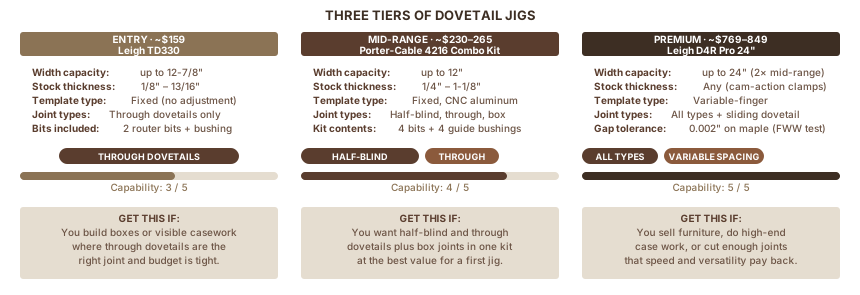
Entry (~$159): Leigh TD330
The TD330 is the least expensive jig Leigh makes, and it cuts through dovetails cleanly at a price that fits a starter budget. It handles stock up to 12-7/8 inches wide and 1/8 to 13/16 inch thick, works with a handheld router or router table, and includes two router bits and Leigh's guide bushing. Fine Woodworking's review found it produced excellent through dovetails. The limitation: through dovetails only. If you need half-blind dovetails for drawer fronts, you'll need to step up.
Get this if: you primarily build boxes, chests, or visible casework where through dovetails are the right joint.
Mid-range (~$230–265): Porter-Cable 4216 Deluxe Combo Kit
The Porter-Cable 4216 covers more joint types than anything else at this price. The kit includes a half-blind template, a through dovetail/box joint template, a miniature template for small stock, four router bits, and four guide bushings. It handles stock up to 12 inches wide and 1/4 to 1-1/8 inches thick. CNC-machined aluminum templates, good instructions, and a fixed-template design that's beginner-friendly.
The limitation: fixed spacing means uniform joints. The 12-inch capacity is tight if you're building wide drawer faces. For most drawer and box work, 12 inches is enough.
Get this if: you want half-blind and through dovetails plus box joints in one kit, at the best value for a first jig.
Premium (~$769–849): Leigh D4R Pro 24"
The Leigh D4R Pro is the serious production jig. Variable-finger design with 24 inches of capacity, double what the Porter-Cable handles. It cuts through dovetails, half-blind, rabbeted half-blind, asymmetric, and sliding dovetails plus box joints. The cam-action clamps adjust for stock thickness in seconds. First setup takes about 30 minutes; subsequent setups run under 10.
In Fine Woodworking's testing, it was the only jig that achieved 0.002-inch gap tolerances on maple consistently — every joint was usable, which no other jig in the test matched.
Buy the D4R Pro if you're selling work, building high-end case pieces where visible joints matter, or cutting production quantities regularly. For a hobbyist cutting two projects a year, the Porter-Cable 4216 does the job.
Get this if: you sell furniture, do high-end case work, or cut enough joints that the D4R Pro's speed and versatility pay back the investment.
Part 5: What Router You Need
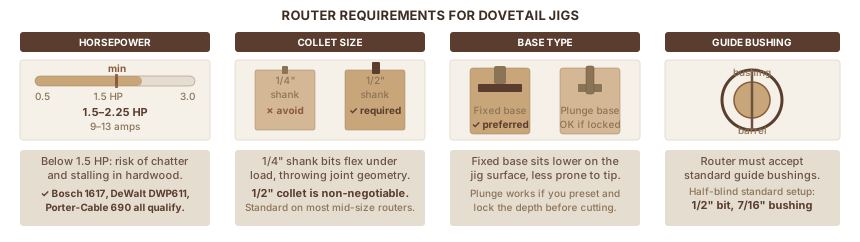
Most mid-range routers will work. The critical specs:
- HP: 1.5 HP minimum, 2 HP preferred. Leigh recommends a midsize router, 1.5 to 2.25 HP (9–13 amps). Below 1.5 HP, you risk chatter and stalling, especially in hardwood.
- Collet: 1/2 inch. Quarter-inch shank bits flex enough to throw off the joint geometry. Don't try to use them.
- Base: Fixed base preferred. A fixed base sits lower on the jig surface, less prone to tipping. A plunge router works if you preset and lock the depth before cutting.
- Guide bushing: Your router must accept standard guide bushings. Most US-made and -sold routers do (Porter-Cable bushing pattern). Check your router's manual if uncertain.
For the standard half-blind cut, Popular Woodworking's technique guide specifies a 1/2-inch, 14° dovetail bit with a 7/16-inch guide bushing. This combination is what most half-blind jig setups are built around.
If you already own a decent 1.75 HP fixed-base router with a 1/2-inch collet (Bosch 1617, DeWalt DWP611, Porter-Cable 690), you're set.
Part 6: Setup Your First Day With a Jig
The most common frustration with dovetail jigs is expecting flawless joints within the first hour. Most jigs need fine-tuning across a combination of settings before the joint fits right. Plan to use scrap before touching project stock.
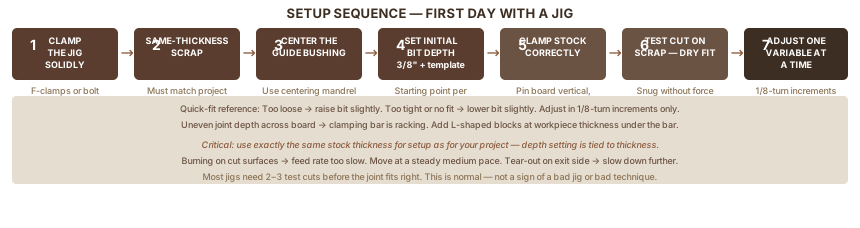
Setup sequence:
- Clamp the jig solidly. Movement during the cut ruins everything. Clamp to a bench with F-clamps or bolt to a vise. Don't hand-hold it.
- Cut from same-thickness scrap. Depth setting is tied to stock thickness. If your project stock is 3/4 inch, your scrap must be exactly 3/4 inch.
- Center the guide bushing. Use a centering mandrel (or the cone supplied with many jigs) to center the bushing to the bit's axis before your first cut.
- Set initial bit depth to 3/8 inch plus template thickness. This is the standard starting point per Popular Woodworking's setup guide. Verify the bit clears the bushing by hand-turning before routing.
- Clamp stock correctly. Pin board clamps vertically; tail board clamps horizontally. Both boards butt firmly to the jig's stop.
- Make a test cut on scrap. Assemble dry. A fit that's snug without forcing is the target. Too loose: raise the bit slightly. Too tight or no fit: lower the bit slightly.
- Adjust one variable at a time. Move the depth in 1/8-turn increments. If you change depth and clamp position simultaneously, you'll lose track of what fixed the problem.
Woodsmith's dovetail jig setup guide and Wealden Tool's tips both emphasize the same principle: patience with setup prevents frustration later.
Common setup problems:
| Problem | Likely cause | Fix |
|---|---|---|
| Joint fits scrap, not project stock | Different thickness | Retest with exact project-thickness scrap |
| Uneven joint depth across the board | Clamping bar racking | Add L-shaped blocks at workpiece thickness under the bar |
| Can't isolate the problem | Changed too many settings at once | Reset to baseline, change one variable |
| Burning on cut surfaces | Feed rate too slow | Move router at a steady, medium pace |
| Tear-out on the exit side | Feed rate too fast, or grain direction | Slow down; back up cut direction on tear-out edge |
Part 7: Where Dovetail Jigs Fit In
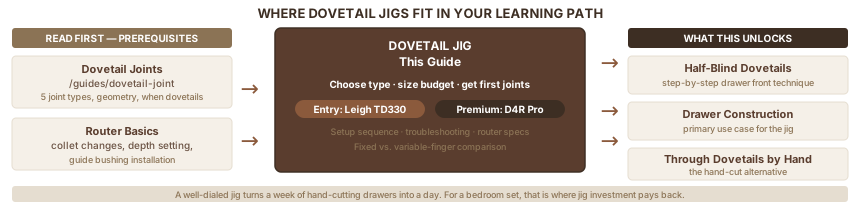
Before you use a jig, read these:
- Dovetail Joints — how the geometry works, the five types, when dovetails make sense vs. other joints
- Basic router skills (collet changes, depth adjustment, guide bushing installation)
Related guides:
- Through Dovetails by Hand — the hand-cut alternative; useful to understand before committing to either method
- Half-Blind Dovetails — the step-by-step technique for the most common drawer joint
- Drawer Construction — the primary use case for dovetail jigs; how the joints fit into a full drawer build
What this skill unlocks: Once you're comfortable with a jig, drawer construction gets faster. A bedroom set that might take a week of hand cutting takes a day with a well-dialed jig. If you're building to sell, that's where jig investment pays back.
Sources
This guide draws on manufacturer specifications, professional tool test data, and woodworking technique references.
- Popular Woodworking: Half-Blind Dovetails by Jig — bit and bushing specs, setup sequence
- Fine Woodworking: Dovetail Jigs Tool Test — comparative test data including D4R Pro gap tolerance and success rate
- Fine Woodworking: Leigh TD330 Review — entry-Leigh jig performance
- Leigh Tools: D4R Pro Overview — specs, capacity, joint types
- Porter-Cable: 4216 Product Page — kit contents, stock capacity specs
- Rockler: Hand or Router Cut Dovetails — structural equivalence of hand-cut vs. jig-cut
- Wood and Shop: Leigh Jig vs. Hand-Cut Dovetails — practical comparison including variable-width scenarios
- Canadian Woodworking: Dovetail Router Jigs — fixed-template vs. variable-finger overview
- Woodsmith: Dovetail Jig Secrets — depth adjustment technique
- Wealden Tool: Five Tips for Basic Dovetail Jigs — setup tips
- Sawmill Creek: Optimal Router HP for Dovetail Jig — router HP recommendations from experienced users
Tools Used
How We Research
We don't take affiliate revenue or accept review units. Picks come from multi-source research — manufacturer specs, OSHA / EPA / ASTM regs, and long-form practitioner threads — plus Ahmed's hands-on use where relevant. When we recommend something, we explain why.
Up Next
What are Mortise, Dovetail, and Mitre Joints?
JOINERY · Beginner