
Dado Stacks at a Glance
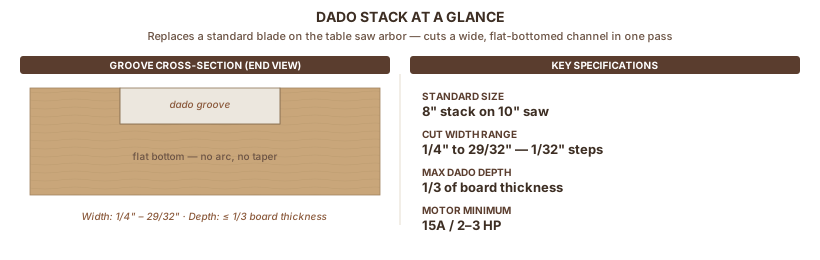
A dado stack replaces your table saw's regular blade with a set of blades and cutters that remove a wide, flat channel in one pass. Standard saw blades cut a single 1/8" kerf. According to Freud's configuration chart, a full dado stack cuts from 1/4" to as wide as 29/32" in one shot. For cabinet work and furniture joinery, this is the tool that makes shelf dadoes, drawer grooves, and rabbets fast and repeatable.
| Standard size | 8" (for 10" table saws) |
| Cut width range | 1/4" to 29/32" |
| Budget pick | Oshlun SDS-0842 (~$70) |
| Best value overall | Freud SD508 (~$200) |
| Max dado depth | 1/3 of board thickness |
| Motor requirement | 15A / 2–3 HP minimum |
In this guide:
- How the stack works and what's in the box
- Which size fits your saw — and the arbor check you must do first
- What a dado stack can cut, with dimensions
- Dado stack vs. router: which one to reach for
- What to buy at each budget
- Step-by-step setup and common mistakes
Part 1: How a Dado Stack Works
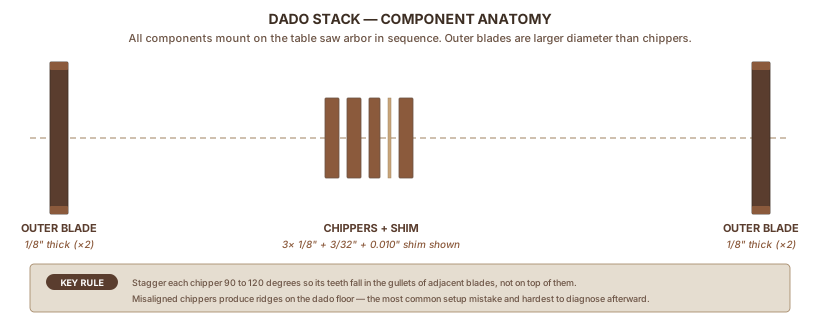
A dado stack is a collection of components you stack onto the table saw's arbor to achieve the cut width you need.
| Component | What it does | Typical count per set |
|---|---|---|
| Outer blades (2) | Score and cut the clean walls of the groove | Always 2 |
| Chippers | Remove waste between the outer blades; come in 1/8" and 3/32" widths | 2–6 |
| Shims | Fine-tune total width in 1/32" increments | Several |
The outer blades work like a small circular saw, cutting the walls of the groove. The chippers are thicker blades with wider, fewer teeth that hog out the material between them. Shims fill the gaps to dial the total width to exactly what you need.
That shimming system is the whole point. "3/4" plywood is actually 23/32" thick. Your router bit is a fixed diameter that either fits or doesn't. A dado stack adjusts in 1/32" steps, so you can sneak up on a perfect fit.
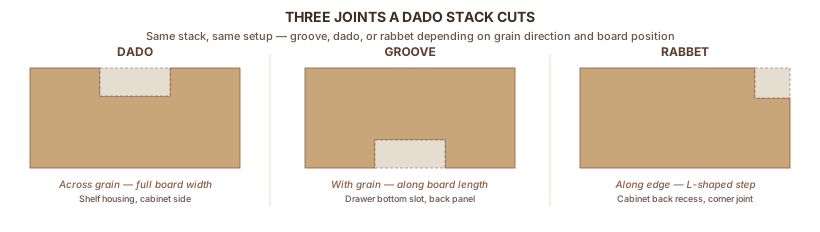
Three joint types, one tool:
- Dado — channel cut across the grain (shelf housing in a bookcase side)
- Groove — channel cut with the grain (drawer bottom slot)
- Rabbet — channel along an edge (cabinet back recess)
Stacked vs. wobble dado blades:
| Type | Bottom flatness | Cut quality | Cost | Verdict |
|---|---|---|---|---|
| Stacked dado set | Flat | Excellent | $65–$350 | What serious woodworkers use |
| Wobble dado blade | Curved (subtle arc) | Adequate | $30–$80 | Fine for jigs; not for furniture |
A wobble blade is a single blade mounted on an eccentric hub. It rotates in a slight arc, which cuts wider than its kerf but leaves a curved bottom. Woodworkers Journal's comparison covers this in detail. That curve doesn't matter for a jig or a rough groove. It matters a lot for a bookcase shelf that needs to sit flat. Buy a stacked set.
Part 2: Size and Table Saw Compatibility
Get this wrong and you've bought a blade set you can't use.
Size by saw:
| Dado stack size | Saw size | Max depth of cut |
|---|---|---|
| 6" | 8" and 8-1/4" table saws | ~1" |
| 8" | 10" table saws (standard) | ~1.5" |
| 10" | Specialty only | — |
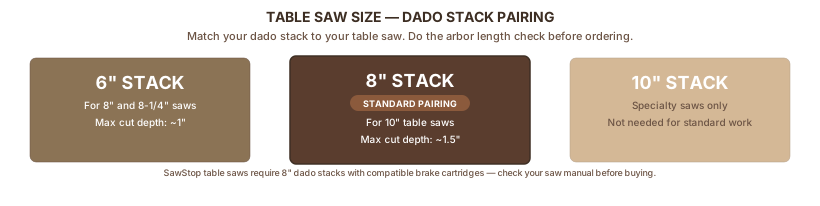
The standard pairing: 10" saw, 8" dado stack. Ten-inch dado sets exist but aren't necessary. The Wood Whisperer's size comparison confirms that an 8" stack on a 10" saw gives 1.5" depth of cut, which covers every standard furniture joint. Stick with the 8".
The Arbor Length Check — Do This Before You Buy
More important than size: check your saw's arbor length. The arbor (the shaft the blade mounts on) must be long enough to hold the complete dado stack and still engage the nut with at least 3 full threads. If the nut doesn't thread completely, the stack can come loose during operation.
How to check:
- Unplug the saw
- Remove the blade, washer, and nut completely
- Look at the exposed threaded arbor stub
- Estimate or measure the exposed threaded length
- Compare to the total width of the dado stack you plan to use (typically 3/4" to 1" assembled)
- You need stack width + enough thread for the nut to seat with 3 threads protruding past the nut face
Saws that commonly fail this check: Contractor saws, jobsite saws, older Craftsman and Ryobi models. Some manufacturers explicitly state the saw doesn't accept dado blades. Check your manual before ordering.
Saws that work: Cabinet saws, hybrid saws, most mid-range 10" contractor saws from DeWalt and similar brands.
A Note for European Readers
Dado stacks are not legal on EU and UK table saws manufactured to current safety standards. Workshopedia's guide to dado blades explains the regulation: European safety rules require saw blades to stop within 10 seconds of power-off, and a dado stack's mass prevents this. EU and UK saws are built with deliberately short arbors. The maximum kerf width allowed is 15.5mm. If your saw was purchased in Europe or the UK, verify before buying.
Motor Requirements
An 8" dado stack needs real motor power. 15A (about 2–3 HP) is the minimum. Underpowered saws bog down at full width in hardwood. Softwood and plywood are more forgiving, but you'll feel the motor strain.
Part 3: What Dado Stacks Cut
| Joint | Width | Depth | Common use |
|---|---|---|---|
| Shelf dado | Match actual plywood (~23/32" for "3/4") | 1/4"–3/8" | Bookcase sides, cabinet shelves |
| Drawer bottom groove | 1/4" | 1/4" | Drawer box bottom panel |
| Cabinet back groove | 1/4"–3/8" | 3/8" | Cabinet back panel recess |
| Half-lap joint | Half of material width | Half of material thickness | Frame joinery, trestle bases |
| Rabbet at corner | Match panel thickness | Match panel thickness | Drawer corner, cabinet back |
| Box joint | Match desired finger width | Full material thickness | Box and drawer corners |
Depth rule: Never cut deeper than 1/3 of the board's thickness. Dimensions.com's dado joint reference specifies a maximum depth of 1/2 the board thickness, but 1/3 is the safer working target. In 3/4" stock, keep dado depth at 1/4" or less. Go deeper and the board is structurally weakened at the cut.
For how to actually make these cuts, see Dado Cuts with a Table Saw. For the joinery types explained in more detail, see Dado Joints.
Part 4: Dado Stack vs. Router
| Task | Dado stack | Router | Use this |
|---|---|---|---|
| Multiple through-dadoes (cabinets, bookcases) | 1 pass each | Multiple passes | Stack |
| Stop dado (blind groove, doesn't go all the way across) | Awkward | Natural | Router |
| Crosscut dado near the end of a long board | Difficult to control safely | Safe with a guide rail | Router |
| Fine-tuning width to match actual plywood | 1/32" increments | Fixed bit diameter | Stack |
| Setup time | 5–15 minutes | 1–2 minutes | Router |
| Long-term cost (the tool only) | $65–$220 | $20–$50 bit (if you own a router) | Router |
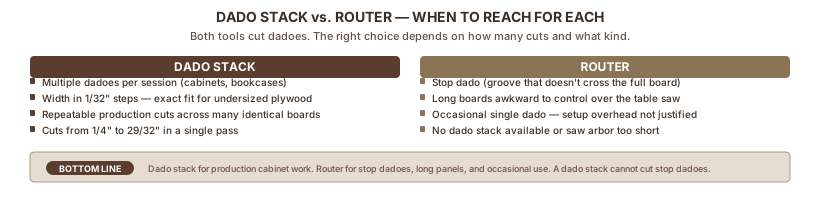
The practical split: If you build cabinets or bookcases, a dado stack pays for itself in time saved. Cutting 12 shelf dadoes with a router takes four times as long. If you cut an occasional dado, a router with a straight bit is entirely adequate.
One thing a dado stack can't do: stop dadoes (grooves that don't run all the way across). Those always go to the router. For router dado technique, see Router Tables.
Part 5: What to Buy
| Brand | Size | Price | Outer blade teeth | Notes |
|---|---|---|---|---|
| Oshlun SDS-0842 | 8" | ~$70 | 42T | Best budget pick; consistently outperforms its price |
| Freud SD208 | 8" | ~$115 | 10/12T | Reliable entry-level; fewer teeth means more tearout |
| Freud SD508 | 8" | ~$200 | 24T | Fine Woodworking picked this as the best overall value after testing 15 dado sets |
| Forrest DSET | 8" | ~$300+ | Premium carbide | Hand-tensioned plates; includes resharpening service |
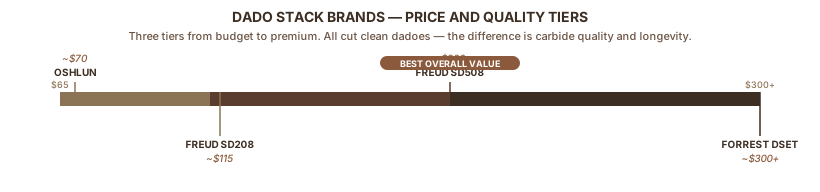
For a first dado stack with a verified compatible saw: buy the Oshlun SDS-0842. At about $70, the 42-tooth outer blades reduce tearout compared to budget sets with 10–12 teeth. The woodworking community consistently recommends it as the best entry-level stacked dado set.
For regular cabinet and furniture work: buy the Freud SD508. The 24-tooth outer blades, comprehensive chipper selection, and 1/32" shim increments make dialing in exact fits straightforward. Fine Woodworking tested 15 dado sets and named it the best overall value — a result widely referenced in woodworking forums.
For a long-term investment: the Forrest DSET. The quality premium is real. Forrest earns its price through longevity: hand-tensioned plates, superior carbide, and a resharpening service that keeps it performing for decades.
SD208 vs. SD508: The SD508 costs roughly twice as much. It delivers 24-tooth outer blades (versus 10–12 teeth on the SD208), a wider width range (up to 29/32" vs. 7/8"), and finer shim increments. Build regularly and the SD508 is worth it. If budget is the constraint, the SD208 works fine.
On Freud specifically: Freud is an Italian-owned brand known for industrial blade quality. "Freud dado stack" in search results usually refers to either the SD208 or the SD508. Both work. The SD508 is the one to buy if your budget allows.
Part 6: Assembling a Dado Stack
- Unplug the saw. Not optional.
- Remove the throat plate, riving knife, and blade guard. A dado cut requires removing the riving knife.
- Remove the existing blade (nut, then washer, then blade).
- Clean the arbor. Sawdust on the arbor causes runout and vibration.
- Clean every component in the dado set: both faces of each outer blade, chipper, and shim.
- Install the first outer blade against the arbor flange, teeth facing the cutting direction (toward you from below the table).
- Add chippers. Critical: stagger each chipper so its teeth fall in the gaps between adjacent blade teeth. No tooth should touch another. Spread chippers evenly around the circumference. Loading them all on one side causes vibration.
- Add shims between chippers as needed. Hold each shim firmly as you add it. Shims that fall into the arbor threads prevent the stack from closing flush.
- Install the second outer blade with teeth facing the same direction as the first.
- Skip the arbor washer for stacks wider than about 3/8". Thread the nut directly against the outer blade.
- Tighten the nut firmly. Grizzly's assembly guide specifies at least 3 threads protruding past the nut face as the safety minimum.
- Install a dado-specific throat plate. A regular blade insert has a narrow slot that causes tearout and chip ejection with a dado stack. Use the dado insert that came with your saw, or make a zero-clearance insert. Rockler's installation walkthrough covers this step in detail.
- Set blade height and fence position. Make a test cut in scrap. Check the width with calipers before cutting your project stock.

Common setup mistakes:
| Mistake | What happens | Fix |
|---|---|---|
| Not staggering chippers | Teeth contact each other → gap between plates → can't tighten → severe vibration | Stagger each chipper 90–120° from the adjacent ones |
| Shim falls into arbor threads | Stack won't close flush → runout → rough cuts | Hold the shim with a finger during installation |
| Using the arbor washer with a wide stack | Nut won't engage fully | Omit the washer for any stack wider than ~3/8" |
| No dado throat plate | Excessive tearout on the bottom face | Use the saw's dado insert or a zero-clearance plate |
| Not checking arbor length before buying | Incompatible saw, wasted purchase | Do the arbor length check before you order |
Part 7: Maintenance
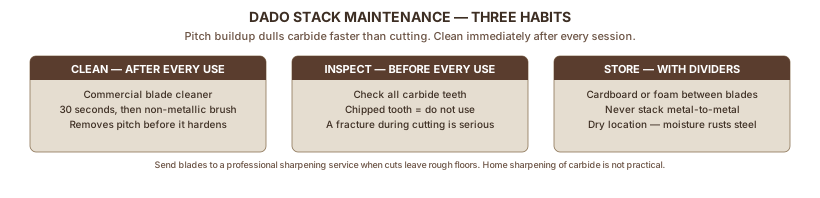
After each use: Clean pitch and resin from all blades and chippers with commercial blade cleaner. Apply, let sit 30 seconds, scrub with a non-metallic brush. Pitch buildup increases friction, slows cuts, and generates heat that dulls carbide.
Before each use: Inspect the carbide teeth on all components. A chipped tooth can fracture during operation. If teeth are chipped or missing, don't use that component until it's been serviced.
Storage: Keep blades and chippers separated with cardboard or foam dividers. Most sets include a case for this. Never stack metal-to-metal without protection. Store in a dry location: moisture rusts the steel plate.
Sharpening: Carbide holds an edge well through many board feet of use. When cuts start leaving rough bottoms or more tearout than usual, send the set to a professional blade sharpening service. Forrest offers resharpening for their own sets. Home sharpening of carbide teeth isn't practical.
Part 8: Where Dado Stacks Fit
Cabinet and bookcase work is where a dado stack earns its price. The tool cuts the shelf dadoes in the case sides, the groove for the back panel, and any rabbets at the corners, all from one setup.
See How to Build a Cabinet for how those cuts fit into a full cabinet build. For choosing the sheet goods that go into those dadoes, see Sheet Goods for Cabinets.
For the technique of making these cuts, start with Dado Cuts with a Table Saw.
Sources
This guide draws on manufacturer specifications, woodworking trade publications, and community-sourced practice from professional and experienced woodworkers.
- Freud Dado Chipper Set-Up & Configuration Guide — official width configurations and chipper arrangements by target dado width
- Woodworkers Journal: Stacked vs. Wobbly Dado Blades — comparison of cut quality, bottom flatness, and vibration between dado blade types
- The Wood Whisperer: 6" vs. 8" Dado Stacks — size pairing by table saw, depth of cut data
- Workshopedia: The Comprehensive Guide to Dado Blades — EU/UK safety regulation context, kerf width limits
- Dimensions.com: Wood Joint — Dado — standard dado depth and width dimensions
- Grizzly: How to Properly Stack Your Dado Blades — arbor thread safety minimum, chipper stagger requirements
- Rockler: How to Install a Dado Stack on a Table Saw — complete installation sequence including throat plate selection
- LumberJocks: Freud SD208 vs. SD508 — community comparison of Freud dado sets, Fine Woodworking test results referenced
- Canadian Woodworking: Rabbets, Dados and Grooves — joint type definitions and applications
Tools Used
Also Referenced
How We Research
We don't take affiliate revenue or accept review units. Picks come from multi-source research — manufacturer specs, OSHA / EPA / ASTM regs, and long-form practitioner threads — plus Ahmed's hands-on use where relevant. When we recommend something, we explain why.
Up Next
Dado Cut: What It Is and How to Cut One
JOINERY · Beginner