
Wooden Work Bench at a Glance
A workbench is a tool for holding wood — not just a table you work on top of. The design choice matters less than most people think: a simple bench built from $150 in construction lumber will outperform any retail workbench if it's the right height for your body and has a face vise. Start with the simplest design you can build in a weekend. You'll build a better one in a few years once you know what you actually need.
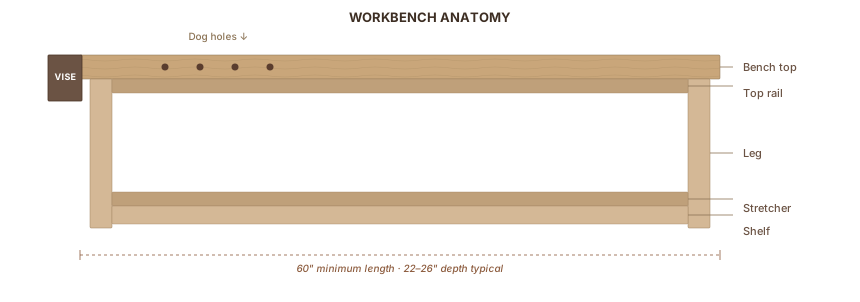
| Skill level | Beginner |
| Build time | 1–2 weekends |
| Material cost | $100–200 (construction lumber) |
| Recommended height | Your knuckle height (usually 34–36") |
| Minimum size | 60" long × 24" deep |
| First vise | Face vise, front-left corner (right-handers) |
In this guide:
- Five bench designs and which to build first
- How to find your correct height
- Choosing your lumber
- Building the bench step by step
- Adding a vise and workholding
- Seven mistakes first-time builders make
Part 1: What Makes a Bench Different From a Work Table
A regular table holds things. A workbench holds wood while you cut, plane, chisel, and sand it — and that's a completely different job.
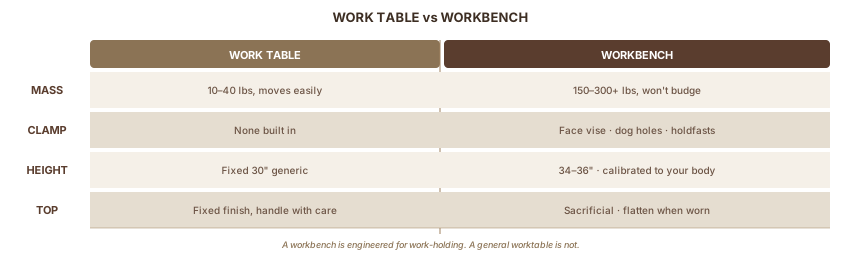
The key differences:
Mass. A good workbench weighs 150 to 300+ pounds finished. That weight keeps it from moving when you push a hand plane across a board or chop a mortise with a mallet. A folding table rattles. A bench doesn't.
Clamping. A workbench is designed around work-holding: a face vise on the front edge, dog holes for bench dogs, and holdfast holes for the fastest hold-and-release tool in the shop. Without these, you're fighting the bench instead of the wood.
Height. A bench height is calibrated to your body and the work you do, not a generic 30-inch table height. Wrong height = back pain within an hour.
Sacrificial top. The bench top will get scratched, glued, and hammered. That's correct. It's not furniture. When it goes out of flat, you flatten it. When it gets too beaten up, you replace the top. A $500 dining table doesn't work like this.
You don't need a perfect bench to start woodworking. Sawhorses and a solid door blank will get you through small projects while you plan the real bench. But once you have even a basic bench, you'll wonder how you worked without one.
Part 2: Five Bench Designs and Which to Build First
There are five design traditions most woodworkers encounter. Three are realistic first builds. Two aren't.
Simple 2×4 DIY Bench
The most popular beginner approach. Pocket screws or lag bolts, dimensional lumber, plywood or 2×6 planked top. You can find free plans from a dozen sources (Jay Bates, Jen Woodhouse, Matthias Wandel, Family Handyman). Build time: one weekend. Cost: $100–200.
Good for: power tool woodworking, assembly, small projects. Works well. Not heavy enough for serious hand tool work.
Paul Sellers Design
Paul Sellers — a master craftsman who trained in the English tradition — designed this bench specifically to be accessible to beginners. Construction-grade 2×4 and 2×6 lumber, roughly 8 hand-cut mortise-and-tenon joints, free plans and video at paulsellers.com. Materials run $120–150 today.
The mortise-and-tenon joints are intentionally the teaching moment. You're not just building a bench — you're learning the most important joint in furniture making. Students new to woodworking build this bench after just a few months of practice.
Nicholson (English)
Named after 19th-century craftsman Peter Nicholson. The defining feature: a thick front apron instead of a massive laminated slab top. This cuts build time significantly — no gluing up a 4-inch slab. The top is framed planks, not a laminated block.
Built from construction-grade Southern Yellow Pine or Douglas Fir. Budget around $120–150. Simple joinery, accessible for beginners, and results in a genuinely solid hand tool bench. Richard Maguire of The English Woodworker calls it "a surprisingly accessible build — a rock solid workbench without spending all year building it."
Roubo (French Continental)
Named after 18th-century craftsman André Roubo. Thick laminated top (3.5–5 inches), leg vise on the front left, tail vise on the right end. Finished weight: 300+ pounds. Excellent for serious hand tool work.
Do not build this as your first bench. It requires significant joinery skill, serious material cost ($250–400+), and months of build time. Christopher Schwarz's free "Anarchist's Workbench" (PDF at Lost Art Press) simplifies the design — 12 mortise-and-tenon joints, under $300 in construction lumber — but it's still an intermediate project.
Scandinavian / European
Low stretchers, no upper shelf, tail vise integrated into the end. Designed primarily for hand planing. Beautiful, functional, complex to build. Build this as a second bench, not your first.
Which to build:
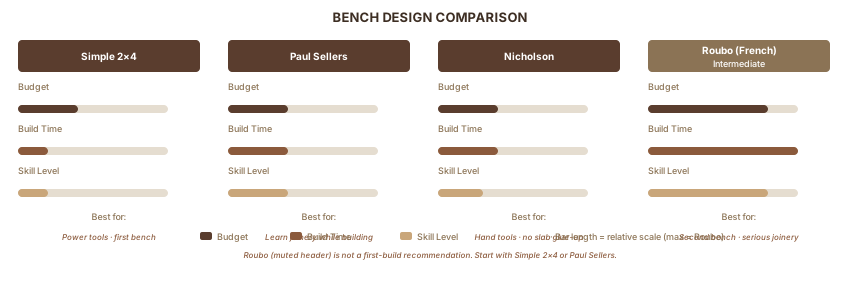
| Design | Budget | Build time | Skill required | Best for |
|---|---|---|---|---|
| Simple 2×4 | $100–200 | 1 weekend | Beginner | Power tool users, first bench |
| Paul Sellers | $120–150 | 2–3 weekends | Beginner | Learning hand joinery alongside building |
| Nicholson | $120–150 | 1–2 weekends | Beginner | Hand tool work without the slab build |
| Roubo | $250–400+ | 3–6 months | Intermediate | Second bench for serious hand tool work |
For most beginners: start with the simple 2×4 bench. If you want to learn joinery while building, do the Paul Sellers design instead. Both are legitimate first benches.
Part 3: How to Find Your Correct Height
Most plans say "build it 34 to 36 inches tall." That's useless without knowing your height.
The knuckle rule: Stand relaxed with your arms at your sides. Measure from the floor to the top knuckle of your thumb. That's your bench height.
For most adults, this lands between 34 and 36 inches — but you're not most adults. Measure yourself before you cut anything.
Stumpy Nubs Woodworking Journal has a good breakdown of why this works: the knuckle height positions your arms for a natural pushing stroke, which is where most bench work happens.

Adjust for your main tasks:
| Task | Height adjustment | Why |
|---|---|---|
| Hand planing | 2–4" lower than knuckle height | More downward force, less back strain |
| Carving / fine detail | 2–4" higher | Closer to eye level |
| Assembly and power tools | 1–2" higher | Less stooping on layout work |
| General joinery | Knuckle height | The right default |
If you're not sure, build at knuckle height. That's where most work happens for most people. You can add adjustable leveling feet later to fine-tune.
One more thing: subtract the thickness of your finished top before you cut your legs. If your glued-up top is 3 inches thick, your legs need to be 3 inches shorter than your target bench height.
Part 4: Choosing Your Lumber: The Honest Answer
Construction lumber works. Here's what to know about it.
SPF (Spruce-Pine-Fir) is what most beginner bench plans specify. It's cheap and available everywhere. The problem: construction-grade SPF off the shelf is often 15–19% moisture content. In a heated shop, it will dry to 6–8% — and as it dries, it moves. Boards will cup, twist, and warp.
The fix is simple: buy your lumber 1–2 weeks early and let it acclimate in your shop. Then cut and build. Most of the movement happens fast.
Also, sort carefully. Don't grab the first boards you see. Stand them up and look down their faces for bow and twist. Reject anything with bad knots or wild grain. For the benchtop, prefer 2×8 or 2×10 over 2×4 — wider boards are more stable and easier to glue up flat.
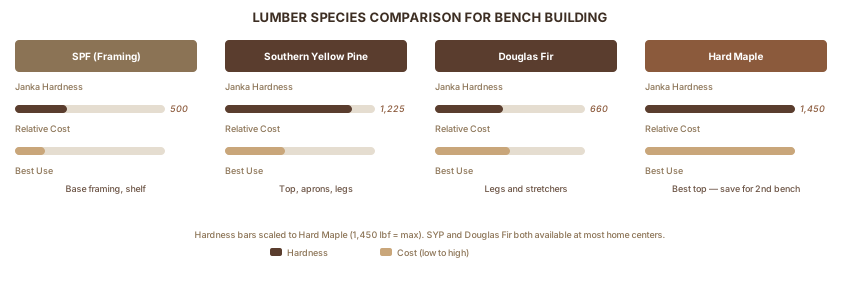
| Species | Janka hardness | Cost | Best use |
|---|---|---|---|
| SPF (framing 2×4) | ~500 lbf | Cheapest | Base framing, shelf |
| Southern Yellow Pine | ~1,225 lbf | Low | Top, aprons, legs — harder and heavier |
| Douglas Fir | ~660 lbf | Low–moderate | Legs and stretchers; harder than SPF |
| Hard Maple | ~1,450 lbf | High | Ideal top surface — save for second bench |
Recommendation: If you can find Southern Yellow Pine or Douglas Fir at your local home center, use those for the top. SPF works, but it's softer. For the base framing, standard SPF is fine.
The English Woodworker on wood selection for benches has a more detailed breakdown if you want to go deeper on species comparisons.
Part 5: Building the Bench Step by Step
This sequence follows the simple 2×4 design — the fastest path to a functional bench.
What you'll need (6-foot bench)
- Top: 5–6 pieces of 2×8 or 2×6, 6 feet long (edge-glued face-to-face for a solid top)
- Legs: 4 pieces of 4×4, or double-laminated 2×4 pairs, cut to bench height minus top thickness
- Top rails: 2 pieces of 2×4, 6 feet (run front and back under the top)
- Lower stretchers: 2 pieces of 2×4, 6 feet, plus 2 short pieces for the end panels
- Shelf: One sheet of 3/4" plywood, cut to fit between the lower stretchers
- Fasteners: 3" and 3.5" structural screws or 3/8" lag bolts, wood glue
The build sequence
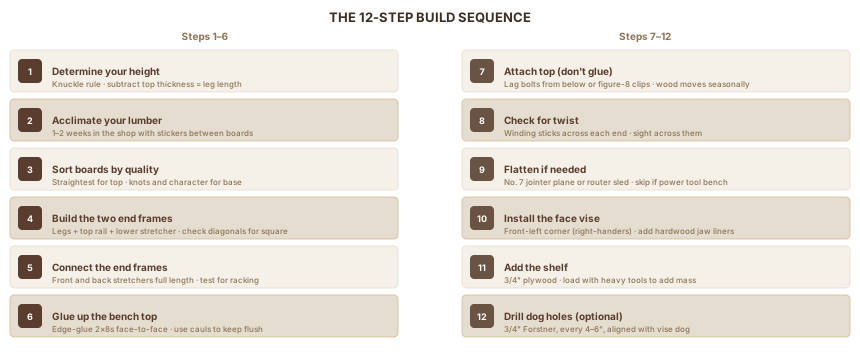
1. Determine your height. Use the knuckle rule (above). Subtract your top thickness. That's your leg length.
2. Buy and acclimate your lumber. Bring it into the shop 1–2 weeks before you build. Stack it with stickers between each board for airflow.
3. Sort your boards. Pick the straightest, least-knotty boards for the top. Everything with knots and character goes in the base.
4. Build the two end frames. Each frame is two legs connected by a top rail and a lower stretcher. Drill pilot holes and lag-bolt the joints. Check each frame for square diagonally — measure corner to corner both ways and adjust until the measurements match.
5. Connect the end frames. The front and back stretchers run the full length. Bolt through into the end frames. Test for racking (grab the top and push diagonally). It should feel solid. If it rocks, add a diagonal brace.
6. Glue up the top. Apply glue to the faces of your 2×8 boards, clamp them edge-to-face into a slab. Keep the faces flush during clamping — cauls (straight clamping boards) help. Let it cure 24 hours.
7. Attach the top — but don't glue it. Bolt the top to the base from below, or use figure-8 clips. Don't glue the top to the base permanently. Wood moves with the seasons, and a glued-down top can crack the base.
8. Check for twist. Lay two straight sticks (called winding sticks — a pair of parallel staves that reveal whether a surface is twisted) across the top at each end and sight across them. If they're not parallel, the top has twist. Flat tops are worth chasing.
9. Flatten if needed. For a power tool bench, skip this unless twist is severe. For hand tool work: a No. 7 jointer plane removes twist in 30–45 minutes. The Wood Whisperer's Episode 174 covers the router sled method if you don't have a long plane.
10. Install the face vise. See Adding a Vise and Workholding below.
11. Add the shelf. Cut your plywood shelf and drop it between the lower stretchers. Load it with heavy stuff: cast iron planes, bar clamps, anything dense. Mass is what makes a bench feel solid.
12. Drill dog holes (optional). A 3/4" Forstner bit, drilled every 4–6 inches in a line aligned with your vise dog. Use a drill press if you have one — keeping the holes plumb matters. These can wait until after the vise is installed.
Part 6: Adding a Vise and Workholding
A single face vise handles 80% of woodworking clamping tasks. That's your starting point.
Vise options:
| Vise | Approximate price | Notes |
|---|---|---|
| Pony (Jorgensen) #27091 | $60–80 | Best entry-level; quick-release; 7" jaw opening; community-validated |
| Irwin quick-release woodworking vise | $40–60 | Light duty; adequate for beginner |
| Rockler Heavy-Duty Quick-Release | $100–130 | Step up in quality; larger opening; worth the extra money if budget allows |
The Pony #27091 is the right pick for most first benches. Widely used, well-reviewed, and the quick-release mechanism makes it fast to open and reposition.
Installing the vise:
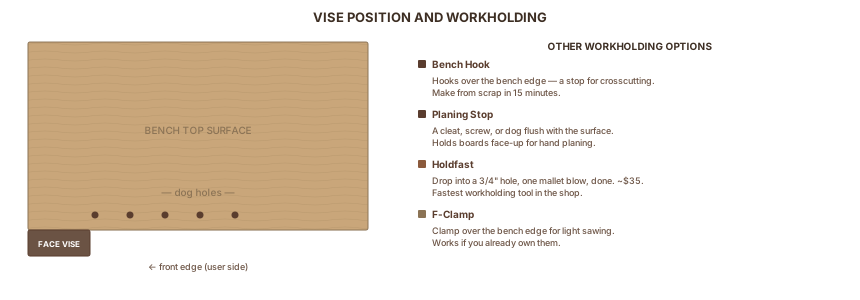
- Position: Front-left corner for right-handers (front-right for left-handers)
- Height: The top of the vise jaw should be flush with or 1/16" below the benchtop surface
- Jaw liners: Add hardwood faces (3/4" stock) to both the fixed and moveable jaws, flush with the bench surface. This prevents the metal jaws from denting your workpieces.
- Mounting: If your top is 2" or thicker, lag screws from below work well. Thinner tops need carriage bolts.
- Pre-drill everything. Splitting a bench top on the last step is a bad day. Pilot holes cost 30 seconds.
The English Woodworker's face vise guide has a detailed walkthrough of jaw sizing and installation.
Workholding without a vise:
You don't need a vise to start using the bench:
- Bench hook: An L-shaped jig that hooks over the bench edge and provides a stop for crosscutting. Make one from scrap in 15 minutes.
- Planing stop: A dog in a hole, a cleat screwed to the bench surface, or even a stout screw driven flush. Holds boards for face planing.
- Holdfast: A cast iron pin that drops into a 3/4" hole and locks with a mallet blow. Releases with a tap from behind. Lee Valley sells holdfasts for about $35. Fastest workholding tool in the shop.
- F-clamps: Clamp over the bench edge for light sawing and carving. Not as fast as a vise but you may already own them.
Part 7: Seven Mistakes First-Time Builders Make
These come up constantly in forums and in Popular Woodworking's guide to common bench-building errors. Most are easy to avoid.
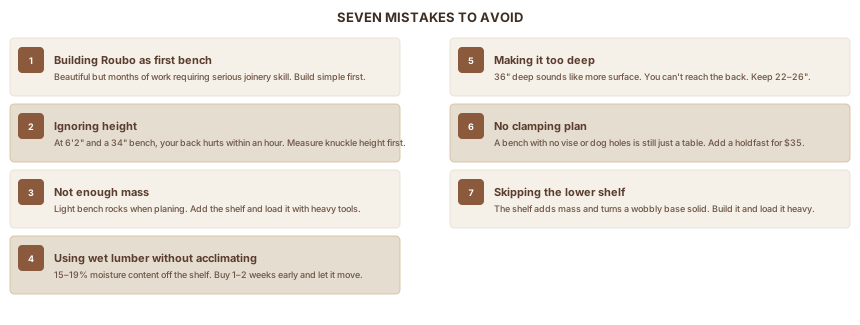
1. Building the Roubo as a first bench. It's beautiful. It's also months of work and requires serious skill. Build simple first.
2. Ignoring height. "I'll just build it 34 inches and see." If you're 6'2" and your bench is 34" tall, your back will tell you within an hour. Measure your knuckle height.
3. Not enough mass. A light bench rocks and rattles when you plane. Add the lower shelf and load it with heavy tools. If the bench still moves, add weight — a few bricks, a bucket of sand.
4. Using wet lumber without acclimating. Construction lumber off the shelf is often 15–19% moisture content. It will shrink and warp as it dries in your shop. Buy early, stack with stickers, let it move before you cut.
5. Making it too deep. A bench 36" deep sounds like more work surface. It's actually worse — you can't reach the back without climbing over it. Most benches are 22–26" deep for a reason.
6. No clamping plan. A bench with no vise and no dog holes is still just a table. Even if you're not ready to install a vise on day one, drill the dog holes and pick up a holdfast. That's $35 and a Forstner bit.
7. Skipping the lower shelf. The shelf isn't just storage. It adds significant mass to the base and turns a wobbly assembly into a solid bench. Build it and load it.
Part 8: What to Do After the Build
Flatten the top when it causes real problems. Not before. A slightly uneven bench is fine for most work. When you notice it affecting your results — a hand plane chattering over a hump, a board that rocks — fix it. A No. 7 jointer plane and 30 minutes handles most bench top issues.
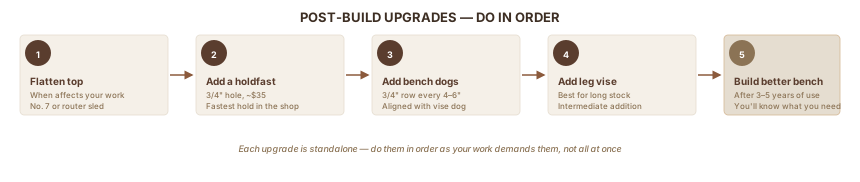
Add a holdfast if you haven't already. It's the fastest workholding tool in the shop. Drop it in a 3/4" hole, one mallet blow, done. Sharpening Fundamentals has context on hand tool setup if you're also getting started with hand planes.
Add bench dogs once the vise is installed. A single row of 3/4" holes, every 4–6", aligned with the vise dog. Lets you clamp boards flat on the top for face planing and large layout work.
Consider a leg vise as your second vise upgrade. Leg vises provide the largest clamping surface of any design and are excellent for holding long stock on edge. They're an intermediate addition — not needed for a first bench.
Build a better bench in 3–5 years. Most woodworkers build two or three benches over their lifetime. Your first bench teaches you what you actually need. See Choosing and Buying Your First Workbench for the design comparison that makes more sense after you've used a bench for a year. And if you want to upgrade to a proper hand tool bench, Build a Nicholson Workbench is the next step.
Related guides:
- First Workshop Setup — shop layout and tool priorities before the bench
- Buying Lumber — selecting and sizing lumber for this build
- Mortise and Tenon — if you're doing the Paul Sellers approach
Sources
The measurements, material guidance, and design comparisons in this guide draw from woodworking educators, community forums, and manufacturer documentation.
- Paul Sellers: Workbench Plans and Build Series — mortise-and-tenon construction from construction lumber, $65–150 in materials
- Christopher Schwarz: The Anarchist's Workbench — free PDF; simplified Roubo from construction lumber; design philosophy
- The English Woodworker: The Nicholson Tradition — Nicholson design overview and beginner recommendation
- The English Woodworker: Best Wood for Workbench Building — species selection, material tradeoffs
- The English Woodworker: Choosing the Best Face Vise — vise types, installation guidance
- Popular Woodworking: Mistakes of First-Time Bench Builders — common design and construction errors
- Stumpy Nubs Woodworking Journal: How to Calculate the Perfect Workbench Height — knuckle rule, task-specific height adjustments
- Tyler Brown Woodworking: Best Workbench Height — height calculator and task breakdown
- The Wood Whisperer: Flattening Workbenches with a Router — Episode 174; router sled flattening method
- Jay Bates: Build a Woodworking Workbench — popular beginner plans, home center materials
- Jay Bates: 1-Year Workbench Review — long-term validation of the simple 2×4 design
- Matthias Wandel: How to Build a Simple Sturdy Workbench — engineering approach, minimal tools required
- Family Handyman: Build a Workbench on a Budget — step-by-step plans with cut list
- Jen Woodhouse: Simple DIY Workbench Plans — photo-documented 2×4 build
- Lost Art Press: The Nicholson Bench for Starters — Schwarz endorsement for beginners
- Sawmill Creek: SPF for Bench Top Discussion — practitioner discussion on construction lumber for bench tops
- Rockler: Choosing the Best Bench Vise — vise types and installation considerations
- Highland Woodworking: Flatten a Workbench with a Router — router sled method overview
How We Research
We don't take affiliate revenue or accept review units. Picks come from multi-source research — manufacturer specs, OSHA / EPA / ASTM regs, and long-form practitioner threads — plus Ahmed's hands-on use where relevant. When we recommend something, we explain why.
Up Next
How to Build a Fold-Down Workbench
WORKSHOP · Beginner