
Dowel Jig at a Glance
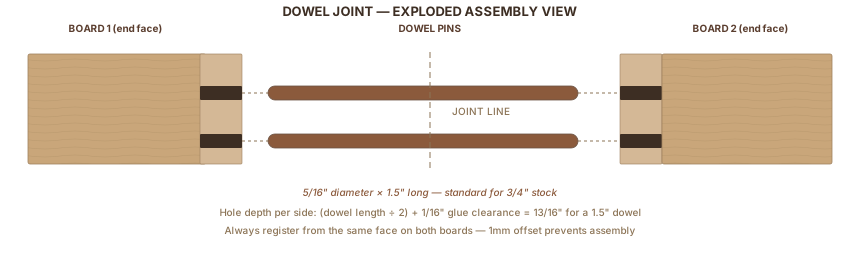
A dowel jig guides your drill bit to create aligned holes in two boards so the wooden pins that connect them line up. Without one, matching holes across two separate boards is nearly impossible. Even a 1mm offset prevents assembly. For most beginners, a self-centering jig in the $30–50 range is the right starting point.
| Best jig for beginners | Self-centering, $30–50 (e.g., Milescraft DowelJigKit) |
| Best jig for regular furniture work | JessEm Dowelling Jig, ~$120–160 |
| Right dowel size for 3/4" stock | 5/16" diameter, 1.5" long |
| Strength vs. pocket holes | ~1.6× stronger (independent lab testing) |
| The one rule | Always register the jig from the same face on both boards |
| Hole depth formula | (Dowel length ÷ 2) + 1/16" for glue clearance |
In this guide:
- The four types of dowel jigs and what each one does
- Which jig to buy for your setup and budget
- Dowel sizing: the rule of thirds
- Step-by-step: how to set up and drill
- Three problems you'll hit and how to fix them
- Dowels vs. pocket holes and what the strength tests show
Part 1: What a Dowel Jig Does (and Why Freehand Drilling Fails)
A dowel joint is simple: cylindrical wooden pins inserted into matching holes in two mating boards. When glued, the pins lock the pieces together and resist the forces trying to slide the joint apart. The glue bonds to the long-grain walls of the holes, the strongest interface wood glue has.
The problem is alignment. A drill press makes perfectly perpendicular holes in a single board. But it doesn't index between boards. Any angular deviation in the drill path means the holes in Board A and Board B don't line up. Even 1mm of offset prevents assembly or creates a gap you can see.
A dowel jig solves this by fixing the bit's position relative to the board's face and edge, registering consistently so both boards get holes in the same location, and guiding the bit through hardened steel bushings that prevent wander during drilling.
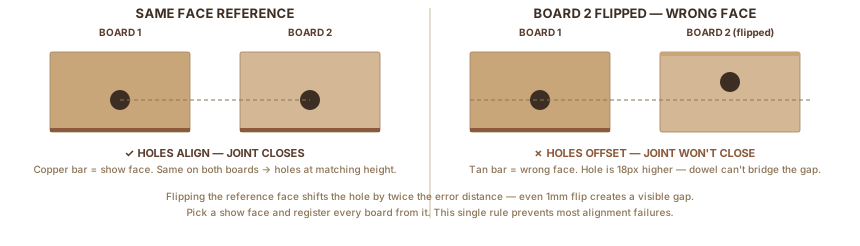
One rule before you drill anything: always register the jig from the same face on both boards. Pick a "show face," the face that will be visible in the finished piece, and keep it against the same reference surface on every board. Flip the reference face on one board and your holes shift by twice the error distance. This causes most alignment failures, and it's entirely preventable.
Part 2: The Four Types of Dowel Jigs
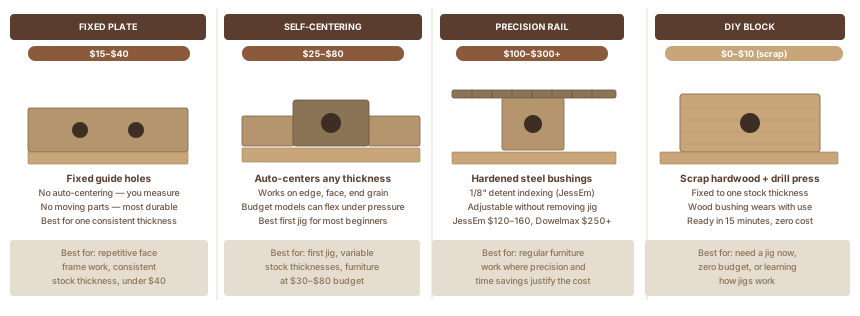
Fixed-Plate Jigs ($15–$40)
A rectangular plate with pre-drilled guide holes at fixed spacing. The classic design: the Dowl-It jig and the vintage Stanley #59 (still available used on eBay and in antique tool shops for under $30).
You position the jig manually, aligning it with your pencil marks, and clamp it in place. No automatic centering. You measure and decide.
The pros: simplest, cheapest, most durable jigs on the market. No moving parts means nothing to wear or break. For repetitive work at a consistent stock thickness, like running face frame after face frame of 3/4" stock, a plate jig is fast and reliable.
The cons: no automatic centering. For varying stock thicknesses, you do the math yourself.
Start here if: your budget is under $40 and most of your work uses consistent stock thickness.
Self-Centering Jigs ($25–$80)
The most common beginner option. Sliding jaws spread symmetrically from center and automatically center the guide bushing on any board thickness, whether the stock is 1/2", 3/4", or 1-1/4". You clamp it onto the board edge and the hole is automatically centered.
Common options: Milescraft DowelJigKit (~$30), various Wolfcraft models, and a range of Amazon versions.
The pros: auto-centers on any thickness without measuring, works on edge grain, face, and end grain.
The cons: accuracy depends on the jaws staying rigid under drilling pressure. Budget versions can flex or slip. One subtlety: if your boards vary even slightly in thickness, the self-centering jig centers on each board's actual thickness. The holes are centered, but not at the same absolute distance from the face. For most furniture, this is fine. For precise, production-quality work, it's a limitation.
Start here if: you're building furniture with variable stock thicknesses and this is your first jig.
Precision Guide-Rail and Bushing Jigs ($100–$300+)
These are a different category of tool. An indexing plate with hardened steel guide bushings, a reference fence, and a detachable drilling block. The two most recommended by professional furniture makers are the JessEm Dowelling Jig ($120–$160) and the Dowelmax ($250–$300).
The JessEm is the more practical choice for most people. It uses 1/8" indexing increments with positive detents at common offsets, so you dial in a setting and it locks there. Four alignment methods cover every grain orientation. You can adjust it without removing the jig from the workpiece, which no other dowel jig allows. Fine Woodworking reviewed it in 2024 and called it "the most versatile doweling jig available." Plates for 1/4", 3/8", and 1/2" dowels are included.
The Dowelmax is built to tighter tolerances and favors production work where you run the same joint hundreds of times. It's slower to set up but more repeatable at volume.
The pros: hardened bushings prevent bit wander; indexing system makes between-board registration fast and accurate; production-grade repeatability.
The cons: real money for an occasional furniture builder. The JessEm pays off quickly if you do regular furniture work. It's overkill for one bookshelf a year.
Upgrade here when: self-centering accuracy isn't meeting your needs, or you're building furniture seriously enough to value the time savings.
DIY Block Jigs ($0–$10)
Cut a piece of hard maple or beech to roughly 3" × 1.5" × 1.5". Drill a guide hole through it on the drill press. The press ensures it's perpendicular. Mark a reference line on one face. That's it.
The upgrade: epoxy a 1/2" OD steel tube with 1/16" walls into the hole. This gives you a metal guide that won't wear, and the tube accepts a 3/8" bit perfectly.
The pros: free, builds in 15 minutes, teaches you exactly how jigs work by making one yourself.
The cons: fixed to one stock thickness. No auto-centering. Wood-only guides wear with use.
Use this when: you need a jig right now and don't have one, or you want to understand the mechanics before spending money.
Part 3: Which Jig to Buy for Your Setup
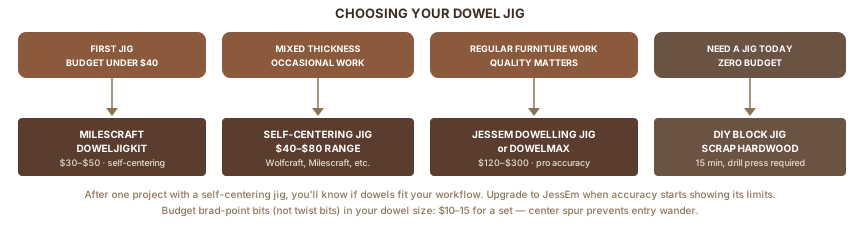
| Your situation | Recommendation |
|---|---|
| First jig, under $40 | Milescraft DowelJigKit or Dowl-It plate jig |
| Occasional furniture, mixed stock thicknesses | Self-centering jig, $40–$80 |
| Regular furniture maker, quality work matters | JessEm Dowelling Jig (~$120–$160) |
| Production or professional volume | JessEm or Dowelmax |
| Need a jig today, zero spend | DIY block jig from scrap hardwood |
If you've done a few projects and want to try dowel joinery for a cabinet or side table, start with a self-centering jig in the $30–50 range. You'll know within one project whether dowels fit your workflow. If they do, upgrade to JessEm when the self-centering accuracy starts showing its limits.
Budget one more thing: you'll need brad-point drill bits in sizes matching your jig's bushings. A set costs $10–15 and is worth buying right. Twist bits work but can wander at entry. Brad-point bits have a center spur that holds position.
Part 4: Dowel Sizing: The Rule of Thirds
Here are the numbers.
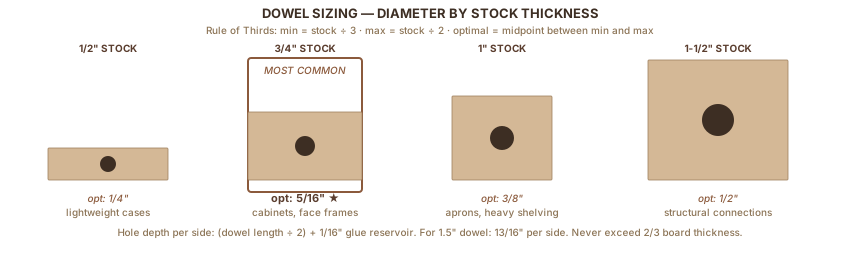
Diameter
The Rule of Thirds and Half, documented by Excel Dowel and Chicago Dowel:
- Minimum: 1/3 of the actual thickness of the thinnest board
- Maximum: 1/2 of the actual thickness of the thinnest board
- Optimal: halfway between minimum and maximum
For most furniture and cabinet work, 3/4" stock is your thinnest board. That gives you:
- Min: 1/4"
- Max: 3/8"
- Optimal: 5/16"
The full table:
| Stock thickness | Optimal diameter | Common application |
|---|---|---|
| 1/2" plywood | 1/4" | Lightweight cases, drawer construction |
| 3/4" (standard cabinet) | 5/16" | Cabinets, face frames, furniture |
| 1" stock | 3/8" | Furniture aprons, heavy shelving |
| 1-1/2" (2× material) | 1/2" | Structural connections |
If your jig only has 1/4" and 3/8" bushings (common with basic kits), use 3/8" for 3/4" stock. It's within the acceptable range.
Depth
The formula: (dowel length ÷ 2) + 1/16"
The extra 1/16" is the glue reservoir. Without it, glue hydraulically locks the joint. You'll feel the joint resist and assume an alignment problem. It's not alignment. It's the missing clearance. Richelieu's dowel pin FAQ specifies this clearance precisely. Set it with a depth stop collar.
For a standard 1.5" dowel: (0.75") + (0.0625") = 13/16" per side.
Never exceed 2/3 of board thickness in hole depth. You'll blow through the back face.
Spacing
When using multiple dowels per joint: space them at least 3× the dowel diameter apart. For edge-glued panels, 6–8" center to center works well. Start 2–3" from each end.
Part 5: How to Set Up and Use a Dowel Jig
Test on scrap first. Always. Use the same species or a similar density as your project wood. The fit matters.
What you need:
- Dowel jig with appropriate bushings
- Brad-point drill bits matching your dowel diameter
- Drill with depth stop collar (or a strip of tape as a flag)
- Pencil and square
- Dowel centers (optional but highly recommended; details in Step 5)
- Scrap boards for testing
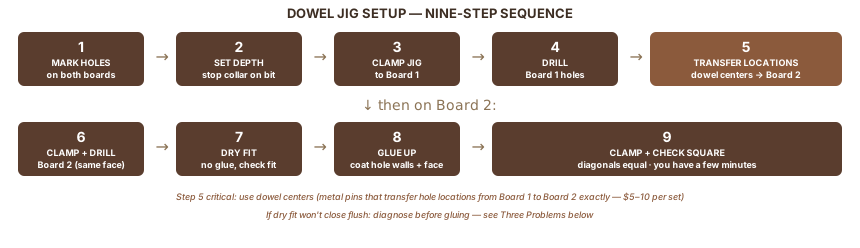
Step 1: Mark hole locations on both boards. Mark desired dowel positions on the joint line with a pencil. For face frames: one mark centered on each rail end. For panels: every 6–8". Make marks dark and clear. You'll reference them under clamping pressure.
Step 2: Set drill depth. Set the depth stop collar so the bit extends (dowel length ÷ 2) + 1/16" past the bottom of the jig. For 1.5" dowels, that's 13/16". Drill a test hole in scrap and measure the actual depth with a combination square or calipers before touching project wood.
Step 3: Clamp jig to first board. Position the jig bushing over your first mark. Ensure the jig is flush against the board face. For self-centering jigs, check that both jaws make even contact. Tighten the clamp firmly. Jig movement during drilling is the second most common cause of misalignment.
Step 4: Drill. Hold the drill perpendicular, let the bushing guide the bit, use steady downward pressure. Don't force it. Clear chips between holes by blowing them out or backing the bit up partway.
Step 5: Transfer locations to the second board. This is where most beginners make the flip error. Keep your show face as your reference. Two reliable methods:
Pencil transfer: measure the same marks onto Board 2 using a square.
Dowel centers (better): insert metal dowel centers into the holes you just drilled in Board 1. Press Board 2 against them with the joint faces together and show faces aligned. The points in the centers leave precise marks in Board 2 exactly where the holes belong. A set of dowel centers for common sizes runs $5–10 and is the clearest way to transfer locations accurately.
Step 6: Clamp and drill Board 2. Same procedure, same face reference.
Step 7: Dry fit. Insert dowels (no glue). Close the joint completely. It should close flush with normal hand pressure or light mallet taps. If it won't close, or closes with a twist, stop and diagnose before applying glue. See the troubleshooting section below.
Step 8: Glue up. Squeeze glue around the full interior perimeter of each hole. Go around the walls, not just a blob at the bottom. Apply glue to the joint face. Insert dowels into Board 1 with a slight twist to distribute glue. Apply glue to the joint face of Board 2. Close the joint, then clamp.
Correct clamping pressure produces a small amount of glue squeezeout at the joint face. That's the sign you have adequate coverage. Excessive pressure starves the joint.
Step 9: Check for square immediately. Before the glue sets, check that the assembly is square. Diagonals should be equal. You have a few minutes to adjust.
Part 6: Three Problems You'll Hit (and How to Fix Them)
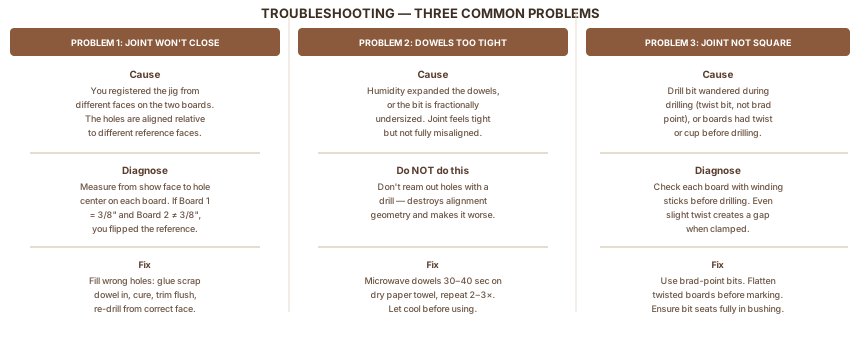
Problem 1: The joint won't close (holes don't align)
What happened: You registered from different faces on the two boards.
Diagnose it: With a combination square, measure the distance from the show face to the center of a hole on each board. If Board 1 is 3/8" and Board 2 is also 3/8", the holes should align. If one is 3/8" and the other is something different, you flipped the reference.
Fix it before glue: Fill the wrong holes. Insert a tight-fitting scrap dowel with glue, let cure overnight, trim flush with a sharp chisel. Re-drill from the correct face reference.
Fix minor misalignment after drilling: A round file can slightly enlarge the opening on the less-critical piece, giving just enough play to get the joint to close. Use this only for very small offsets; anything significant needs the fill-and-redrill approach.
Problem 2: Dowels are too tight (joint won't close)
What happened: Humidity in the shop, tight-grained wood, or a drill bit that's fractionally undersize.
What not to do: Don't ream out the holes with a drill. That destroys the alignment geometry and makes things worse.
The fix: dry out the dowels. Place 15–20 on a dry paper towel, microwave on high for 30–40 seconds, repeat 2–3 times. You'll see moisture transfer to the towel. Let the dowels cool completely before use. This tip comes from Sawmill Creek practitioner forums and works reliably when humidity is the cause.
If the issue persists after drying: test with a drill bit that's 0.5mm over nominal on scrap wood before committing to the project.
Problem 3: Joint closes but isn't square, or has a face gap
What happened: The drill bit wandered during drilling (not fully seated in the bushing), or the boards had twist or cup before drilling.
Fix for angled holes: Ensure full contact between the bit shank and the bushing wall before drilling. Use brad-point bits. The center spur prevents entry wander. Moderate drill speed (don't rush).
Fix for board prep issues: Check each board with a winding stick or straightedge before drilling. A board with even slight twist will create a gap when clamped. Flatten with a hand plane or planer before marking.
Part 7: Dowels vs. Pocket Holes vs. Biscuits vs. Mortise and Tenon
Here's the honest comparison, grounded in actual testing.

Strength numbers
From Matthias Wandel's independent joint strength testing, using spruce stock:
| Joint | Avg breaking force | Relative strength |
|---|---|---|
| Pocket holes (no glue) | 99 lbs | 1× |
| Dowels (Titebond 3) | 156 lbs | 1.6× |
| Mortise and tenon | 222 lbs | 2.2× |
Canadian Woodworking's oak test found dowels averaging 650 lbs vs. mortise and tenon at 500 lbs. The pattern varies by species and loading direction. Biscuits fall below dowels in most test configurations.
The decision guide
Choose dowels when:
- Furniture is visible from multiple angles, with no place to hide a pocket hole
- You need more strength than pocket holes provide, for furniture that will actually be used
- Face frames where precise alignment at the joint line matters
- You want hidden joinery and can't afford a Domino biscuit joiner
Choose pocket holes when:
- Speed is the priority and the joint is inside a cabinet or covered
- Cabinet carcass construction where no joint face is visible
- Site work where you need to move fast
Choose biscuits when:
- Panel alignment is the main goal (the glue provides the strength on long-grain edge joints)
- You already own a biscuit joiner and the joint configuration works for it
Choose mortise and tenon when:
- Maximum long-term structural strength matters: chairs, chair rails, any joint that takes sustained racking loads
- You're building heirloom furniture meant to outlast you
- You have the skills and tools to cut them accurately
For most furniture builders learning the craft, dowels hit a sweet spot: stronger than pocket holes, simpler than mortise and tenon, more widely applicable than biscuits. For a coffee table, bookcase, face frames, or dining table base, dowels are the right call.
Part 8: Where Dowel Joinery Fits in Real Projects
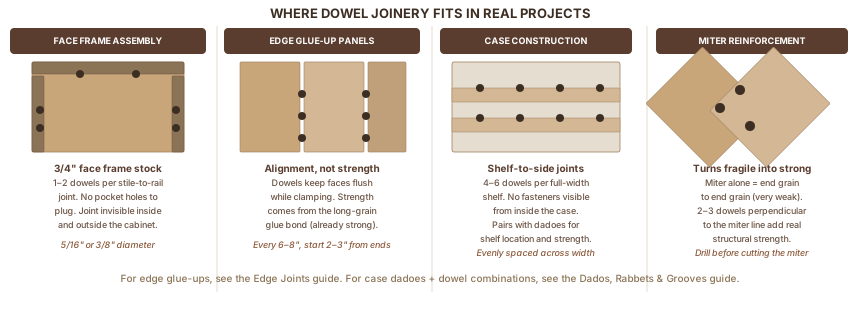
Face frame assembly. Standard 3/4" face frame stock with one or two 5/16" or 3/8" dowels per stile-to-rail joint. A self-centering jig auto-centers on 3/4" stock. The joint is invisible: no pocket hole to plug, no fastener visible from inside the cabinet.
Edge-gluing panels. Dowels here primarily serve alignment. They keep board faces flush while clamping. The actual strength comes from the long-grain glue bond, which is already very strong on a well-fitted edge joint. Space dowels every 6–8" and start 2–3" from the ends. See edge joints and panel glue-ups for the full technique.
Case construction. Shelf-to-side joints, top and bottom panels in plywood carcasses. Use four to six dowels per joint for a full-width shelf, spaced evenly. The advantage over pocket holes: no fasteners visible from inside the case. For cases that also use dados and rabbets for shelf location and back panels, see dados, rabbets, and grooves for how those cut types complement dowel joinery.
Reinforcing miter joints. A 45° miter joint has almost no structural strength on its own. It's end grain to end grain. Adding two or three dowels perpendicular to the miter line turns a fragile glue joint into one that holds weight. See miter joints for how reinforcement options compare.
Sources
Research for this guide drew on independent strength testing, manufacturer specifications, industry publications, and practitioner forums.
- Matthias Wandel, Woodgears.ca — pocket hole and dowel joint strength test — independent lab results comparing pocket holes, dowels, and mortise and tenon
- Canadian Woodworking — How Strong is a Dowel Joint? — solid oak strength test with specific load data
- Excel Dowel FAQ — rule of thirds and half, dowel sizing standards
- Richelieu — Dowel Pin FAQ — 1/16" glue clearance specification
- Fine Woodworking — JessEm Dowelling Jig Review (2024) — precision jig comparison
- Kreg Tool — How to Use a Dowel Jig — step-by-step procedure reference
- Woodshop Diaries — How to Use a Dowel Jig — beginner-focused technique guide
- Sawmill Creek — Dowel Pins Too Tight — microwave drying technique for tight dowels
- WoodWeb — Face Frame Joinery — cabinet industry face frame applications
- Jorbins.com — Dowel Size and the Rule of Thirds — detailed sizing formula with practical examples
How We Research
We don't take affiliate revenue or accept review units. Picks come from multi-source research — manufacturer specs, OSHA / EPA / ASTM regs, and long-form practitioner threads — plus Ahmed's hands-on use where relevant. When we recommend something, we explain why.
Up Next
F Clamps: A Complete Guide for Woodworkers
WORKSHOP · Beginner