
QUICK ANSWER: A dust extractor is a high-pressure HEPA vacuum built to bolt onto a power tool (sander, track saw, router) through a 27 mm or 35 mm hose and pull fine dust out before it reaches the air. It's not a shop vac with a fancier filter — the airflow physics are different (lower CFM, higher static pressure) and the filtration target is sub-micron particles your lungs can't expel. Best mid-range pick: DeWalt DWV010 (
$419, HEPA + auto-clean + tool-trigger auto-start). Budget pick: Hercules 12-gallon ($299, still HEPA + OSHA-compliant).
Dust Extractor at a Glance
A dust extractor is a high-pressure, HEPA-filtration vacuum built to connect directly to power tools (sander, track saw, router) and pull fine dust out before it reaches the air. The physics and the filtration are different from a shop vac, and the result for your lungs is different. For most home woodworkers, start with the DeWalt DWV010 (~$419); if budget is the constraint, the Hercules 12-gallon at $299 delivers HEPA filtration and OSHA compliance at a price nothing else matches.
| Best pick (mid-range) | DeWalt DWV010 — HEPA, auto-clean, auto-start, ~$419 |
| Best value | Hercules 12-gal — dual HEPA, OSHA-compliant, ~$299 |
| Filter class for hardwood | Class M (99.9%) minimum; HEPA (99.97%) preferred |
| Key difference from shop vac | High pressure for small ports; HEPA filtration captures sub-micron dust |
| Not for | Table saw, jointer, planer — those need a dust collector |
| Price range | $299 (budget) to $899 (Festool) |
In this guide:
- What a dust extractor does — and how it differs from a shop vac or dust collector
- When you actually need one
- The specs that separate good models from mediocre ones
- Recommended models by budget with specific reasons
- How to connect it to your tools and keep it working

Part 1: What a Dust Extractor Does (and What It Can't)
A dust extractor is a high-pressure, low-volume vacuum with HEPA-grade filtration. Connect it to a tool's dust port and it pulls dust out at the source, before it enters the air.
Three tools handle dust in woodworking, and they do different jobs.
A shop vac moves a lot of air (150 to 200 CFM) at moderate pressure. It's built for general cleanup: chips off the floor, wet spills, large debris. The filters most shop vacs ship with let sub-micron particles straight through. Those particles don't settle on the floor. They stay airborne for hours. Running a shop vac while sanding doesn't clean the air. It recirculates the finest and most dangerous particles back into your breathing zone.
A dust extractor moves less air (85 to 160 CFM) but at much higher pressure: 80 to 100 inches of water lift. That combination is engineered specifically for small tool ports: the 27mm port on a random orbital sander, the 36mm port on a track saw. High pressure starts air moving through restricted openings that would kill the airflow on a dust collector. HEPA or Class M filtration captures 99.9 to 99.97% of particles including sub-micron dust. Most run between 62 and 80 decibels, quiet enough for a conversation next to them.
A dust collector moves a large volume of air (350 to 1,000+ CFM) at low pressure. That's exactly what you need to move chips and shavings through four-inch ductwork from a table saw, jointer, or planer. Connect a dust collector to your random orbital sander, though, and you'll get almost no suction. Different port size, different pressure profile, different job.
| Shop Vac | Dust Extractor | Dust Collector | |
|---|---|---|---|
| CFM | 150–200 | 85–160 | 350–1,000+ |
| Water lift | Moderate | 80–100" | Low |
| Port size | 2.5" | 27–36mm | 4" |
| Filtration | Usually inadequate | HEPA / Class M | Variable |
| Best for | General cleanup, wet spills | Handheld power tools | Stationary machines |
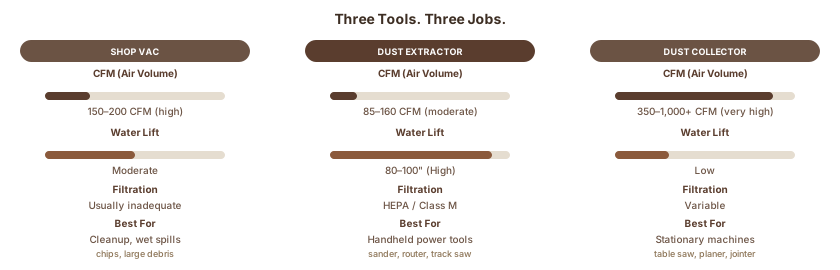
88% of woodworking airborne particles are smaller than 1 micron. Standard shop vac filters pass these particles back into the air you breathe. A dust extractor catches them at the source.
What a dust extractor can't do
Don't buy one expecting it to replace a dust collector. The physics don't work. A table saw, planer, or jointer generates chips faster than any extractor can handle. Those machines need four-inch ductwork and a dedicated dust collector behind them.
A dust extractor also can't eliminate all airborne dust. Fine particles that escape the tool port stay suspended. An ambient air filtration unit running continuously in your shop catches what the extractor misses. And wear a P100 respirator on heavy sanding sessions regardless of how good your extractor is.
Part 2: When You Actually Need One
Buy a dust extractor if:
- Your primary tools are handheld — random orbital sander, track saw, router, jigsaw
- You sand for more than 30 minutes at a time
- You work regularly with hardwoods or MDF
- You do finish carpentry or job-site work where a stationary collector won't go
- You already have stationary machines and want the portable complement for handheld work
Skip it for now if:
- All your work is with stationary machines (table saw, jointer, planer) — start with a dust collector or cyclone setup instead
- Your budget is under $200 and you only do occasional light work — upgrade your shop vac filter to a HEPA bag as a minimum compromise
Most woodworkers add a dust extractor when they start sanding furniture or doing finish work. The sander is when it matters most: random orbital sanding generates the finest particles of any shop tool, at high volume, right in your breathing zone.
Which tool connects to which equipment
| Tool | Port Size | Right Equipment |
|---|---|---|
| Random orbital sander | 27mm | Dust extractor |
| Track saw | 27–36mm | Dust extractor |
| Router (handheld) | 27–36mm | Dust extractor |
| Jigsaw | 27–36mm | Dust extractor |
| Oscillating multi-tool | 27mm | Dust extractor |
| Miter saw | 2.5" | Shop vac or extractor |
| Router table | 2.5" (fence) | Dust extractor or collector |
| Table saw | 4" | Dust collector |
| Jointer | 4" | Dust collector |
| Planer (12–13") | 4" | Dust collector |
| Bandsaw | 4" | Dust collector |
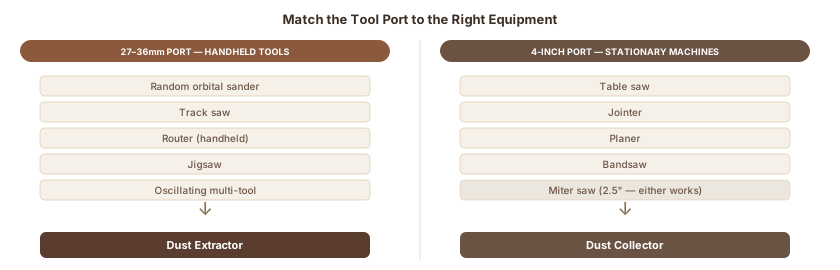
If you have both handheld and stationary tools, you'll eventually want both: an extractor for the portable work and a collector for the machines. Start with whichever gets more daily use.
Part 3: Specs That Matter
Most manufacturers lead with motor size, RPM, or horsepower. These aren't what separate a good extractor from a mediocre one. Here's what to actually look at.
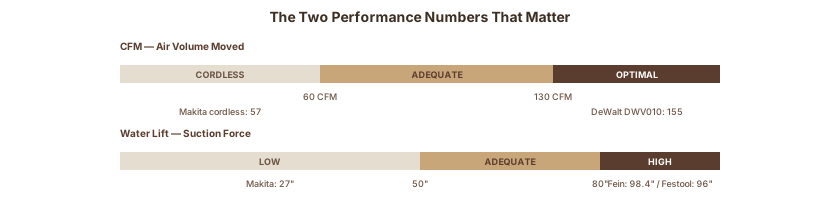
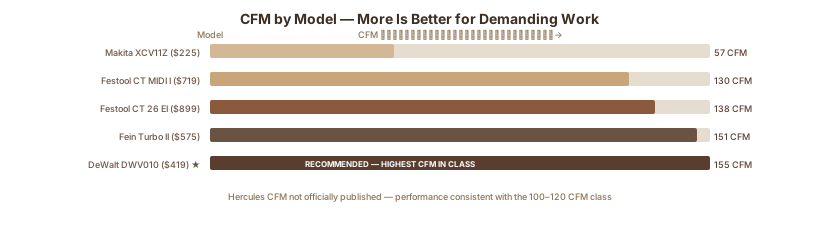
CFM (cubic feet per minute). Volume of air moved. Carries particles from the tool port to the collection canister once they're in motion. Look for 100+ CFM for general handheld tool use, 130+ CFM for demanding applications like routing or heavy sanding. The DeWalt DWV010 runs at 155 CFM, highest in its class. The Festool CT 26 EI runs at 138 CFM. The Makita XCV11Z cordless runs at 57 CFM, which is noticeably limiting for anything demanding.
Static water lift. How much pulling force the motor sustains against resistance. Water lift gets air moving through restricted ports; CFM keeps it moving once it's flowing. Look for 80+ inches of water lift for reliable performance on small tool ports. The Fein Turbo II runs at 98.4 inches. The Festool CT 26 EI runs at 96 inches. The Makita XCV11Z cordless runs at 27 inches, the most significant practical limitation of that otherwise portable tool.
Filter class. The single most important spec for health protection. In the US, the target is HEPA: 99.97% of particles at 0.3 microns. The European equivalent is Class M: 99.9% capture. Both are adequate for woodworking. Don't accept Class L (99%) if you work with hardwoods or MDF.
Auto-start. The extractor turns on when your tool does, and shuts off a few seconds after it stops. Without auto-start, you'll constantly forget to start the extractor before the tool runs. Pay for this feature. It has more impact on your actual dust exposure than almost any other spec.
Variable suction control. For random orbital sanders specifically: too much suction at the pad pulls the sander aggressively into the work, slows the orbit, and produces burn marks. Dial back to 60–70% of maximum for sanding. Most extractors in the $300+ range have this.
Noise. Not a performance spec, but it matters in a home shop where family shares the space. Shop vacs run at 85–95 decibels, hearing-protection territory. The Fein Turbo runs at 66 dB. The Festool CT MIDI runs at 62 dB on its low setting. Most other extractors fall between 70 and 80 dB.
Two specs to ignore: peak horsepower (marketing, not performance) and RPM (irrelevant for vacuum comparison).
Part 4: Dust Hazard Classes Explained
The International Agency for Research on Cancer classifies hardwood wood dust as a Group 1 carcinogen, in the same category as asbestos. Specifically: hardwood dust causes nasal cavity and paranasal sinus cancer. Oak, mahogany, beech, walnut, birch, elm, and ash all have documented risk at chronic exposure levels.
Beyond cancer: wood dust causes asthma, hypersensitivity pneumonitis, chronic bronchitis, and nasal sensitization. Once you're sensitized to a species, low subsequent exposures can trigger severe reactions.
The OSHA permissible exposure limit for hardwood dust is 5 mg/m³ averaged over an eight-hour day. NIOSH recommends 1 mg/m³, five times stricter, based on the cancer evidence.
A standard shop vac filter passes the smallest, most dangerous particles back into the air. An extractor with HEPA or Class M filtration captures them.
The three European hazard classes, defined in EN 60335-2-69, are now referenced by US manufacturers and standard across the industry:
| Class | Captures | Use For |
|---|---|---|
| L (99%) | Most particles | Softwood, gypsum |
| M (99.9%) | Fine dust including hardwood | Hardwood, MDF, concrete |
| H (99.995%) | Sub-micron particles | Asbestos, lead, regulated carcinogens |
| HEPA (99.97% at 0.3μm) | Fine and ultrafine | All woodworking (US standard) |

For home woodworking: HEPA or Class M. Don't buy a Class L extractor if you work with hardwoods.
MDF contains urea-formaldehyde resin. Sanding it generates a mix of wood fiber and formaldehyde, technically an H-class hazard. Wear a P100 respirator when sanding MDF for extended periods, regardless of your extractor's filter class.
Part 5: Recommended Models by Budget
These are specific picks with reasons, not a list of options. Prices are approximate as of early 2026; check current listings.
Budget (under $350): Hercules 12-Gallon HEPA Dust Extractor — $299.99
Harbor Freight launched this in October 2024, and it is legitimately surprising. Popular Woodworking reviewed it as "the cheapest OSHA-compliant extractor by $200." It runs dual self-cleaning HEPA filters, includes a 24-foot cord and 17-foot antistatic hose (the longest in the category), has tool-triggered auto-start, and a variable speed dial. 12-gallon capacity means you're not emptying it constantly.
The knock against Harbor Freight tools is durability under professional use. For a home woodworker using it a few hours a week, that's not the concern it would be in a production shop.
Mid-range ($350–$600): DeWalt DWV010 — ~$419
The right buy for most home woodworkers. 155 CFM, highest in its class. HEPA filtration. Auto-filter cleaning every 30 seconds: a burst of reverse air dislodges cake from the filter media automatically. Tool-activated outlet for auto-start. EPA RRP compliant for lead dust if you're working on pre-1978 paint. Shorter stature than most extractors, so it fits under a workbench. Rated 8.8/10 by Pro Tool Reviews.
If you want more capacity: the DeWalt DWV012 has the same specs in a 10-gallon package for ~$529.
Mid-range alternative: Fein Turbo II HEPA — ~$575
The quietest non-Festool extractor on the market at 66 dB. If your shop is attached to your house, or you use it while the family is home, the noise difference over a standard extractor is noticeable. Fein's official specs: 151 CFM, 98.4" water lift, 8.5-gallon capacity. Three-year warranty. The trade-off vs. the DeWalt: no auto-filter cleaning (manual shake-out) and costs ~$150 more.
Premium ($600+): Festool CT MIDI I ($719) or CT 26 EI ($899)
Festool's pricing is real, and so is the quality. The CT MIDI I is the compact option: 130 CFM, 62 dB, 15-liter capacity, Bluetooth auto-start that pairs with Festool cordless tools. If you're buying Festool sanders or track saws, the hoses click in without adapters and the Bluetooth auto-start makes the system feel completely integrated.
The CT 26 EI is the shop standard at $899: 138 CFM, 26-liter capacity, touch-panel controls, and app integration. Choose the MIDI I for a small shop or job site. Choose the CT 26 EI for a dedicated shop setup where you want the best.
Only choose Festool if you're already buying Festool tools, or if integration and quiet operation are worth that premium to you. The DeWalt DWV010 is a much better value in pure extraction performance per dollar.
Cordless: Makita XCV11Z — ~$225 bare tool
The only genuinely portable extractor in the group: 10.1 lbs, runs on 18V LXT batteries, 60 minutes on a 5Ah pack, HEPA filtration. The limiting factor is 57 CFM and 27" water lift — usable for light sanding and cleanup, not ideal for heavy routing or track saw work. Buy it if cordless operation is a genuine requirement, not as a substitute for a full-power extractor.
| Model | CFM | Filter | Auto-Clean | Auto-Start | Price |
|---|---|---|---|---|---|
| Hercules 58966 | — | Dual HEPA | Post-tool purge | Yes | $299 |
| DeWalt DWV010 | 155 | HEPA | Every 30 sec | Yes | ~$419 |
| Fein Turbo II HEPA | 151 | HEPA | Manual | Yes | ~$575 |
| Festool CT MIDI I | 130 | HEPA | Manual | Bluetooth | $719 |
| Festool CT 26 EI | 138 | HEPA | Manual | Bluetooth | $899 |
| Makita XCV11Z | 57 | HEPA | — | AWS (cordless) | ~$225 bare |
Part 6: Connecting to Your Tools
Hose and adapters
Festool uses 27mm and 36mm metric fittings. Most US tools use 1.25" or 2.5" fittings. These don't match natively. The solution is brand-specific adapters from ToolCurve ($10–25 each), which give you a sealed, wobble-free connection for specific tool models. Budget for one or two adapters when buying a non-Festool extractor.
For most US extractors: the 2.5" standard hose connects directly to miter saw dust ports. Reducers to 1.25" and 1.875" are typically included in the box.
Longer hoses: most extractors ship with 13–16 ft. That's enough for a workbench setup. For mobility around the shop, 16–20 ft is more comfortable. Stay under 20 ft of flexible hose — longer runs add meaningful pressure loss.

By tool
Random orbital sander. Connect the 27mm hose to the sander port. Dial suction to 60–70% of maximum — too much suction pulls the pad into the surface, degrades finish quality, and slows the orbit. Turn on the extractor before the sander starts (auto-start handles this automatically).
Track saw. Most track saws have a 36mm dust port. Connect the extractor hose via the included reducer or a ToolCurve adapter. Capture efficiency is very high — nearly all visible dust is contained at the blade.
Router (handheld). Most mid-sized routers have 36mm ports and dust collection shrouds or bases. Some trim routers use 27mm. Check your router's manual for the port size. Note that not all router operations allow a connected hose — freehand work especially.
Miter saw. Most miter saws have a 2.5" dust port that connects directly to a shop vac or extractor. Capture efficiency is lower than other tools — expect 60–70% at best because the blade ejects chips forward, not rearward. A dust hood mounted behind the blade improves this.
Auto-start setup
With a corded tool: plug the tool into the extractor's switched outlet. The extractor detects current draw and starts automatically. Works with any corded tool.
With a cordless tool: you need either Makita AWS Bluetooth (compatible tools pair with AWS-enabled extractors), Milwaukee VACLINK, or a third-party iVAC sensor that clamps onto your extension cord. Without one of these, you start the extractor manually.
Maintaining the filter
Clean the filter after every session. This takes two minutes and is the single most effective thing you can do to maintain suction performance. For manual-clean models: remove the filter, hold it over a trash can, and tap it gently against a hard surface to dislodge loose dust. Use compressed air from the outside of the pleats — not the inside — at 90 PSI max, nozzle 2 inches from the media. Never wash a HEPA filter with water unless the manufacturer explicitly says the filter is washable.
Auto-clean models still need periodic inspection. Auto-cleaning handles surface clogging; it doesn't eliminate gradual buildup.
Replace the filter bag when it's two-thirds full. A full bag increases backpressure and drops CFM. Replace the HEPA filter every six months under regular use, or immediately if it's torn or suction doesn't return after cleaning. Festool replacement HEPA filters are genuinely expensive ($40–80); this is a real ongoing cost that belongs in your budget decision.
Part 7: Common Mistakes
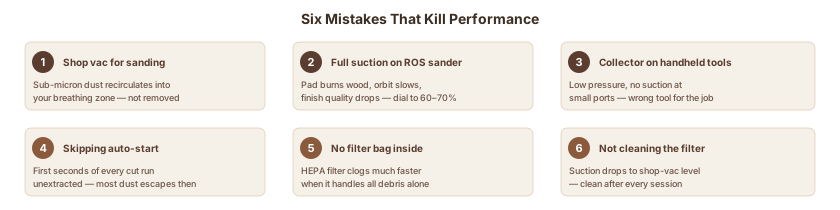
Using a shop vac for sanding. The most consequential. Shop vac filters pass sub-micron particles. You're redistributing fine dust into the air, not removing it. If you sand hardwood for 30 minutes with a shop vac "collecting" the dust, you've breathed more of it than if you had no vacuum at all — because the vac concentrates the small particles and recirculates them.
Too much suction on a random orbital sander. Running at full extractor suction pulls the sander into the surface. The orbit slows, the pad burns the wood, and your finish quality drops. Dial back to 60–70%.
Connecting a dust collector to handheld tools. High-volume, low-pressure equipment doesn't pull through small ports. You'll feel almost nothing at the tool. Dust collectors need four-inch ductwork to work.
Skipping auto-start. You'll forget to turn on the extractor before you turn on the tool. Every time this happens, you're running the tool unextracted during the first seconds of the cut — which is when the most dust escapes. Auto-start solves this for a few extra dollars at purchase.
Skipping the filter bag. Running without a bag means the HEPA filter does all the work — collecting chips, debris, and fine particles simultaneously. It clogs far faster. Always run bag plus filter together.
Not cleaning the filter. A clogged filter drops suction performance to shop-vac levels. The extractor sounds normal but isn't pulling. Clean it after every session.
Part 8: Where a Dust Extractor Fits in Your Shop
A dust extractor handles handheld tools. A dust collector handles stationary machines. The complete setup for a serious home shop is both: an extractor on a rolling stand connected to your sander and track saw, a one-to-one-and-a-half horsepower collector on the machines with ductwork and blast gates, and a ceiling-mounted ambient filter running continuously.
If you're starting out, get the extractor first. It handles the tools you're using most, and it does the most for your lungs.

Related guides:
- Jointer vs. Planer — understanding which stationary machines you're buying for
- DIY Dust Collector — when you're ready to add collection for your stationary machines
- Cyclone Dust Collector — adding pre-separation to extend filter life
FAQ
How is a dust extractor different from a shop vac?
A shop vac moves high CFM at low static pressure, built to suck up nails, sawdust, and water through a 2-1/2 inch hose. A dust extractor moves lower CFM (~150 CFM typical) at high static pressure (~95 inches of water column), through a smaller 27 mm or 35 mm hose, with a sealed HEPA filter system rated to capture particles down to 0.3 microns. Different physics for a different job: a shop vac handles bulk debris; an extractor pulls invisible airborne dust before it reaches your lungs.
Do I really need HEPA filtration in a home shop?
If you cut hardwoods regularly, yes. The fine dust from oak, walnut, and most exotic species is classified as a Group 1 human carcinogen by IARC, and the worst particles (≤5 microns) reach the deep lung where the body can't expel them. A non-HEPA filter recycles those particles back into your shop air. HEPA captures 99.97% of particles ≥0.3 microns. For one-time projects in softwoods, a Class M (99.9%) extractor is acceptable; for any sustained hardwood work, HEPA is the floor.
What size dust extractor is right for a one-person shop?
For a one-person small shop running a track saw, sander, and router, a mid-size 8–12 gallon extractor with HEPA + auto-start is the practical match. The DeWalt DWV010 ($419) and the Hercules 12-gallon ($299) both fit this profile. Larger 16-gallon units add capacity but rarely add value at the one-person scale — you'll empty an 8-gallon every few weeks anyway, and the bigger unit is harder to roll into a corner when you need bench space.
Can one dust extractor connect to multiple tools?
Yes, but one tool at a time. Most extractors include a tool-trigger outlet (typically rated 8–15 amps) that auto-starts the extractor when the connected tool turns on. Swap the hose between your sander, track saw, and router as needed. Trying to run two tools simultaneously off one extractor splits the airflow and undercuts the static pressure both tools need — get a second extractor or a dedicated dust collector before you try to share.
How often should I change the HEPA filter?
Visual cue: when your extractor's airflow drops noticeably even after emptying the bag, the filter is loaded. Most HEPA cartridges last 200–400 hours of active use in a typical small shop, or roughly 12–18 months for a hobbyist running it 1–2 hours per week. Self-cleaning models (auto-clean reverse pulse) extend life by 2–3×. When you replace, buy the OEM HEPA cartridge — third-party "compatible" filters often fall short of the 99.97% rating.
Sources
- OSHA — Wood Dust Overview — carcinogen classification, PEL standards
- OSHA eTool — Wood Dust Health Hazards — exposure routes and health effects
- CDC/NIOSH — PEL for Wood Dust — 1 mg/m³ recommended limit
- Tyler Brown Woodworking — Shop Vac vs Dust Extractor — physics comparison
- Pro Tool Reviews — CFM vs Water Lift — spec explanation
- Harbor Freight Newsroom — Hercules Extractor Launch — October 2024 product announcement
- Popular Woodworking — Hercules Review — tested review
- DeWalt — DWV010 Official Specs — manufacturer specifications
- Fein — Turbo II Official Specs — manufacturer specifications
- Woodcraft — Festool CT MIDI I ($719) — verified pricing
- Woodcraft — Festool CT 26 EI ($899) — verified pricing
- Makita USA — XCV11Z Specs — manufacturer specifications
- Pro Tool Reviews — DeWalt DWV012 Review — tested review
- Hengst Filtration — Dust Classes M and H Explained — class definitions
How We Research
We don't take affiliate revenue or accept review units. Picks come from multi-source research — manufacturer specs, OSHA / EPA / ASTM regs, and long-form practitioner threads — plus Ahmed's hands-on use where relevant. When we recommend something, we explain why.
Up Next
Do You Need a Cyclone Collector?
WORKSHOP · Beginner