
How to Use This Guide
Laminating plywood means face-gluing two or more sheets together to create a thicker, stiffer panel. It's one of the most useful techniques in a small shop: two sheets of 3/4" plywood become a 1.5" panel that costs $70-100 and out-performs most commercial alternatives for shop and furniture work.
This guide covers every step, from glue selection through flattening, plus an honest comparison of when to DIY versus when to just buy Baltic birch or LVL.
If you need to pick a glue: Start with Part 2.
If you're ready to start gluing: Jump to Part 3.
If something bowed on you: Head to Part 5.
If you're deciding whether to laminate or buy: See Part 6.
Laminate Plywood at a Glance
Face-gluing plywood sheets is straightforward: glue, cauls, clamps, cure. The technique is accessible to anyone with a set of bar clamps and a flat surface.
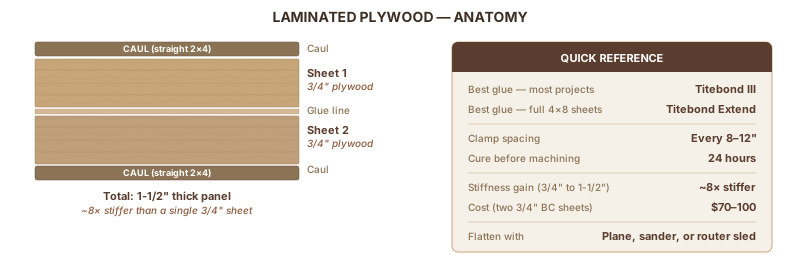
| Two 3/4" sheets | → 1.5" panel, roughly 8× more rigid than one sheet |
|---|---|
| Best glue (most projects) | Titebond III |
| Best glue (full 4×8 sheets) | Titebond Extend |
| Clamp spacing | Every 8–12 inches |
| Cure before machining | 24 hours |
| Flatten with | Jack plane, belt sander, or router sled |
In this guide:
- Why laminate and when it makes sense
- Which glue to use
- Step-by-step prep and glue-up
- Common mistakes
- Flattening the panel after cure
- DIY vs. buying pre-made panels
- Edge treatment options
Part 1: Why Laminate Plywood
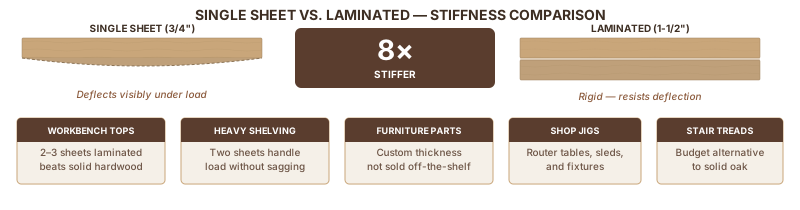
The reason to laminate is stiffness. Bending resistance scales with the cube of panel thickness, so doubling from 3/4" to 1.5" makes a panel roughly 8 times harder to deflect under load. That's why a workbench built from one sheet of plywood bounces when you strike it with a mallet, and a bench built from two laminated sheets feels like concrete.
When laminating makes sense
Workbench tops are the most common application. Two or three sheets of 3/4" plywood, laminated face-to-face, produce a top that's rigid, flat, and cheap compared to buying a solid hardwood slab. Paul Sellers builds his workbenches this way and considers laminated plywood one of the best bench top materials for the price.
Heavy shelving benefits from the same logic. A single 3/4" sheet deflects noticeably under books or tools. Two laminated sheets handle the same load without sagging.
Furniture parts (table legs, aprons, thick shelf standards) can be laminated to custom thicknesses not available in standard sheet goods. A 1-1/8" leg needs two sheets: one 3/4", one 3/8".
Shop jigs and fixtures get used heavily. Laminated plywood router tables, crosscut sled bases, and slab-flattening jigs hold up far better than single sheets.
Stair treads can be laminated from two sheets of 3/4" plywood as a budget-friendly alternative to solid oak or commercial pre-treads.
What laminating is (and isn't)
Face-gluing two sheets together is different from how plywood is manufactured. Factory plywood uses thin veneers with alternating 90° grain directions, pressed and heated. When you DIY-laminate two 3/4" sheets, each sheet already has that internal alternating-grain structure. You're adding macro thickness, not rebuilding the panel engineering. The result is a thick, stable panel that behaves like a very stiff plywood.
Part 2: Glue Selection
Pick the right glue before anything else. The main variables are panel size (which determines how much open time you need) and environment (indoor vs. outdoor or wet).
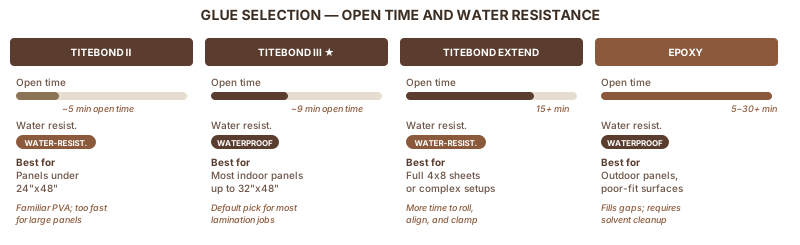
| Glue | Open Time | Water Resistance | Best For |
|---|---|---|---|
| Titebond II | ~5 min | Water-resistant (Type II) | Panels under 24"×48" |
| Titebond III | ~9 min | Waterproof (Type I) | Most indoor laminations |
| Titebond Extend | 15+ min | Water-resistant (Type II) | Full 4×8 sheets or larger |
| Epoxy | 5–30 min (varies) | Fully waterproof | Outdoor panels; poorly fitted surfaces |
The default pick is Titebond III. The Titebond III product page lists ANSI/HPVA Type I waterproof classification and roughly 9 minutes of assembly time. That covers panels up to about 32"×48", and it cleans up with water before curing. The Wood Whisperer's Titebond comparison puts Titebond III at the top for versatility: waterproof rating, extended open time, familiar cleanup.
For full 4×8 panels, use Titebond Extend. Five minutes isn't enough time to roll glue across a 32 sq ft surface, align the second sheet, add cauls, and start clamping. The Titebond Extend product page targets the 15+ minute open time specifically at "complex operations" and large face-gluing jobs.
For outdoor panels or poorly fitting surfaces, use epoxy. Two-part epoxy is fully waterproof and fills gaps that PVA won't. The tradeoff: mixing, solvent cleanup, and higher cost.
Do not use contact cement for structural plywood lamination. Contact cement is designed for bonding high-pressure laminate (HPL like Formica) to a plywood substrate. For face-gluing plywood to plywood, it's not a structural adhesive.
RELATED: Wood Glue Types and When to Use Each A deeper look at PVA, polyurethane, hide glue, and epoxy — what each one does and when to reach for it.
Part 3: Prep and Glue-Up
Set everything up before you apply glue. Once glue hits the surface, you're working against the clock. Titebond III gives you 9 minutes; Titebond Extend gives you 15. Any clamp fumbling or sheet misalignment eats directly into that window.
What you need
- Two or more plywood sheets (same nominal thickness)
- Glue (Titebond III or Extend)
- Foam paint roller (4" or 6") for spreading glue
- Cauls: straight 2×4 or 2×6 boards, as long as the panel is wide
- Clamps: bar clamps or pipe clamps, enough to place every 8–12 inches along the panel length
- Packing tape or paste wax (to keep glue off the caul faces)
- Pencil for reference marks
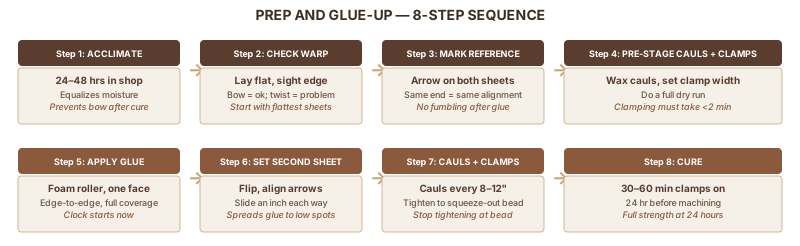
Step 1: Acclimate the sheets
Bring all sheets into your shop 24-48 hours before gluing. Plywood delivered from a lumber yard or left in a cold garage often has higher moisture content than shop-stored sheets. Glue two sheets at different moisture levels and the wetter one shrinks as it equalizes. That differential movement bows the panel. Acclimating everything first eliminates this.
Step 2: Check for warp
Set each sheet on your workbench and look down its face. A slightly bowed sheet is fine; clamping pressure will flatten it. A severely twisted sheet (the four corners don't sit in the same plane) is a problem. Twisted sheets can introduce stress that persists even after curing. Start with the flattest sheets you have for furniture-grade panels; for workbench tops and shop jigs, moderate warp is acceptable.
Step 3: Mark your reference edge
Lay both sheets face-to-face in the orientation you want them glued. Mark an arrow on both sheets indicating the same end. When the second sheet goes on after gluing, you'll flip it face down and align that reference mark. No fumbling to figure out which end is which once glue is involved.
Step 4: Pre-stage cauls and clamps
Apply packing tape or paste wax to one face of each caul (the side that will contact the panel). This prevents the caul from bonding to the panel if squeeze-out touches it.
Set all your clamps to the right width. Stage them within arm's reach. Lay the cauls nearby. Do a quick dry run: place cauls across the panel, position clamps, tighten one or two, then loosen everything. You're confirming the setup works before glue is involved.
Step 5: Apply glue
Roll glue onto one face of the bottom sheet. Cover the entire surface edge to edge, including the corners. A foam roller distributes glue faster and more evenly than a brush on large surfaces. Aim for complete, uniform coverage: not so thick it pools at the edges, not so thin that dry spots appear. At roughly 150-200 sq ft of coverage per quart, a quart of Titebond handles about five standard 4×8 panel laminations at single-spread application.
Step 6: Set the second sheet
Flip the second sheet and set it onto the glued face, aligning your reference marks. Press down firmly. Slide the sheet an inch in each direction to spread glue into any low spots, then bring it back to alignment.
Step 7: Cauls and clamping
Lay cauls across the full width of the panel, spacing them every 8–12 inches along the length, on both the top and bottom face. Place clamps between the cauls, spacing them every 8–12 inches as well. Alternate clamps from the top and from the bottom of the stack.
Tighten clamps until a thin, consistent bead of glue squeezes out along all edges. That bead confirms glue reached the edges and pressure is adequate. Stop tightening once you see it. In Fine Woodworking's benchtop clamping discussion, the target is "enough pressure to bring the joints into tight contact," not the maximum your clamps can deliver. Cranking past that squeeze-out bead pushes the remaining glue out of the joint and starves the bond.
Step 8: Cure
Leave the clamps on for at least 30-60 minutes (light handling). Wait the full 24 hours before running the panel through a saw, sander, or planer. Glue continues hardening for 24 hours; machining before full cure can introduce stress at the glue line.
Part 4: Common Mistakes
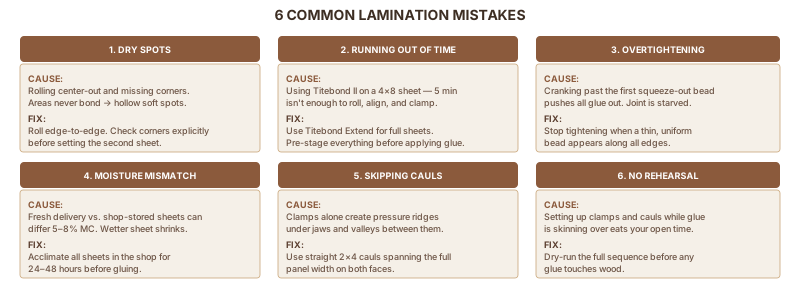
1. Dry spots from skipping glue coverage
Rolling from the center out and missing the corners creates dry spots, areas that never bond. These show up as hollow, slightly soft spots after curing. Roll edge to edge on every application, and check the corners explicitly.
2. Running out of time on large panels
If you spread glue on a 4×8 sheet with Titebond II, you have about 5 minutes before the glue starts to skin over. That's not enough time to roll the full surface, flip the second sheet, align it, add cauls, and start clamping. Use Titebond Extend or Titebond III for anything larger than about 24"×48", and pre-stage everything so clamping takes under 2 minutes.
3. Overtightening (starved joint)
When you crank clamps past the first squeeze-out bead, you push the remaining glue out of the joint. The cured joint is starved: less glue means less contact area and a weaker bond. Tighten until squeeze-out appears uniformly, then stop.
4. Mismatched moisture content
Fresh lumber yard delivery versus shop-stored plywood can vary by 5-8% in moisture content. As the wetter sheet dries, it shrinks. The dry sheet resists. The result is a bowed panel. Woodworking Network's delamination guide identifies moisture mismatch as one of the primary causes of failed laminations. Let everything acclimate in your shop for 24-48 hours before gluing.
5. Skipping cauls
Without cauls, individual bar clamps create high-pressure ridges directly under the clamp jaws and low-pressure valleys between them. The panel bows between the clamps. A set of straight 2×4 cauls spanning the full width distributes pressure evenly across the surface. This is the single biggest difference between a flat lamination and a bowed one. Per Paul Sellers' workbench guide, construction lumber cauls "really reduce the required number of clamps" while improving the quality of the lamination.
6. Not rehearsing the sequence
Setting up clamps and cauls while glue is drying on the sheet turns a 9-minute open time into a 4-minute open time. Rehearse the full clamping sequence before any glue touches the wood.
Part 5: Flattening After Glue-Up
A well-clamped, well-caul'd panel usually comes out flat. After removing clamps, check with winding sticks or a long straightedge. Winding sticks are two parallel strips laid across the near and far ends of the panel; sight across them from one end. If the sticks look parallel, the panel is flat. Minor deviation is normal and fixable. Severe warp after glue-up almost always traces back to skipped cauls or mismatched moisture content.
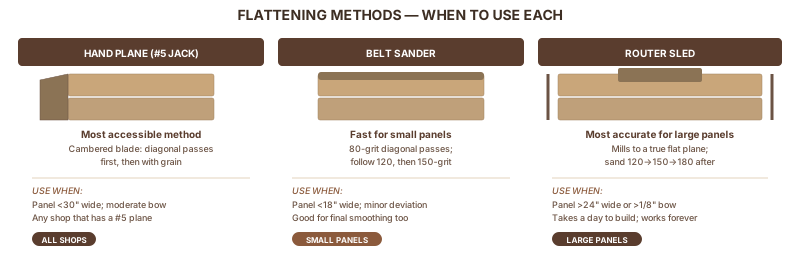
Hand plane
A #5 jack plane with a cambered blade is the most accessible method for most shops. A cambered blade has a slightly rounded cutting edge that takes thick, fast shavings without leaving hard-edged ridges. Start with diagonal passes to knock down high spots, then finish with passes parallel to the grain. Woodcraft's hand-planing guide calls this the reliable sequence: diagonal first, then with grain. The jack plane handles panels up to about 24-30" wide comfortably.
Belt sander
For panels under about 18" wide, a belt sander with 80-grit removes material quickly. Work in diagonal or figure-8 passes, keeping the sander moving to avoid grooves. Follow with 120-grit and 150-grit to even out the surface. Faster than hand planing for small panels; less controlled for large ones.
Router sled
For panels wider than 24" or with more than about 1/8" of bow, a router sled is the right tool. A sled bridges over the panel on two parallel rails. A router with a flat-bottom surfacing bit mills the entire surface to a single plane. The Woodworkers Guild of America's slab flattening method covers building and using a simple version. After milling, sand to remove router marks (120 → 150 → 180 grit). Building the sled takes a day; it handles any size panel after that.
A note on drum sanders: A drum sander dimensions, it doesn't flatten. As the panel enters, the feed table presses it flat. When it exits, the bow springs back. Use a drum sander after a hand plane or router sled pass, as a final surface smoothing and thickness step.
Part 6: DIY vs. Buy
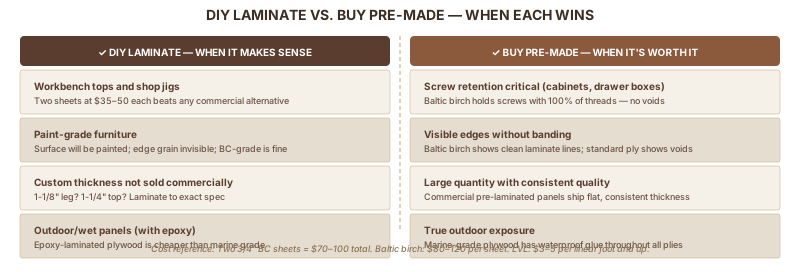
| Situation | DIY Lamination | Buy Pre-Made |
|---|---|---|
| Workbench tops, shop jigs, fixtures | ✓ Laminate | — |
| Paint-grade furniture | ✓ Laminate | — |
| Screw retention critical (cabinet carcasses, drawer boxes) | — | Baltic birch |
| Visible edges without banding | — | Baltic birch |
| Outdoor or wet-environment panels | Epoxy-laminated plywood | Marine-grade plywood |
| Custom thickness not available commercially | ✓ Laminate | — |
| Large quantity with consistent quality needed | — | Pre-laminated commercial panels |
The cost math
Two sheets of 3/4" BC-grade plywood at a home center run $35-50 each, so a laminated 1.5" panel costs $70-100 total. A single sheet of 3/4" Baltic birch runs $80-120 at most lumber dealers; laminating two Baltic birch sheets gives you a better panel but the cost is doubled. Woodworkers Source's Baltic birch guide notes that Baltic birch's void-free core "holds screws with 100% of their threads" — that screw retention advantage matters for cabinetry and drawer boxes. For workbench tops and shop jigs where you're driving screws into solid wood faces anyway, standard plywood lamination is the practical choice.
LVL (laminated veneer lumber) costs $3-5 per linear foot and climbs from there for wide stock. DIY plywood lamination beats that cost significantly for custom structural thickness.
Part 7: Edge Treatment
Laminated plywood edges show the internal glue lines and layer boundaries. For shop projects, leave the edges raw or paint them. For furniture, three options:
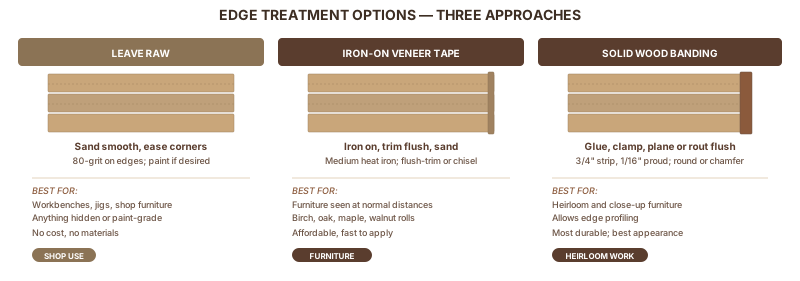
Leave raw
For workbench tops, jigs, or anything hidden or painted: sand the edges smooth with 80-grit, ease the corners slightly, and call it done.
Iron-on veneer edge banding
Pre-glued wood veneer tape with heat-activated adhesive on the back. Apply with a household iron set to medium heat, pressing the tape onto the edge as you move along. Trim the overhang with a flush-trim bit or sharp chisel, sand to 150-grit, and finish. Family Handyman's iron-on veneer edging guide shows the full process in detail. Available in most common species (birch, oak, maple, walnut) in rolls from 8 to 250 feet. Quick, affordable, and convincing at normal viewing distances.
Solid wood edge banding
Glue and clamp a solid wood strip to the edge — typically 3/4" wide and 1/16" thicker than the panel. After curing, plane or rout the strip flush, then shape with a roundover or chamfer bit if desired. More durable than iron-on veneer, allows edge profiling, and looks better close-up. The right choice for furniture you'll keep.
Sources
Research for this guide drew on manufacturer technical data, respected woodworking educators, and trade knowledge bases.
- The Wood Whisperer — Differences Between Titebond Glues — comparing Titebond II, III, and Extend
- Titebond III product page — open time and water resistance specs
- Titebond Extend product page — extended open time for large panels
- Paul Sellers — Making Your Workbench — clamping setup and caul approach
- Fine Woodworking — Clamping benchtop lamination — clamping pressure and technique
- Woodworkers Source — Baltic Birch guide — screw retention and when Baltic birch is worth it
- WWGOA — Flatten Wood Slabs with Router — router sled flattening method
- Woodcraft — Flattening Boards by Hand — jack plane technique
- Family Handyman — Iron-on Veneer Edging — edge banding application
- Woodworking Network — Why Plywood Delamination Occurs — failure modes and moisture causes
Also Referenced
Up Next
How to Prime MDF Without Fiber Puffing
WOOD & MATERIALS · Beginner