
Circle Jig for a Router at a Glance
A router circle jig is a trammel, a rigid arm with a pivot pin at one end and your router at the other. The pin stakes into the center of your circle; the router orbits it at a fixed radius. The simplest version is a strip of 1/4" plywood with two holes in it. Build one in 20 minutes from scrap, or buy a commercial jig for $30–150. The mechanism is identical either way.
| DIY build time | 20 minutes, ~$0 from scrap |
| Commercial pick (small circles) | Jasper 200J, ~$35–50, 2-1/4"–18-3/16" |
| Commercial pick (any size) | Milescraft CircleGuideKit, ~$30–85, 1.5"–52" |
| Minimum radius | 1-1/8" with compact router; ~3" with full-size |
| Max depth per pass | 1/8" solid wood; 1/4" MDF |
| Feed direction | Counterclockwise (conventional cut) |
In this guide:
- How the mechanism works and why the radius measurement matters
- Build a trammel from scrap in 20 minutes
- Commercial jigs: what to buy and why
- Setup, depth, feed direction, and tearout control
- How to avoid a pivot hole in your finished piece
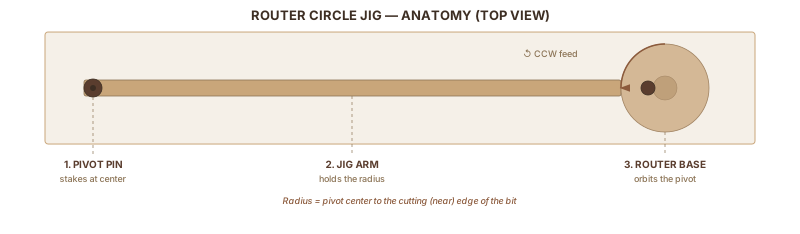
Part 1: How a Router Circle Jig Works
The jig is a trammel: a compass for routers. One end holds the router (via the base plate). The other end has a pivot pin that drops into a small hole at the center of your circle. The distance between the pivot pin and the cutting edge of the bit is the radius.
The router swings counterclockwise around the pivot. Because the arm is rigid and the pivot is fixed, the bit traces a perfectly round path at a constant radius. Woodsmith's circle routing jig guide covers the build and technique if you want a magazine-grade plan to work from.
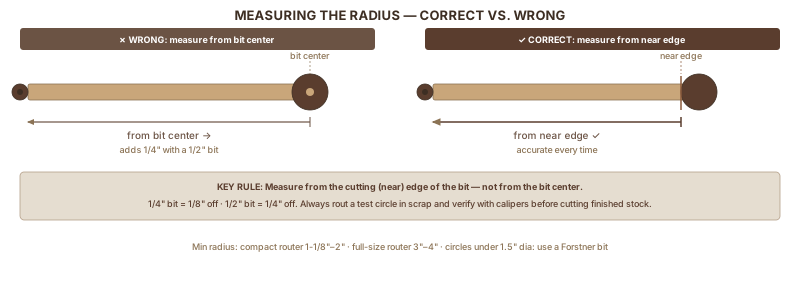
Measuring the radius correctly
The radius runs from the near edge (cutting edge) of the bit to the center of the pivot pin, not from the bit's center or the collet.
With a 1/2" diameter bit, the cutting edge sits 1/4" from the bit's center. Measure from bit center to pivot, and your circle comes out 1/4" too large. With a 1/4" bit, you'll be 1/8" off. Small errors that destroy a speaker baffle fit or an inlay ring.
Set your jig, route a test circle in MDF or scrap, measure the actual diameter with calipers, and adjust before touching finished stock.
What limits the minimum radius
You can't place the pivot closer to the bit than the edge of your router base allows. The base itself creates a physical floor.
- Compact/trim router: 1-1/8"–2" minimum radius (2-1/4"–4" minimum diameter)
- Full-size router: 3"–4" minimum radius (6"–8" minimum diameter)
For circles smaller than 3" diameter, use a Forstner bit or hole saw. Both are faster and more accurate at that scale.
Part 2: Build a Router Circle Jig in 20 Minutes
The DIY trammel handles 90% of circle-cutting work. You probably have everything you need in your scrap bin right now. Family Handyman's circle jig guide covers the same core build — these steps work.
What you need
- 1/4" Baltic birch plywood or MDF (for trim router); 1/2" plywood for full-size router
- Width: 2.5"–3"
- Length: your maximum desired radius + 4" (extra for router attachment)
- 1/4" brad nail, finishing nail, or 1/4" bolt for the pivot pin
- Longer screws if your base plate screws won't reach through the arm thickness (check before drilling)
Use Baltic birch or any flat plywood. Avoid standard MDF for the jig arm. It swells with humidity and your holes drift. MDF is fine as a workpiece to rout circles in.
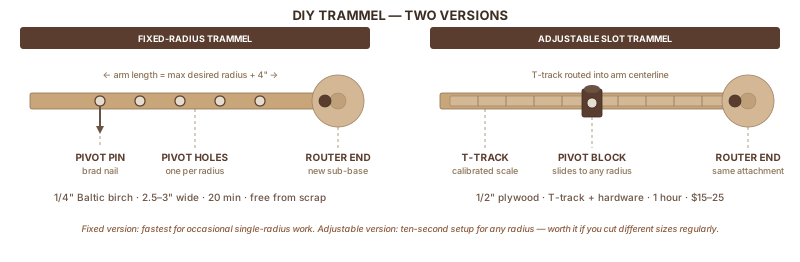
Fixed-radius trammel build (the fast version)
- Remove your router's sub-base. Trace the screw holes and bit opening onto your plywood strip.
- Drill the bit hole to match your router's opening (typically 1-3/8" diameter). Use a Forstner bit to match your factory sub-base hole.
- Drill countersunk holes at the base plate screw locations. Attach the plywood strip to the router. The strip becomes your new sub-base.
- Install your router bit. Measure from the near (cutting) edge of the bit outward along the arm to your desired radius. Mark that point and drill a 1/4" hole.
- Push a brad nail through the hole, point down. That's your pivot.
For multiple radii, drill additional holes at different distances and label each with a marker. Or rout a slot along the arm length and use a bolt-and-knob system to lock at any position.
The adjustable slot version (1 hour, worth it if you cut circles regularly)
If you cut different circle sizes often (speaker builds, a series of round boxes), the fixed-hole jig gets tedious. Rout a 3/4"-wide slot along the arm's centerline. Install T-track in the slot. A carriage bolt and wing nut lock the pivot block at any radius. Scribe a ruler scale along the slot with a marking gauge and awl. Setup time drops from five minutes (drilling a new hole) to ten seconds. Wood Shop Diaries has a good version of this adjustable design with photos.
Material cost: $15–25 for T-track and hardware.
Part 3: Commercial Jigs Compared
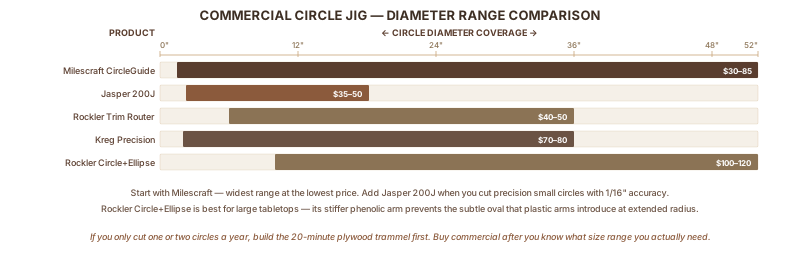
Buy a commercial jig when you want fast, repeatable radius changes and a calibrated scale. The DIY trammel is one fixed radius at a time; the commercial jig slides to any radius and locks.
| Product | Diameter range | Price | Best for |
|---|---|---|---|
| Milescraft CircleGuideKit | 1.5"–52" | $30–85 | Best value; widest range; fits 47+ routers |
| Jasper 200J | 2-1/4"–18-3/16", 256 positions | $35–50 | Precision small circles; 1/16" increments |
| Rockler Trim Router Circle Jig | 6"–36" | $40–50 | Trim router users |
| Kreg Precision Router Circle Jig | 2"–36" | $70–80 | Mid-range accuracy |
| Rockler Circle & Ellipse Jig | 10"–52" (cuts ellipses too) | $100–120 | Large tabletops; heavy shop use |
If you cut mostly small circles (speaker baffles, round boxes, inlay rings)
Get the Jasper 200J. It's CNC-machined acrylic with 256 pre-drilled hole positions in 1/16" increments. Setup takes ten seconds. Snap the pivot to a new hole and you're done. Works with plunge routers. The 1/16" increment matters when you're cutting a speaker baffle that must fit a specific driver.
If you cut a mix of sizes, including large ones
Get the Milescraft CircleGuideKit. Its TurnLock system attaches to most routers without tools. The arm slides from 3/4" radius (1.5" diameter) up to 26" radius (52" diameter), covering everything from a small inlay ring to a 48" round dining table. The arm has both imperial and metric scales. At $30–85 depending on configuration, it's the lowest-cost entry to adjustable circle cutting.
If you build large round furniture regularly
Consider the Rockler Circle & Ellipse Jig at $100–120. The phenolic core is stiffer than the Milescraft's plastic arm, which matters at large radii where arm sag can introduce a subtle oval instead of a true circle. The ellipse function is a bonus for occasional oval tabletops.
Buying verdict
Start with the Milescraft CircleGuideKit. It covers every size at the lowest cost. If you find yourself making precision small circles frequently (speaker enclosures, clock inserts, inlay rings), add the Jasper 200J. The two together cost less than the Rockler large jig and cover a wider range.
If you're only cutting one or two circles a year, build the 20-minute plywood trammel first. Buy later when you know the size range you actually need.
Part 4: Setting Up and Routing Your Circle
Before you cut
Mark the center. Use an awl punch, not a pencil dot. A pencil mark is too imprecise for the pivot to sit without wandering.
Test your radius on scrap. Set the jig, rout a circle in MDF or a cutoff piece, and measure the actual diameter with calipers. Adjust before touching finished stock. This one step prevents the most expensive mistakes.
Clamp the workpiece. Circle routing creates consistent lateral force through the full revolution. An unsecured workpiece shifts and produces an oval. Clamp it to the bench, or put it on a non-slip router mat and weight the corners.
Routing the circle
- Set bit depth to 1/8" below the surface for the first pass.
- Start the router. Let it reach full speed before touching the workpiece. Two to three seconds is enough.
- Lower the bit (plunge router: use the plunge mechanism; fixed-base router: start at the edge of the workpiece or a pre-drilled starter hole).
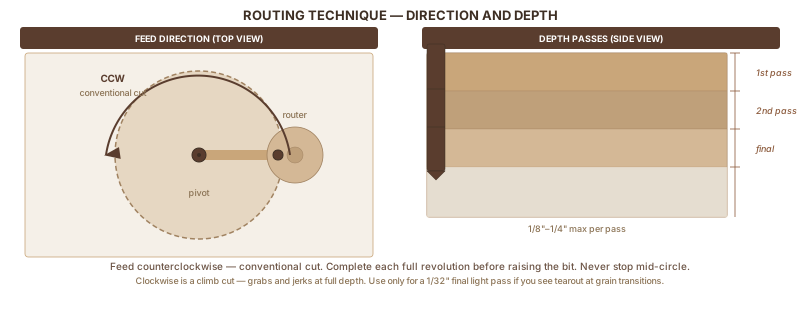
- Feed counterclockwise. Slow and steady. Rushing causes burning. Listen for the bit: a higher pitch or smoke means slow down.
- Complete a full circuit per pass. Never stop mid-circle and lift the bit; you'll leave a dip.
- Raise the bit, increase depth by 1/8"–1/4", and repeat.
- Final pass: route a full circuit at finished depth, then take one very slow final circuit without changing depth to clean up any fuzz.
Depth limits by bit size
| Bit diameter | Max depth per pass |
|---|---|
| 1/4" | 1/8" |
| 3/8" | 3/16" |
| 1/2" | 1/4" |
Circle routing puts more lateral force on the bit than straight-line routing. Keep passes shallow. Sawmill Creek's bit depth thread covers the reasoning: the lateral force during circle routing is constant around the full arc, unlike straight cuts where the force varies.
Bit selection
A 1/2" spiral upcut carbide bit is the best all-around choice. According to toolstoday.com's tearout guide, upcut bits evacuate chips more efficiently than straight bits, which reduces heat and bit wear on deep cuts.
For MDF and plywood through-cuts, the upcut is the clear winner. For decorative face routing where tearout on the top surface is unacceptable, switch to a downcut spiral. It presses fibers down for a clean top face, at the cost of more heat (use slower feed and shallower passes).
Avoid 1/4" diameter bits for passes deeper than 1/8". They flex under the lateral force of circle routing, producing wavy edges.
Feed direction and tearout
Move the router counterclockwise. This is a conventional cut: the bit feeds into the cut against its rotation, keeping the router stable and predictable. Stumpy Nubs covers router feed direction safety in detail if you want the full explanation of why direction matters.
Moving clockwise is a climb cut. The Wood Whisperer's climb-cutting guide covers the mechanics: climb cuts can reduce tearout in difficult grain, but at full depth they risk the bit grabbing and yanking the router sideways. Use a clockwise pass only for a very light final cleanup (1/32"), and only if conventional passes are leaving tearout at grain-direction transitions.
On plywood face veneer, apply blue painter's tape along the cut line before routing. The tape stabilizes the veneer fibers during the cut. Rockler's plywood tearout guide has additional strategies, including backup boards and compression bits, if tape alone doesn't get a clean edge.
The free-spinning disc problem
When you route a circle all the way through a panel, the cutout becomes a free disc on the final pass. It can spin and grab the bit, gouging the edge. Before the last pass, either drive a screw through the disc area into the benchtop (in a waste zone that won't show), or apply double-sided tape between the disc and a scrap backer underneath.
Part 5: Mistakes That Ruin Circles
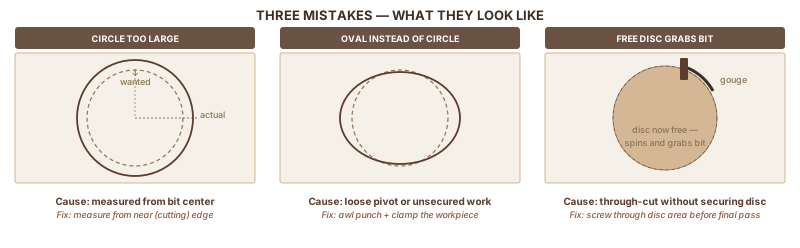
| Mistake | What you see | Fix |
|---|---|---|
| Measuring radius from bit center, not near edge | Circle is 1/8"–1/4" too large | Measure from cutting edge of bit to pivot center |
| Loose pivot pin | Subtle oval or wobble at one point | Pre-drill 1/4" hole for the pivot; don't push into face grain |
| Too-deep passes | Burning, chatter, bit deflection | 1/8"–1/4" max per pass (see table above) |
| Moving clockwise (full pass) | Rough cut; router grabs and jerks | Always counterclockwise for full-depth passes |
| Workpiece not clamped | Circle shifts to an oval | Clamp to bench; use non-slip mat at minimum |
| Free disc on final pass | Bit grabs and gouges the edge | Screw through disc area before final pass |
| Dull bit | Burning, rough edge, heavy hand pressure | Replace or sharpen before circle cuts. Circle routing exposes a tired bit fast. |
| Plywood without tape | Face veneer splinters | Apply painter's tape to the cut line first |
Part 6: Routing Without a Pivot Hole
The pivot pin needs something to sit in, and that's usually a small hole in your workpiece. For tabletops and show pieces, that hole is a problem.
Method 1: Scrap backer pad (most reliable)
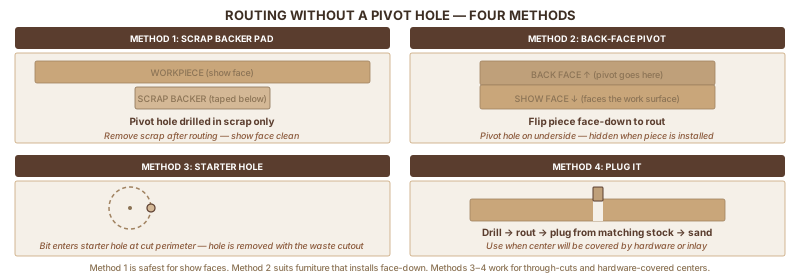
Apply double-sided tape to the back face of the workpiece. Cut a scrap of MDF or plywood about 4" × 4" and tape it to the center, centered on your circle mark. Mark the center on the scrap and drill the pivot hole into the scrap only. Route the circle. After cutting, remove the scrap with a putty knife (heat from a hair dryer loosens the tape). The finished piece has no hole. Rockler's six circle-cutting techniques shows this method alongside other pivot hole strategies.
This works for any workpiece where you can access both faces.
Method 2: Back-face pivot
Flip the workpiece so the show face is down. Drive the pivot into the back face: the bottom of a tabletop, the underside of a lazy susan. The hole is hidden when the piece is in use. Good for any piece that sits face-down or is installed against a wall.
Method 3: Starter hole for through-cuts
For speaker baffles and panel cutouts (anywhere you're routing a hole all the way through), drill a starter hole at the perimeter of the cut before routing. Lower the bit into the starter hole. The pivot sits at center, but the bit enters through the starter hole rather than plunging through the face. The starter hole lands in the waste area and is removed with the cutout.
Method 4: Plug it
Route the circle normally with a pivot hole. After cutting, use a plug cutter to cut a plug from matching stock. Glue the plug flush and sand it. Works well when the center area will be covered by a table pedestal bolt hole, a decorative inlay, or a hardware fitting. For a more elegant shop-made solution without any hole at all, Christofix's no-center-hole jig design is worth reading.
Part 7: What a Circle Jig Can Make
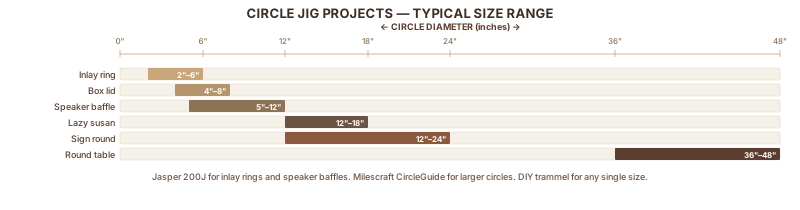
| Project | Typical diameter | Notes |
|---|---|---|
| Speaker baffle cutout | 5"–12" | Through-cut in MDF; upcut bit; starter hole method |
| Round box lid | 4"–8" | Trim router + Jasper 200J; scrap backer |
| Lazy susan | 12"–18" | Large DIY trammel or Milescraft; back-face pivot |
| Clock face round | 12"–18" | Same setup as lazy susan |
| Round dining tabletop | 36"–48" | DIY large trammel; jigsaw rough cut first, router cleans edge |
| Inlay ring | 2"–6" | Jasper 200J; decorative surface rout, not through-cut |
| Sign round | 12"–24" | Light cleanup pass after bandsaw rough cut |
| Cabinet door arc | Variable | Router table jig for edge profiling |
For tabletops over 36" diameter, rough-cut with a jigsaw first (leave 1/4" of waste) and use the circle jig for a single cleanup pass. Running the router from full stock on a 48" circle puts serious arm fatigue on the operator.
Related Guides
Before cutting circles with a router, you need a router that works for the task. The wood routers guide covers router selection: fixed-base vs. plunge, compact vs. full-size. For circle cuts in material over 1/2" thick, a plunge router is significantly easier to control.
The router tables guide covers the table-based approach to circle routing, where the workpiece rotates on a fixed pivot rather than the router moving. Better for small circles and edge profiling on already-cut rounds.
The dovetail jig guide and dowel jig guide cover other shop-made precision jigs that follow similar build principles.
Sources
Research for this guide drew on manufacturer documentation, woodworking magazine tutorials, and expert practitioner discussions on technique.
- Woodsmith — Router Jig for Cutting Circles — Jig design and construction
- Family Handyman — How to Make a Router Circle Jig — DIY build instructions and measurements
- Wood Shop Diaries — How to Make a Circle Jig for Your Router — Adjustable slot jig design
- Rockler Trim Router Circle Jig — Manufacturer specs (6"–36" range)
- Jasper Tools — 200J model specifications, 256 hole positions, 1/16" increments
- Milescraft CircleGuideKit product page — Official diameter range and TurnLock attachment specs
- Sawmill Creek — Ideal Bit Diameter and Pass Depth for Circle Routing — Expert discussion on depth limits and lateral force
- Tools Today — How to Avoid Router Tearout — Upcut vs. downcut bit comparison; chip evacuation data
- The Wood Whisperer — Router Climb-Cutting — When and how to use climb cuts safely
- Stumpy Nubs — Safe Router Feed Directions — Conventional vs. climb cut safety
- Rockler — Preventing Tearout When Routing Plywood — Plywood-specific tearout strategies
- Rockler — Six Circle Cutting Techniques — Pivot hole avoidance methods
- Christofix — No Center Hole Router Circle Jig — Shop-made no-hole pivot design
Tools Used
Tagged
How We Research
We don't take affiliate revenue or accept review units. Picks come from multi-source research — manufacturer specs, OSHA / EPA / ASTM regs, and long-form practitioner threads — plus Ahmed's hands-on use where relevant. When we recommend something, we explain why.
Up Next
Dowel Jig: How to Choose, Set Up, and Use One
WORKSHOP · Beginner