
QUICK ANSWER: A working DIY dust collection system costs $75–$380. The simplest build is a shop vac plus a Thien baffle separator on a 5-gallon bucket — about $80 total in materials, and it captures 90%+ of chips before they reach the filter. Upgrade to a dedicated 1 HP collector ($130) when you add a table saw or planer. The single most important upgrade for your lungs is a sub-micron canister filter — separators stop chips, but only the filter stops the invisible particles that cause long-term lung damage.
DIY Dust Collector at a Glance
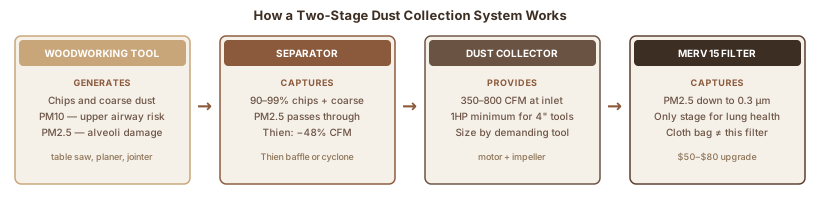
A working DIY dust collection system costs $75–$380. Start with a shop vac and a Thien baffle separator ($8–$36 in materials). It captures over 90% of chips before they reach your filter. Add a dedicated 1HP collector ($130) when you get a table saw or planer. The canister filter upgrade ($50–$80) matters more for your lungs than any separator. Cyclones and baffles don't stop invisible fine particles. Only a sub-micron filter does.
| Entry cost | $8–$36 (DIY Thien baffle separator only) |
| Full DIY system | $75–$155 (shop vac + separator + hose + gates) |
| Upgrade tier | $270–$380 (1HP collector + drum separator + canister filter) |
| Thien baffle CFM efficiency | 52% of baseline (48% airflow lost through separator) |
| True cyclone CFM efficiency | 76% of baseline (Dust Deputy) |
| Critical filter spec | MERV 15 or higher for sub-micron particle capture |
In this guide:
- Which approach fits your shop and budget
- Build a Thien baffle separator step by step
- Size your system and route hose
- The five mistakes that cripple DIY systems
Part 1: What Wood Dust Actually Does
Wood dust is an IARC Group 1 carcinogen. IARC placed it in the same category as tobacco smoke in 1995. The sawdust you can see isn't what injures you. It's the fraction you can't.
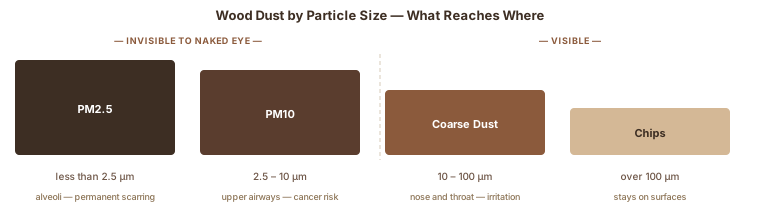
Dust particles fall into size ranges that matter. Chips and visible shavings above 100 µm land on your floor and workbench — sweep them up. Particles in the PM10 range (10–100 µm) penetrate into your upper airways and nasal passages; long-term, they're the primary driver of woodworker nasal and sinus cancer. The PM2.5 fraction (under 2.5 µm) reaches your alveoli. That's where irreversible scarring happens. These particles are invisible. You can't see them, and your shop vac filter probably isn't stopping them.
About one-third of the total airborne dust from typical woodworking is sub-micron by weight. The chip collection that keeps your floor clean is doing less than half the job from a health standpoint.
The regulatory limits reflect this (OSHA Wood Dust eTool):
| Body | Hardwood | Softwood |
|---|---|---|
| OSHA PEL | 1 mg/m³ | 5 mg/m³ |
| NIOSH REL | 1 mg/m³ | 1 mg/m³ |
| ACGIH TLV | 1 mg/m³ | 1 mg/m³ |
Species with confirmed nasal cancer associations: oak, beech, mahogany, walnut, birch, elm, ash. If you work with these regularly, hardwood limits apply.
For hobbyists at 4–8 hours per week, cumulative exposure is far below occupational levels. Any functional dust collection is dramatically better than none. But knowing what you're protecting against shapes which system you build.
Part 2: How Dust Collection Works
CFM and Static Pressure
Two numbers govern every dust collection system.
CFM (cubic feet per minute): Volume of air moved. This determines whether you can pull dust off the tool surface before it escapes into your shop air.
Static pressure: Resistance to airflow in your ducts, measured in inches of water column ("WC). Every elbow, every foot of pipe, every filter, every separator adds resistance. More resistance means less CFM delivered at the tool.
Dust collectors and shop vacs trade these off differently. A shop vac produces high static pressure at low CFM, useful for small 1"–1.5" hoses on hand-held sanders. A 1.5HP dust collector produces 800 CFM at its inlet at much lower static pressure, which is what you need for stationary tools with 4" ports. Running your table saw off a shop vac means you're delivering roughly 100–180 CFM where the saw needs 350–450. You're collecting about one-third of what comes off the blade.
CFM by Duct Diameter
At 4,000 FPM (the design velocity that keeps particles suspended in horizontal runs), each pipe diameter delivers:
| Diameter | CFM at 4,000 FPM |
|---|---|
| 2.5" | ~130 |
| 4" | 349 |
| 5" | 545 |
| 6" | 785 |
| 8" | 1,396 |
This is why you can't run a table saw on a 2.5" hose. The table saw port needs 350 CFM minimum. A 2.5" hose delivers 130. You're running at 37% of what's required.
Where CFM Goes
Static pressure losses accumulate fast. Here's what a typical home shop system actually costs you in airflow:
| Component | Static Pressure Loss |
|---|---|
| System entry (collector inlet) | ~1.0" WC |
| Dirty cartridge filter | ~2.0" WC |
| 4" rigid pipe, per 5 feet | 0.285" WC |
| 90° elbow (4") | ~0.47" WC |
| 1 foot of 4" flex hose | ~0.35" WC |
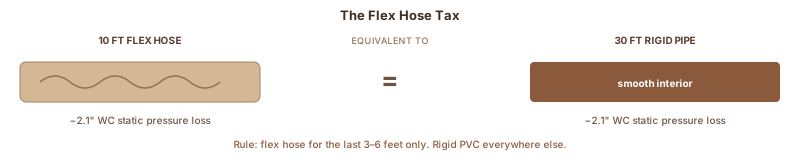
The flex hose numbers are stark. Ten feet of corrugated flex hose is equivalent to roughly 30 feet of smooth rigid pipe in static pressure loss. A 25-foot flex hose run costs approximately 40% of your collector-rated CFM. Run rigid PVC or steel duct everywhere in your shop, and use flex hose only for the last 3–6 feet connecting to each tool.
The 800 CFM Principle
Standard woodworking guidance says 350–450 CFM is enough for chip collection at stationary tools. That's correct for chips. For fine dust capture at the source, Bill Pentz's research at billpentz.com puts the real threshold at ~800 CFM at the collector inlet. After typical ductwork losses, a 1.5HP collector rated 800 CFM delivers 400–600 CFM at the tool.
Your separator only moves debris from the filter to a collection bin. A cyclone or Thien baffle doesn't stop PM2.5. Only the downstream filter does. Both the collector capacity and the filter specification matter for health protection. See Bill Pentz's full research for the underlying data.
Part 3: Four DIY Approaches at Every Budget
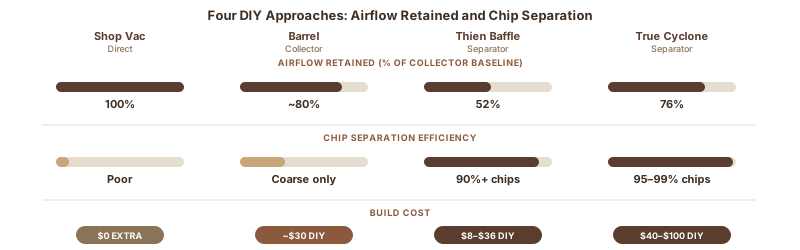
| Approach | Airflow Loss | Chip Sep. | Fine Dust Sep. | Build Cost | Best For |
|---|---|---|---|---|---|
| Shop vac direct | None | None (filter only) | Filter only | $0 extra | Occasional use, hand tools |
| Barrel collector | 15–25% | Gravity (coarse only) | Poor | ~$30 DIY | Simple chip capture |
| Thien baffle | ~48% | Excellent | Moderate | $8–$36 | Budget, space-limited |
| True cyclone | ~24% | Excellent | Better | $40–$100 | Daily shop use |
Shop Vac Direct
No separator. All material flows to the filter. CFM: 50–180 depending on the vac. The problem: fine dust clogs the filter fast, which drops CFM further, which eventually forces the vac to bypass unfiltered air back into your shop. A shop vac with a loaded filter produces more fine dust in the shop air than one running clean. If you're using a shop vac without a separator, upgrade to a MERV 15 cartridge filter and clean it after every session — that matters more than any separator.
Barrel or Trash Can Collector
A barrel positioned between the tool and the dust collector, with inlet and outlet ports. Chips fall into the barrel by gravity before reaching the filter. Catches coarse chips well; fine dust mostly passes through. Simple and cheap. The main limitation: you have to empty the barrel before it fills to the outlet level, and it does nothing for the fine particles that matter most for health.
Thien Baffle Separator
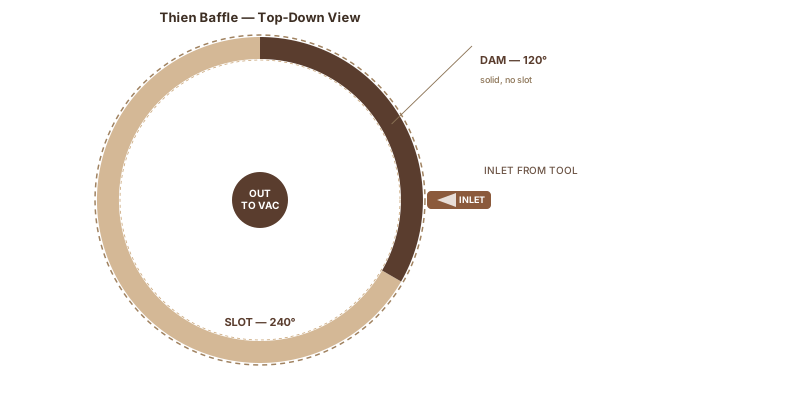
Designed by J. Phil Thien around 2007. A flat plywood disc mounted inside a container creates a 2D cyclonic flow — air spins horizontally, chips drop through a slot in the baffle into the collection zone below, and cleaner air exits upward to the filter.
Efficiency from testing (YouCanMakeThisToo anemometer test): the Thien baffle retains 52% of baseline airflow (versus 76% for a true commercial cyclone). That means you're losing 48% of your collector's CFM through the separator. On an already-marginal system, that's significant. On a well-sized 1HP+ collector, it's manageable.
The Thien's advantage over commercial cyclones: it maintains full separation efficiency until material is 3" below the baffle. True cyclones degrade at about 25% fill. You can run a Thien separator much fuller before performance drops.
Nathan Darnell documented a 5-gallon bucket Thien build for $8.04 in materials. Ettowoodworking's $36 DIY cyclone build reported approximately 90% chip separation.
True Cyclone Separator
A 3D helical cone. Air enters tangentially at the top, spirals down along the cone wall. As the cone narrows, tangential velocity increases (by conservation of angular momentum), which boosts centrifugal force on particles. Debris slings to the wall and slides into the collection bin below. Clean air reverses and exits upward through the center.
The cyclone outperforms the Thien on fine dust because the 3D geometry continuously accelerates centrifugal force as the cone narrows. The Thien's flat spiral only works in the horizontal plane. Any particle that escapes the baffle isn't recovered.
ShopHacks tested the Oneida Dust Deputy against a flat-disc separator using a controlled corn starch test. The Dust Deputy passed 4–10 times less fine dust. It also retained 76% of baseline CFM versus 52% for the Thien.
Commercial option: Oneida Dust Deputy DIY cyclone ($39.99 for the cyclone alone) or the Deluxe kit with bucket, hose, and casters ($79). The anti-static version ($70–$80) addresses the static charge that builds up in PVC systems.
Part 4: Building a Thien Baffle Separator
The 5-gallon bucket Thien baffle is the entry point for most builders. It takes 1–2 hours, costs $25–$35, and handles a shop vac connection completely.
Materials
| Item | Cost |
|---|---|
| (2) 5-gallon buckets (90-mil minimum wall thickness) | $6–$10 |
| Snap lid for 5-gal bucket | $2–$3 |
| 3/4" plywood scrap (roughly 10" × 10") | Scrap |
| 2" PVC elbow (inlet) | $3–$5 |
| 2" PVC coupling (outlet) | $2–$3 |
| 2" rubber no-hub coupling | ~$7 |
| Silicone sealant | $5 |
| Total | ~$25–$35 |
Bucket wall thickness: Standard big-box store 5-gallon buckets are often under 90 mil. Under shop vac suction, they collapse inward. Either use two nested buckets (outer supports inner) or find 90+ mil industrial buckets from a restaurant supply or janitorial supplier.
Build Steps
1. Prepare the containers. Cut the bottom off one bucket — this becomes the upper cyclone chamber. The second bucket stays intact as the collection bin. The upper bucket fits friction-tight over the lower bucket lip.
2. Make the baffle disk. Cut a plywood circle 1/4" smaller than the bucket's inner diameter. Mark the drop slot: 1.125" inward from the edge, covering 240° of the circumference. The remaining 120° arc stays at full diameter — this is the dam wall that prevents re-entrainment of settled material. Cut the slot with a jigsaw, sand smooth.
3. Install the inlet port. Drill a hole in the upper chamber wall for the 2" PVC elbow. The elbow must fire tangentially along the inner wall. Angle it so air follows the circle, not shoots across the center. Position 0.75" from the container wall.
4. Install the outlet port. Drill a centered hole in the lid for the 2" PVC coupling. This connects to your shop vac.
5. Orient inlet and outlet correctly. The inlet (dirty air from your tool) sits at the wall. The outlet (clean air to the vac) sits at the center of the lid. They should be approximately 180° apart so air travels the full circumference before exiting. Reversing these two ports is the most common build error. It runs the cyclone backward and destroys separation.
6. Seal all joints with silicone. Let cure 24 hours.
7. Connect and test. Tool hose connects to the inlet elbow. The outlet coupling connects to your shop vac. Run the system and feel around all joints for air leaks. Any leak equals lost CFM and reduced separation. You should see debris accumulating in the lower collection bucket, not the shop vac filter.
Connect the PVC outlet to your shop vac hose using the rubber no-hub coupling. Measure your shop vac hose's outer diameter with calipers first — "2.5-inch" hoses vary between brands.
Scaling Up: 30-Gallon Drum Version
When you add a 1HP+ dust collector with 4" ductwork, scale the same Thien design to a 30-gallon metal trash can. Use 4" DWV PVC fittings throughout. Keep the same 240°/120° geometry — slot width scales to roughly 10–12% of the drum's inner radius. A metal drum is better than plastic; it won't flex under the higher suction of a dedicated collector. Add a foam weatherstripping gasket at the lid rim and bungee cords to hold the lid secure.
For commercial cyclone separators compatible with 4" systems, see the cyclone dust collector guide.
Part 5: Sizing and Routing Your System
Step 1: Find Your Most Demanding Tool
Each tool in your shop has a minimum CFM requirement. The tool with the highest requirement determines your collector's minimum capacity:
| Tool | Port Size | Required CFM |
|---|---|---|
| Thickness planer (12–13") | 4" | 400–500 |
| Table saw | 4" | 350–450 |
| jointer)-vs-planer) (6–8") | 4" | 350–450 |
| Bandsaw | 4" | 350 |
| Drum sander | 4" | 350–400 |
| Miter saw | 2.5" | 350–400 |
| Router table | 2.5"–4" | 195–350 |
| Random orbital sander | 1"–1.5" | 50–75 |
Use a shop vac for hand-held sanders — they need high static pressure in small hoses, not high CFM. A dust collector stalls at the 1"–1.5" hose diameter those tools use.
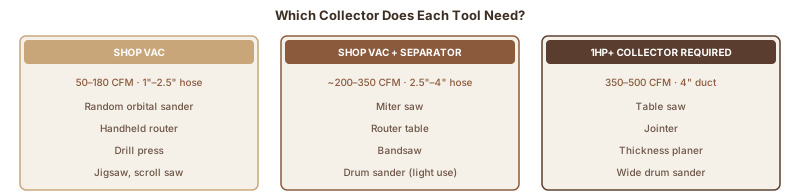
The miter saw caveat: even with 350–400 CFM through the 2.5" port, the blade guard geometry blocks most dust from reaching the collection port. You'll capture roughly 50–60% of the dust a miter saw generates regardless of CFM. A rear hood addition captures the rest.
Step 2: Account for Ductwork Losses
Nameplate CFM on any collector is measured at the inlet with no duct attached. Your actual delivered CFM is lower. For a 1.5HP collector rated 800 CFM:
| System Configuration | Delivered CFM at Tool |
|---|---|
| 10 ft rigid pipe + 1 elbow | ~650 |
| 20 ft rigid pipe + 2 elbows | ~500 |
| 30 ft rigid pipe + 3 elbows | ~400 |
| Each 6 ft of flex hose added | subtract ~15–20% |
A 1.5HP collector delivering 400–500 CFM at the tool handles most home shop single-tool operation.
Step 3: Size Your Ductwork
Match duct diameter to required CFM:
| Required CFM | Minimum Duct Diameter |
|---|---|
| ~130 | 2.5" |
| ~350 | 4" |
| ~545 | 5" |
| ~785 | 6" |
Run your main trunk one diameter size larger than the biggest branch. If all machines use 4" drops, run a 5" or 6" main trunk. This prevents the trunk from becoming the bottleneck.
Step 4: Route with Minimal Resistance
Every 90° elbow costs the equivalent of 5–6 feet of straight pipe. Replace them with two 45° wye fittings wherever the run allows. Branch off the main trunk with 45° wyes, not T-fittings. T-fittings create turbulence that kills separation efficiency.
Place one blast gate per machine branch at the trunk junction, not at the tool. Keep all gates closed except the active machine. This concentrates your available CFM rather than splitting it across idle branches. If you're using directional commercial blast gates, check the arrow markings: installed backward, they leak constantly.
Part 6: Five Mistakes That Kill DIY Systems
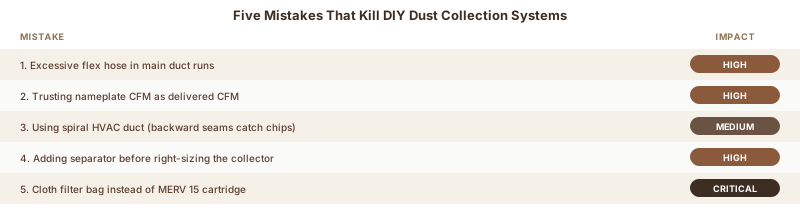
1. Excessive flex hose. Corrugated flex hose generates up to three times the resistance of smooth rigid pipe per foot. Ten feet of flex is equivalent to 30 feet of rigid pipe in static pressure loss. Limit flex to 3–6 feet at each tool connection. Run rigid PVC everywhere else.
2. Believing the nameplate CFM. A collector rated 1,200 CFM delivers 350–400 CFM at the tool through 20 feet of 4" duct with a separator and filter in line. A 1.5HP unit through just 4" piping delivers 400–600 CFM. Size based on delivered CFM, not the number on the box.
3. Using HVAC duct. Spiral HVAC duct has backward-facing seams on the interior. Chips catch on those seams and build up until they block the duct. Use smooth-interior PVC sewer/drain pipe or purpose-made steel dust collection duct.
4. Adding a separator to an undersized system. A Thien baffle costs you 48% of your airflow. A cyclone separator costs 24%. If your collector is already marginal, delivering just enough CFM for chip collection, adding a separator makes the whole system worse. Upgrade the collector first, then add the separator.
5. Wrong filter specification. Standard cloth bags let through particles below 5–30 µm. That's the exact particle size range that causes serious lung disease. A cartridge filter rated MERV 15 or higher captures particles down to 0.3–0.5 µm. Wynn Environmental makes cartridge filter upgrades for most common 1–2HP dust collectors for $50–$80. This is the highest-impact health improvement you can make to an existing system. It matters more than the separator.
Part 7: Complete System Costs
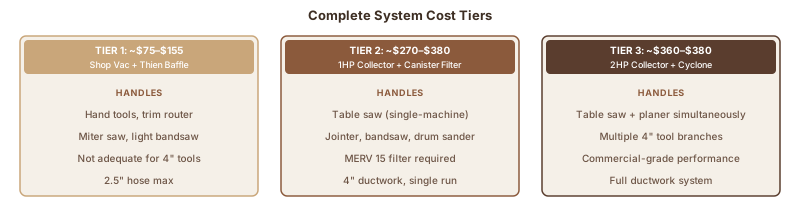
Tier 1: ~$100 — Shop Vac + Thien Baffle
| Component | Cost |
|---|---|
| Shop vac (existing or used) | $0–$60 |
| DIY Thien baffle separator | $8–$36 |
| 6–10 ft 2.5" hose | $15–$25 |
| Blast gates (2–3 DIY or plastic) | $0–$25 |
| PVC fittings | $10–$20 |
| Total | ~$75–$155 |
Handles hand tools, miter saw, and light router work. Not adequate for table saw, jointer, or planer. The shop vac CFM (100–180 CFM) can't serve stationary 4" tools regardless of the separator.
Tier 2: ~$270–$380 — 1HP Collector + Drum Separator + Canister Filter
| Component | Cost |
|---|---|
| Harbor Freight 1HP Central Machinery collector | ~$130 |
| DIY Thien baffle on 30-gal metal trash can | $25–$40 |
| 4" flexible hose (10 ft) | $20–$30 |
| Blast gates (3–4) | $24–$60 |
| 4" PVC sewer pipe + wye fittings | $20–$40 |
| Wynn Environmental MERV 15 canister filter | $50–$80 |
| Total | ~$270–$380 |
Handles table saw, jointer, and bandsaw at single-tool use. The canister filter upgrade is the critical component in this tier. Without it, you're doing chip collection, not dust control.
Tier 3: ~$360–$380 — Commercial 2HP + Dust Deputy
| Component | Cost |
|---|---|
| Harbor Freight 2HP 35-gal dust collector | ~$250 |
| Oneida Dust Deputy Deluxe kit | $79 |
| 4" hose upgrade | $30–$50 |
| Total | ~$360–$380 |
Commercial-grade two-stage performance. Handles table saw and 12–13" planer simultaneously. The filter stays clean dramatically longer with the cyclone upstream. This is the practical ceiling for DIY-assembled systems before custom ductwork adds further cost.
When to Upgrade from DIY to Commercial
A dedicated collector motor and impeller rarely make sense as a DIY build — a Harbor Freight 2HP collector ($250) costs less than fabricating an equivalent from scratch. DIY makes sense for separators, ductwork, and blast gates.
Upgrade when your primary tool draws more than 75% of your delivered CFM. A 12" planer pulling 450 CFM from a collector delivering 600 CFM at the tool leaves 150 CFM reserve. That's not enough headroom for filter loading or any secondary demand.
For shops over 400 sq ft with multiple stationary tools, or production work above 10 hours per week, a fixed ductwork system with a 2HP+ collector becomes cost-effective compared to moving hoses between machines.
Part 8: Maintaining What You Built
| Task | Frequency | How |
|---|---|---|
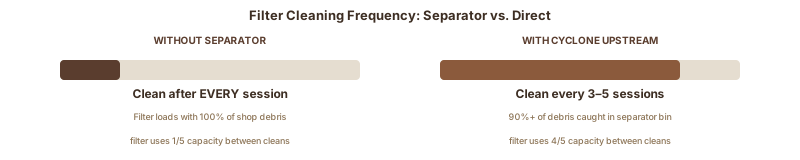
| Filter cleaning | After every session | Compressed air from outside, nozzle 2"+ from media |
| With cyclone separator | Every 3–5 sessions | Filter loads far slower with 90%+ of debris caught upstream |
| Separator emptying | When 2/3–3/4 full | Weekly for 4–8 hr/week shops |
| Filter replacement | When cleaning stops restoring suction | 3–5 years typical for cartridge in a home shop |
| Flex hose inspection | Every 3–6 months | Check for cracks and loose clamps |
| PVC tape joints | Annually | Tape adhesive ages; seams open seasonally |
| Blast gate cleaning | Every few sessions | Clear dust from gate slots; stuck gates = leaking branches |
The simplest suction check: hold your hand at the tool port with the gate open. A noticeable drop from your usual baseline means the filter needs cleaning or the separator is getting full. If you want a gauge rather than a hand, a $15–$25 magnehelic differential pressure gauge on the filter housing removes the guesswork. At 6" WC or above, clean the filter.
Sources
Research for this guide drew on engineering documentation, independent test data, manufacturer specifications, and documented DIY builds. Primary sources:
- J. Phil Thien — Cyclone Separator Baffle — baffle geometry specifications (inventor's own documentation)
- Bill Pentz — Cyclone and Dust Collection Research — health effects, CFM principles, 800 CFM fine dust threshold
- OSHA Wood Dust eTool — exposure limits and health effects
- IARC Monograph Vol. 62 — Group 1 carcinogen classification for wood dust
- YouCanMakeThisToo — Thien vs. Cyclone Test — 837/439/634 CFM anemometer data
- ShopHacks — Dust Deputy vs. Dustopper — controlled fine dust separation test
- Woodgears.ca — Hose Effects — empirical flex hose CFM loss measurements
- Oneida Air Systems — static pressure loss data by component and diameter
- Nathan Darnell — $8 Bucket Build — detailed $8.04 Thien baffle build documentation
- Ettowoodworking — $36 Cyclone Build — 90% chip separation on a $36 build
- Stumpy Nubs — Dust Collection Mistakes — common mistake analysis
- Wynn Environmental — Woodworking Filters — MERV 15 filter recommendations and cartridge upgrade guidance
- Woodworking Calculators — System Guide — tool-by-tool CFM table
- Harbor Freight 1HP Dust Collector — current pricing reference
- Harbor Freight 2HP Dust Collector — current pricing reference
- Oneida Dust Deputy Deluxe — current pricing and specs
- Grizzly G1028Z2 — commercial collector reference specs
- Toolstoday — Garage to Pro Guide — upgrade path framework
How We Research
We don't take affiliate revenue or accept review units. Picks come from multi-source research — manufacturer specs, OSHA / EPA / ASTM regs, and long-form practitioner threads — plus Ahmed's hands-on use where relevant. When we recommend something, we explain why.
Up Next
What Filter Does My Shop Vac Need?
WORKSHOP · Beginner