
Router Sled at a Glance
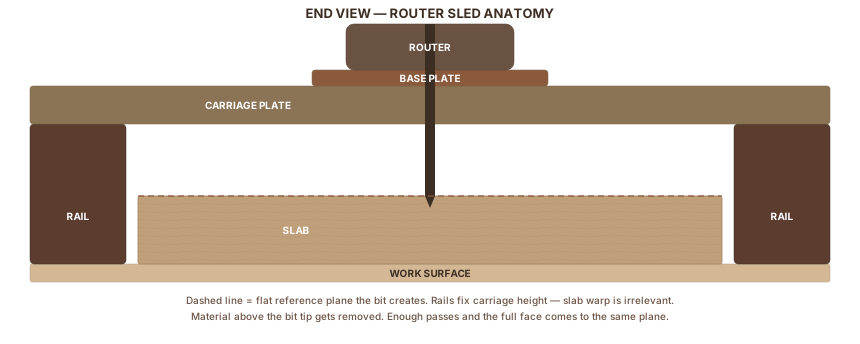
A router sled is two parallel rails at equal height on either side of your workpiece, with a carriage that holds a router above it. Because the router travels at a fixed height, anything taller than the bit gets cut down. Make enough overlapping passes and the whole face is flat — no matter how wide the slab or how bad the warp.
You need one when your board is too wide for your planer, too warped for your jointer, or too figured for a hand plane.
| Cost to build | $30–$50 (wood rails) or $100–$150 (aluminum) |
| Build time | 3–4 hours |
| Min. router HP | 1.75 HP (with 1" bit); 2 HP recommended |
| Recommended bit | 1.5" diameter, 1/2" shank surfacing bit |
| Depth per pass | 1/16"–1/8" in hardwood; up to 3/16" in softwood |
| Max slab width | Unlimited — determined only by your rail length |
In this guide:
- Why you need one — and when you don't
- Build the sled
- Router and bit setup
- Secure your slab
- Make the passes
- Troubleshooting
How to Use This Guide
You have a slab and a router. This guide gets you from both to a flat face.
If you want to understand what a sled does: Start at Part 1. It covers when the sled beats your other options and — just as important — when it doesn't.
If you're ready to build: Jump to Part 2. The build takes 3–4 hours and costs $30–$50 in materials.
If you already have a sled: Skip to Part 3 (router setup) or Part 4 (workholding). Most sled problems trace back to one of those two areas.
If something went wrong: Part 6 is a symptom-first troubleshooting table.
Part 1: What a Router Sled Does (and When to Skip It)
The mechanism
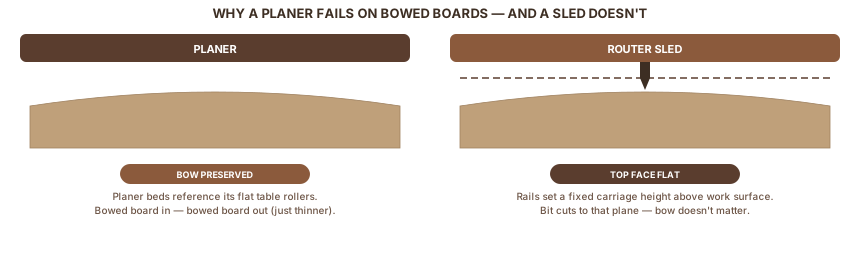
Two rails sit on either side of your slab at a fixed, equal height. A carriage rides on those rails and holds your router with the bit pointing down. Because the rails set the bit height — not the slab — anything taller than the bit gets cut. Move the carriage across in overlapping passes and the whole face comes to the same plane.
A router cuts by rotating through wood, not slicing along it. Grain direction is irrelevant. That's why it works on wood that destroys a hand plane.
Four scenarios where the sled wins
1. Board wider than your planer. Most benchtop and contractor planers top out at 12"–15". As the WoodWorkers Guild of America points out, a 22" walnut slab has nowhere to go except a drum sander, a hand plane, or a router sled. The sled is the fastest of the three.
2. Severe warp. Run a bowed board through a planer and you get a thinner bowed board. The planer follows the bottom face of the board — if that face is curved, the planer curves the top face to match. The router sled removes the high spots regardless of the shape underneath. It flattens; the planer thickness-planes.
3. Live-edge slabs. The irregular edges and often-convex bark side mean a live-edge slab can't reference on a jointer and can slide off a planer bed. The sled holds the slab wherever you put it. You control where material comes off.
4. Figured or reversing grain. Bird's-eye, crotch-cut, and highly figured wood tear out badly under a hand plane. The router doesn't slice along grain — it just rotates through wood. Grain direction is irrelevant.
When to use something else
The sled is overkill if:
- The board is under 10"–12" wide. A hand plane or jointer is faster with less setup.
- The warp is under 1/8". A belt sander or cabinet scraper is faster.
- The board fits your planer and jointer. Those tools are faster and produce a cleaner surface than a router sled.
- You need a finished surface. The router leaves circular marks that need sanding — 80 grit to get through the marks, then 120 and 180 before finishing.
The standard workflow
Router sled flattens Face 1. Thickness planer runs Face 2 parallel to Face 1. Hand planes or a random-orbit sander clean up the router marks. The sled is a dimensioning tool, not a finish tool.
Part 2: Build the Sled
There are four main designs. The simple bar sled is the one to build first. Two rails, one carriage, done.
Choosing your rail material
Rails are the most critical part of the build. Any bow or flex transfers directly to your slab surface. If the rail sags 1/16" at mid-span, you get a 1/16" ridge running across the middle of every slab you flatten with it. MW Woodworks' router sled plans make this clear: rail flatness is what separates a sled that works from one that doesn't.
| Rail material | Practical max span | Approx. cost (pair) | Notes |
|---|---|---|---|
| Aluminum T-slot extrusion | 10+ ft | $80–$120 | Zero deflection at any reasonable span; best choice |
| Hard maple or ash (8/4, jointed flat) | 4 ft | $20–$35 | Good for most applications; check before each use |
| 3/4" plywood (glued up to 4" wide) | 4 ft | $10–$20 | Budget option; check for seasonal movement |
| MDF | Not recommended | — | Absorbs moisture and warps; never use for rails |
For a first sled, hard maple or ash rails up to 4 ft work well for most slab projects. If you're flattening slabs over 4 ft long, step up to aluminum.
Materials (for a general-purpose sled, handles slabs up to 24" wide × 48" long)
Rails:
- 2 pieces of 8/4 hard maple or ash, jointed flat, 6–8 ft long
- OR 2 pieces of aluminum T-slot extrusion, same length
Carriage:
- 1 piece 3/4" plywood, approximately 24" × 18"
- 2 runner strips of 3/4" plywood, sized to ride on the rail tops
Hardware:
- Pocket screws or drywall screws
- Paste wax (critical — apply to all contact surfaces)
Total cost: $30–$50 in materials for the wood version. A weekend afternoon to build.
Build sequence
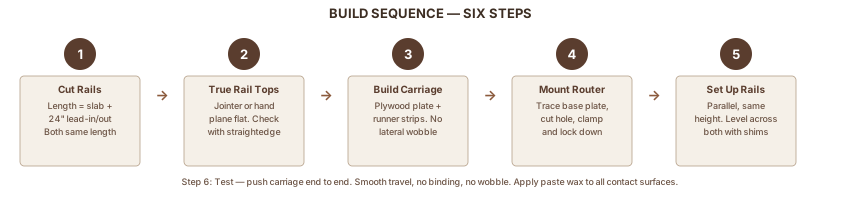
Step 1: Cut rails to length. Rail length = the longest workpiece you plan to flatten, plus 24". That 24" gives you 12" of lead-in and 12" of lead-out on each end — you need room to start and stop the pass before the carriage reaches the slab. Both rails must be exactly the same length.
Step 2: True the rail tops. Run the top edge of each rail across a jointer, or hand-plane it flat. Check with a reliable 48"+ straightedge: you're looking for zero daylight between the straightedge and the rail. This step determines the quality of every slab you flatten with this jig. Spend extra time here. Apply paste wax to the rail tops when done.
Step 3: Build the carriage. Cut the carriage plate wide enough to span both rails with a 2" overhang on each side. Rip two runner strips from 3/4" stock to ride on the rail tops. Test the fit: the runners should slide smoothly with no lateral play. Glue and screw the runners to the underside of the carriage, checking that the carriage travels straight with no wobble.
Step 4: Mount the router. Trace your router's base plate onto the carriage. Cut the hole. The router should drop in and sit flat on the carriage surface. Most builders clamp the base plate to the carriage and add a locking screw through the side to keep it from rotating during use.
Step 5: Set up the rails. Lay both rails parallel on a flat surface, spaced so the carriage overhangs each by 2". Check that both rails are at the same height. Lay a long level or straightedge across both rails — if the carriage rocks, one rail is low. Shim the low rail until it reads level.
Step 6: Test before you cut. Install the router, push the carriage end to end. It should travel smoothly with no binding and no lateral wobble. Apply paste wax to any point where the runners contact the rails.
Part 3: Router and Bit Setup
Which router you need
If you own a 2–2.25 HP router — a Porter-Cable 7518, Bosch 1617, or DeWalt 618 — you're ready. Don't buy a router for this project. The router you own will work.
| Router class | HP | Max bit diameter | Passes per 24" slab |
|---|---|---|---|
| Compact/trim router | 1–1.25 HP | Not recommended | — |
| Mid-size router | 1.5–1.75 HP | 1" | 20–25 |
| Full-size router | 2–2.25 HP | 1.5" | 12–15 |
| Heavy-duty router | 3+ HP | 2"+ | 8–10 |
A plunge router makes depth adjustment easier between passes. A fixed-base router works fine — just adjust with a depth-ring.
The surfacing bit
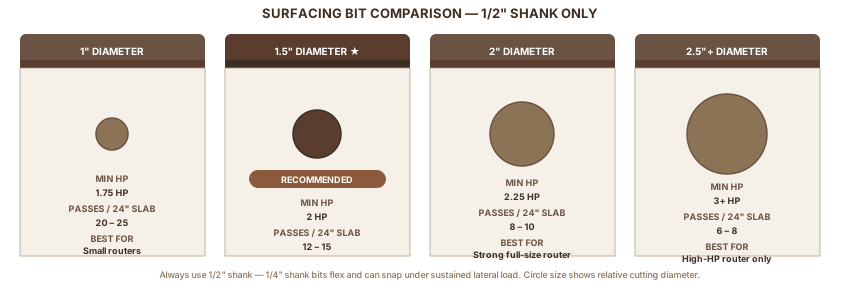
Use a flat-bottom surfacing bit, also called a spoilboard cutter or slab-flattening bit. Always use a 1/2" shank. A 1/4" shank bit can flex and snap under the sustained lateral load of slab work — it's not about router power, it's about shank rigidity.
The 1.5" diameter is the practical sweet spot. It covers 12–15 passes across a 24" slab with a 2–2.25 HP router. The Amana Tool RC-2250 (1.5" diameter, 1/2" shank, indexable carbide inserts) is a reliable specific choice. Freud and Whiteside make comparable bits. Community consensus from Router Forums and LumberJocks consistently lands on 1.5" as the right size for general slab work.
| Diameter | Min. HP | Passes per 24" slab | Notes |
|---|---|---|---|
| 1" | 1.75 HP | 20–25 | Works with smaller routers; slow going |
| 1.5" | 2 HP | 12–15 | Best balance of speed and load |
| 2" | 2.25 HP | 8–10 | Faster; needs a strong router |
| 2.5"+ | 3+ HP | 6–8 | CNC-style; efficient but demanding |
Speed and depth settings
RPM: Follow the bit manufacturer's spec. For 1–1.5" bits, this is typically 18,000–22,000 RPM. Larger bits need lower RPM — more diameter means more peripheral speed at the same RPM.
Depth per pass:
- Hardwoods (oak, walnut, maple): start at 1/16". Max 1/8" once you know your setup.
- Softwoods (pine, fir, cedar): up to 3/16" with a sharp bit.
- If the motor bogs down or the bit chatters, reduce depth immediately.
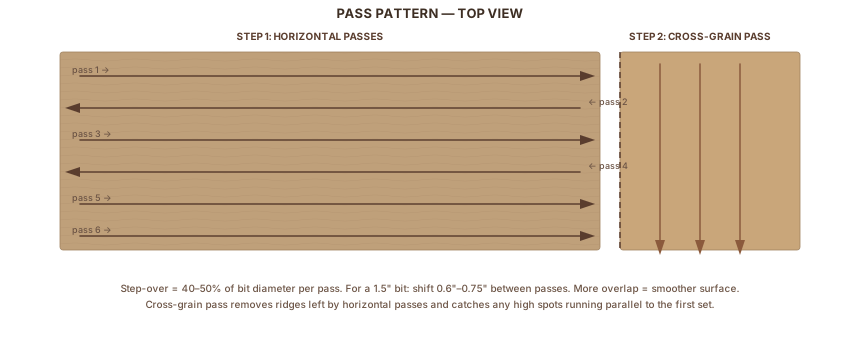
Step-over: 40%–50% of the bit diameter. For a 1.5" bit, that's 0.6"–0.75" of lateral shift between passes. More overlap means a smoother surface but more time.
Part 4: Securing the Slab
This is where most first attempts go wrong. The router doesn't know the slab moved — it just cuts whatever's under it. A slab that shifts 1/16" during a pass leaves a visible step.
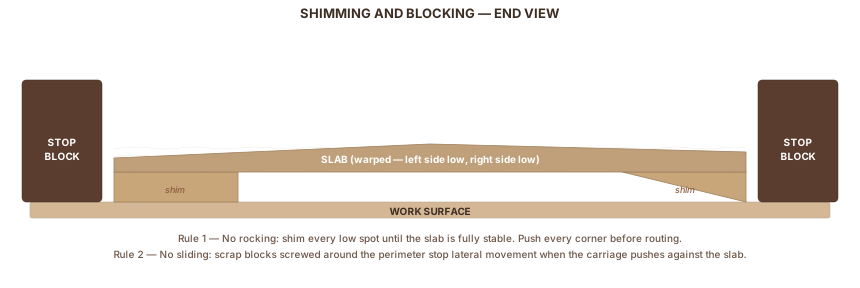
Two rules:
- The slab cannot rock.
- The slab cannot slide laterally.
For boards with cup, bow, or twist
Orient the cupped face up. If the board cups like a bowl (concave center), face that side up — the router addresses the high edges first. If the board bows like a bridge (high center), face the arch up.
Place the board on a flat surface. It will rock on the high spots. Slip shims under every low spot — MDF scraps, folded cardboard, or commercial wedges — until the board is completely stable. Then block around all four sides with scraps to prevent lateral movement. Test by pushing hard on every corner and edge: nothing should move.
For live-edge slabs
Live-edge slabs need more care because the bottom is rarely flat.
- Set the slab on your work surface with the roughest face up. Rock it to find every contact point.
- Slip shims under every low spot until the slab is fully stable and no longer rocks. Every low corner needs support — four-point contact is the minimum; most slabs need more.
- Build a blocking frame around the perimeter — scrap pieces screwed to a sacrificial base or MDF sheet. These stop the slab from sliding when the carriage pushes against it.
- Push hard on every edge and corner by hand. If anything moves, add more blocking or shims.
- For bark edges that are fragile: stop the router 1/4" short of the bark. Clean the transition with a chisel or hand plane.
The shimming step is what beginners most often skip. According to Infinity Tools' slab flattening guide, it's why a first slab comes out with a hump or an uneven patch in one corner.
Part 5: Making the Passes
Setting bit depth
Lower the bit to just touch the highest point of the slab. Lock the depth. Then lower an additional 1/16" — that's your first pass depth. Don't set it deeper until you've seen how your router handles the load.
The pass sequence
Start at one end of the slab and push the carriage across at a steady 1"–2" per second. Never stop with the bit spinning — a pause leaves a burn mark or a divot. At the far end, lift the router (or lock the plunge on a plunge router), shift the carriage laterally by 40%–50% of the bit diameter, and repeat in the opposite direction.
After covering the full face in one direction, rotate the sled 90° and make a cross-grain pass at the same depth. This removes the ridges left by the first set of passes and catches any high spots that ran parallel to your initial direction.
Checking progress
After each full pass sequence, mark high spots with a pencil — draw circles around them. Lower the bit 1/16" and re-pass only the areas that still need material. Check across all corners with winding sticks. When the winding sticks read flat (no twist visible), you're done.
The final pass: set the bit to 1/32" depth, full coverage, maximum overlap. This is the finish pass that clears any remaining ridges before you move to sanding.
Part 6: Troubleshooting
| Problem | Most likely cause | Fix |
|---|---|---|
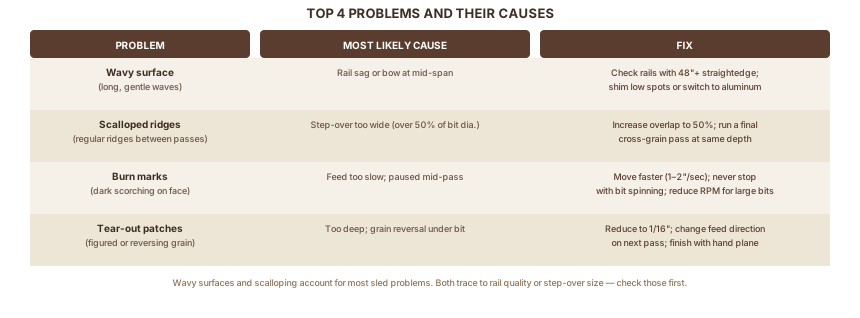
| Wavy surface (long, gentle waves) | Rail sag or bow at mid-span | Check rails with a 48"+ straightedge; shim low spots or replace with aluminum |
| Scalloped surface (regular ridges between passes) | Step-over too large | Increase overlap to 50%; run a final cross-grain pass |
| Chatter marks (short corrugated ridges) | Too deep; dull bit; RPM too low | Reduce to 1/16"; replace bit if used 10+ hours on hardwood; increase RPM |
| Burn marks | Feed too slow; paused mid-pass | Move faster; never stop; reduce RPM for large-diameter bits |
| Router bit won't reach slab | Rails too tall for slab thickness | Extend bit further from router base; lower rail setup |
| Slab moves mid-pass | Insufficient blocking or shimming | Add perimeter blocking; secure all shims; use non-slip mat |
| Tear-out in patches | Reversing grain; too deep | Reduce to 1/16"; change feed direction on next pass; clean up with a hand plane |
The Sawmill Creek forums troubleshooting threads show that wavy surfaces and scalloping account for most sled problems. Both trace back to rail quality or step-over size.
Quick Reference
Router bit selection
| Bit diameter | Minimum router HP | Passes per 24" slab |
|---|---|---|
| 1" | 1.75 HP | 20–25 |
| 1.5" | 2 HP | 12–15 |
| 2" | 2.25 HP | 8–10 |
| 2.5"+ | 3+ HP | 6–8 |
Rail material selection
| Material | Max span | Cost (pair, 8 ft) | Notes |
|---|---|---|---|
| Aluminum T-slot extrusion | 10+ ft | $80–$120 | Best choice; zero deflection |
| Hard maple or ash (8/4, jointed) | 4 ft | $20–$35 | Good for most slabs; check before use |
| 3/4" plywood (glued up) | 4 ft | $10–$20 | Budget option; watch for seasonal movement |
| MDF | Avoid | — | Warp-prone; don't use for rails |
Sources
Research drew on build tutorials, community forums, and manufacturer documentation. Sources listed in order of first appearance in the guide.
- WoodWorkers Guild of America — Flatten Wood Slabs with a Router — planer capacity limits, sled fundamentals
- MW Woodworks — How to Make a Router Sled — rail flatness, build steps, material list
- Amana Tool RC-2250 — 1.5" surfacing bit specifications
- Router Forums — Slab Flattening Sled and Router Bit — bit selection community consensus
- LumberJocks — Recommended Router Bit thread — experienced practitioners on bit choice
- Infinity Tools — How to Flatten a Slab — live-edge workholding and shimming
- Sawmill Creek — Router Planing Sled Problems thread — real-world troubleshooting cases
Tagged
How We Research
We don't take affiliate revenue or accept review units. Picks come from multi-source research — manufacturer specs, OSHA / EPA / ASTM regs, and long-form practitioner threads — plus Ahmed's hands-on use where relevant. When we recommend something, we explain why.
Up Next
Flush-Trim Bits vs Guide Bushings: Which Wins?
POWER TOOLS · Beginner