
MDF at a Glance
MDF (Medium Density Fiberboard) is an engineered panel made from wood fibers and urea-formaldehyde resin, heat-pressed into smooth, uniform sheets that run 40–50% less than plywood and machine to crisp, paint-ready surfaces without grain telegraphing through. A standard 3/4-in. 4×8 sheet weighs roughly 97 lb — about 30% more than comparable plywood — so plan for extra support in shelving and cabinets. Raw edges are porous and demand two or three coats of shellac-based primer before topcoating. The one hard limit: any sustained moisture exposure swells the core and destroys structural integrity, making MDF a poor choice for exterior or high-humidity applications.
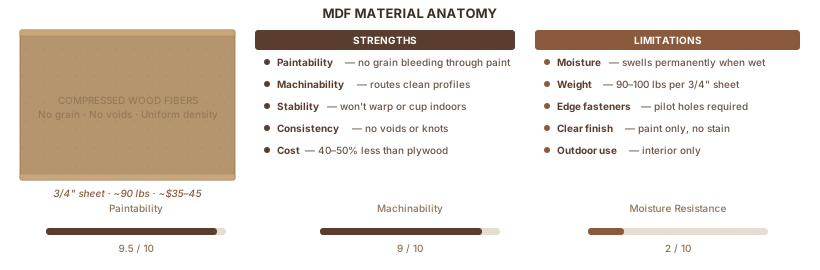
| What it is | Wood fibers + adhesive, compressed into uniform panels |
| Density | 600-800 kg/m³ (37-50 lb/ft³) |
| Best for | Painted cabinets, shelves, wall panels, shop jigs |
| Avoid for | Outdoor projects, moisture exposure, clear finishes |
| Cost | ~$35-45 per 3/4" 4x8 sheet (vs. $60-80 for birch plywood) |
| Key rule | Always prime before painting. Always seal the edges. |
In this guide:
- How MDF is made and why that matters for your project
- Properties compared to plywood, particle board, and solid wood
- Which grade to buy and what's available at the store
- When to choose MDF and when to skip it
- How to finish MDF so it looks professional
Part 1: How MDF Is Made
MDF isn't sawdust glued together. That's particle board. MDF uses individual wood fibers refined to the consistency of cotton, then compressed under heat and pressure with adhesive resin. The fiber structure is what gives MDF its smooth surface, consistent density, and ability to hold a routed profile without chipping.

The process starts with softwood residuals: chips and shavings left over from sawmills. Mills steam these and feed them through a defibrator that separates individual wood fibers. Workers blend the fibers with adhesive resin (about 8-15% by weight) and wax, spread the mixture into a mat, and hot-press it at 150-200°C (300-390°F) and 200-300 PSI. After pressing, the panels cool, get sanded smooth on both faces, and cut to standard sheet sizes.
The result is a panel with no grain direction, no knots, no voids, and consistent density from face to face. Solid wood has grain that runs one direction and properties that change depending on which way you cut. Plywood alternates grain direction across layers but still has face grain. MDF has none of that. It machines the same in every direction.
Most MDF uses urea-formaldehyde (UF) adhesive, the cheapest option. Since 2018, all MDF sold in the US must meet EPA TSCA Title VI formaldehyde emission limits. Some manufacturers use polymeric MDI (pMDI) adhesive instead, which contains no formaldehyde at all. These panels carry a NAF (No Added Formaldehyde) label and cost more.
MDF first hit commercial production in the 1960s as a way to turn sawmill waste into usable panels. Today it's one of the most widely produced engineered wood products in the world.
Part 2: MDF vs Plywood, Particle Board, and Solid Wood
Every sheet good has trade-offs. This table shows where MDF fits.
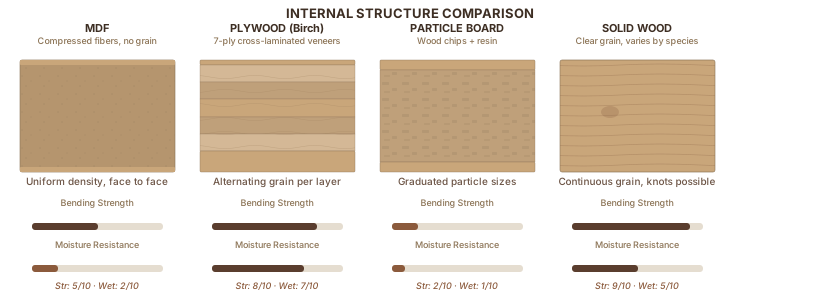
| Property | MDF | Plywood (Birch) | Particle Board | Solid Wood |
|---|---|---|---|---|
| Density | 600-800 kg/m³ | 400-700 kg/m³ | 500-700 kg/m³ | Varies (350-900) |
| Bending strength (MOR) | 28-80 MPa | 40-70 MPa | 11-20 MPa | 40-130 MPa |
| Stiffness (MOE) | 2,500-5,000 MPa | 7,000-12,000 MPa | 1,500-3,500 MPa | 8,000-14,000 MPa |
| Moisture resistance | Poor | Good (exterior grades) | Very poor | Moderate |
| Screw holding (face) | Fair | Good | Fair | Very good |
| Screw holding (edge) | Poor | Very good | Very poor | Good |
| Surface smoothness | Excellent | Good (shows grain) | Rough | Shows grain |
| Dimensional stability | Excellent | Good | Good | Poor (seasonal) |
| Machinability | Excellent | Good | Fair | Varies |
| Cost (3/4" 4x8) | ~$35-45 | ~$60-80 | ~$25-35 | $$$+ |
| Paintability | Excellent | Good | Fair | Good |
Where MDF wins: Surface smoothness, paintability, machinability, dimensional stability, and cost. If you're building something that gets painted, MDF is hard to beat. It won't warp, won't show grain through the paint, and routes cleanly for panel profiles.
Where plywood wins: Strength, stiffness, moisture resistance, and screw holding. For structural shelving, anything near water, or projects where you need reliable fastener grip in the edges, plywood is the better choice.
Where particle board fits: Budget projects where appearance doesn't matter. It's the cheapest option but the weakest and most moisture-sensitive. Most flat-pack furniture uses particle board with a melamine or veneer surface.
Where solid wood wins: Natural beauty, refinishability, and structural strength. If you want visible wood grain, a piece you can sand and refinish in 20 years, or something heirloom-quality, solid wood is the right call. It costs more and moves seasonally, but nothing else looks or feels like real wood.
Part 3: MDF Grades and Types
Not all MDF is the same. Walk into Home Depot or Lowes and you'll find standard MDF in 1/4", 1/2", and 3/4" thicknesses, all in 4x8 sheets. But specialty grades exist for specific applications.
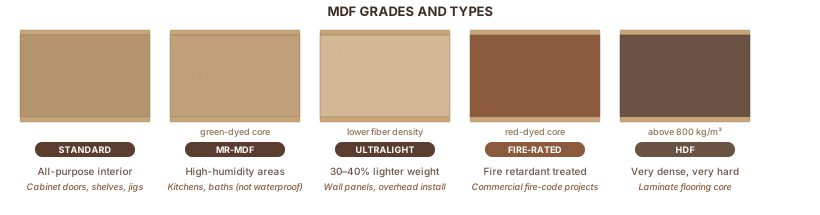
Standard MDF is the workhorse. Interior use, general purpose. This is what you'll grab for cabinet doors, shelves, and jigs. It's the cheapest grade and the most widely available.
Moisture-resistant MDF (MR-MDF) has a green-dyed core so you can identify it. Wax and melamine additives reduce moisture absorption. Use it in kitchens and bathrooms where humidity is higher, but don't confuse "moisture-resistant" with "waterproof." Submerge it and it'll swell like standard MDF. It handles humidity better, not standing water.
Ultralight MDF weighs 30-40% less than standard. The density drops to about 500-600 kg/m³, which makes it easier to handle for wall panels and overhead installations. Trade-off: it's slightly weaker and doesn't hold fasteners quite as well.
Fire-rated MDF has a red-dyed core and is treated with fire retardants. You'll need this for commercial projects where building codes require fire-rated materials. Not something most home woodworkers will encounter.
HDF (High Density Fiberboard) is the dense cousin, above 800 kg/m³. You've walked on it. It's the core material under most laminate flooring. Very hard surface. Not commonly sold as sheet goods for woodworking.
What's Available and What It Costs
| Thickness | Common Uses | Approx. Price (4x8 sheet) |
|---|---|---|
| 1/4" (6mm) | Drawer bottoms, backing panels, templates | $15-20 |
| 1/2" (12mm) | Wall panels, cabinet backs, lighter shelves | $25-35 |
| 3/4" (18mm) | Cabinet doors, shelving, furniture panels | $35-45 |
For comparison, a 3/4" 4x8 sheet of birch plywood runs $60-80 at the same stores. MDF gives you 40-50% more material for your money. That adds up fast on a bookcase or a set of cabinet doors.
Part 4: When MDF Makes Sense and When It Doesn't
MDF isn't cheap junk and it isn't a miracle panel. It's a budget-smart material with real limitations. Knowing both sides lets you pick it confidently when it fits and skip it when it doesn't.
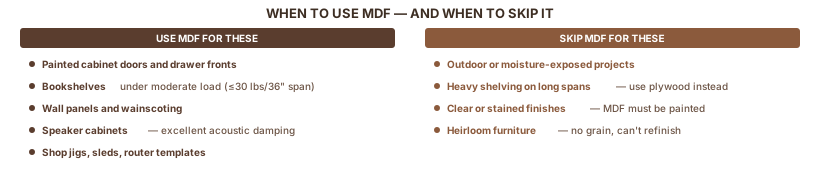
Use MDF for These Projects
Painted cabinet doors and drawer fronts. This is MDF's best application. It won't warp across the door like solid wood can, takes paint beautifully, and profiles cleanly for raised-panel or Shaker-style doors. Professional cabinet shops use MDF for painted doors all the time.
Bookshelves and shelving units. For painted shelves under moderate loads, MDF works well. It's flat, stable, and affordable. On a 36" span with 3/4" MDF, keep the load under about 30 pounds to avoid noticeable sag over time. For heavy book collections, plywood is the better pick.
Wall panels and wainscoting. MDF machines into clean, consistent panel profiles. It's dimensionally stable, so it won't gap or buckle with seasonal humidity changes the way solid wood paneling can.
Speaker cabinets. MDF's density gives it excellent acoustic damping properties. The material absorbs vibration instead of resonating. Most commercial speaker enclosures use MDF.
Shop jigs and router templates. Flat, stable, cheap, and replaceable. MDF makes excellent crosscut sleds, router templates, and assembly jigs. When a jig wears out, make another one for a few dollars.
Prototyping. Building something for the first time? Mock it up in MDF. Work out the dimensions and proportions before committing to expensive hardwood.
Skip MDF for These
Outdoor or moisture-exposed projects. MDF swells irreversibly when it gets wet. A wet edge balloons to twice its thickness and won't go back. Even MR-MDF can't handle standing water or rain. Use treated lumber, cedar, or marine-grade plywood instead.
Heavy loads on long spans. MDF sags more than plywood under sustained weight. For a bookshelf carrying heavy books across a 4-foot span, use 3/4" plywood or add a center support.
Heirloom furniture. MDF has no natural grain, can't be stained to show figure, and can't be sanded down and refinished the way solid wood can. If the piece is meant to last generations and look like wood, use wood.
Clear or stained finishes. Without grain to show, a clear-coated MDF surface looks flat and shows every surface inconsistency. MDF is meant to be painted.
Part 5: How to Finish MDF
MDF takes paint better than any other sheet good, but only if you prep it right. Skip the prep and the finish fails.
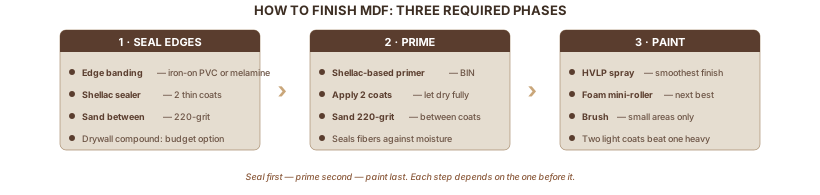
Seal the Edges First
Raw MDF edges are the biggest finishing challenge. The cut edge absorbs liquid like a sponge. Paint, primer, stain all soak in unevenly and leave a rough, swollen mess.
Three ways to handle edges:
Edge banding is the cleanest solution. Iron-on PVC or melamine strips cover the edge completely. Apply with a household iron, trim with a utility knife. Takes five minutes per edge and gives a factory look.
Sanding sealer or shellac works for edges that will be painted. Brush on a coat of shellac (Zinsser SealCoat works), let it dry, sand lightly with 220-grit, and repeat. Two coats seals the edge enough for paint.
Drywall compound is a budget option. Spread a thin layer of lightweight joint compound over the edge, let it dry, sand smooth. The compound fills the porous fiber structure. It works, but takes more sanding than shellac.
Prime Before You Paint
MDF is porous. If you paint directly on bare MDF, the surface drinks the first coat, the finish looks uneven, and the fibers raise slightly and feel rough.
Shellac-based primer like Zinsser BIN is the gold standard for MDF. It seals the porous surface, blocks moisture from raising fibers, and dries fast. Apply two coats, sanding lightly with 220-grit between coats. The second coat should feel smooth and uniform.
PVA-based primers work too, but shellac-based dries faster and seals more completely. If you're doing a lot of MDF work, keep a can of BIN in the shop.
Paint for a Professional Finish
After priming, MDF takes paint beautifully. The surface is so smooth that properly primed and painted MDF looks factory-finished.
Spray gives the smoothest result. An HVLP sprayer or rattle-can enamel creates an even coat with no brush marks. Two light coats beat one heavy coat.
Roller with a foam mini-roller (4" or 6") is the next best option. Foam rollers leave minimal texture on smooth surfaces. Roll in one direction.
Brush works for small areas and edges but leaves slight brush marks on large flat panels. Use a quality brush and thin the paint slightly if brush marks bother you.
Both latex and oil-based paints work on primed MDF. Latex is easier to clean up. Oil-based gives a slightly harder, more durable finish for cabinets and high-use surfaces.
Why Clear Finishes Don't Work
MDF has no grain. A clear polyurethane or lacquer coat on MDF shows every surface inconsistency, roller mark, and fiber pattern. The result looks like coated cardboard, not wood. If you want a natural wood look, use plywood or solid wood. MDF is a paint material.
Part 6: Safety: Dust and Formaldehyde
MDF requires the same respiratory protection you'd use with any sheet good, plus two concerns specific to engineered panels.
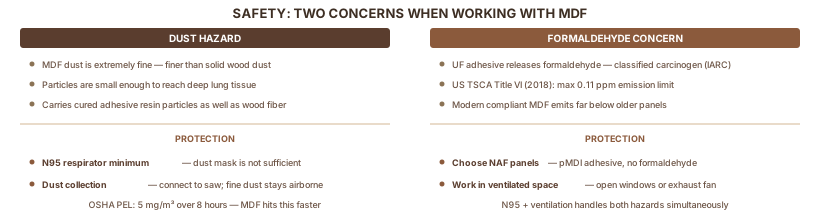
Dust
MDF cutting produces extremely fine dust, finer than what you get from solid wood. The particles are small enough to reach deep into your lungs. The dust also carries fine particles of cured adhesive resin.
Wear an N95 respirator at minimum when cutting, routing, or sanding MDF. A dust mask isn't enough. If you're doing extensive MDF work, connect dust collection to your saw.
OSHA's permissible exposure limit (PEL) for wood dust is 5 mg/m³ over an 8-hour period. MDF dust hits that threshold faster than solid wood dust because the particles are finer and stay airborne longer.
Formaldehyde
Most MDF uses urea-formaldehyde adhesive, and formaldehyde is classified as a known human carcinogen by the International Agency for Research on Cancer (IARC).
Context matters here. Since 2018, all composite wood products sold in the US must meet EPA TSCA Title VI emission limits, which adopted California's strict CARB Phase 2 standards. The limit for MDF is 0.11 ppm. Modern compliant MDF emits formaldehyde at levels far below what older, unregulated panels produced.
If formaldehyde concerns you, look for NAF (No Added Formaldehyde) panels that use pMDI adhesive instead. They cost more but eliminate the concern entirely.
Practical safety: Wear respiratory protection when cutting. Work in a ventilated space. Use dust collection. These precautions protect you from both the dust and any trace formaldehyde released during machining.
Where This Fits

Related guides:
- 3/4" Plywood covers the plywood side of the MDF vs. plywood decision
- Maple vs. Birch Plywood — when hardwood cabinet plywood is the right call over MDF
- Sheet Goods for Cabinets compares material options for cabinet projects
What to learn next:
Once you've chosen MDF for your project, you'll need cutting and finishing skills. Look for guides on cutting sheet goods, edge banding techniques, and painting furniture for professional results.
Sources
- MakeItFrom.com: Medium Density Fiberboard Properties — physical and mechanical property data
- US EPA: Formaldehyde Emission Standards for Composite Wood Products — TSCA Title VI regulatory framework
- California Air Resources Board: ATCM for Composite Wood — CARB Phase 2 emission limits
- Mount Sinai Health System: MDF Safety for Carpenters — occupational health guidance
- Diffen: MDF vs Plywood Comparison — side-by-side material comparison
- Displays2Go: Particle Board vs MDF vs Plywood — three-way comparison data
- Wood and Fiber Science: Mechanical Properties of MDF — density-property relationships
- ResearchGate: MDF Physical and Mechanical Properties — research data tables
- Woodweb: MDF versus Particleboard — technical comparison
- Carbide Processors: Cutting MDF and Plywood — blade selection and cutting guidance
- PMC/NIH: Respiratory Symptoms from MDF Dust Exposure — occupational health study
- Home Depot: MDF Panel Listings — current availability and sizing
Also Referenced
Up Next
1/2 Inch Plywood: Grades, Uses, and How to Choose
WOOD & MATERIALS · Beginner