
How to Use This Guide
Most dining table problems aren't wood problems. They're finish problems. The wood is fine. What's failing is the protective shell on top of it.
This guide walks you from diagnosis through final coat, with specific products, exact numbers, and the reasoning behind each step. You don't need a spray gun or a professional shop. You need a garage or well-ventilated space, some sandpaper, and about a week of evenings and wait times.
If your table is just dull and worn: Jump to Part 1 to confirm it's a scuff-and-recoat, then go straight to Part 5.
If you're stripping it down completely: Read Part 1 through Part 3, then follow Parts 4–5 for stain and finish.
If something went wrong on a previous attempt: Go to Part 6.
Dining Table Refinishing at a Glance
Most dining tables can be refinished in a long weekend plus dry time. The wood itself is almost always fine. Strip the old finish, fix any damage, stain if you want a color change, then apply three coats of oil-based polyurethane. Total project cost runs $75–125 in materials for a first-timer.
| Best strip method | Chemical stripper for veneer and carved details; sanding for flat solid-wood tops |
| Grit progression | 120 → 180 → 220 (bare wood); 220–320 between topcoats |
| Stain dry time | 24–48h (oil-based stain) before first topcoat |
| Topcoat | Oil-based polyurethane, 3 brush-on coats (or 5–6 wipe-on) |
| Between-coat dry | 24h oil-based; 2–3h water-based |
| Full cure | 30 days oil-based; 7–14 days water-based |
In this guide:
- Diagnosing what your table needs
- Getting down to bare wood — strip or sand?
- Fixing water rings, gouges, and veneer problems
- Stain: color selection and application technique
- Applying a durable topcoat
- Troubleshooting sticky finish, bubbles, and blotchy stain
Part 1: Reading What Your Table Is Telling You
Most worn dining tables don't need to be stripped to bare wood. Knowing which intervention yours actually needs saves days of work and protects against over-sanding. On veneer tops, that distinction matters most. You can sand through in seconds.
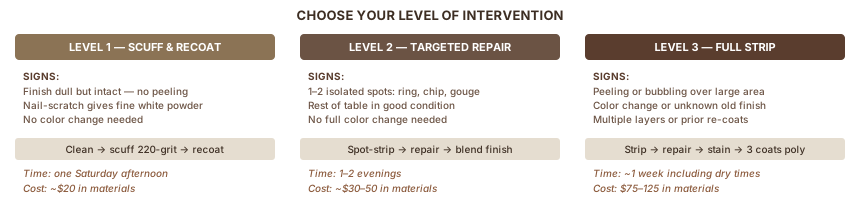
Three Levels of Intervention
Level 1: Scuff and recoat. The finish is dull, maybe slightly scratched, but it's still intact. No peeling, no bare wood showing anywhere. You don't want to change the color. The finish hasn't failed. It's just worn down.
What to do: Clean the surface, scuff sand with 220-grit, and apply a fresh coat of the same finish type. This takes a Saturday afternoon, not a week.
Level 2: Targeted repair. One or two specific problem spots (a white water ring, a small gouge, a patch where the finish chipped off), but the rest of the table is in decent shape.
What to do: Fix the specific damage, spot-strip and re-sand just those areas, and blend in new finish.
Level 3: Full strip to bare wood. The finish is peeling, lifting, or bubbling across more than a small area. You want to change the color. You don't know what's on there and can't guarantee compatibility. Multiple old coats from previous refinishes.
What to do: Chemical strip and sand everything down, repair the wood, and start fresh.
The test for Level 1. Find a hidden spot: the underside of an overhang, or the very edge where legs meet the apron. Scratch it firmly with your fingernail. If the finish comes off as a fine white powder, the film is still intact and Level 1 is viable. If it peels away in sheets or reveals bare wood beneath, you're doing a full strip.
Is It Solid Wood or Veneer?
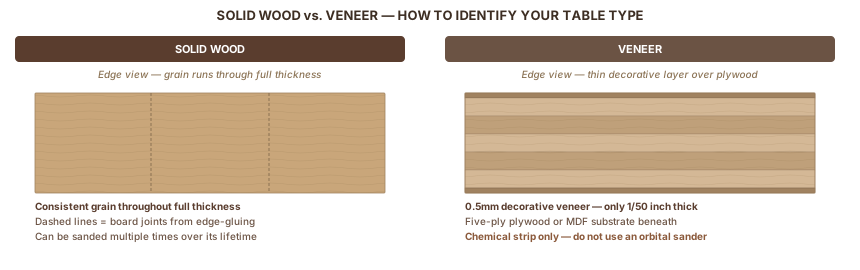
Check the edge where the tabletop meets the apron frame underneath. If you see a thin layer of attractive wood over plywood, MDF, or particleboard, with a distinct glue line between them, it's veneer. If the edge shows natural end grain that matches the top, it's solid wood.
Also check the grain pattern. A dining table top with an impossibly wide, perfectly matched grain pattern that continues identically across the full width is almost certainly veneer. Real solid-wood tops are assembled from multiple boards with visible glue lines.
Why this matters: As Woodworkers Journal notes, modern factory veneer is roughly 0.5mm thick. That's 1/50 of an inch. You can sand through it in seconds with a random orbital sander. Never use a random orbital on veneer. Use chemical stripper and hand-sanding at 120-grit maximum.
Antique furniture (pre-1940s) often has much thicker veneer (3–6mm) that behaves closer to solid wood and can handle more sanding. If your table is a family heirloom or clearly an antique, check the edge closely before deciding.
Identifying the Existing Finish
You need to know what's on there before you refinish over it. Applying a new finish over wax, silicone, or an unknown incompatible base causes adhesion failure and peeling within weeks.
Test on a hidden area (underside of the table). Use a cotton ball dampened with each solvent. Hold it on the surface for 30 seconds and observe. (Fine Woodworking's guide to identifying finishes has the full reference for each finish type.)
| Test solvent | Result | Finish |
|---|---|---|
| Denatured alcohol | Dissolves, gets tacky | Shellac |
| Lacquer thinner | Wipes away cleanly | Lacquer |
| Lacquer thinner | Gets slightly tacky, doesn't wipe | Water-based finish |
| Neither solvent affects it | No change | Oil-based polyurethane or varnish |
If neither solvent does anything, confirm with a blade scrape: use a sharp utility knife blade on a very hidden spot. White or cream-colored plastic-like shavings indicate a film finish (polyurethane, lacquer, or shellac). Nothing comes off = likely a penetrating finish (oil, wax, hardwax oil).
What this tells you about your refinish:
- Shellac: Strips easily with denatured alcohol. New finish (shellac, lacquer, or poly) adheres over shellac.
- Lacquer: Strips with lacquer thinner. Lacquer can go over old lacquer. Polyurethane over lacquer requires an adhesion test.
- Polyurethane or varnish: Can't be re-dissolved. Must be sanded or chemically stripped to bare wood. Once stripped, any finish is compatible.
- Wax or silicone (from years of furniture polish): Must be fully removed with naphtha or mineral spirits before any new finish. This is the most common reason re-coated finishes peel.
Part 2: Getting Down to Bare Wood
Chemical stripping or sanding: the geometry of your table and the condition of the finish should decide.
Chemical Stripping: When and How
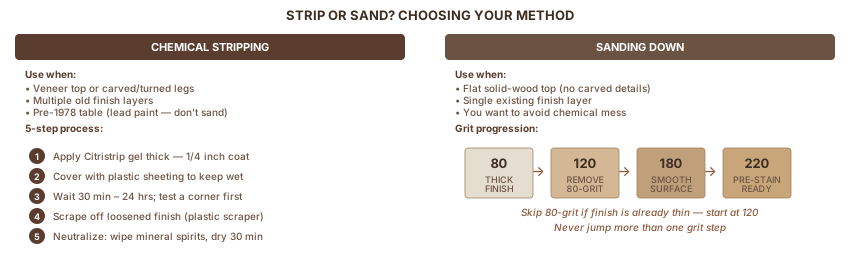
Use chemical stripping when:
- The top is veneer (can't risk sanding through it)
- The legs and apron have carved details, turned elements, or decorative profiles
- There are multiple old finish layers (paint over varnish over stain)
- The table was painted before 1978 (lead paint risk: don't sand it into the air)
- You want to preserve maximum wood material (every sanding pass removes wood; stripping doesn't)
Product: Citristrip Stripping Gel. Available at every hardware store, about $15–20 for a half-gallon. No methylene chloride, no NMP. It uses benzyl alcohol, which is low-VOC and safe for indoor use with proper ventilation. It works slower than old-formula methylene chloride strippers, but those were banned for consumer use by the EPA in 2019.
Application:
- Remove the table legs if possible and work on the top flat. This prevents stripper from running.
- Apply Citristrip with a cheap brush in a thick coat, about 1/4 inch. Don't brush it out thin.
- Cover with plastic sheeting. This keeps the stripper wet and extends its working time dramatically.
- Wait. For a single clear coat: 30–60 minutes. For multiple layers or old paint: 2–4 hours. For thick or stubborn paint: up to 24 hours.
- Test a corner by scraping with a plastic scraper. The finish should lift off easily. If it's still fighting back, cover it again and wait.
- Scrape off the loosened finish. Use a plastic scraper on veneer (metal corners can dig into the soft substrate). Metal scrapers are fine on solid wood.
- For residue in corners or details: dip coarse steel wool (#0 or #1) in mineral spirits and scrub.
- Neutralize: wipe the entire surface with mineral spirits, then let dry 30 minutes. This removes chemical residue that would interfere with the new finish.
Popular Woodworking's case for stripping over sanding: sanding pushes old finish particles into the open wood grain. Stripping lifts the finish off cleanly. On furniture (as opposed to floors), stripping is almost always faster and leaves a cleaner starting surface.
Sanding Down: When and How
Use sanding when:
- The top is a large, flat, solid-wood surface
- There's a single thin layer of finish with no intricate details involved
- You want to avoid the chemical mess
Grit progression for removing old finish down to bare wood:
| Grit | Purpose |
|---|---|
| 80 | Thick or stubborn finish; level an uneven surface |
| 120 | Remove remaining finish and 80-grit scratches |
| 180 | Remove 120-grit scratches, smooth the surface |
| 220 | Final pre-stain surface (stop here for staining) |
Skip 80-grit if the finish is thin or already mostly stripped. Start at 120.
Never jump more than one grit step. Each grit removes the scratch pattern from the previous grit. Jumping from 80 to 220 skips that process and leaves deep 80-grit scratches that show through the finish.
Random orbital sander technique:
- Speed: 1–2 inches per second, overlapping passes
- Pressure: weight of your hand only. Pressing down slows the pad and creates swirl marks
- Pattern: complete horizontal rows first, then complete vertical rows
- Final pass: hand-sand at the last grit parallel to the grain
Always finish with a hand-sanding pass parallel to the grain. This removes the slight circular scratch pattern left by even a random orbital sander.
When you're done sanding: Set a single work light at a very low angle and shine it across the surface (raking light). Any remaining finish, ridges, or deep scratches will jump out. They'll definitely show under the topcoat if you miss them here.
The Combined Approach
For most dining tables with turned or carved legs and a flat top, the most efficient approach is both: chemical strip the legs and apron (stripper gets into every detail), sand the flat top (faster on large flat surfaces with a random orbital).
Safety
Chemical strippers require nitrile or neoprene gloves (not latex) and chemical splash goggles, not just safety glasses. Open windows and doors on both sides of the room to create cross-ventilation. If you feel lightheaded or notice a strong odor, get outside immediately.
Oil-based stains and finishes require: same ventilation. One critical step that surprises new refinishers: oil-soaked rags can spontaneously combust. After using any oil-based stain or finish, lay used rags flat outdoors to dry completely. Don't crumple them up and throw them in a trash can. A metal can with water works too.
Part 3: Fixing What's Underneath
Fix the wood before you apply any finish. Topcoat doesn't hide damage. It magnifies it.
White Water Rings
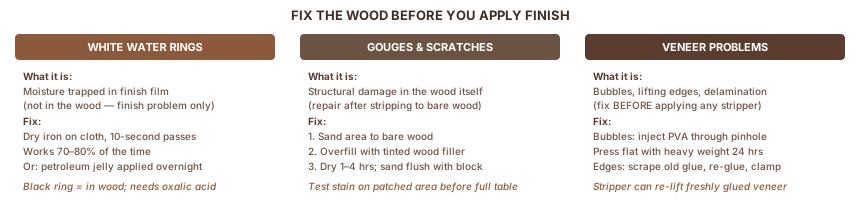
White rings and cloudy patches are moisture trapped in the finish film, not in the wood itself. The wood is fine. You're dealing with a finish problem.
Iron trick (works 70–80% of the time): Place a dry cotton cloth over the ring. Press with a dry iron on low heat, no steam, in 10-second passes. The heat re-melts the finish film and drives out the trapped moisture. Check after each pass. Most white rings disappear within a few applications.
Petroleum jelly method: Apply petroleum jelly directly to the ring, let it sit overnight, wipe off in the morning. The oil molecules replace the moisture that caused the cloudy appearance. Slower than the iron trick, but no risk of heat damage.
Dark or black ring: This means moisture got through the finish and into the wood itself. The iron and jelly methods won't work. You need to strip and sand the affected area, then use wood bleach (oxalic acid) if the stain is deep.
Gouges and Deep Scratches
Repair after stripping to bare wood. Trying to fill gouges before stripping just means stripping the filler too.
- Sand the gouged area to bare wood if not already stripped there.
- Apply wood filler with a putty knife. Overfill slightly. Filler shrinks as it dries, typically 10–15%.
- Let dry completely: 1–4 hours depending on depth and product.
- Sand flush with a 120-grit sanding block. Blocks are essential here: fingers create slight hollows. Finish with 220-grit.
Use tinted wood fillers matched to your species. Most wood fillers accept stain differently than natural wood, which means patches may show slightly under stain. Test your stain on a patched scrap from the same table before committing to the whole surface.
Veneer Problems
Fix veneer before applying stripper. Chemical stripper can seep under newly re-glued edges and lift them back up.
Bubbles: Inject PVA wood glue through a pinhole with a syringe. Press flat with weight (a stack of heavy books with plastic sheeting under them) for 24 hours.
Peeling edges and corners: Scrape out all old dried adhesive. Apply fresh PVA wood glue, then clamp or weight flat. Let dry fully before stripping. For thin veneer on wide edges: veneer tape works well here.
Part 4: Stain — Color, Species, and Application
Stain is optional. If you like the natural color of the wood and just want to protect it, skip to Part 5. Stain adds color. It doesn't add protection.
Do You Need Stain?
Skip stain if: You're happy with the natural wood color. You're painting instead of staining. You want the fastest possible project.
Use stain if: You want to change the color (going darker or warming up a cool wood). The old stain gave it a look you want to restore. You're trying to match another piece of furniture.
Going lighter: Almost impossible to pull off cleanly. Stain always darkens wood. If you need lighter, strip completely and consider bleaching the wood with oxalic acid, or just apply a clear topcoat over the natural bare wood.
Blotch-Prone Species
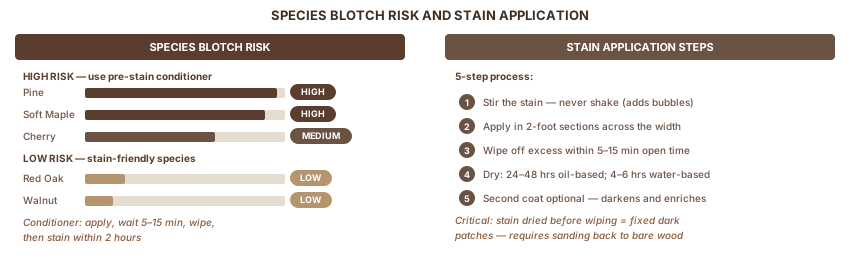
Not all wood takes stain evenly. Soft, porous species have variable grain density. Tight grain absorbs stain differently than loose grain, creating dark and light patches. That's blotching.
Blotch-prone species: pine, poplar, alder, birch, soft maple, cherry. If your table is any of these, use a pre-stain conditioner. The Wood Whisperer's guide to blotch control is the best reference on why this happens and how to prevent it.
Stain-friendly species: oak), white oak, walnut. These absorb stain evenly and are forgiving.
Minwax Pre-Stain Wood Conditioner (or equivalent from General Finishes): Apply to bare wood with a cloth or brush. Let penetrate for 5–15 minutes. Wipe off excess. Apply stain within 2 hours. Wait longer and the conditioner stops being effective. The conditioner partially fills the large pores so they don't absorb dramatically more stain than tight grain. Not perfect on knotty pine (knots stain darker regardless), but significantly better.
Applying Stain
Tools: A foam brush or bristle brush to apply, a lint-free cloth (old cotton t-shirt, cheesecloth) to wipe off excess. Apply with the brush, wipe with the rag. Both tools together.
Applying stain with only a rag works, but on a large tabletop it's slow and inconsistent. Apply generously with the brush to get good coverage, then follow immediately with the rag to lift excess and even out the color.
The critical timing window: Oil-based stain stays workable for 5–15 minutes after application. On a 6-foot dining table, don't try to stain the entire top in one go. Work in 2-foot-wide sections across the width. Apply one section, wipe it off, move to the next. If stain dries before you wipe it, you get dark, uneven patches that require sanding back to bare wood to fix.
Process:
- Stir the stain, never shake (shaking adds air bubbles that transfer to the surface)
- Apply one section at a time in the direction of the grain
- Wipe off excess with the rag within the open time
- Let dry completely: oil-based stain requires 24–48 hours before topcoat; water-based stain, 4–6 hours
- A second coat darkens slightly and can improve richness, but reduces grain definition
Matching Existing Color
Test on the same wood species. Testing stain on pine when your table is oak tells you nothing. Different species absorb stain completely differently.
Four rules:
- Test on the same species (use a scrap from the table, or an underside edge)
- Wait 24 hours to judge. Wet stain looks darker and richer than it actually is once dry.
- Apply topcoat over your test and let dry. Oil-based polyurethane adds an amber warmth that shifts the apparent color.
- View the test in the room's actual light. Hardware store fluorescent light vs. your dining room makes the same stain look like two different products.
If exact color matching is important, take a small wood chip from a hidden area of the table to a paint or stain store. Many will use a spectrophotometer to custom-match a stain to the existing wood. The Wood Whisperer's color matching guide walks through reading test samples and accounting for topcoat amber shift.
Part 5: Applying the Topcoat
The topcoat is what protects the table. A dining table gets daily use, spills, hot dishes, and kids' homework. You need a finish that forms a hard film on the surface.
Choosing the Right Finish
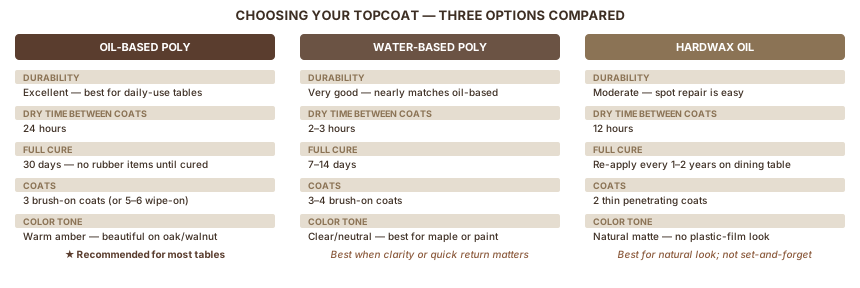
Oil-based polyurethane is the recommendation for most dining tables. It's the most durable DIY-accessible finish, with excellent resistance to scratches, water, alcohol, and heat. Jamestown Distributors' comparison of oil vs. water-based poly shows oil-based consistently outperforming on hardness and scratch resistance for table surfaces. Three coats on a dining table lasts 5–10 years before the next refinish under normal family use.
The only downside: it adds a warm amber tone to the wood. On walnut, oak, or cherry, this is beautiful. On maple, birch, or a painted surface where you want a clear/neutral look, choose water-based poly instead.
| Finish | Durability | Tone | Between-coat dry | Coats | Cleanup |
|---|---|---|---|---|---|
| Oil-based poly (brush-on) | Excellent | Warm amber | 24h | 3 | Mineral spirits |
| Oil-based poly (wipe-on) | Very good | Warm amber | 2h | 5–6 | Mineral spirits |
| Water-based poly | Good–excellent | Clear/neutral | 2–3h | 3–4 | Water |
| Hardwax oil | Moderate | Natural/matte | 12h | 2 | Vegetable oil |
Water-based poly: Has caught up significantly with oil-based in terms of durability. Dries in hours instead of days. Clear finish stays clear (no ambering). Good choice if you want the table usable quickly or if the wood color would be hurt by amber.
Hardwax oil (Rubio Monocoat, Osmo Polyx): A penetrating finish that soaks into the grain rather than forming a film on top. Natural look, no plastic-film appearance. Much easier to spot-repair: sand out damage, re-oil just that spot. Needs reapplication every 1–2 years on a dining table with hard use. Not the right call if you want set-and-forget protection.
Brush-On Polyurethane
What you need: Natural bristle brush 2–2.5" wide (for oil-based), or synthetic bristle/foam (for water-based). 220-grit and 320-grit sandpaper. Tack cloth. Stir stick.
Coat 1: The seal coat:
- Stir the polyurethane gently. Never shake. Shaking creates bubbles that end up in your finish.
- For oil-based: thin with mineral spirits 10–15% (about 1-2 tablespoons per cup). This improves penetration on the first coat and reduces bubbles.
- Apply thin, even strokes with the grain. Overlap each pass by about 25%.
- Work from one end to the other. Don't go back and re-brush areas you've already done. Back-brushing pulls up the film and creates drag marks.
- Watch edges and table legs for drips.
- Let cure fully: 24 hours oil-based, 2–3 hours water-based.
Between coats:
- Scuff sand lightly with 220-grit. The finish will look dull and slightly scratched. That's correct.
- Vacuum, then wipe with a tack cloth. Get all dust off before applying the next coat.
- Apply next coat full-strength (no thinning after coat 1).
Coat 3 (final coat): Apply exactly the same way. Do not sand the final coat. Sanding it creates scratches that require either buffing out or a full re-do.
Wipe-On Method
For beginners, or for tables with legs and details where brush technique is tricky, wipe-on polyurethane is more forgiving.
Use Minwax Wipe-On Poly, or thin standard oil-based poly 50-50 with mineral spirits. Apply with a lint-free cloth in long wiping strokes with the grain. Each coat is thinner than brush-on, so you need 5 to 6 total, per Flowyline's coat count data by finish type. No brush marks, no drips, no bubbles from poor brush technique.
As This Old House's master carpenter Norm Abram recommends for non-professionals: "I'd recommend an oil-based wipe-on polyurethane. It offers great protection, has the look of a hand-rubbed oil finish, and is easy to apply."
Scuff sand with 320-grit between coats 2–3 and again between 4–5. No sanding after the final coat.
The Full Coat Schedule
Oil-based polyurethane:
- Apply coat 1 (thinned): dry 24h
- Scuff sand 220-grit, tack cloth
- Apply coat 2: dry 24h
- Scuff sand 220–320-grit, tack cloth
- Apply coat 3: dry 24h
- Table is ready for light use after 24 hours
Full cure: 30 days. Don't put a tablecloth, rubber-backed placemat, or any rubber item on the table until it's fully cured. Rubber reacts with uncured polyurethane and causes the finish to lift off.
Water-based polyurethane:
- Same process, but between-coat dry is 2–3 hours (per ZAR's dry time testing)
- Full cure: 7–14 days
- Still avoid rubber items until fully cured
Part 6: When Things Go Wrong
Sticky Finish That Won't Dry
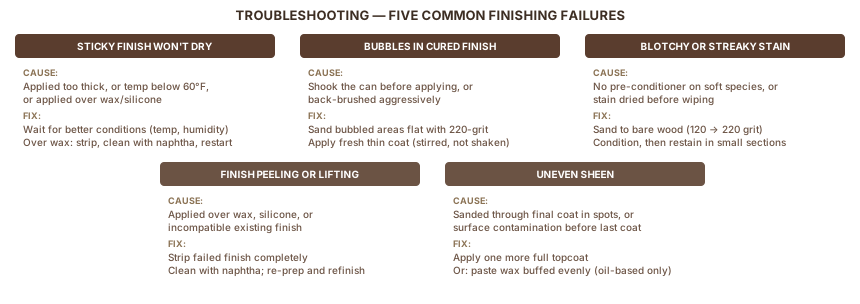
What caused it: Applied too thick (most common), temperature below 60°F, humidity above 85%, or finish applied over incompatible surface (wax or silicone).
Fix: If still tacky after 48 hours, environment or surface prep is the issue. If cool or humid, wait for better conditions. If applied over a contaminated surface, it won't cure properly. Strip it, clean with naphtha, and start over.
Bubbles in the Cured Finish
What caused it: Shook the can before applying, or brushed the finish back and forth too aggressively.
Fix: Let cure fully. Sand the bubbled areas with 220-grit to level them. Wipe with tack cloth. Apply a fresh thin coat with a stirred (not shaken) finish, using light one-direction strokes.
Blotchy or Streaky Stain
What caused it: No pre-conditioner on a soft or blotch-prone species, or stain dried before you wiped it off.
Fix: Sand back to bare wood. There's no way to even out stain that's already set unevenly. Start at 120-grit, progress to 220, apply pre-conditioner this time, let it penetrate and wipe, then restain in small sections.
Finish Peeling or Lifting
What caused it: Applied over wax, silicone furniture polish, or another incompatible finish without proper prep. Adhesion never happened.
Fix: Strip the failed finish completely. Clean the wood with naphtha (not mineral spirits) to remove all silicone and wax contamination. Let dry. Then refinish with proper surface prep.
Uneven Sheen
What caused it: Sanded through the final coat in spots, or contamination on the surface before applying.
Fix: Apply one additional topcoat with a properly prepared surface. If the sheen difference is minor, a coat of paste wax buffed out evenly can unify the appearance on oil-based finishes. Note: you can't apply more poly over wax once it's down.
Where This Fits
A refinished table is a starting point, not a one-time project. Understanding the finish you applied makes every repair easier. If you know it's oil-based poly, the fix for a scratch is a light sand and a fresh wipe-on coat.
For applying your first coat of polyurethane in detail: Applying Polyurethane covers oil vs. water-based in depth, sheen selection, and the rubbing-out process for a glass-smooth final surface.
If your table has deep cracks or voids before you sand: Wood Filler for Cracks covers filler types, color-matching patches, and technique for invisible repairs.
If you're staining an oak table and want to get the color right: Red Oak Stains covers stain behavior on open-grain species, gel stain vs. penetrating stain, and consistent color across a full table.
FAQ
How long does it take to refinish a dining table?
Expect about one week total, most of that dry time. Stripping and sanding is one day of active work. Oil-based stain needs 24–48 hours before topcoat. Each coat of oil-based polyurethane needs 24 hours to dry — three coats is three days of waiting. Total active hands-on time runs 6–10 hours spread across a weekend and evenings; the schedule is mostly about not rushing dry times.
Can I refinish a veneer dining table?
Yes, but the method changes significantly. Never use a random orbital sander on veneer — factory veneer is roughly 0.5mm thick and you can sand through it in seconds. Use chemical stripper (Citristrip gel works well), scrape with a plastic scraper rather than metal, and hand-sand at 120-grit maximum. Check the edge of the tabletop first: a thin decorative layer over plywood or MDF layers beneath it means you have veneer.
Do I need to sand between coats of polyurethane?
Yes — scuff sand with 220-grit between every coat except the final one. This is a light "scuff sand," not a full cut-through: the goal is mechanical adhesion for the next coat, not to remove the film. The surface will look dull and lightly scratched after — that's correct. Vacuum, wipe with a tack cloth to remove all dust, then apply the next coat.
How do I fix a sticky finish that won't dry?
The most common causes are: coat applied too thick, temperature below 60°F, humidity above 85%, or finish applied over wax or silicone furniture polish. If still tacky after 48 hours, wait for better temperature and humidity conditions before adding another coat. If you applied over a contaminated surface, the finish won't cure — strip it, clean with naphtha to remove all silicone and wax, then start over with clean bare wood.
How long before I can use the table after refinishing?
Oil-based polyurethane is ready for light use after 24 hours but doesn't fully cure for 30 days. During that window, don't put rubber-backed placemats, tablecloths with rubber grippers, or any rubber item on the surface — uncured poly reacts with rubber and the finish lifts off in patches. Water-based poly cures faster: 7–14 days. Until fully cured, wipe spills immediately and avoid setting hot dishes directly on the surface.
Sources
This guide draws on manufacturer data sheets, trade publications, and professional finishing resources. Specific product data (dry times, VOC content, coat counts) comes from manufacturer technical documentation.
- This Old House — How to Refinish a Dining Table — full refinishing process including Norm Abram's wipe-on poly recommendation
- Popular Woodworking — Don't Sand Furniture, Strip It — the argument for chemical stripping over sanding on furniture
- Popular Woodworking — Wipe, Don't Brush Stain — rag vs. brush stain application
- Popular Woodworking — How to Control Blotching — blotch prevention on soft woods
- Fine Woodworking — Identifying Finishes for Repair — solvent test methods
- Waterlox — Identifying Your Existing Finish — finish identification guide
- Minwax — Pre-Stain Wood Conditioner — application instructions and timing
- The Wood Whisperer — Blotch Control to Rule Them All — professional blotch prevention techniques
- The Wood Whisperer — Matching Color the Easy Way — stain color matching
- ZAR — How Long Between Coats of Water-Based Polyurethane — dry time data
- Jamestown Distributors — Water vs. Oil-Based Polyurethane — finish comparison
- Woodworkers Journal — Refinishing a Veneer-Topped Dining Table — veneer-specific refinishing guidance
- Family Handyman — Master the Art of Wipe-On Poly — wipe-on technique
- Flowyline — How Many Coats of Polyurethane — coat count data by finish type