
How to Use This Guide
The Grizzly G0771Z is a serious table saw. That's the point of buying it. Serious tools have setup requirements. Skip the alignment steps and you'll get burned wood, binding, and eventually kickback.
This guide covers what to do before your first cut, which blade to buy, and how to rip and crosscut safely. It applies to the current G0771Z and to discontinued models like the G1022Z.
Just unboxed your saw? Start at Part 2 (setup checklist) before you plug it in.
Choosing a blade? Jump to Part 3.
Ready to cut? Part 4 covers ripping, Part 5 covers crosscutting. Read Part 6 on kickback before either.
Grizzly Table Saw at a Glance
The G0771Z runs on standard 120V household current. It has a cast-iron table that stays flat, a T-fence that locks accurately, and a quick-release riving knife that prevents the most common cause of kickback. For a first serious table saw, it's the right buy.
| Current flagship model | G0771Z, 2 HP, 120V |
| Motor type | Induction (hybrid), quieter than contractor saws |
| Arbor | 5/8", 3450 RPM |
| Max cut depth at 90° | 3-1/8" |
| Best starter blade | Diablo D1050X (50-tooth combination) |
| Riving knife | Always installed. The single most important safety device. |
In this guide:
- Setup checklist before your first cut
- Which blade to buy
- How to rip safely
- Crosscutting without kickback
- Why kickback happens and how to stop it
Part 1: What Makes a Grizzly a Different Kind of Table Saw
The G0771Z is a hybrid saw. Understanding what that means tells you what you bought and what you can expect from it.
The three types of 10-inch table saws
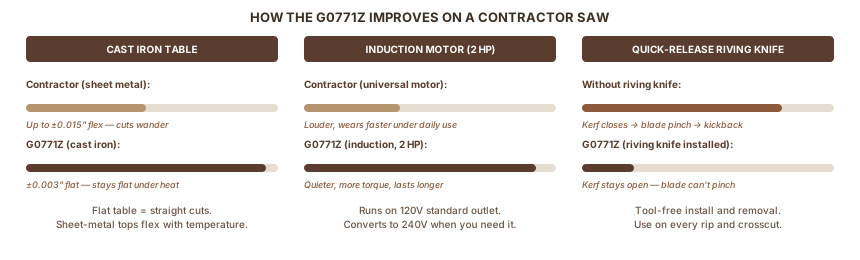
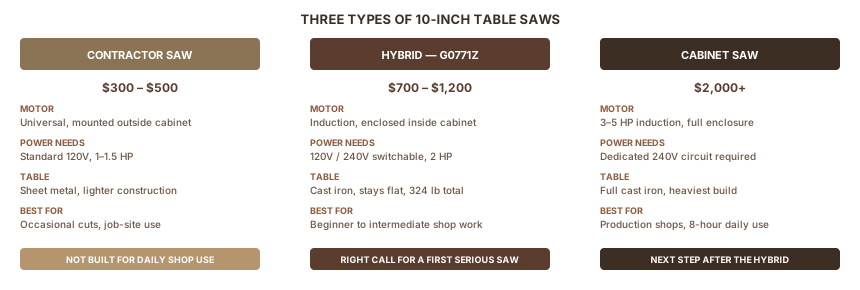
Contractor saws ($300–$500): Universal motor mounted on the outside of the cabinet. Lightweight, portable. Louder and less powerful than hybrid or cabinet saws. The motor wears faster under sustained use. Fine for occasional cuts; not built for regular shop work.
Hybrid saws ($700–$1,200): Induction motor mounted inside an enclosed base. The G0771Z is a hybrid. Induction motors are quieter, produce more torque at lower RPMs, and last longer than universal motors. The enclosed base improves dust collection. The cast-iron table stays flatter under temperature changes than sheet-metal tops. It runs on 120V standard household current. No dedicated 240V circuit required to start.
Cabinet saws ($2,000+): Full cast-iron enclosed base, heaviest construction, maximum rigidity. Built for production shops. The next step after a hybrid when you're cutting 8 hours a day.
For a beginner buying their first serious saw, a hybrid is the right call. You get the motor quality and table flatness of a cabinet saw without the price or the need for a 240V outlet.
A table saw at this level unlocks work a circular saw can't do reliably: accurate repeatable rip cuts to 1/32", dado cuts for shelving and joinery, bevel cuts up to 45°, and consistent crosscuts square enough for furniture. The G0771Z handles all of it on a standard 15-amp circuit.
G0771Z key specifications
Per the Grizzly G0771Z product page and spec sheet:
| Specification | Value |
|---|---|
| Motor | 2 HP, 120V/240V (prewired 120V) |
| Arbor size | 5/8" |
| Arbor speed | 3450 RPM |
| Max cut depth at 90° | 3-1/8" |
| Max cut depth at 45° | 2-1/4" |
| Max dado width | 13/16" |
| Fence type | T-shaped (locks front and rear) |
| Dust port | 4" |
| Approximate shipping weight | 324 lbs |
G1022Z owners — same guide applies
The G1022Z was Grizzly's 10-inch saw for many years before it was discontinued. If that's what you have, all the technique and setup steps in this guide apply the same way. The differences are cosmetic: 1-1/2 HP motor vs. 2 HP, slightly different fence rail design.
Known setup issues to check on delivery
Sawmill Creek and LumberJocks forums have documented a few recurring issues with the G0771Z. Check these before your first cut:
- Painted threads: Factory paint partially fills the threaded holes. Run a matching bolt through every threaded hole before assembly. If you skip this, the screws won't seat.
- Motor cover clearance: On some units, the motor contacts the motor cover when the blade is raised above 2-3/4". If your blade goes slightly off 90° at full height, check here first.
- Wing flatness: One cast-iron wing may sit slightly high. A thin shim (tape works) corrects it.
Grizzly's customer service has a solid reputation. If you receive deformed fence rails or parts that don't fit, contact them. Most users report replacements shipped promptly.
Part 2: Before Your First Cut
Don't skip this. An unaligned saw produces burned cuts, binding, and kickback. Budget 30 minutes before your first cut. Katz-Moses Tools' table saw tune-up guide covers the full version of this checklist.
Tools needed: combination square, pencil or marker, 13mm wrench.

Step 1: Blade parallel to miter slot
This is the most critical alignment. A blade angled away from the miter slot binds wood against the back of the blade mid-cut. That's what causes kickback.
- Lower the blade fully, then raise it to full height.
- Mark one tooth with a pencil.
- Using a combination square, measure the distance from that marked tooth to the near wall of the left miter slot. Write it down.
- Rotate the blade 180° (by hand, unplugged) so the marked tooth is now at the back.
- Measure again. The two numbers should match within 0.005".
If they don't match, the G0771Z owner's manual covers trunnion adjustment. Grizzly's support site also has a step-by-step guide specific to their saws.
Step 2: Blade square to the table
- Raise the blade to full height. Tilt it until the 90° stop engages.
- Hold a combination square against the blade body, between the teeth, not against a tooth tip.
- The blade should be perpendicular to the table. The square contacts both blade and table with no gap.
If there's a gap: find the 90° stop bolt at the front of the saw (near the tilt handwheel) and adjust it. Consult the owner's manual for your specific model.
Step 3: Fence parallel to blade
- Set the fence at 12" from the blade. Lock it.
- Measure from the fence face to a tooth at the front of the blade.
- Rotate that tooth to the back of the blade and measure again.
These two measurements should match. A slight toe-out at the front (fence face angles very slightly away from the blade, toward the operator) is acceptable. Toe-in is not. When the fence angles toward the back of the blade, wood pinches at the exit point. That's another kickback cause.
If the fence is off: the T-fence rail has set screws for adjustment. Rockler's fence alignment guide explains the principle clearly if you're new to this procedure.
Step 4: Riving knife and blade guard installed
The G0771Z has a quick-release riving knife and blade guard system. No tools needed to install or remove. Install both before your first cut.
The riving knife is a curved piece of steel that sits directly behind the blade, in the kerf. It keeps the kerf from closing as the board passes through, preventing the wood from pinching the back of the blade. It's the single most important kickback prevention device on the saw. Use it on every rip and crosscut.
Step 5: Test cut
Rip a piece of scrap pine. Use the board-matching test: flip one half end-for-end and hold the two ripped faces together. If the blade is at exactly 90°, the faces mate perfectly. Any blade angle error shows as a gap that doubles. Easy to spot.
Part 3: Choosing Your Blade
What the numbers mean
A saw blade has two key specs: tooth count and grind type.
Tooth count: Lower numbers (24–40 teeth) cut faster and rougher. Fewer teeth in the wood at once means faster chip evacuation. Higher numbers (60–80 teeth) cut slower and smoother. More teeth means a finer finish, but also more heat.
Grind type: FTG (flat top grind) teeth cut efficiently with the grain. Best for ripping. ATB (alternate top bevel) teeth score the wood fibers before cutting through. Better for crosscutting and sheet goods.
The arbor size on the G0771Z is 5/8". Every blade you buy needs to fit a 5/8" arbor.
Your first blade: Diablo D1050X
Buy the Diablo D1050X: a 10", 50-tooth combination blade at about $35–$45. Marc Spagnuolo at The Wood Whisperer recommends it. Woodworking forums consistently echo it.
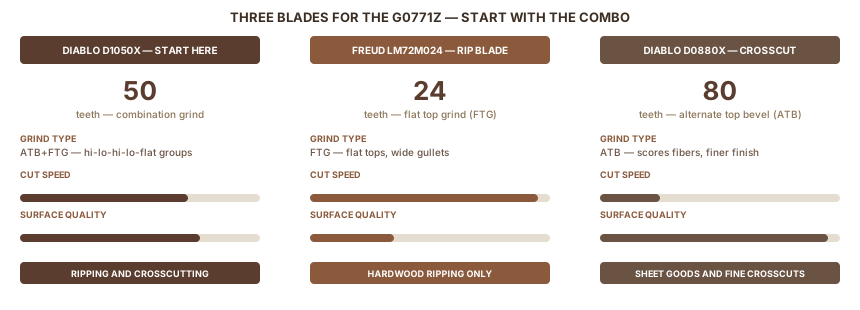
The D1050X has 10 groups of five teeth in a hi-lo-hi-lo-flat pattern. The flat-top teeth handle ripping and the angled teeth handle crosscutting. One blade covers both operations when you're starting out.
Replace the blade that came with your saw first thing. The included blade works, but the Diablo is noticeably sharper and produces cleaner cuts.
Blade selection by task
| Task | Tooth count | Grind | Example blade |
|---|---|---|---|
| General use (start here) | 50 | Combo | Diablo D1050X |
| Ripping hardwood frequently | 24 | FTG | Freud LM72M024 |
| Sheet goods / fine crosscuts | 80 | ATB | Diablo D0880X |
Add the dedicated rip blade when you find yourself ripping hardwood regularly. It cuts faster, runs cooler, and leaves a cleaner rip face. The 24-tooth blade is not for crosscutting.
Blade height
Set the blade so the tips of the teeth are 1/8" above the top surface of the workpiece. That's about one full tooth height above the stock. Stumpy Nubs' blade height analysis covers the trade-offs: a higher setting means fewer teeth in contact, faster cut, less heat, but more blade exposed. A lower setting exposes less blade but generates more heat and slows the cut. At 1/8" above the stock, you're in the middle for general use.
Part 4: How to Rip Safely
Ripping means cutting a board to width by feeding it lengthwise through the blade, parallel to the grain. The fence controls the width.
Setting the fence
Set the fence to your target width. Measure from the fence face to the near side of the blade, the side facing the fence. Lock the fence.
Verify with a tape measure, not just the fence indicator scale. The indicator scale on new saws often needs calibration. Trust the tape over the scale.
Stock prep
Your workpiece needs two things before it goes to the table saw: one flat face (down on the table) and one straight edge (against the fence). A twisted or bowed board against a flat fence creates pressure that can push the board into the back of the blade mid-cut.
If your lumber isn't flat and straight, joint or hand-plane one face and one edge before ripping.
Ripping technique
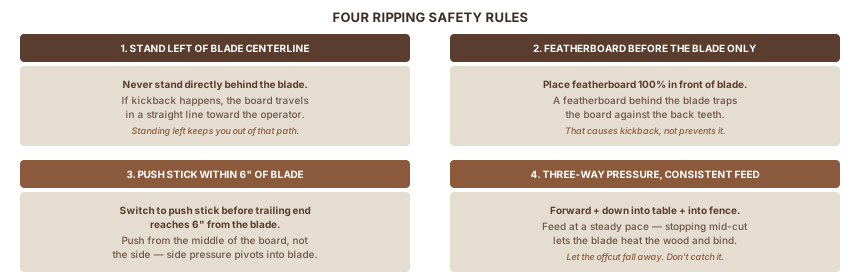
Stand slightly left of the blade centerline. Never stand directly behind it. If kickback happens, you're not in its path.
Feed the board at a consistent pace. Stopping mid-cut lets the blade heat the wood and bind. Don't force it. If you feel resistance, you're feeding too fast.
Keep three-way pressure on the board: forward (through the blade), down (into the table), and sideways (into the fence). The fence keeps the cut straight; don't fight it.
For cuts 3" wide or narrower, use a push stick. Your hand doesn't go near the blade. Once the trailing end of the board is within 6" of the blade, switch to the push stick. Keep the stick in the middle of the board. Pushing from the side pivots the board toward the blade.
Let the offcut fall away. Don't reach behind the blade to catch it.
Featherboard
A featherboard is an angled-finger device that presses the wood against the fence during the cut, preventing the board from wandering. It's worth using on every rip cut.
One critical rule from Woodcraft's kickback guide: place the featherboard 100% in front of the blade. Never behind the leading edge. A featherboard positioned behind the blade traps the wood against the back teeth. That creates kickback, it doesn't prevent it.
Part 5: How to Crosscut Safely
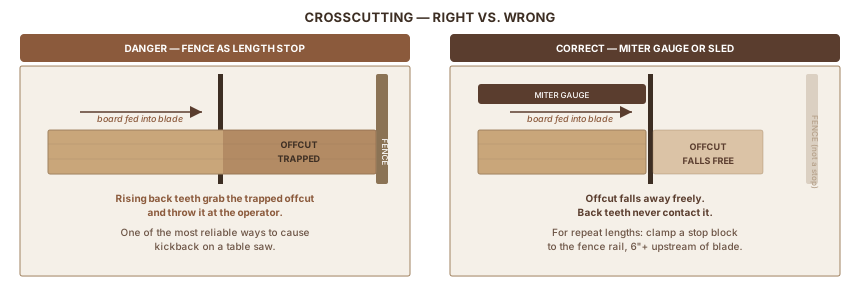
Crosscutting means cutting a board to length, perpendicular to the grain. Use a miter gauge or crosscut sled. Not the fence.
The rule you cannot break
Never use the rip fence as a length stop when crosscutting.
When you crosscut with the fence as a stop, the offcut gets trapped between the fence face and the back of the blade. The rising back teeth grab it and throw it. That's one of the most reliable ways to cause kickback on a table saw.
If you need repeat cuts at a specific length, clamp a stop block to the fence rail far in front of the blade. Six inches or more. The board rides against the block at the start of the cut, then clears the block before it reaches the blade. The offcut can't get trapped.
Miter gauge technique
- Place the miter gauge in the left miter slot.
- Set the gauge to 90° and check with a small combination square.
- Attach an auxiliary wooden fence to the miter gauge: a straight scrap of 3/4" plywood, about 4" tall and 18" long. Run it through the blade once. That kerf becomes your cut reference line.
- Mark your board, align the mark with the kerf, and feed through with steady pressure.
The miter gauge that comes with the G0771Z is adequate for basic work. The detents aren't the tightest. For furniture-quality crosscuts where an off-square cut ruins a joint, a crosscut sled is more reliable.
Crosscut sled
A crosscut sled is a shop-made platform that rides in both miter slots at once. Two runners eliminate the side-to-side slop that makes a miter gauge imprecise. The large base supports wider boards. Most serious woodworkers rely on a sled for their crosscuts.
Build it from 3/4" plywood with two hardwood or UHMW plastic runners. The build takes an afternoon and teaches you measuring and squaring as you go. Make your first sled from scrap. It doesn't need to be pretty. It needs to be square.
Part 6: Kickback, Causes, and Prevention
What it is
Kickback is when wood gets caught by the rising back teeth of the blade and thrown toward the operator. The G0771Z runs at 3450 RPM. Safety data puts kickback as a contributing factor in 60% of table saw hand injuries. Fine Woodworking's December 2024 analysis covers the mechanics in depth.
The back teeth of the blade move upward and toward you. When wood contacts them, those teeth grab and throw. It doesn't matter whether the cause was a pinched kerf, a wandering board, or a trapped offcut. The result is the same.
Three causes
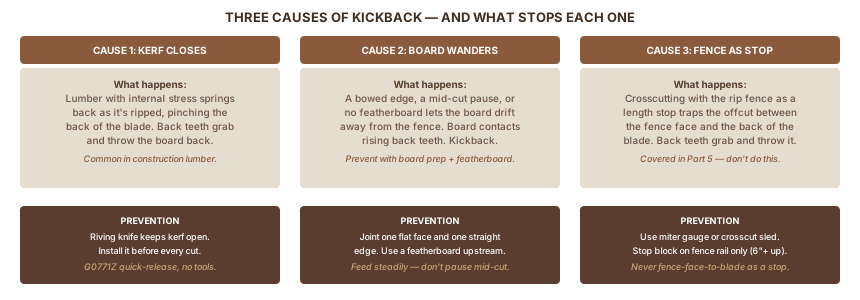
The kerf closes: As a board passes through the blade, the two halves sometimes spring back together and pinch the back of the blade. This happens with lumber that has internal stress, common in construction lumber and green wood. The riving knife prevents it by keeping the kerf open.
Wood contacts the back teeth: If the board wanders away from the fence mid-cut because of a bowed edge, a stop-and-restart, or no featherboard, it can contact the rising back teeth on the exit side. Body position and consistent feeding prevent this.
Crosscutting with the fence as a stop: Covered in Part 5. Don't do it.
What prevents it
The G0771Z comes with the right equipment. Katz-Moses Tools' kickback guide covers this in detail. Use all of it:
- Riving knife: Always installed. It prevents cause #1.
- Blade guard: Use it on every cut where it physically fits. The G0771Z's quick-release guard goes on in seconds.
- Anti-kickback pawls: Metal fingers on the blade guard that dig into the wood if it tries to move backward.
None of these work from a shelf. Install them before you cut.
Quick Reference
G0771Z Specifications
| Spec | Value |
|---|---|
| Motor | 2 HP, 120V (converts to 240V) |
| Arbor | 5/8", 3450 RPM |
| Max cut depth at 90° | 3-1/8" |
| Max cut depth at 45° | 2-1/4" |
| Max dado width | 13/16" |
| Dust port | 4" |
Blade Selection
| Task | Teeth | Grind | Blade |
|---|---|---|---|
| Start here (general) | 50 | Combo | Diablo D1050X |
| Ripping hardwood | 24 | FTG | Freud LM72M024 |
| Sheet goods / finish cuts | 80 | ATB | Diablo D0880X |
Where This Leads
A well-tuned table saw opens up cabinetmaking. Once you're comfortable with ripping and crosscutting, two classic door builds are within reach: Raised Panel Cabinet Doors uses the table saw for both frame grooves and the floating panel profile, and Roll-Up Cabinet Doors depends on consistent slat ripping as the critical first step. Both guides are written for builders who can already work a table saw safely.
Sources
Research for this guide drew on Grizzly's official documentation, woodworking expert resources, and user forum reports from Sawmill Creek and LumberJocks.
- Grizzly G0771Z product page — official specifications and features
- Sawmill Creek: G0771Z user opinions — owner forum documenting setup issues
- Katz-Moses Tools: Table saw tune-up — five-step pre-flight setup checklist
- Grizzly: How to align a table saw blade to miter slot — manufacturer alignment procedure
- Rockler: How to align your table saw fence — fence alignment procedure
- The Wood Whisperer: Which saw blade should I buy? — blade selection guide by Marc Spagnuolo
- Diablo D1050X — 50-tooth combination blade
- Stumpy Nubs: Blade height — blade height trade-off analysis
- Woodcraft: Preventing tablesaw kickback — featherboard placement and kickback prevention
- Rockler: Precision miter gauges and crosscutting sleds — crosscutting methods compared
- Fine Woodworking: Table saw kickback (Dec 2024) — kickback mechanics and injury data
- Katz-Moses Tools: How to prevent table saw kickback — comprehensive kickback prevention guide
Tools Used
Also Referenced
How We Research
We don't take affiliate revenue or accept review units. Picks come from multi-source research — manufacturer specs, OSHA / EPA / ASTM regs, and long-form practitioner threads — plus Ahmed's hands-on use where relevant. When we recommend something, we explain why.
Up Next
Kobalt KT10152: Setup, Cuts, and Honest Expectations
POWER TOOLS · Beginner