
Beech Lumber at a Glance
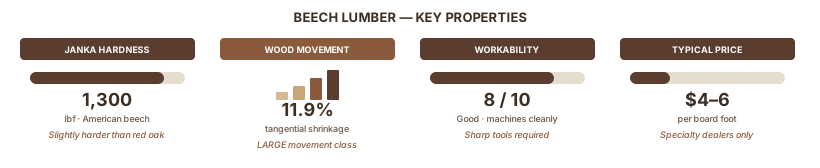
Beech lumber is a dense hardwood — Janka 1,300 lbf (American) to 1,450 lbf (European) — that machines cleanly, costs less than walnut or cherry, and has been the go-to material for workbenches, chair parts, and tool handles in European woodworking for centuries. Its tight, uniform grain takes edges well and glues reliably, making it practical for high-wear applications. The main caveat: beech moves more across the grain than most hardwoods, so wide solid panels must be allowed to float in their frames or they'll crack.
| Janka hardness | 1,300 lbf (American) / 1,450 lbf (European) |
| Classification | Hardwood — harder than red oak (1,290 lbf) |
| Tangential shrinkage | 11.9% — HIGH movement; plan for it in wide panels |
| Price range | ~$4–6 per board foot (specialty hardwood dealers) |
| Best uses | Cutting boards, workbenches, chairs, tool handles, cabinet interiors |
| Outdoor use | Not suitable — low rot resistance |
In this guide:
- Is beech actually a hardwood?
- The wood movement problem, and how to design around it
- What projects work best with beech
- How to finish and stain beech
Part 1: Is Beech a Hardwood?
Yes. Unambiguously.
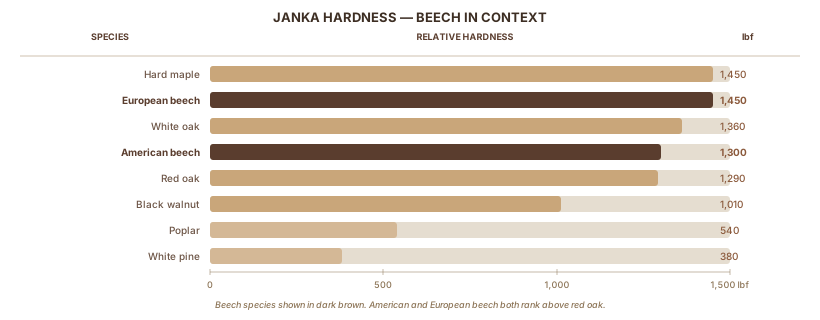
The Wood Database lists American beech at a Janka hardness of 1,300 lbf (the Janka scale measures resistance to denting — higher is harder). That puts it slightly above red oak (1,290 lbf) and just below white oak (1,360 lbf). European beech comes in at 1,450 lbf, matching hard maple. Compare that to white pine at roughly 380 lbf, and you can see why beech has been the traditional choice for workbenches and chair parts for centuries.
| Wood | Janka (lbf) |
|---|---|
| Hard maple | 1,450 |
| European beech | 1,450 |
| White oak | 1,360 |
| American beech | 1,300 |
| Red oak | 1,290 |
| Black walnut | 1,010 |
| Poplar | 540 |
| White pine | 380 |
The term "hardwood" is a botanical category, not a hardness measurement. It refers to deciduous trees with enclosed seeds. Beech qualifies both ways: by classification and by density.
What Beech Looks Like
Pale. Almost blond. American beech runs cream to light reddish-brown with some pinkish variation between logs. European beech is lighter and more consistent — a pale orangey-tan with minimal color variation. Both have straight, fine-to-medium grain and closed pores, similar to maple in texture.
The defining visual feature is ray flecks. Beech has prominent wood rays — the structural tissue that runs radially through the tree. On quartersawn stock (boards cut perpendicular to the growth rings), those rays appear as distinctive silvery-tan flecks across the face. On flat-sawn stock, you see less of the figure, but the grain is clean and uniform.
Pale is polarizing. Beech won't give you walnut's drama or cherry's warmth. But that pale base makes it easier to paint, stain darker, or let a clear finish speak for itself without fighting an underlying color cast.
American vs. European — Which Will You Actually Buy
Most beech lumber sold at hardwood dealers in North America is European beech (Fagus sylvatica). American beech (Fagus grandifolia) is commercially harder to find. Beech Bark Disease and Beech Leaf Disease have pressured Northeast populations, and there's less industrial processing infrastructure behind American beech compared to the European supply chain.
If you search for beech lumber online or ask at a hardwood dealer, you're almost certainly looking at European beech. That's fine. In the shop, the two species behave identically. European beech is slightly finer-grained and more consistent; American beech has slightly more color variation. Neither difference changes how you work the wood.
Big box stores (Home Depot, Lowe's) don't stock beech. You'll need an online hardwood retailer or a local hardwood dealer.
Part 2: Beech's One Catch: High Wood Movement
Beech moves a lot. More than red oak, more than maple, more than walnut. Plan for it in any project with a panel wider than six inches, and you're fine. Ignore it, and solid beech panels will crack.
The Shrinkage Numbers
The Wood Database classifies beech as having large movement in service:
| Species | Tangential | Radial | Movement class |
|---|---|---|---|
| American beech | 11.9% | 5.5% | Large |
| European beech | 11.7% | 5.8% | Large |
| Red oak | 8.6% | 4.0% | Medium |
| Hard maple | 9.9% | 4.8% | Medium |
| Black walnut | 7.8% | 5.5% | Small-medium |
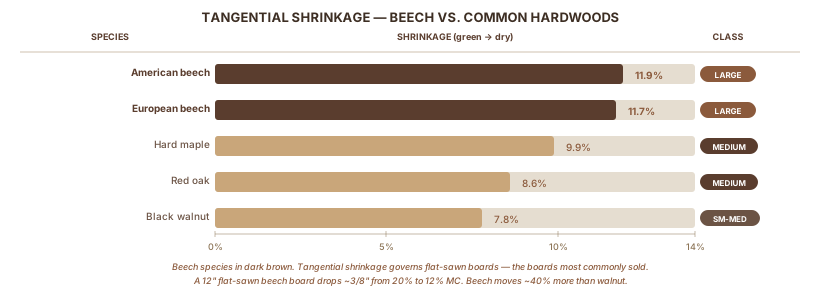
Tangential shrinkage governs flat-sawn boards. It measures how much the board moves across its face as moisture content changes. At 11.9%, beech moves about 40% more than walnut and 38% more than red oak under identical humidity swings.
A 12-inch flat-sawn beech board dropping from 20% to 12% moisture content shrinks about 3/8 inch, according to Snow Valley Furniture's movement data. In a typical home with seasonal humidity swings from 30% to 60% RH, that same panel moves 1/4 to 3/8 inch over a year.
What to Do About It
The movement doesn't disqualify beech. It shapes where you use it.
Small items (under 6" wide): Don't worry about it. Cutting boards, tool handles, small shelves — seasonal movement is minor enough to ignore.
Wide panels (over 12" solid): Don't glue solid beech into a rigid frame. Use floating-panel frame-and-panel construction. Leave gaps for expansion. Figure-8 fasteners or slotted screws for tabletop attachments.
Tabletops: Allow 3/8 to 1/2 inch of seasonal movement in the design. Breadboard ends need slotted screw holes — not glued at the ends — so the top can move freely.
If you want stability: Use quartersawn stock — boards cut so the growth rings run perpendicular to the face. The radial shrinkage (5.5–5.8%) is half the tangential. Quartersawn beech moves much less, and it shows the ray fleck figure prominently.
For a deeper look at calculating panel movement, the Hardwood Expansion Rate Reference has species-by-species coefficients and a calculation method.
Part 3: How Beech Works in the Shop
Beech is beginner-friendly as long as your tools are sharp.
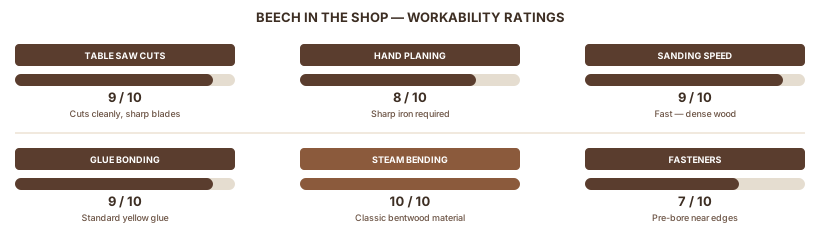
It cuts cleanly on the table saw. It planes well with a sharp hand plane. It sands quickly — the density means abrasives cut through it fast. Carbide saw blades and router bits handle it without complaint. The closed grain produces smooth surfaces without raising much.
The key requirement: sharp tools. Dull blades or plane irons will tear out beech along its ray flecks. The sharper your tools, the cleaner your results — which is true for any hardwood, but beech shows it clearly.
Gluing: Excellent. Standard yellow glue (Titebond Original or II) produces strong bonds with normal surface prep. No special adhesives needed.
Fasteners: Pre-bore before driving screws or nails close to edges. Beech will split without a pilot hole. Once fastened, it holds hardware well.
Steam bending: Beech excels here — it's the classic steam-bending wood. Woodcraft's WoodSense article on beech notes that Michael Thonet used steam-bent beech for his Model No. 14 chair in 1859, and that design has produced an estimated 50 million chairs. For curved work like chair backs, bent parts, and sculptural pieces, beech is the natural choice.
Dust: Fine particles; wear an N95 or use dust collection when sanding.
Part 4: What to Build with Beech
Beech is hard, fine-grained, and food safe. Those three things push it toward a specific set of projects.
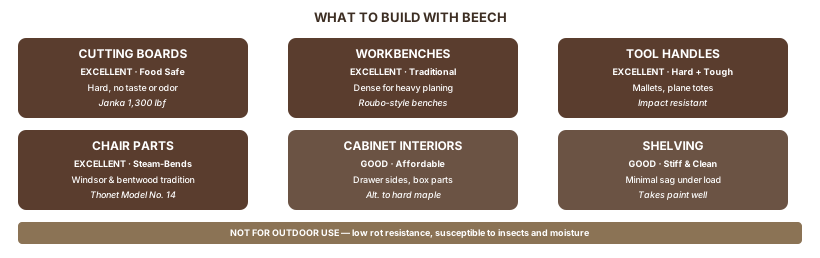
Cutting boards. Beech is food safe, has no taste or odor, and Janka 1,300 handles hard chopping without gouging. Traditional kitchen use in Europe goes back centuries. Face-grain and edge-grain boards both work well.
Workbenches. The traditional European workbench material. Roubo-style benches (the flat, heavy-slab design from the 18th century) used beech. It's dense enough for heavy planing, takes dog holes without tearout, and accepts vise hardware cleanly. If you're building a workbench, beech is an authentic choice — and it's cheaper than the maple many American woodworkers default to.
Tool handles. Mallet heads are traditionally beech (with ash or hickory for the handle). Hand plane totes, chisel handles, wooden clamp screws — beech's combination of hardness and workability is ideal for parts that take impact.
Chair parts. Spindles, legs, stretchers. Windsor chair tradition in England relied heavily on beech for turned parts. Steam-bent chair backs and arm bows in the bentwood tradition (Thonet, Breuer, Aalto) are all beech.
Cabinet interiors and drawer sides. Affordable alternative to hard maple for cabinet boxes and drawer components. Machines to a smooth surface, takes paint well, and holds drawer slides securely.
Shelving. Strong and stiff with a minimal sag under load. Clean edges under a router bit. Accepts paint or clear finishes without drama.
Beech is not suitable outdoors. Low rot resistance, susceptible to insects and moisture — it fails in exposed conditions. Keep it inside.
RELATED: Wooden Work Bench Beech is the traditional material for European-style workbenches — here's how to design the right height and build one from construction lumber.
Part 5: Finishing Beech
Clear Finishes — Just Apply Them
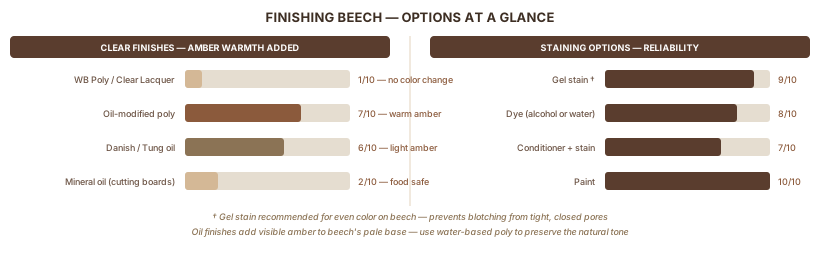
Polyurethane, lacquer, Danish oil, tung oil, shellac — all work on beech without tricks. Sand to 180–220 grit, wipe off the dust, apply your topcoat.
One color consideration: beech is pale. Oil-modified polyurethane and Danish oil add an amber warmth that's visible on such a light base. If you want to keep the natural pale tone, use water-based polyurethane or clear lacquer. They dry clear with no amber cast.
For cutting boards: mineral oil is the standard. It's food safe and penetrates well. Apply generously, let it soak for 20 minutes, wipe off the excess. Reapply when the surface looks dry.
Staining — Use Gel Stain
Beech can blotch with direct application of oil-based or water-based pigment stains. Its closed pores absorb unevenly between the rays and surrounding wood cells. Woodworkers Source recommends gel stain as the most reliable approach for achieving even color. The challenge is similar to staining maple — the same closed-pore structure causes the same uneven absorption.
Your options for a stained finish:
Gel stain (best results): Sits on the surface rather than soaking in. Apply with a rag, wipe off the excess. Even color without prep.
Conditioner + oil stain: A pre-stain wood conditioner partially fills the pores before the stain goes on. Reduces blotching significantly. Apply conditioner, let it dry, then apply stain within 15–30 minutes.
Dye (alcohol or water-based): Penetrates more evenly than pigment stains because the particles are much smaller. Good for dramatic color changes.
Paint: Works well on beech. The fine, closed grain primes cleanly and produces a smooth painted surface. Children's furniture and painted shelving are common applications.
If you want dark walnut-brown or ebonized black, plan to use gel stain or dye. Direct oil stain won't produce even results. For true black via iron acetate, apply a strong tea pre-treatment first. Beech has low tannin content and won't react without it.
Part 6: Beech vs. Common Alternatives
| Beech | Red Oak | Hard Maple | Black Walnut | Poplar | |
|---|---|---|---|---|---|
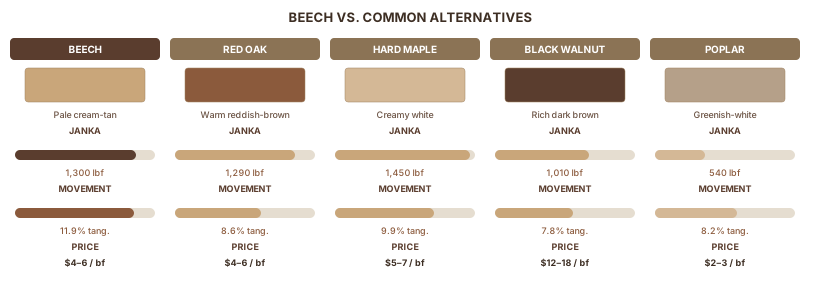
| Janka (lbf) | 1,300 | 1,290 | 1,450 | 1,010 | 540 |
| Tangential shrinkage | 11.9% | 8.6% | 9.9% | 7.8% | 8.2% |
| Color | Pale cream | Reddish-brown | Cream-white | Rich dark brown | Greenish-white |
| Outdoor durability | Non-durable | Non-durable | Non-durable | Moderate | Non-durable |
| Big-box availability | No | Yes | Rarely | No | Yes |
| Typical price/bf | $4–6 | $4–6 | $5–7 | $12–18 | $2–3 |
Choose beech for workbenches, cutting boards, chair parts, and tool handles anywhere you want a hard, fine-grained, affordable domestic hardwood. Woodweb's knowledge base on beech as a maple alternative notes it typically runs $1/bf less than hard maple from the same supplier.
Choose red oak if you want hardwood from a big-box store without specialty sourcing, or if you want open pores that take stain more evenly.
Choose hard maple if you need slightly more hardness (1,450 lbf vs. 1,300), or if you're in a region where maple is the default hardwood.
Choose walnut if you want rich natural color and a dramatic-looking piece. Walnut moves less and looks dramatically better under a clear coat. It costs two to three times more.
Choose poplar if you're on a tight budget, practicing a technique, or building a painted project where the surface will be fully covered.
Where This Fits
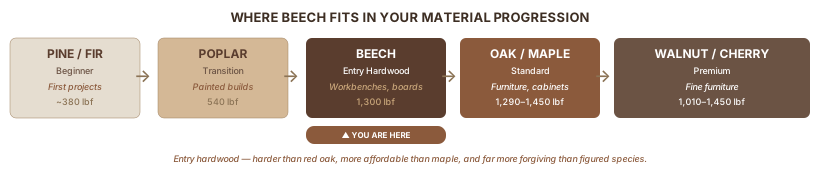
Beech is entry-level hardwood. It machines like a dense wood without punishing you the way figured maple or hard maple can. Start here if you're moving off pine or poplar for the first time.
Before this guide: Understanding Wood Grain and Movement — the principles behind wood movement and why beech's numbers matter for your design.
Related reference: Hardwood Expansion Rate Reference — species-by-species movement data for calculating panel expansion in your specific humidity range.
Related species overview: Hardwood Species Guide and Wood Species Quick-Reference for comparing beech to other common hardwoods.
Next project: Build a Cutting Board — the classic first hardwood project where beech excels.
Sources
Properties data come from wood science references, supplier technical pages, and woodworking community sources.
- The Wood Database — American Beech — Janka hardness, shrinkage coefficients, workability notes
- The Wood Database — European Beech — Janka 1,450 lbf, shrinkage data, movement classification
- Woodcraft WoodSense — Spotlight on Beech — historical uses, Thonet Model No. 14, workbench applications
- Woodworkers Source: 7 Techniques for Finishing Beech — gel stain recommendation, washcoat and dye techniques
- WoodBin: Wood Shrinkage Table — comparative shrinkage data across species
- Snow Valley Furniture: Movement and Shrinkage — practical panel movement calculation (3/8" per 12" board)
- Woodweb: Beech as an Alternative to Maple — price comparison, workability, finishing discussion
- Woodworking Network: American vs. European Beech — commercial species comparison
Wood Species
Up Next
What Is Curly Maple?
WOOD & MATERIALS · Beginner