
Bandsaw Box at a Glance
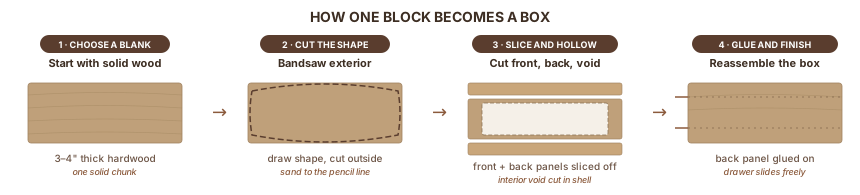
A bandsaw box comes from a single block of wood. You cut it apart, hollow the inside, and glue it back together. One tool, one afternoon, no joinery. The result looks like it was carved from one piece because it was. For a first bandsaw project, nothing beats this: fast setup, low material cost, and something you'll actually want to give away.
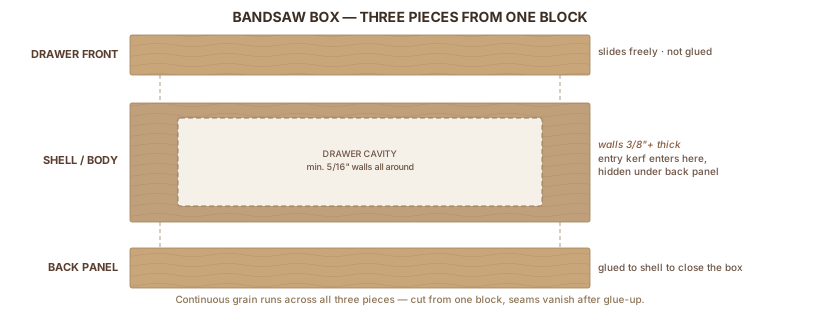
| Difficulty | Beginner |
| Active build time | 3–4 hours |
| Glue cure | 2–4 hours (overnight preferred) |
| Minimum blank | 3" × 4" × 6" |
| Best blade | 1/4" 4–6 TPI (teeth per inch) for curves |
| Wood cost | $15–30 in hardwood (scraps work too) |
In this guide:
- What you need — tools, blade, and wood
- Plan grain direction before the first cut
- Build a bandsaw box step by step
- Six things that go wrong and how to fix them
Part 1: What Makes This Project Work
The bandsaw box doesn't require joinery. There's no mortise and tenon, no dovetail, no dado. You cut a block of wood apart in a specific sequence, hollow out the pieces that become the drawer cavity, and glue everything back together with some parts removed. The result: a box with a sliding drawer that appears seamless from the outside.
That simplicity is the point. One afternoon, one power tool, and the project teaches you things you'll use for years: how to plan grain direction, how to control a curved cut, how to glue up without warping thin pieces, and how to sand curved surfaces without flattening them. It also makes a good gift.
What you need before starting: Basic bandsaw safety. If you've made a few straight cuts on a bandsaw, you're ready. The techniques are straightforward once you understand why each step matters.
Part 2: What You Need
Tools
You need a bandsaw. A 9" or 14" works (the 14" is more common, but the project doesn't need throat depth or resaw capacity). You also need:
- 1/4" 4–6 TPI blade for curved cuts (see below for details)
- Pencil and square
- 2–3 F-clamps or bar clamps
- Sandpaper: 80, 120, 180, 220 grit
- Optional but helpful: oscillating spindle sander or drill press with drum sanding attachment
If you don't own a spindle sander, hand-sand the curves. It takes longer but the technique is identical.
Blade selection
Blade width determines the tightest curve you can cut. A wider blade can't follow tight curves. It binds or pushes off the line. This table from Woodcraft's blade guide shows the relationship:
| Blade width | Minimum radius | Best use |
|---|---|---|
| 1/8" | ~3/16" | Very tight scroll-work curves |
| 3/16" | ~5/16" | Tight bandsaw box curves |
| 1/4" | ~3/4"–1" | Standard box curves (recommended) |
| 3/8" | ~1-3/4"–2" | Gentle curves only |
| 1/2" | Straight only | Back panel straight cut |
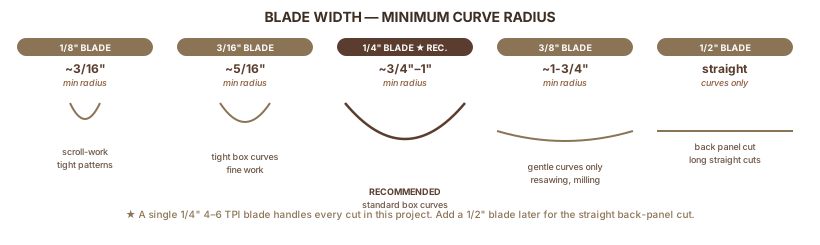
For your first box, a single 1/4" 4–6 TPI blade handles everything. Once you've built a few, consider keeping two: 1/4" for curves and 1/2" for the straight back panel cut. Popular Woodworking's bandsaw box guide recommends a 1/2" 4 TPI hook-tooth blade for long straight cuts. The extra width prevents the blade from bending and producing a bowed cut surface.
The kerf gap problem. The blade removes material equal to its kerf (the width of the cut, roughly 0.025"–0.040" for a 1/4" blade). That gap becomes the gap between the drawer and the box shell. On a fresh bandsaw box, the drawer can feel sloppy.
The fix: adhesive-backed felt lining inside the box cavity. Popular Woodworking's 7 Tips calls felt lining one of the most important finishing touches: felt thickness roughly matches one blade kerf, filling the gap and making the drawer glide with just the right resistance. Use wool-blend felt, not craft store felt. It's thicker and won't peel over time.
Wood selection
Blank dimensions: 3-4" thick, 4-5" wide, 6-10" long. A 3" × 4" × 8" blank is a good starting size. For a practice run before using expensive wood, grab a 4×4 cedar or poplar post from a home center and cut an 8" length. Costs $5–8.
Species that work well:
| Species | Cuts | Stability | Look | Cost |
|---|---|---|---|---|
| Walnut | Excellent | Good | Rich dark brown, dramatic grain | $$–$$$ |
| maple) | Good | Excellent | Pale, tight grain, very clean | $ |
| Cherry | Excellent | Good | Warm brown, darkens with age | $$ |
| Mahogany | Excellent | Excellent | Red-brown, even grain | $$ |
| Basswood | Very easy | Good | Pale, subtle | $ |
Avoid highly figured wood (burl, spalted, crotch) for your first box. Both look stunning but are unpredictable to cut. Soft pine can work but tears out on curves.
Cut from a single chunk when possible. The WoodWorkers Guild of America recommends starting with one solid piece rather than a glued-up blank. A single block gives you perfect grain match at every seam. No mismatched lines when the drawer closes. If you glue up a blank, align the grain carefully before the glue cures.
Part 3: Plan Grain Direction Before You Cut
Most tutorials skip this step. Don't.
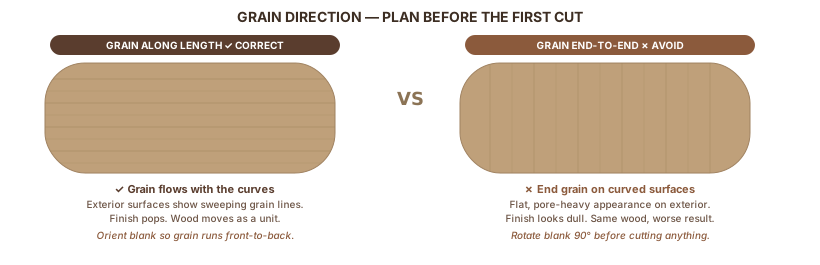
The grain orientation in your blank determines both the appearance and stability of the finished box.
The rule: Grain should run along the longest dimension of the box (front to back, not top to bottom).
Why appearance depends on this: When grain runs lengthwise, the curved exterior surfaces reveal grain lines that flow around the box. They sweep through the shape, following the curves you cut. When grain runs end-to-end, the curved surfaces show mostly end grain. Flat, pore-heavy, visually dull. Same wood, completely different result.
Why stability depends on this: A single block cut this way moves as a unit. Seasonal wood expansion and contraction happen in a predictable direction (mostly thickness). Pieces stay aligned.
How to check before cutting: Draw grain lines on the face of your blank with a pencil. Trace where you see the grain going. Visualize those lines on your finished box. Rotate the blank until the lines curve gracefully around where the exterior shape will be. That's your orientation.
Mark the top of the blank with a pencil T before any cut so you don't accidentally flip it.
Part 4: Build a Bandsaw Box Step by Step
This sequence covers a simple box with one drawer (trapezoid or organic-curved shape). Master this before trying anything with multiple drawers or hidden compartments.
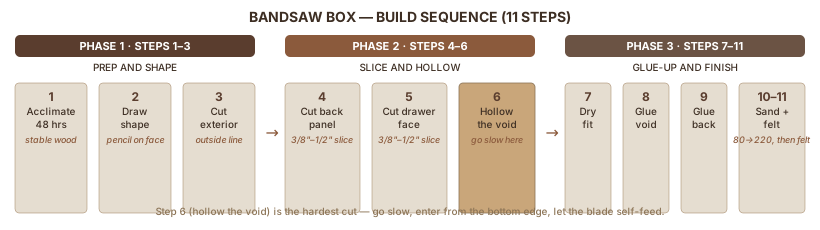
Steps 1–3: Prep the blank and establish the exterior shape
Step 1: Let the wood acclimate in your shop for 48 hours before cutting. Fresh lumber from a supplier can move after cutting, throwing off your fits.
Step 2: Draw the exterior shape on the face of the blank with a pencil. Keep curves smooth and generous. No inside corners, no sharp points. Leave at least 3/8" of wall thickness around the perimeter. If you're using a template (free ones are on Instructables and Pinterest), trace it now.
Step 3: Cut the exterior shape on the bandsaw. Feed slowly, let the blade lead, don't force turns. Cut just outside your pencil line. You'll sand to it later. For tight turns: approach gradually, back out if resistance builds.
Steps 4–6: Separate the back panel, drawer face, and interior void
Step 4: Cut the back panel. Set your fence or clamp a straight-edge guide 3/8"–1/2" from the blade. Cut one flat slice from the back of the blank. Set it aside. This gets glued back on at the end to close the box. Use a wider blade here if you have one. A narrow blade drifts on long straight cuts.
Step 5: Cut the drawer front face. Mark 3/8"–1/2" from the front of the blank. Cut that slice off. Set it aside. This becomes the visible face of the drawer.
Step 6: Cut the interior void. Go slow. This is where most beginners run into trouble.
On the drawer blank (the main body after removing back and front):
- Draw the interior walls: minimum 5/16" thick on all sides
- Enter from the side bottom of the blank (this kerf gets hidden under the back panel later)
- Follow your interior line at a slow, steady feed rate
- Let the blade self-feed; don't push
- If resistance builds: stop the saw, back the blade out slowly, cut a relief cut from the nearest edge to the bind point, then re-enter. Fine Woodworking explains blade binding as usually caused by pushing too fast or using too wide a blade for the radius
- Exit through the same kerf you entered
Aim for walls 5/16"–3/8" thick. Thinner walls are fragile. Thicker walls mean less drawer space.
Steps 7–9: Dry-fit, glue, and wait
Step 7: Dry-fit everything. Before any glue, assemble the back panel, shell, and drawer front. The drawer should slide in and out smoothly. Grain lines should match at every seam.
Make alignment marks: draw a pencil line across each seam. When you reassemble after gluing, align these marks for perfect grain match.
Step 8: Glue the interior void walls. Apply a thin, even coat of PVA glue (Titebond Original or Titebond II) to the interior void walls. Reassemble. Apply light clamping pressure, just enough to close the seam and squeeze out a thin bead of glue. Fine Woodworking's glue-up guide says tighten only until you see that thin bead, then stop. Too much pressure bows thin curved walls or snaps fragile grain.
Wait at least 2 hours. Overnight is better.
Step 9: Glue the back panel. Apply glue to the flat back surface of the shell. Clamp the back panel flat against it. Wait 2 hours. Do not glue the drawer front. It slides freely.
Steps 10–11: Sand and finish
Step 10: Sand the exterior. Work through 80 → 120 → 180 → 220 grit. For the curved exterior, an oscillating spindle sander or a shaped sanding block (trace the curve onto scrap, bandsaw it, sand it smooth) works far better than flat sandpaper. Woodcraft's guide on smoothing curves shows how to make the complementary block.
Critical rule: Barely touch the mating surfaces (the faces where the drawer slides against the box shell). They came off the saw clean. Every pass of sandpaper rounds those edges and creates a permanent visible gap. Mark them with a pencil line before sanding. Don't sand past it.
Step 11: Felt lining. After the exterior finish cures, line the inside of the box cavity with adhesive-backed felt. Cut pieces to fit the interior walls exactly. Wool-blend felt holds up. Cheap craft felt peels. The felt fills the kerf gap and makes the drawer glide.
Part 5: Six Things That Go Wrong and How to Fix Them
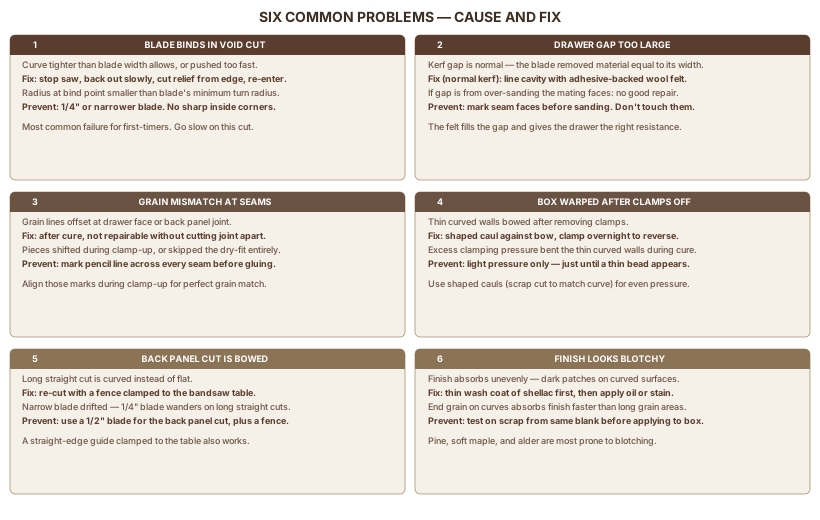
1. Blade binds during the interior void cut The curve radius is tighter than the blade width allows, or you pushed too fast. Stop the saw immediately. With the saw off, back the blade out slowly. Cut a relief cut from the nearest edge toward the bind point. Re-enter the cut. Prevention: 1/4" or narrower blade; smooth curves with no inside corners.
2. Drawer gap is too large That's the normal kerf gap. Felt lining fills it. If the gap came from over-sanding the mating surfaces, there's no good repair. Sand the exterior freely. Barely touch the seam faces.
3. Grain lines don't match at the seams after glue-up You either skipped the dry-fit or the pieces shifted during clamping. Pencil alignment marks across each seam before gluing, then align them during clamp-up. Major misalignment after cure isn't fixable without cutting the joint apart.
4. Box warped after clamps came off Too much clamping pressure bent the thin walls. Make a shaped caul: bandsaw a piece of scrap to match the box exterior curve, clamp it against the bow overnight. Prevention: light pressure; shaped cauls; stable species (walnut, maple, cherry).
5. Back panel cut is bowed, not flat A narrow blade drifted on the long straight cut. Use a fence or straight-edge guide clamped to the bandsaw table. A 1/2" blade stays straight better than a 1/4" blade on this cut.
6. Finish looks blotchy Pine, soft maple, and alder absorb finish unevenly on curved surfaces where end grain is exposed. Test on scrap from the same wood first. For blotch-prone species, apply a thin wash coat of shellac before Danish oil or stain. The shellac seals the pores evenly.
Part 6: Finishing Curved Wood
Danish oil is the easiest choice for a first bandsaw box. It's a wipe-on penetrating finish with no brush, no lap marks, no drips on curves. Apply with a lint-free rag, wipe off the excess after 15 minutes, repeat 2–3 coats with 24 hours between. On walnut or cherry, it pops the grain and adds warmth without hiding the wood.
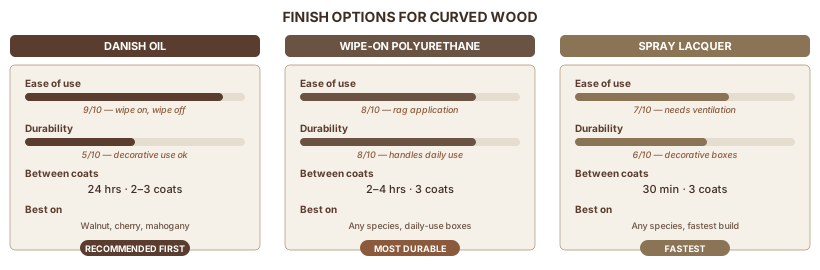
Two faster options:
Wipe-on polyurethane. More durable than oil. Better if the box will be handled daily. Three thin coats, 2–4 hours between, light 320-grit sand between coats. Wipe on with a rag. Slightly harder surface feel when cured.
Spray lacquer. Fastest. Thin coats, 30 minutes between, no brush strokes on curves. Needs good ventilation. Three coats is enough for a decorative box.
Test your chosen finish on a scrap piece from the same blank first. Danish oil that looks stunning on walnut can look blotchy on pine from the same board.
Part 7: What to Build Next
After a simple box, the progression splits: more complex bandsaw designs, or new projects that build on the same bandsaw foundation.
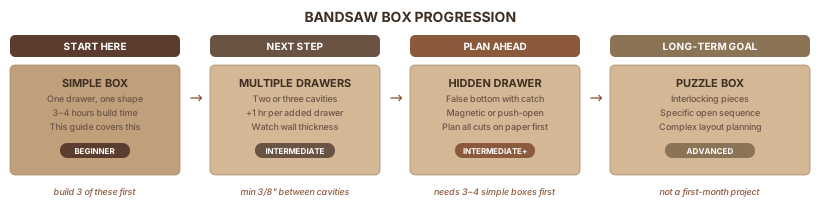
More complex bandsaw boxes:
Multiple drawers. Same technique repeated for each cavity. Add about an hour per drawer. Watch the walls between cavities. Minimum 3/8" between them or they'll break.
Hidden drawer. A false bottom below the main drawer, opened with a magnetic catch or pressure-point mechanism. Requires planning all cuts on paper before touching the wood. JMA Wood Studio's guide on secret compartments walks through the technique. Build three or four simple boxes first.
Puzzle box. Multiple interlocking pieces that require a specific sequence to open. Significantly more complex. Not a first-month project.
By the third simple box, the interior void cut stops feeling scary. That's when variations start to make sense.
Where This Fits
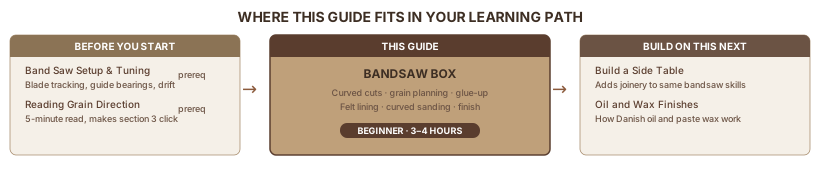
Before you start:
- Band Saw Setup and Tuning — if you haven't adjusted blade tracking or guide bearings recently
- Reading Grain Direction — a five-minute read that makes the grain direction section above click
Related guides:
- Choosing the Right Band Saw — if you're deciding on a 9" or 14" saw
- Oil and Wax Finishes — how Danish oil and paste wax work, and when to use each
What to build next: Once you've built a few boxes, Build a Side Table is the natural step up. It adds joinery and wood movement planning to the same bandsaw skills.
Sources
Research for this guide drew from woodworking tutorials, manufacturer blade specifications, and practitioner publications.
- Popular Woodworking: 7 Tips for Making Bandsaw Boxes — felt lining, minimal sanding on mating surfaces, 1/2" blade for straight cuts
- Woodcraft: Choosing the Right Bandsaw Blade — blade width to minimum radius relationship
- Fine Woodworking: How to Keep a Bandsaw Blade from Binding — causes and technique for interior void cuts
- Fine Woodworking: How to Glue Up Joints — clamping pressure by wood type and joint geometry
- WoodWorkers Guild of America: How to Make a Bandsaw Box — single-block construction principle
- JMA Wood Studio: Beginner Guide — beginner-specific tips and common mistakes
- JMA Wood Studio: Grain Selection Guide — species and grain direction for bandsaw boxes
- JMA Wood Studio: Secret Compartments — hidden drawer technique
- Woodcraft: Smoothing Curves — shaped sanding blocks for complementary curves
- Make Something: How to Make a Bandsaw Box — detailed build sequence, blade specifications
- Canadian Woodworking: Creating a Bandsaw Box — species selection and grain direction
- Dakin-Flathers: Band Saw Blade TPI Chart — TPI selection by material thickness
- Ravenview: Bandsaw Blade Radius Chart — blade width to minimum radius
- Fine Woodworking: Beautiful Bandsawn Boxes — expert design and technique
Tools Used
Tagged
Up Next
Best Band Saw for Woodworking: 5 Picks From $400 to $2,400
POWER TOOLS · Intermediate