
QUICK ANSWER: A river-table epoxy build needs two products that look similar but fail catastrophically if swapped: deep-pour epoxy (for 1–2" thick channels, cures over 24–72 hours) and coating epoxy (for thin films under 1/8", cures in 4–8 hours). Use deep-pour for the river channel, coating epoxy for the topcoat. Seal the wood edges with a thin flood-coat layer BEFORE the main pour, or trapped air will rise through the deep epoxy as a cloud of bubbles. Budget $200–600 in epoxy + wood for a typical 36–48" river table.
Epoxy Coffee Tables at a Glance
Epoxy coffee tables combine wood slabs with poured resin to create statement furniture. The most popular build is a river table: two slabs separated by a channel of colored or clear epoxy. Two things trip up every first-time builder. Deep-pour and coating epoxy are completely different products that fail spectacularly if you swap them. And the wood must be sealed before the main pour, or you'll get a cloud of bubbles rising through the clear channel. Everything else is patience and grit progression.
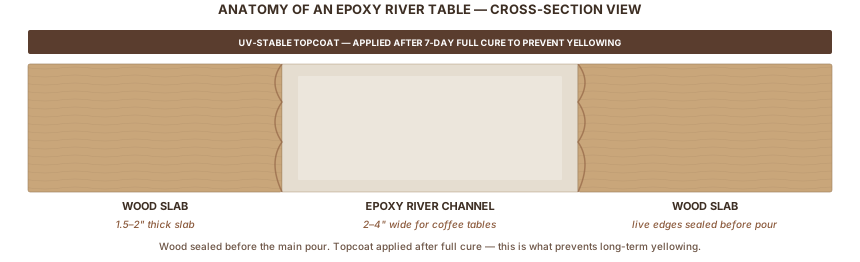
| Most popular style | River table — two slabs with an epoxy channel |
| Epoxy for deep pours (>1/4") | Deep-pour/casting epoxy — max 1–2" per layer |
| Epoxy for final coat | Table-top coating epoxy or clear polyurethane |
| Work temperature | 70–80°F; below 65°F risks incomplete cure |
| Time to demold | 48–72 hours; full cure (sandable) at 7 days |
| DIY coffee table cost | $300–$600 in materials |
In this guide:
- Choosing your project type and wood species
- Understanding the two epoxy types and why they matter
- Building a leakproof mold and anchoring your slabs
- Seal coat, mixing protocol, and the pour sequence
- Sanding sequence and topcoat selection
- Troubleshooting the five failures every first-timer hits
Part 1: Choose Your Project Type and Wood
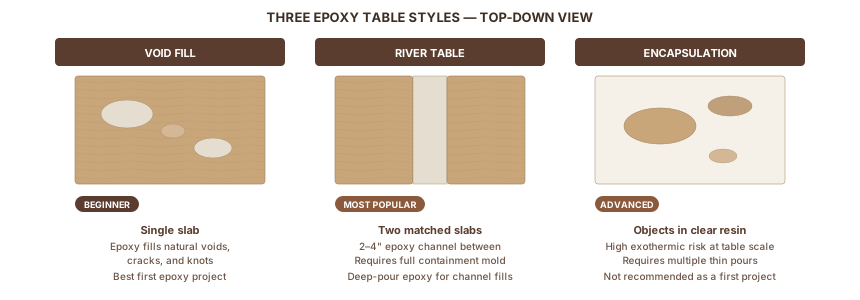
Three epoxy table styles
Live-edge void fill is the simplest starting point. You have a single slab with natural voids, cracks, or checked edges. Epoxy fills those spaces. The wood dominates visually; the resin is an accent. This project teaches you the pour, seal, and sanding sequence without the complexity of a full mold.
River table is the most popular and most dramatic. Two matched slabs face each other across a channel of colored or clear epoxy. For a coffee table, that channel is typically 2–4" wide. Narrow reads as a crack; wider starts to look like a pond. The river table requires a full containment mold, deep-pour epoxy for any channel deeper than 1/4", and a method to keep the slabs from floating during the pour (more on this in the mold section).
Full encapsulation (objects fully suspended in clear epoxy) is the most technically demanding. Large-volume pours generate serious exothermic heat at coffee table scale. Not a first project.
If this is your first epoxy build: start with a void fill or a river table with a shallow channel (1" or less). Once you've done one successful pour, the deep-pour technique feels much less intimidating.
Wood that works
The best species for epoxy tables are hard enough to sand cleanly and have stable, predictable grain. Black walnut is the classic choice: rich dark color, fine grain, machines well, and pairs visually with almost any epoxy color. Hard maple contrasts beautifully with dark or vibrant epoxy. White oak works, though its open grain requires a thorough seal coat. Cherry is a bit softer but finishes beautifully.
Avoid pine and softwoods at coffee table scale. They're too soft for daily use, they dent, and their open grain releases bubbles into the pour even after sealing. Reclaimed barn wood with unknown moisture content is a gamble. High moisture trapped in the slab will vapor-bubble through your entire pour.
Moisture content matters more than species. Any slab going into an epoxy table should read below 10% on a moisture meter, with 6–8% ideal. Moisture trapped in the wood turns to vapor during the exothermic cure and creates bubbles throughout the pour.
Janka hardness (measured in pounds-force) tells you how resistant a species is to denting and surface damage. Anything above 900 lbf works for a coffee table.
| Species | Janka hardness | Good for beginners? | Notes |
|---|---|---|---|
| Black walnut | 1,010 lbf | Yes | Classic choice; fine grain, machines cleanly |
| Hard maple | 1,450 lbf | Yes | Very hard; brilliant with colorful epoxy |
| White oak | 1,360 lbf | Yes | Open grain — thorough seal coat critical |
| Cherry | 950 lbf | Yes | Warmer tone; moves seasonally, allow for it |
| Ash | 1,320 lbf | Yes | Open grain; dramatic look with dark epoxy |
| Eastern pine | 870 lbf | No | Too soft; moisture issues; bubble source |
Standard coffee table proportions: 36–48" long × 18–24" wide, with slabs at 1.5–2" finished thickness.
Part 2: The Two Epoxies (Don't Mix Them Up)
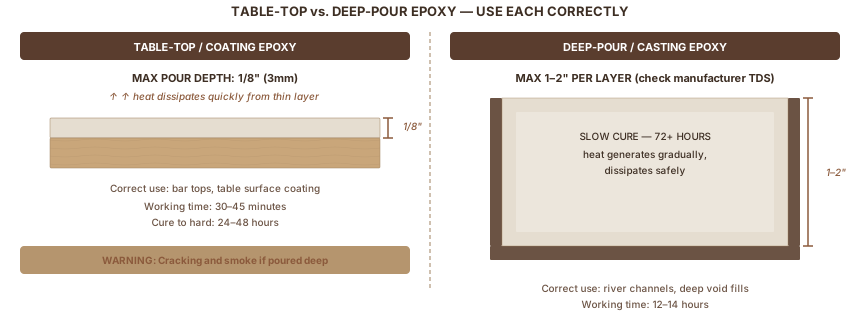
This is the mistake that ruins first builds. Deep-pour casting epoxy and table-top coating epoxy are not interchangeable. Pouring table-top epoxy into a 2" river channel generates enough heat to crack the cured pour, warp your slab, and in extreme cases smoke.
What makes them different
The core difference is exothermic reaction management. When epoxy cures, it generates heat. A thin layer (1/8") spreads that heat across a large surface and dissipates it safely. A deep pour traps heat in the center. Deep-pour epoxy uses a slower hardener that extends the cure over 72+ hours. The heat generates slowly enough to dissipate. Table-top epoxy uses a faster hardener that generates the same total heat in a fraction of the time, all concentrated in the middle of a thick pour.
| Property | Table-Top (Coating) Epoxy | Deep-Pour (Casting) Epoxy |
|---|---|---|
| Viscosity | High (honey-like) | Low (water-like) |
| Max single pour depth | 1/8" (3mm) | 1–2" per layer (check TDS) |
| Cure time to hard | 24–48 hours | 72+ hours |
| Working time (pot life*) | 30–45 minutes | 12–14 hours |
| Primary use | Protective coating, bar tops | River fills, deep void casting |
| Exothermic risk | High if poured > 1/4" deep | Low at manufacturer-rated depths |
*Pot life: the window of time after mixing when the epoxy is still liquid enough to pour. After pot life expires, the epoxy gels in the container and generates dangerous heat if left in a mass.
TotalBoat's table-top vs. deep-pour comparison puts it plainly: these are different chemistries designed for different applications.
Which epoxy for a coffee table
River channel deeper than 1/4": use deep-pour epoxy for all fill layers. Pour in layers no thicker than the manufacturer's rated maximum (typically 1–2" per pour, but read the TDS — it varies by brand). Popular deep-pour options: TotalBoat TotalCast, Pro Marine Supplies Deep Pour, System Three SilverTip.
Final surface coat (the last 1/8" or less): switch to table-top epoxy or apply a UV-stable polyurethane topcoat instead. Table-top epoxy (TotalBoat TableTop Plus, MAS Table Top Pro) gives you a glass-smooth, self-leveling finish. Polyurethane offers better UV protection and is discussed in the topcoat section.
Small void fills under 1/4" deep: either type works. Table-top epoxy is thicker, which keeps it from running out of shallow voids before it gels.
Part 3: Build the Mold
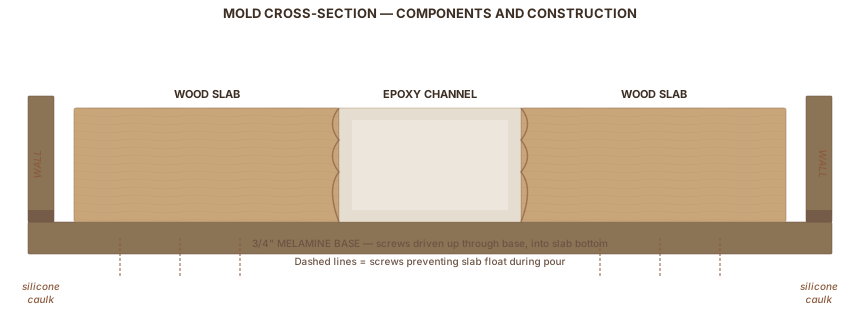
The mold contains the epoxy during the pour and determines the shape of the finished surface. Most first-time mold failures come from two sources: leaks at the seams, and wood slabs that float.
Materials
- 3/4" melamine-coated particleboard (the plastic-coated surface resists epoxy bonding — that's what you want)
- 100% silicone caulk (not latex, not "paintable" — specifically silicone)
- Mold release: Johnson's Paste Wax or a dedicated mold release spray like Stoner E236
- Screws and a drill
Avoid raw plywood as a mold material. Epoxy soaks into it and bonds permanently. ChillEpoxy's mold guide explains why melamine is so reliable: the smooth plastic coating simply doesn't give epoxy anything to grip.
Construction
- Cut the mold base 4–6" larger than your finished table on all sides. This gives you room to work and collects any overflow.
- Cut side walls: height equals your intended pour depth plus 1/2". These form the containment walls.
- Attach the walls using screws driven through the exterior faces into the base. Never screw through the interior melamine face. A screw hole on the epoxy-contact surface will leak.
- Run a bead of 100% silicone caulk along every interior seam. Smooth with a gloved finger. Let it cure 24 hours before proceeding.
- Apply two coats of paste wax to all interior melamine surfaces, letting each coat haze before buffing. This is your primary release agent.
- Position your wood slabs exactly where you want them on the mold base.
- Screw the slabs to the mold base from underneath. Drill through the base and drive screws up into the slab bottom. This prevents floating.
Before mixing any epoxy: run water along all interior seams and watch for 10 minutes. A pinhole leak becomes a catastrophic one under the pressure of liquid epoxy. Any drip gets a fresh bead of silicone, another 12-hour cure, and another water test.
Preventing float
Wood is buoyant in liquid epoxy. A 2" walnut slab will push up through a 2" pour if it isn't secured. Screwing from underneath is the most reliable method. As a backup, use bar clamps spanning the mold to hold slabs down during the pour. Remove the clamps after 3–4 hours, before the epoxy gels around the clamp contact points.
Part 4: Mix and Pour
Calculate your epoxy volume
Length × Width × Depth (all in inches) ÷ 231 = gallons needed. Buy 20–30% extra: wood absorbs some epoxy, and running short mid-pour means a visible layer line.
Example: a 40" river channel, 3" wide, 1.5" deep = 180 cubic inches ÷ 231 = 0.78 gallons. Order 1 full gallon. The Blacktail Studio epoxy calculator does this math for any shape.
The seal coat (don't skip this)
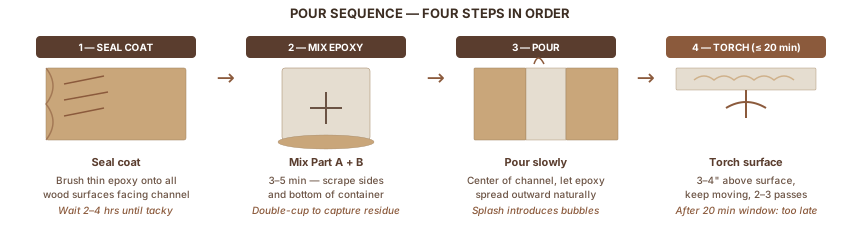
Before the main pour, brush a thin coat of epoxy onto every wood surface that will contact the river: live edges, knots, cracks, end grain, and natural voids. Work it into the grain with a stiff brush. End grain is especially thirsty — apply generously.
This seal coat saturates open wood pores with epoxy, which prevents air from escaping during the main pour. Without it, trapped air migrates upward through the liquid resin and leaves a cloud of fine bubbles throughout your pour. Torch the seal coat surface immediately (within 15–20 minutes) to pop any surface bubbles, then let it reach a tacky-but-not-wet state. At 75°F, that's typically 2–4 hours before the main pour.
Mixing protocol
Epoxy cure failures come from one of three sources: wrong ratio, cold materials, or inadequate mixing. Fix all three before you start.
- Bring resin and hardener to 70–75°F overnight if they've been stored in a cold garage. Cold epoxy is thicker, mixes harder, and cures slower.
- Measure Part A (resin) first, using measuring cups or a digital scale set to the manufacturer's volume ratio. Add Part B (hardener). Never reverse order. Starting with hardener makes the ratio harder to control.
- Mix for 3–5 minutes. Set a timer. Scrape the sides and especially the bottom of the container — unmixed resin clings there and creates soft spots in the cured pour.
- "Double-cup" the batch: pour the mixed epoxy into a second clean container and mix for another minute. This captures any unmixed material clinging to the first container's walls.
- Add colorant now (mica powder, transparent dye, or alcohol ink). Stir thoroughly until completely uniform.
- Pour within the working time window — table-top epoxy within 30–45 minutes, deep-pour within 12 hours.
Work in a 70–80°F environment with relative humidity below 75%. Per West System's troubleshooting guide, temperature below 65°F slows the cure dramatically and may prevent full crosslinking. High humidity above 75% causes amine blush — a white haze that forms on the cured surface and requires light sanding and a wipe-down with isopropyl alcohol to fix.
The pour
Pour slowly, starting at the center of the channel and letting the epoxy spread outward. Use a stir stick to coax it into corners. Pouring fast splashes and introduces bubbles.
Torch the surface within 20 minutes of pouring: pass the flame 3–4" above the surface, keep it moving constantly, 2–3 passes. TotalBoat's bubble guide is clear on the timing window. After 20 minutes, the epoxy is too far into the cure to tolerate the heat safely. You'll get a scorched, wavy surface.
For channels deeper than the single-layer maximum, pour in layers. Let each layer gel to a rubbery but not hard consistency (typically 24 hours at 75°F), then lightly sand the surface with 120 grit to create inter-layer adhesion before the next pour.
Part 5: Sand and Topcoat
Wait the full 7 days
Deep-pour epoxy reaches demolding hardness at 48–72 hours, but full chemical cure (Barcol hardness, full crosslinking) takes 7 days. Sand before that and you're grinding soft, uncured material into the surface — it clogs your paper and smears into the pores.
Sanding sequence
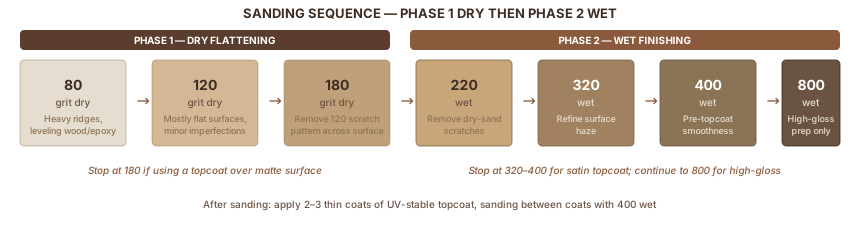
Phase 1: Flattening (dry). Address any ridges, high/low spots between wood and epoxy, and surface imperfections from the mold.
- 80 grit dry: for significant ridges or uneven surfaces
- 120 grit dry: for mostly flat surfaces with minor imperfections
- 180 grit dry: remove the 120 scratch pattern across the whole surface
Use a random-orbit sander. Keep it moving — dwelling in one spot builds heat that can cloud the epoxy.
Phase 2: Finishing (wet). Wet sanding prevents heat buildup and keeps epoxy dust suspended in water rather than the air.
| Grit | Method | Goal | Move up when... |
|---|---|---|---|
| 220 | Wet | Remove dry-sand scratches | Surface has uniform haze |
| 320 | Wet | Refine haze | Previous scratches gone |
| 400 | Wet | Pre-topcoat smoothness | Clean, consistent matte sheen |
| 800 | Wet | Pre-topcoat high-gloss prep | All 400 scratches gone |
For a matte/satin topcoat finish, stop at 320–400 wet. For a high-gloss topcoat, continue to 800. Per eQualle's grit guide, skipping a grit leaves deeper scratches that show under the topcoat.
The UV problem: why topcoat isn't optional
All standard epoxy yellows under UV exposure. Resin Society's real-world testing shows visible yellowing in 6–12 months near a window and 12–24 months in indirect indoor light. Even UV-stable epoxy formulations (which contain HALS, a class of UV-absorbing chemicals called Hindered Amine Light Stabilizers) slow but don't stop this process. A UV-blocking topcoat is what actually protects long-term clarity.
Topcoat options
| Topcoat | UV resistance | Sheen | Notes |
|---|---|---|---|
| Water-based poly (Varathane Diamond) | Good | Satin to gloss | Easiest; slight amber tone; 3–4 wk full cure |
| Oil-based spar urethane (Minwax Helmsman) | Very good | Gloss | Better UV; warm amber; slower dry time |
| Polyaspartic / aliphatic urethane | Excellent | Gloss | Commercial-grade hardness; short pot life |
For most home coffee tables: water-based polyurethane. Apply after sanding to 320–400 wet, which gives the topcoat something to grip. Two to three thin coats, sanding between each with 400 wet. For detailed application technique, see the applying polyurethane guide.
Part 6: When Things Go Wrong
These failures hit first-time builders consistently. All are preventable. Most are fixable after the fact. TotalBoat's epoxy troubleshooting reference covers each of these in more depth.
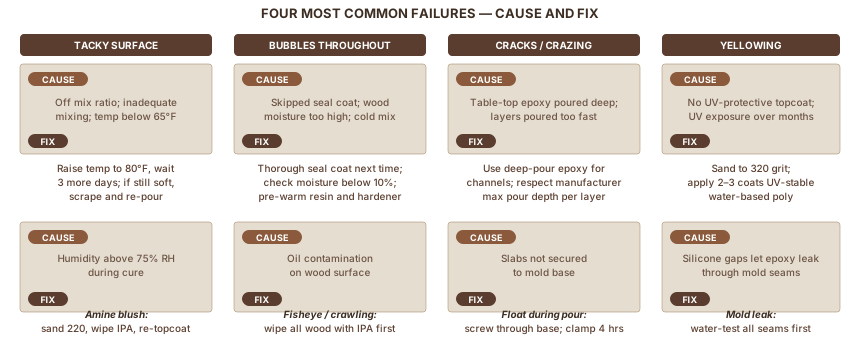
| Problem | Most likely cause | Fix |
|---|---|---|
| Surface stays tacky after 5+ days | Off mix ratio; inadequate mixing; temperature < 65°F | Raise ambient temp to 80°F; wait 3 more days; if still soft, scrape and re-pour |
| Cracks or crazing in cured epoxy | Table-top epoxy poured too deep; deep-pour poured in layers too fast | Use deep-pour for channels; respect manufacturer's max pour depth; layer correctly |
| Bubbles throughout the pour | Skipped seal coat; wood moisture too high; cold materials | Thorough seal coat next time; check moisture content; pre-warm resin and hardener |
| Surface yellowed within a year | No UV-protective topcoat applied | Sand back to 320 grit; apply 2–3 coats UV-stable water-based poly |
| Wood slabs floated up in the pour | Slabs not secured to mold | Screw through mold base from underneath next time; clamp slabs for first 4 hours |
| White haze on surface (amine blush) | Humidity > 75% RH during cure | Sand lightly with 220; wipe with isopropyl alcohol; re-topcoat |
| Epoxy leaked from mold | Inadequate silicone sealing | Water-test all seams before every pour; re-caulk and test again |
| Fisheye or crawling in seal coat | Oil contamination on wood surface | Wipe all wood with isopropyl alcohol before applying seal coat |
Where This Fits
Prerequisites: If you haven't applied a clear finish over wood before, read the applying polyurethane guide first. The topcoating steps assume you're comfortable with brush application and coat timing.
Related projects: Coffee table with drawer for an alternative coffee table build. How to refinish a table for working on existing furniture.

What's next: Once you've poured a river table, void fills in other furniture pieces feel routine. You've already solved the hard problems: mold building, sealing, and bubble management. After that, epoxy-filled knots in a cutting board, accent fills in a shelf or bench, or a full-encapsulation resin casting project for smaller objects.
Sources
Research on epoxy chemistry, pour technique, wood selection, troubleshooting, and sanding informed this guide.
- TotalBoat: Table Top vs. Deep Pour Epoxy — spec comparison and use-case guidance
- TotalBoat: Getting Rid of Bubbles in Epoxy — bubble removal timing and 20-minute window
- TotalBoat: Table Top Epoxy Problems — cure failure troubleshooting
- West System: Epoxy Problem Solver — temperature and mixing failure reference
- ChillEpoxy: Building a Melamine Mold — mold construction technique
- Blacktail Studio: Epoxy Volume Calculator — volume formula and calculation method
- eQualle: Sanding Epoxy River Tables — grit progression for epoxy surfaces
- Resin Society: Do Epoxy Tables Yellow? — real-world UV yellowing timeline with photos
Tools Used
Wood Species
Also Referenced