
1x6 Lumber at a Glance
A 1x6 board measures 3/4 inch thick by 5-1/2 inches wide — not 1 inch by 6 inches. That gap isn't a defect or a scam. It's the result of drying and planing at the mill, and it's been standard in the lumber industry for decades. Pine and SPF whitewood are the cheapest options at big-box stores; poplar takes paint the cleanest; cedar is what you want outdoors; oak is for stained furniture that needs to look good for decades. Grades run from Select (minimal defects, clear grain) to #2 Common (budget, for painted or utility work). Inspect every board before you load it — straightness, knots, and moisture content all matter more than brand or store.
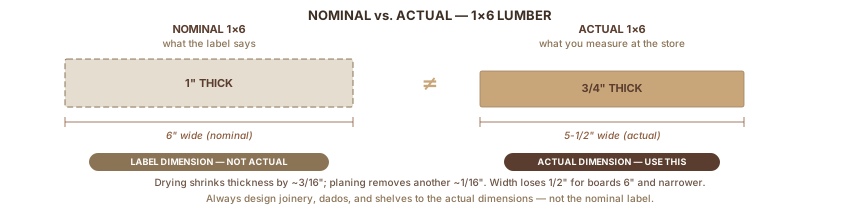
| Actual size | 3/4" thick × 5-1/2" wide |
| Standard lengths | 6, 8, 10, 12, 16 ft |
| Common species | Pine, Poplar, Cedar, Red Oak, SPF Whitewood |
| Budget pick (painted work) | SPF Whitewood or Pine #2 — $1.50–3/lf |
| Best all-rounder | Pine #1 Common — painted or natural, easy to work |
| Best for paint | Poplar — takes paint cleaner than any other 1x6 |
In this guide:
- Why a 1x6 isn't actually 1 inch by 6 inches
- Pine, poplar, cedar, oak, and whitewood compared
- Reading grade stamps and surface codes
- Which 1x6 for your specific project
Part 1: Why a 1x6 Isn't Actually 1 Inch by 6 Inches
Walk into any lumberyard or Home Depot and pull a board labeled "1×6." Measure it. You'll get 3/4 inch thick by 5-1/2 inches wide, every time. The label refers to the nominal dimension — the rough size of the wood before the mill finishes it.
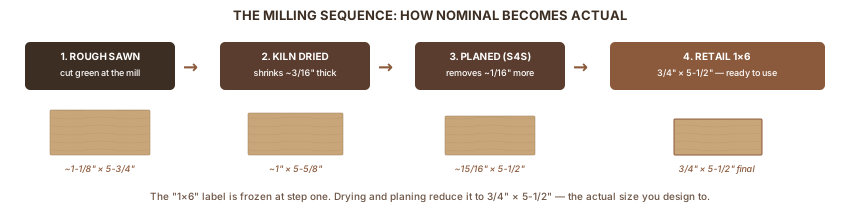
Here's what happens between the tree and the store. Baird Brothers' guide on nominal vs. actual dimensions walks through it clearly: after the log is sawn into boards, the green lumber goes into a kiln to dry. As moisture leaves the wood, the cells shrink. A board that starts at 1 inch thick loses about 3/16 inch just from drying. Then it goes through a planer to create flat, parallel surfaces — removing another 1/16 inch or so. Same process on the width: a 6-inch rough board exits the planer at 5-1/2 inches. Lowe's nominal size guide confirms this is consistent across retail and specialty sources.
The lengths don't shrink in any meaningful way. An 8-foot board stays 8 feet.
What This Means for Your Project
If you design shelves assuming 1-inch-thick boards, your dado depths will be off, your joinery won't fit, and your material estimates will be wrong. Always design to the actual dimensions — 3/4 inch thick, 5-1/2 inches wide.
If you genuinely need 1-inch-thick stock, you have two options. First, buy 5/4 lumber (nominal five-quarter, actual ~1-1/8 inch), available at lumber yards and online mills, and surface it down to 1 inch with a planer. Second, glue up two 1/2-inch sheets of plywood. Standard retail 1x6 dimensional lumber will not get you to actual 1 inch thickness.
Nominal vs. Actual: The Full 1x Series
| Nominal | Actual thickness | Actual width |
|---|---|---|
| 1×2 | 3/4" | 1-1/2" |
| 1×3 | 3/4" | 2-1/2" |
| 1×4 | 3/4" | 3-1/2" |
| 1×6 | 3/4" | 5-1/2" |
| 1×8 | 3/4" | 7-1/4" |
| 1×10 | 3/4" | 9-1/4" |
| 1×12 | 3/4" | 11-1/4" |
Thickness is always 3/4 inch for standard 1x boards. Width loses 1/2 inch on boards up to 6 inches, and 3/4 inch on wider boards.
Part 2: Pine, Poplar, Cedar, Oak, and Whitewood: Which to Choose
Five species make up almost everything on the 1x6 shelf at any lumber source. Each has a different personality — different workability, different finishing behavior, different price.
Pine (Eastern White, Southern Yellow)
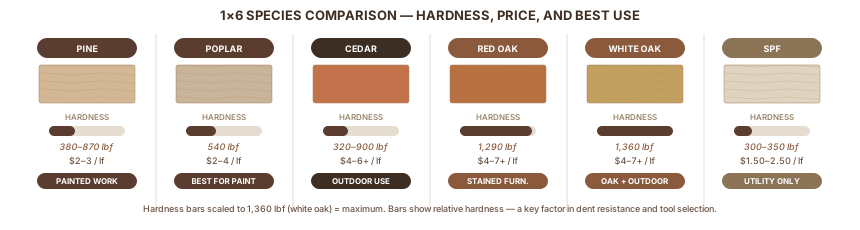
Price: $2–3 per linear foot. Janka hardness: 380–870 lbf depending on variety.
Pine is the default starting point for most beginners. It's soft, it machines easily, and it's cheap. The catch: pine is a terrible candidate for stain if you don't prep it. The early wood (the lighter, springy part of each growth ring) and late wood (the darker, denser part) absorb stain at wildly different rates. The result is blotchy, ring-visible color. Fine Woodworking's guide to blotch control walks through the fix: use a pre-stain wood conditioner, sand to 100–120 grit (not finer — closing the pores makes it worse), or use a gel stain that sits on the surface instead of soaking in.
For painted projects, pine is excellent. Paint hides the grain, and pine's smooth surface takes primer well.
Outdoors, skip regular pine. It has no natural rot resistance and will fail in two to three years without paint or sealer. Use pressure-treated pine or cedar instead.
Best for: Painted shelves, trim, cabinet carcasses, beginner practice projects.
Poplar (Yellow Poplar)
Price: $2–4 per linear foot. Janka hardness: 540 lbf.
Poplar is the best-kept secret in the 1x6 world. It's harder than pine, machines cleaner, and takes paint better than almost any other domestic wood. The grain is fine and even, without pine's strong growth rings, so paint goes on uniformly and looks professional. It costs about the same as pine and is available at most big-box stores.
The trade-off: poplar's grain is subtle enough to disappear under stain. If your project will be stained, pine or oak will give you more visible character. If it's being painted, poplar is the better choice.
Best for: Painted furniture, trim, cabinet doors, any project where clean paint adhesion matters.
Cedar (Western Red, Eastern White, Aromatic Red)
Price: $4–6+ per linear foot. Janka hardness: 320–900 lbf depending on variety.
Cedar is the outdoor wood. Natural oils in the wood resist rot, insects, and moisture. Left unfinished, it weathers to gray. Sealed annually with a penetrating oil or spar varnish, it holds its warm reddish color for years. Dutch Crafters' comparison of cedar vs. pine for outdoor furniture documents cedar lasting 10+ years outdoors versus 2–3 years for untreated pine.
Cedar costs two to three times more than pine. That premium is worth it for outdoor furniture, planters, and anything exposed to weather. For interior shelves where you want the natural look, cedar's warm color and aroma make it a nice choice too.
Best for: Outdoor furniture, deck railings, planters, visible interior shelves with a natural finish.
Oak (Red Oak, White Oak)
Price: $4–7+ per linear foot. Janka hardness: 1,290–1,360 lbf.
Oak is the premium species for stained furniture. The grain is coarse and visible, stain colors show up clearly, and the wood is hard enough to resist denting in daily-use furniture. Red oak and white oak behave differently in one critical way: red oak has open pores that absorb water readily, making it a poor outdoor choice. White oak's pores are closed by tyloses, making it nearly impervious to water — it's the wood used in boat building and wine barrels. For outdoor projects where you want visible wood grain, white oak is the species to choose.
Oak requires sharper tools and more deliberate technique than pine or poplar. It's not a beginner trap, but it rewards proper setup.
Best for: Stained furniture and cabinetry, formal interiors, high-visibility pieces. White oak for outdoor use when appearance matters.
For a broader comparison of hardwood species — including walnut, cherry, and maple — see the Hardwood Species Guide.
SPF Whitewood (Spruce-Pine-Fir Blend)
Price: $1.50–2.50 per linear foot. Janka hardness: 300–350 lbf.
When Home Depot or Lowe's labels a board "whitewood," they're not selling you a specific species. Silicon Underground's investigation into whitewood and Fine Homebuilding's forum discussion on SPF confirm that whitewood is an SPF blend — spruce, pine, or fir, mixed based on what's available in that region's supply chain. You can't count on consistent properties from board to board.
Whitewood is fine for framing, crates, and utility shelving that will be painted or covered. It's not appropriate for any finish work where species consistency matters — stained projects, natural-finish furniture, or anything you'll be putting significant finishing effort into.
Best for: Budget utility work, framing, storage that will be painted. Skip it for any visible finish work.
Species at a Glance
| Species | Price/lf | Janka | Outdoor? | Paint | Stain | Best for |
|---|---|---|---|---|---|---|
| Pine | $2–3 | 380–870 | Poor | Good | Prep needed | Painted shelves, trim |
| Poplar | $2–4 | 540 | Poor | Excellent | Subtle | Painted furniture, trim |
| Cedar | $4–6+ | 320–900 | Excellent | Good | Good | Outdoor, natural interior |
| Red Oak | $4–7+ | 1,290 | Poor | Overkill | Excellent | Stained furniture |
| White Oak | $4–7+ | 1,360 | Excellent | Overkill | Excellent | Stained furniture, outdoor |
| SPF Whitewood | $1.50–2.50 | 300–350 | Poor | Adequate | Avoid | Utility, framing |
Part 3: Reading Grade Stamps and Surface Codes
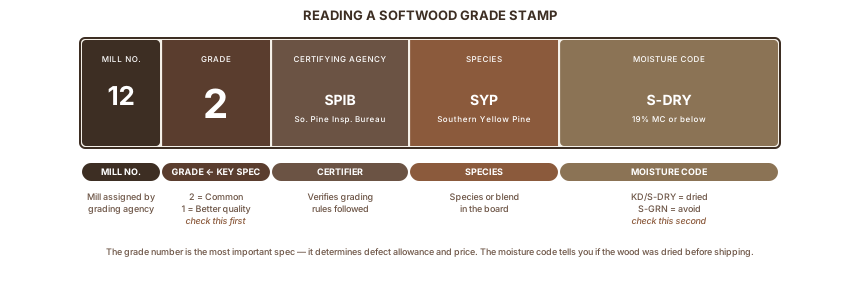
Every piece of dimensional lumber carries a grade stamp on its face or end. Most buyers ignore it. Reading it takes ten seconds and tells you exactly what you're getting.
The Grade System
Softwood grades run from Select (the best, fewest defects) down to Stud (framing only). WoodBin's softwood grading reference covers the full system. For 1x6 at retail, you'll encounter four grades:
| Grade | Defect allowance | Price tier | Best for |
|---|---|---|---|
| Select (B, C, D) | Minimal — small tight knots only | $$$ | Cabinetry, visible trim, stained furniture |
| #1 Common | Tight knots ≤1/3 board width; sound | $$ | Visible shelves, furniture, painted/natural |
| #2 Common | Knots up to 1/2 board width; some loose | $ | Painted projects, utility, construction |
| #3 / Stud | Splits, loose knots, poor surface | ¢ | Framing only — will be covered |
Most 1x6 at big-box stores is #2 Common. If you want visible-quality boards, you're looking for #1 Common or Select. #1 boards typically cost 20–30% more than #2.
The rule is simple: visible surface, natural finish → buy #1 or Select. Painted surface → #1 or #2 (check individual boards). Hidden or utility → #2 is fine.
What S4S, S2S, and Rough-Sawn Mean
These codes describe how many faces of the board the mill surfaced:
S4S (Surfaced Four Sides) — all four faces planed flat. This is what every board at a big-box store is. Dimensions are consistent: 3/4" × 5-1/2". No prep needed beyond light sanding. The Wood Whisperer's explanation of S2S vs. S4S walks through the differences if you want the full picture.
S2S (Surfaced Two Sides) — wide faces planed, edges left rough. Cheaper than S4S, but you'll need to joint the edges before assembly. Thickness is consistent; width varies slightly.
Rough-sawn — straight from the mill, no planing. Common for specialty hardwoods. Cheaper, but requires a jointer and planer to flatten. Dimensions vary; expect up to 1/8" variation across boards.
For 1x6 projects at any skill level, you're buying S4S. It's ready to use.
Reading the Moisture Stamp
The grade stamp also shows how the board was dried:
- KD (Kiln Dried) — dried to 19% moisture content or below before shipping
- KD-15 — dried to 15% MC, better
- S-DRY — also 19% or below
- S-GRN (Green) — not dried; will shrink and move after you bring it home
Buy KD or S-DRY whenever possible. Wagner Meters' guide on buying lumber recommends targeting 6–9% MC for indoor furniture — which means kiln-dried lumber still needs acclimation in your shop before you use it.
Part 4: How to Inspect a 1x6 Before You Buy
Big-box boards spend weeks outside, stacked in the weather, handled by forklift. A significant percentage have defects that will only show up after you cut into them. Plan on culling 10–20% of what you pull from the stack. Decks.com's lumber defects guide covers the full taxonomy; these six are what matter in a 1x6.
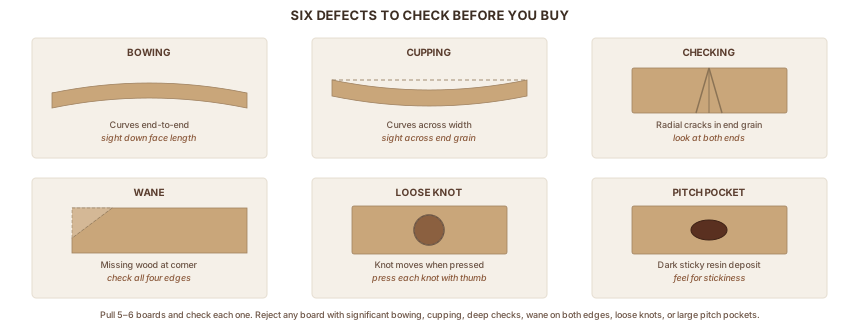
Bowing — the board bends end-to-end when you sight down its length. Hold one end at eye level and look down the face. It should be straight. A slight bow is workable for shelves; significant bow means the board will fight you in assembly.
Cupping — the board curves across its width, like a shallow U. Sight across the narrow end, looking at the face. A cupped board rocks on a flat surface and won't glue up flush.
Checking — cracks running along the grain, often from the pith outward. Look at the end grain. Surface checks under 1/8 inch deep are fine; deep checks that run the length weaken the board.
Wane — missing wood at corners or edges, sometimes with bark still attached. Look at all four corners. Any wane reduces your usable width.
Loose knots — a knot you can push with your thumb. Press each knot. Tight knots are fine and often attractive; loose knots will fall out, leaving holes.
Pitch pockets — dark sticky deposits in the wood. Feel for them. Minor ones on the surface sand out; deep ones can bleed through finish coats.
The 60-Second Store Checklist
Pull 5–6 boards from the stack before deciding which to take. Run this check on each:
- Sight down the length — does it bow or twist?
- Sight across the width — is it cupped?
- Look at the end grain — any deep radial cracks?
- Check all four edges for wane
- Press each knot — do they all hold firm?
- Feel the surface for pitch pockets or sticky spots
- Try to twist it gently — sound boards resist
Take the straightest boards you find. Always buy one or two more than you calculated — defects you missed in the store show up the moment you start cutting.
Part 5: Which 1x6 for Your Project
Most buying decisions come down to three questions: Will the wood be visible? What finish are you using? Where does the project live?
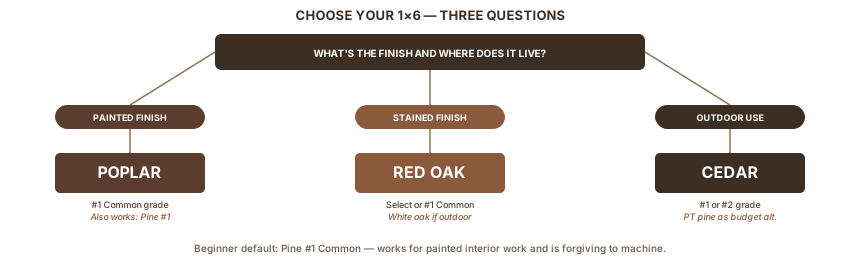
| Project | Species | Grade | Why |
|---|---|---|---|
| Painted interior shelves | Poplar or Pine | #1 Common | Even surface, hides grain; poplar takes paint cleaner |
| Stained interior shelves | Red Oak | #1 Common | Attractive grain, takes stain evenly |
| Painted furniture | Poplar | #1 Common | Best paint surface of any 1x6 species |
| Stained furniture | Red Oak or White Oak | Select or #1 | Visible grain presence; white oak for extra durability |
| Outdoor furniture | Cedar | #1 or #2 | Natural rot resistance; lasts 10+ years with sealing |
| Interior trim (painted) | Poplar | #1 or Select | Machines cleanly, light color, perfect paint adhesion |
| Budget utility shelves | Pine or SPF | #2 | Will be painted; knots don't matter |
| Fence boards / siding | Cedar or pressure-treated Pine | #2 | Rot resistance; grade matters less for weathered work |
The Beginner's Default
If you're building painted interior furniture or shelves for the first time, start with #1 Common pine or poplar from a lumber yard, not a big-box store. The full guide to buying lumber — big-box vs. lumber yard, S4S vs. rough covers the selection process in more depth. Lumber yards stock kiln-dried stock with consistent moisture content, better milling, and a lower defect rate. You'll pay 20–30% more per board but waste far less. The cost comes out close to even once you account for culling.
How Many Boards to Buy
Use this formula: total linear feet needed × (1 + waste factor). Add 10% for simple straight cuts; 15% for projects with joinery; 20% for complex layouts with many pieces.
Example: four 48-inch shelves.
- Raw need: 4 × 4 ft = 16 lf
- Waste factor: simple cuts = +10%
- Calculation: 16 × 1.10 = 17.6 lf
- Buy: two 1×6×10 ft boards (20 lf) — leaves a small buffer
Acclimate Before You Cut
Lumber from a store sits at whatever moisture content it absorbed during storage — often 10–16% at big-box retailers. Your shop likely runs at 30–50% relative humidity in winter, which means the wood will move after you bring it home. Wagner Meters recommends letting kiln-dried stock acclimate for at least a week per inch of thickness — so a 3/4" 1x6 needs about one week lying flat in your shop before you cut it. Skip this and joints crack, drawers stick, and shelves bow.
Part 6: Five Mistakes That Ruin a 1x6 Project
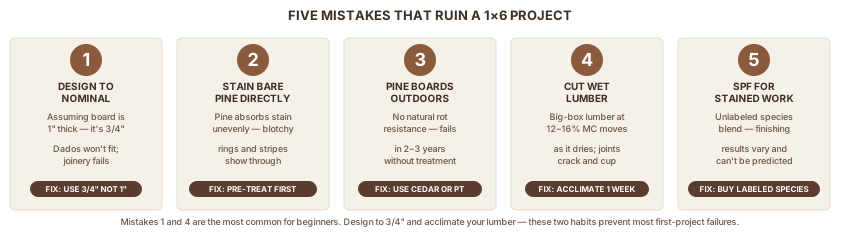
1. Designing to nominal, not actual. If you built the dado to 1 inch assuming the board is a full inch thick, the joint won't fit. Always design using 3/4 inch as the actual thickness.
2. Staining pine without pre-treating it. The Wood Whisperer's blotch control guide explains the chemistry: pine's uneven grain density makes stain absorb at wildly different rates. Pre-stain wood conditioner, gel stain, or a washcoat of thinned shellac are all valid fixes. Skipping this step and applying stain straight to bare pine is how you get the blotchy, striped result.
3. Using regular pine outdoors. Pine has no natural rot resistance. Two to three years in the weather and it's done. Use cedar, white oak, or pressure-treated Southern Yellow Pine for anything that lives outside.
4. Bringing wet lumber straight to the bench. Big-box lumber often runs 12–16% moisture content. Your shop wood equilibrium is probably 6–9%. Cut that lumber immediately and it will move as it dries — joints open, panels cup, drawers bind. One week of acclimation prevents all of this.
5. Buying SPF whitewood for stained furniture. The species is unlabeled and varies by region and season. You might get spruce, you might get fir, you might get a mix. Finishing results are unpredictable. Buy labeled species — pine, poplar, oak — for any project where the wood surface will be visible.
Part 7: Where to Go Next
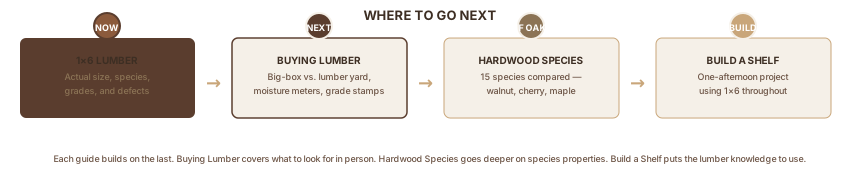
Once you know your 1x6 species and have good boards, the next step is getting them flat and smooth. The buying lumber guide covers the store selection process in more depth, including how to use a moisture meter and what to look for on a grade stamp beyond the basics here. If you're working with hardwoods like oak or walnut, the Hardwood Species Guide compares the properties of 15 species with a scannable reference table.
Working on the same project in a 1x4 width? 1x4 Lumber covers the same species, grades, and selection process for narrower stock.
Ready to build something with these boards? Build a Simple Shelf is a one-afternoon project that uses 1x6 dimensional lumber throughout — it puts everything on this page into practice.
FAQ
Why is a 1x6 actually only ¾ inch by 5½ inches?
The "1x6" is a nominal dimension — the size of the rough green board before it's dried and surfaced. The mill rips the green log to roughly 1 inch by 6 inches, then dries it (which shrinks it about 5%), then runs it through a planer that surfaces all four sides (S4S) to a uniform finished size. By the time the board hits the lumberyard rack it measures ¾ inch thick by 5½ inches wide. This has been the U.S. standard since 1964 under the American Softwood Lumber Standard PS 20.
What's the strongest 1x6 species at the big-box store?
Oak (red or white) is the strongest 1x6 species at most big-box stores, but you'll only find it in select racks at Home Depot and Lowe's, usually labeled "1x6 oak board" and priced 4–5x higher than pine. Among the cheaper options, Southern Yellow Pine outperforms Eastern White Pine for any structural use. Cedar is the weakest of the common species but the most rot-resistant, which is why it dominates outdoor 1x6 projects.
Can I rip a 1x8 down to a 1x6 width?
Yes, and it's often cheaper than buying a 1x6 directly. A 1x8 measures ¾" × 7¼" and rips cleanly to 5½" on a table saw, leaving a 1¾" off-cut. The trick is whether the 1x8 stock at your store is straight enough and free-of-defect enough to justify the work — many big-box 1x8 boards have edge defects that disappear when ripped narrower. Check both racks before buying.
How much does a 1x6 cost at Home Depot?
An 8-foot 1x6 pine board runs $7–12 at Home Depot, depending on grade and region. Cedar 1x6 runs $14–22 for the same length. Oak 1x6 (when stocked) runs $35–55 for an 8-footer. Prices climb sharply with grade — a Premium pine board with no visible knots costs nearly double a Standard board with knots. The economical choice for a beginner project is usually #2 or "Standard" pine.
What's the longest 1x6 board I can buy?
Most big-box stores stock 1x6 in 6, 8, 10, 12, and 16-foot lengths. Lumberyards (not big-box) carry 18 and 20-foot 1x6 in select species. For projects longer than 16 feet, plan to scarf-joint two boards rather than special-order — a long 1x6 is hard to transport and almost always shows up bowed.
Sources
Research for this guide drew on lumber industry standards, supplier technical guides, woodworking publications, and expert woodworking educators.
- Baird Brothers — nominal vs. actual lumber dimensions — industry-standard explanation of the nominal/actual gap
- Lowe's nominal sizing guide — retail confirmation of actual dimensions
- WoodBin softwood grading reference — complete softwood grade system explained
- The Wood Whisperer — S2S and S4S — surfacing terminology and tradeoffs
- Decks.com — common wood defects — defect identification and causes
- Wagner Meters — how to buy lumber — moisture content, acclimation, and selection
- Silicon Underground — what whitewood is at Home Depot/Lowe's — SPF blend identification
- Fine Homebuilding forum — whitewood/SPF discussion — professional confirmation of whitewood variability
- Fine Woodworking — avoiding blotchy stain on pine — pine finishing chemistry and solutions
- The Wood Whisperer — blotch control — pre-stain conditioning methods
- Dutch Crafters — cedar vs. pine for outdoor furniture — outdoor durability comparison
- Centennial Woods — lumber yard vs. big-box — sourcing comparison with quality tradeoffs
- Archtoolbox — lumber dimensions reference — complete nominal/actual table
- Kreg Tool — understanding lumber sizing — beginner-friendly sizing guide
- SPIB grading rules — Southern Pine Inspection Bureau grade standards
Also Referenced
How We Research
We don't take affiliate revenue or accept review units. Picks come from multi-source research — manufacturer specs, OSHA / EPA / ASTM regs, and long-form practitioner threads — plus Ahmed's hands-on use where relevant. When we recommend something, we explain why.
Up Next
1x6 Lumber Dimensions: Actual Size 3/4" × 5-1/2"
WOOD & MATERIALS · Beginner