
How to Use This Guide
The Kobalt KT10152 sells for ~$329 and generates more forum complaints than almost any saw in its class. Most of those complaints trace back to three things: the saw wasn't calibrated out of the box, the wrong technique was used, or the buyer expected cabinet-saw precision from a jobsite portable.
This guide gives you the honest verdict on whether to buy it, a six-step setup sequence that eliminates most common problems, and safe technique for every cut the saw can make.
- Deciding whether to buy: Start with Part 1.
- Already have it and need to set it up: Jump to Part 2.
- Something's wrong with your saw: Part 5.
Kobalt Table Saw at a Glance
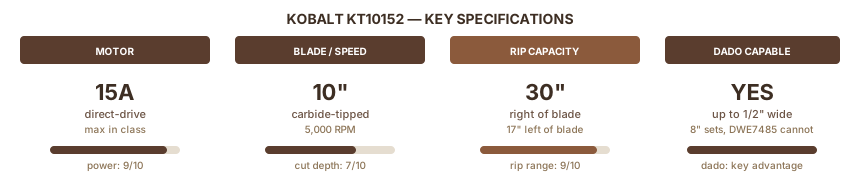
The Kobalt KT10152 is a 15-amp portable table saw with a 10-inch blade, 30-inch right rip capacity, and a fold-and-roll stand. It cuts softwoods and plywood well. It needs calibration before the first cut. Specs from the official KT10152 manual.
| Spec | Value |
|---|---|
| Motor | 15 amp |
| Blade speed | 5,000 RPM |
| Blade | 10" carbide-tipped |
| Right rip capacity | 30" |
| Left rip capacity | 17" |
| Max blade height | 3.5" |
| Max dado width | 1/2" per pass |
| Dust port | 2.5" |
| Warranty | 3-year limited |
| Price | ~$329 retail |
In this guide:
- Is the Kobalt KT10152 worth buying?
- Out-of-box setup and calibration
- Ripping, crosscutting, and sheet goods
- Common problems and fixes
Part 1: Is the Kobalt KT10152 Worth Buying?
The short answer: yes, with conditions.
Buy it if you're building with softwoods, plywood, or light hardwoods like red oak and ash, and you want dado capability that the DeWalt DWE7485 can't offer. Expect to spend 30 minutes calibrating before the first cut. Expect real limitations with full sheet goods and extended hardwood work.
Don't buy it if you're doing hardwood furniture regularly. The 15-amp motor bogs on hard maple and similar dense species. And don't buy it expecting the precision of a $1,200 contractor saw.
The Spec Table
The KT10152 is a jobsite portable table saw, the entry category in the table saw world. Understanding what that means saves frustration.
| Category | Price | Table | Motor | Weight | Examples |
|---|---|---|---|---|---|
| Jobsite/portable | $200–$450 | Aluminum/steel | 15 amp | 45–65 lbs | KT10152, DWE7485, R4520 |
| Contractor saw | $600–$1,200 | Cast iron | Belt-drive | 200–300 lbs | Jet, older Ridgid |
| Cabinet saw | $2,000+ | Full cast iron | 3–5 HP | 300–600 lbs | SawStop, Powermatic |
The aluminum table on a jobsite saw isn't a flaw. It's a design choice for portability. You give up some vibration damping and flatness you'd get from cast iron. For most weekend projects, you won't notice.
KT10152 vs. the Competition
These three saws compete directly for the same buyer:
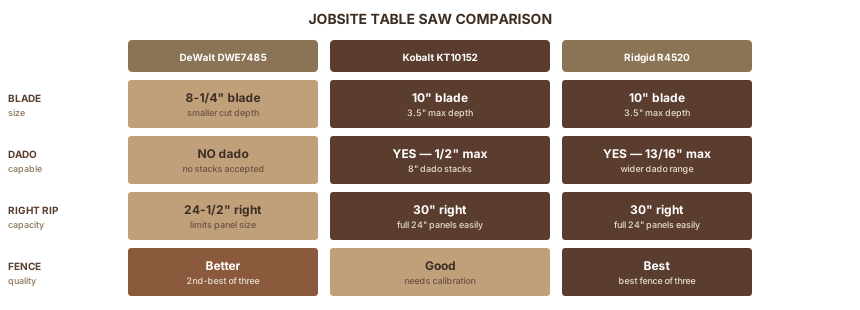
| Feature | Kobalt KT10152 | DeWalt DWE7485 | Ridgid R4520 |
|---|---|---|---|
| Price | ~$329 | ~$299–349 | ~$379–429 |
| Blade size | 10" | 8-1/4" | 10" |
| Right rip capacity | 30" | 24.5" | 30" |
| Left rip capacity | 17" | 12" | 15" |
| Dado capability | Yes (1/2" max) | No | Yes (13/16") |
| Table material | Aluminum/steel | Aluminum | Cast iron |
| Fence quality | Good | Better | Best of three |
| Warranty | 3-year limited | 3-year | Lifetime service |
The DeWalt DWE7485 is more compact and has a better fence, but it uses an 8-1/4" blade and cannot accept dado stacks at all. The smaller blade also limits cut depth. If you ever want to cut dadoes for shelf joinery, the DeWalt can't do it.
The Ridgid R4520 has a cast iron table, the best fence of the three, and accepts dado stacks up to 13/16" wide. The lifetime service agreement is real value. It costs $50–100 more. If you can afford it, the Ridgid is the better saw. But the Kobalt delivers most of what the Ridgid does at a lower price. Protablesawreviews.com's Kobalt vs. Ridgid comparison sums it up as "90% of the performance at 85% of the cost."
The Kobalt wins on price-to-capability when dado work matters and when 30" rip capacity matters more than fence precision. It beats the DeWalt specifically because the 10" blade handles a wider range of work and dado stacks are possible.
What It Does and Doesn't Do
The KT10152 handles these well:
- Ripping 2×4s, 2×6s, and other dimensional lumber
- Softwoods (pine, poplar) and light hardwoods (red oak, ash)
- Breaking plywood down into workable pieces
- Dado work up to 1/2" wide per pass
- Crosscutting with the miter gauge or a shop-built sled
It struggles here:
- Full 4×8 sheet goods: the narrow stand tips with an unsupported sheet; break it down with a circular saw first
- Dense hardwoods like hard maple, wenge, or hickory: the 15-amp motor bogs under sustained load
- Wide dadoes over 1/2": multiple passes required
- Precision cabinet work requiring sub-0.005" repeatability
A saw in this category unlocks real furniture work. You can build shelves, benches, and simple tables with the KT10152 that you can't build safely with a circular saw alone. The rip fence and dado capability are what make it a workshop tool rather than a rough-cut tool.
RELATED: Jobsite Table Saw Guide How to choose a jobsite saw, what to look for, and what you give up compared to contractor and cabinet saws.
Part 2: Out-of-Box Setup and Calibration
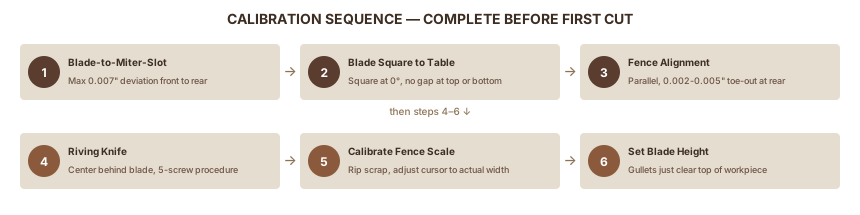
The KT10152 ships with major components roughly aligned. Shipping moves things. Spend 30 minutes calibrating before the first cut. This sequence matters: blade first, then table square to blade, then fence. Reverse that order and you'll calibrate against a bad reference.
Tools you need:
- Combination square (6" or 12")
- Ruler or tape measure
- Hex key set (metric)
- Marker
Step 1: Blade-to-Miter-Slot Alignment
This is the foundational calibration. The blade must be parallel to the miter slot. If it isn't, every cut introduces error and kickback risk.
- Unplug the saw.
- Mark one tooth with a marker.
- Rotate the marked tooth to the front of the blade. Measure the distance from that tooth to the near wall of the miter slot. Write it down.
- Rotate the blade until the same tooth is at the rear. Measure the same distance at the rear.
- The two measurements should differ by no more than 0.003". Up to 0.007" is acceptable.
- If out of spec: consult the KT10152 manual on ManualsLib for the trunnion adjustment procedure specific to this saw.
Always use the same tooth for both measurements. Blade runout (minor wobble inherent to any blade) will give you false readings if you rotate to a different tooth.
Step 2: Blade Square to the Table
- Set the bevel to 0°.
- Hold a combination square against the blade body (between the teeth, not on the tooth tips).
- Check for a gap at the top or bottom. No gap means it's square.
- If not square: locate the bevel-stop adjustment screw behind the saw's tilt mechanism and adjust.
Step 3: Fence Alignment
With the blade parallel to the miter slot, align the fence to the same slot.
- Lock the fence at any position.
- Measure from the fence face to the miter slot at the front of the fence.
- Measure again at the rear.
- The fence should be parallel or toed out 0.002–0.005" at the rear (rear slightly farther from blade than front).
That small toe-out isn't a mistake. Per Table Saw Guru's fence alignment guide, a fence set dead parallel is more prone to burning and kickback because the workpiece can bind between blade and fence after the cut. A tiny toe-out lets the kerf open as the board clears the blade.
Adjust via the set screws on the fence head using an Allen wrench. Small turns. Less than 1/4 turn at a time. Recheck after each.
Step 4: Riving Knife Alignment
The riving knife is the curved steel piece directly behind the blade. It keeps the kerf open after the cut, which prevents the main mechanical cause of kickback. Keep it installed for every cut.
Per the KT10152 manual's riving knife section:
- Place the saw on its side and remove the dust bin to access the mounting.
- There are five screws: three small adjustment screws and two clamping screws.
- Loosen all five.
- Center the knife behind the blade. It should be in the same plane as the blade, not tilted left or right.
- Tighten the three adjustment screws first to hold position.
- Then tighten the two clamping screws.
Multiple forum threads (including one on The Garage Journal) document this problem. The manual's instructions are confusing on this point. The sequence above works.
Step 5: Calibrate the Fence Scale
Lock the fence at a measurement you can verify with a tape measure, say 6 inches. Rip a piece of scrap and measure the actual width. If the cut measures 6-1/16", the scale reads 1/16" optimistic. Adjust the fence cursor to read the actual measured value. Now the scale matches reality.
Step 6: Set Blade Height
Set the blade so the bottom of the gullets (the gaps between teeth) just clears the top surface of your workpiece. For 3/4" stock, the blade projects roughly 1" above the table. For 1-1/2" stock, roughly 1-3/4".
Stumpy Nubs covers the blade height debate in detail. The practical position: set the gullets just clearing the material. This is what most blade manufacturers assume, and it minimizes the heat buildup that burns wood and dulls blades faster.
Part 3: Ripping, Crosscutting, and Sheet Goods
Ripping Safely
Ripping is cutting a board lengthwise along the grain. It's the table saw's primary job. Getting it right requires correct setup and body position.
Before the cut:
- One face must be flat, one edge must be straight. Any bow in the board causes it to lift off the table or drift away from the fence mid-cut. If the board isn't flat and straight, joint it first.
- Set the fence to your width. Set blade height (gullets just clearing the top).
- Confirm the riving knife is installed.
Cutting technique:
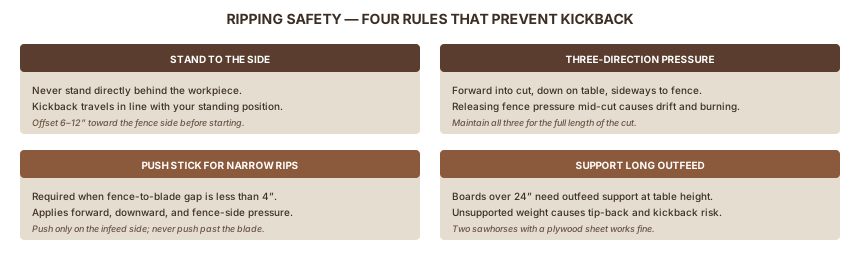
- Stand slightly to the side of the board, not directly behind it. Per Katz-Moses Tools' 13 mistakes guide, standing behind the workpiece puts you in the kickback line. If the board kicks back, it travels at chest height at significant force.
- Feed at a slow, steady pace. Pausing causes burning. Rushing causes binding.
- Apply pressure in three directions: forward (into the cut), down (into the table), and sideways (into the fence). Keep the board against the fence for the full length of the cut.
- Use a push stick when the gap between fence and blade is less than 4 inches. The push stick applies that same three-directional pressure: forward, down, and into the fence.
- Only push on the infeed side. Past the blade, use a push stick between blade and fence to guide the cut piece clear. Never push on the offcut side of the blade.
Outfeed support: Any board over 24 inches long needs something to catch it at the outfeed. Two sawhorses with a piece of plywood at the same height as the saw table works. Without support, long boards tip toward you and can kick back.
Crosscutting
Use the miter gauge for crosscuts (cuts perpendicular to the grain). Square the gauge to 90° and hold the board firmly against the face.
Never use the rip fence as a stop for crosscuts. The cut-off piece is trapped between the spinning blade and the fence, which is one of the most reliable ways to cause kickback.
For repeated crosscuts to the same length: clamp a stop block to the fence rail on the infeed side (before the blade). The board butts against the block, you slide it away from the block before the blade reaches it. The offcut is then free to move away from the blade.
A crosscut sled improves on the miter gauge for most crosscut work. It supports longer boards, keeps the cut square without holding the gauge, and takes an afternoon to build. See the dado joint guide for table saw for an example of the kind of work a sled enables.
Sheet Goods and Plywood
The KT10152's 30-inch right rip capacity handles most furniture parts. You can rip a 24-inch-wide panel, no problem. You cannot safely feed a full 4×8 sheet through the saw without first breaking it down.
Full sheet problem: a 4×8 sheet of plywood weighs 50–80 pounds and is unwieldy. The KT10152's narrow stand base means the saw can tip when a heavy sheet is fed unsupported. The saw is also 8 feet long with the sheet hanging off the back.
Use a circular saw to break the sheet into pieces within 1–2 inches of final dimension, then bring those pieces to the table saw for accurate sizing. The table saw is for precision. Let the circular saw do the rough work.
Part 4: Dado Work
Can the KT10152 cut dadoes? Yes. There are real limits.
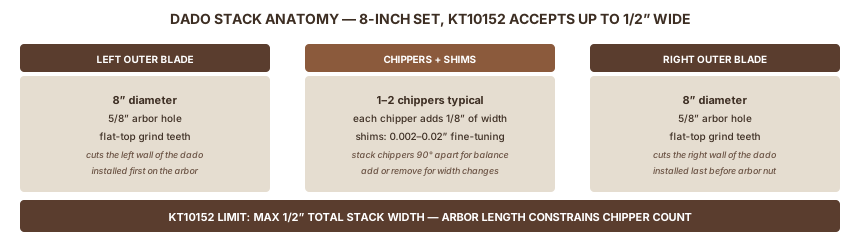
Per page 39 of the KT10152 manual, the saw accepts dado stacks up to 1/2 inch wide and 8 inches in diameter. Most quality 8-inch dado sets (Freud, IRWIN, Oshlun) fit physically. The arbor length limits how many chippers you can stack, which caps the width at 1/2 inch per pass.
The DeWalt DWE7485 cannot cut dadoes at all. If you build shelves, cabinets, or any joinery that uses dado joints, this is the main reason to choose the Kobalt over the DeWalt.
What You Need
- Dado throat plate: Kobalt part 36-506K, available at Lowe's for ~$15–20. Don't run a dado stack with the standard insert. The blade opening is too narrow and the insert will be destroyed.
- Dado stack: Any quality 8-inch dado set. The Freud SD208 and IRWIN Marples sets both fit.
Cutting Dadoes
- Install the dado stack to the desired width (up to 1/2") and mount the dado throat plate.
- Set depth of cut with a test piece of scrap.
- Use the miter gauge for dadoes cut across the grain. Use the fence for dadoes cut along the grain (like shelf pin holes or cabinet back rabbets).
- Use a featherboard at the infeed side to keep consistent pressure and depth.
For dadoes wider than 1/2 inch: make multiple passes. Set the fence for the first pass, cut, shift the fence the width of one pass, cut again. Sneak up on the final width using test pieces.
Part 5: Common Problems and Fixes
Fence Drift
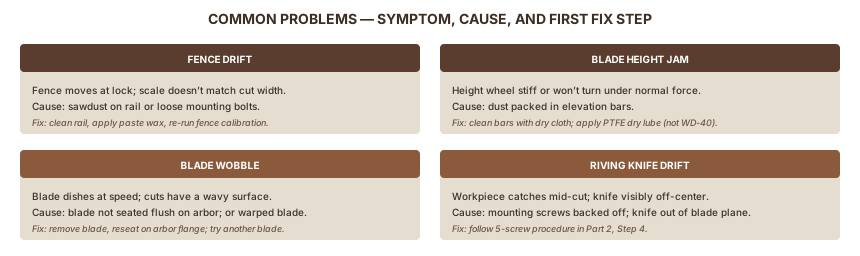
The fence moves when you lock it, or the measurement at the scale doesn't match the actual cut width.
Fix:
- Clean the fence rail with a dry cloth. Sawdust buildup causes inconsistent friction.
- Apply a light coat of paste wax to the rail (not spray lubricant, which gums up with dust).
- Press down firmly on the fence head when engaging the latch. The single-latch system on the KT10152 requires a deliberate downward press to lock fully.
- Re-run the fence calibration from Part 2.
If drift continues after cleaning and lubrication: check that the fence rail mounting bolts are tight. A loose rail means the fence is anchoring to something that moves.
Blade Height Adjustment Jam
The height adjustment wheel feels stiff or won't turn; the saw dust is packed into the mechanism.
Fix: Clean the elevation bars with a dry cloth. Don't use WD-40 or oil; both attract more dust. Apply a PTFE dry lubricant (Boeshield T-9 or similar). If the thin metal crank handle has snapped, contact Kobalt support at 1-888-3KOBALT for a replacement part, or check Lowe's parts department.
Blade Wobble or Vibration
The blade appears to wobble or dish at speed; cuts have a wavy surface or more vibration than expected.
Fix:
- Unplug the saw and remove the blade.
- Check that the blade is seated flush on the arbor flange. Any gap causes wobble.
- Reinstall and torque the arbor nut snugly but not excessively. Over-torquing deforms thin blades.
- Try a different blade. A blade problem (warped or low-quality) will present the same symptom as an arbor problem.
- If the wobble persists with multiple blades: the arbor itself is damaged. Return the saw under warranty.
Riving Knife Out of Alignment
The workpiece catches on the riving knife mid-cut, or the knife is visibly off-center behind the blade.
Fix: Follow the riving knife alignment sequence in Part 2, Step 4. The five-screw procedure takes about 10 minutes once you know the sequence. It's tedious. The riving knife cannot be skipped. It is your primary mechanical defense against kickback.
RELATED: Table Saw Fence Setup and Adjustment How different fence types work, how to calibrate them, and when an upgrade makes sense.
Part 6: The Five Upgrades That Make the Most Difference
The stock KT10152 works. These five additions improve it, ranked by impact per dollar spent:
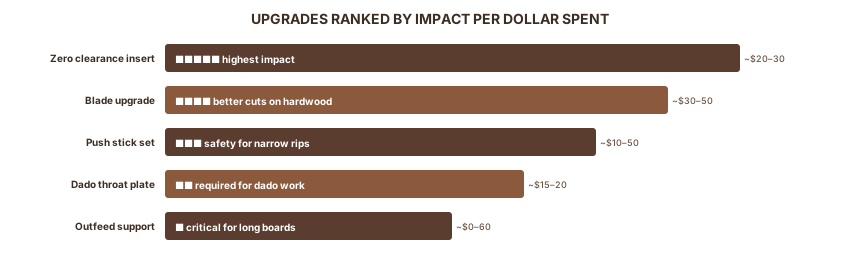
1. Zero clearance insert — ~$20–30 The stock throat plate has a wide opening that lets small pieces fall into the blade, causes tearout on plywood, and routes dust into the cabinet instead of the dust port. Zerosert.com sells a KT10152-specific laminated insert for ~$25. Installs in 5 minutes. It's the most impactful upgrade for cut quality and safety.
2. Blade upgrade — ~$30–50 The stock carbide blade cuts. A quality aftermarket blade cuts better. The Freud Diablo D1040X 10-inch 40-tooth ATB runs ~$30–40 and improves plywood and hardwood cuts. See the best table saw blade guide for the full comparison.
3. Push stick set — ~$10–50 At minimum, a dedicated push stick with a heel for narrow rips. The GRR-RIPPER ($40–50) applies consistent three-directional pressure and handles strips down to 1/8 inch. A shop-made push stick cut from 3/4" plywood costs nothing and works fine for wider rips.
4. Dado throat plate — ~$15–20 Required before any dado stack work. Kobalt part 36-506K from Lowe's. Don't skip it. The standard insert doesn't support the wider dado stack and will be destroyed on the first pass.
5. Outfeed support — ~$0–60 Two adjustable sawhorses with a piece of 3/4" plywood at table height costs almost nothing if you already have sawhorses. If you don't, Rockler roller stands run ~$30–40 each. Long boards and sheet goods require outfeed support.
FAQ
Does the Kobalt KT10152 accept dado stacks?
Yes. The KT10152 accepts 8-inch dado stacks up to 1/2 inch wide, per page 39 of the official manual. You'll need the Kobalt dado throat plate (part 36-506K, ~$15–20 from Lowe's) before cutting — the standard insert doesn't support the wider stack. This is the main practical advantage the Kobalt has over the DeWalt DWE7485, which cannot accept dado stacks at all.
Why does my fence drift when I lock it?
Sawdust buildup on the rail is the most common cause. Clean the rail with a dry cloth, apply paste wax (not spray lubricant — it gums up with dust), and press down firmly on the fence head when engaging the latch. The KT10152's single-latch system requires deliberate downward pressure to lock fully. If drift continues after cleaning and lubricating, check that the fence rail mounting bolts are tight.
How much setup time does the KT10152 need out of the box?
Budget 30 minutes before the first cut. The calibration sequence has six steps: blade-to-miter-slot alignment (max 0.007" deviation), blade square to table at 0°, fence alignment with 0.002–0.005" toe-out, riving knife centering, fence scale calibration, and blade height setting. Skipping blade-to-slot introduces errors that compound into bad cuts and increased kickback risk.
Can I run full 4×8 plywood sheets through the KT10152?
Not safely. A 4×8 sheet weighs 50–80 pounds and the KT10152's narrow stand base can tip with a heavy unsupported sheet. Break full sheets down with a circular saw to within 1–2 inches of final dimension, then bring those pieces to the table saw for accurate sizing. The saw's 30-inch right rip capacity handles most furniture parts once they're at a manageable size.
What blade should I upgrade to first?
The Freud Diablo D1040X 10-inch 40-tooth ATB blade runs $30–40 and is the most cost-effective first upgrade. It improves cut quality on plywood and light hardwoods like red oak and ash — the stock blade works but leaves a rougher surface on sheet goods. Pair it with a zero clearance insert ($25) for the biggest combined improvement in cut quality and dust control.
Sources
Research for this guide pulled from Kobalt's official documentation, independent tool reviews, and woodworking forum discussions across Reddit, LumberJocks, and The Garage Journal.
- Pro Tool Reviews — Kobalt KT10152 Portable Table Saw Review — hands-on specs and verdict
- ManualsLib — Kobalt KT10152 Manual — full official manual including dado specs (page 39) and riving knife procedure
- Table Saw Guru — Fence Alignment Guide — step-by-step fence calibration with tolerances
- Katz-Moses Tools — 13 Table Saw Mistakes — safety rules and technique errors
- Katz-Moses Tools — Kickback Prevention — causes and mechanical defenses
- Stumpy Nubs — Blade Height Debate — gullet-clearing height rationale
- Fine Woodworking — Table Saw Kickback — physics of kickback
- protablesawreviews.com — Kobalt vs. DeWalt — comparison specs
- protablesawreviews.com — Kobalt vs. Ridgid — value comparison
- Zerosert.com — KT10152 Zero Clearance Insert — product details
- Lowe's — Kobalt Dado Insert Plate 36-506K — dado throat plate product page
- The Garage Journal — Kobalt Riving Knife Alignment Thread — community riving knife fix
How We Research
We don't take affiliate revenue or accept review units. Picks come from multi-source research — manufacturer specs, OSHA / EPA / ASTM regs, and long-form practitioner threads — plus Ahmed's hands-on use where relevant. When we recommend something, we explain why.
Up Next
Push Block vs Push Stick: Which One You Actually Need
POWER TOOLS · Beginner