
Table Saw Fence at a Glance
Your table saw fence controls every rip cut you make. A good fence locks parallel to the blade, stays where you set it, and reads accurately. A bad one drifts, binds, and burns wood. Most stock fences are fixable. Some aren't worth the effort. This guide helps you figure out which category yours falls into.
| What it does | Guides the workpiece parallel to the blade for consistent-width rip cuts |
| Acceptable parallelism | ≤0.005" front-to-rear difference (slight toe-out, never toe-in) |
| Most common problem | Fence shifts position when you lock it down (lockdown creep) |
| Best budget upgrade | Auxiliary tall fence — $20 in materials, 2 hours to build |
| Aftermarket range | $150–$500, from Shop Fox W1716 to Biesemeyer |
| Critical safety rule | The rear of the fence must always be equal to or farther from the blade than the front |
In this guide:
- How table saw fences actually work
- Test your fence in 15 minutes with five checks
- Fix, improve, or replace — choosing the right path
- When a bad cut isn't the fence's fault
Part 1: How Table Saw Fences Work
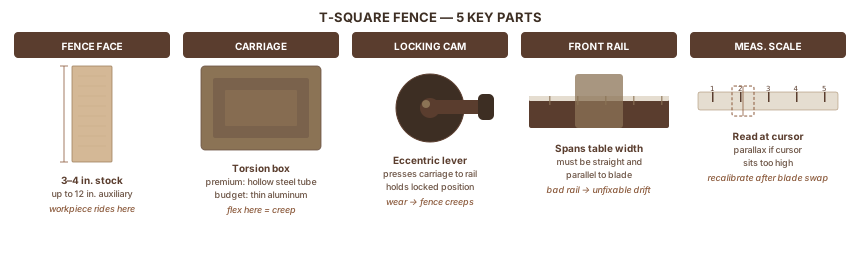
A table saw fence is simpler than it looks. Five parts, one job: keep the workpiece moving parallel to the blade.
The Five Parts That Matter
The front rail spans the full table width. On modern T-square fences (the standard design since Biesemeyer introduced it in the 1980s), the fence hooks over this rail and all locking force gets applied here. The front rail also carries the measurement scale. If this rail isn't straight and parallel to the blade, nothing else you do will fix your cuts.
The carriage is the structural box that slides along the rail. Quality fences use a hollow steel tube (a torsion box) that resists twisting. Budget fences use a thin aluminum channel that can flex when you tighten the lock — and that flex moves the fence face.
The fence face is the flat vertical surface your workpiece rides against. Premium fences use HDPE plastic or laminated birch plywood. Stock fences usually have bare aluminum, which can develop waves or scratches over time. A bowed face introduces taper into every cut.
The locking cam is an eccentric lever that presses the carriage against the rail. When it's tight, the fence shouldn't move. When the cam wears, or sawdust packs into the mechanism, locking force drops and the fence starts creeping.
The measurement scale is a stick-on or engraved tape on the rail, read by a cursor on the carriage. Three things make it unreliable: the tape itself can be inaccurate, the cursor sits too high above the tape (causing parallax errors depending on your eye angle), and different blade thicknesses shift the effective reading by 1/32" or more.
Each part contributes to accuracy, and they work in series: rail alignment → carriage fit → cam rigidity → face flatness → scale calibration. An error at any link propagates to every cut.
Why Parallelism Is a Safety Issue
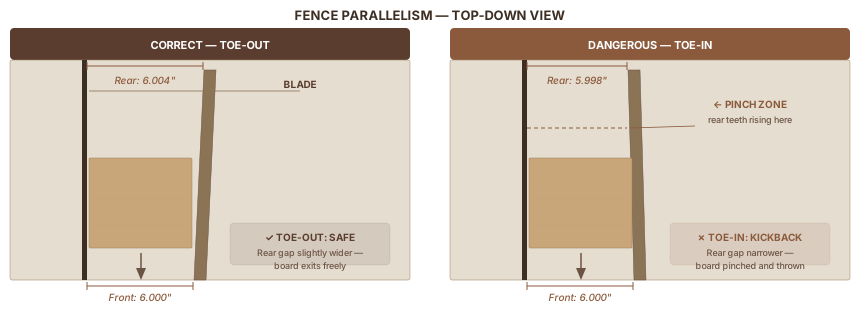
The fence should sit parallel to the blade or with 0.002"–0.005" of rear toe-out. That means the back of the fence is slightly farther from the blade than the front. This tiny gap prevents the workpiece from being pinched against the blade's rising rear teeth, as Fine Woodworking's fence alignment guide explains.
A fence that toes in, even by a thousandth of an inch, creates a funnel. The board enters the cut fine, then gets squeezed between the fence and the back of the blade. The rising teeth grab the wood and throw it back at you. This is kickback, and fence toe-in is one of its leading causes.
Three Ways Fences Fail
Creeping: The fence shifts when you lock it. You set 3-1/2", lock the handle, and the cut comes out 3-9/16". The cam's offset pivot pulls the carriage laterally as it rotates, and on cheap fences the aluminum flexes enough to shift the face before friction takes hold. Worn bumpers and sawdust in the cam compound the problem.
Binding: The workpiece slows or stops mid-cut. The blade burns the wood. In the worst case, the board kicks back. Primary cause: fence toed in at the rear. Secondary: the blade itself isn't parallel to the miter slot, so even a good fence can't prevent binding.
Inaccuracy: Cuts don't match what the scale reads. Usually it's scale miscalibration — the tape wasn't set to your current blade position. Sometimes it's parallax from the cursor sitting too high. A bowed fence face also throws measurements off, because the workpiece contacts the face at one point rather than along its full length.
Part 2: Test Your Fence: Five Checks in 15 Minutes
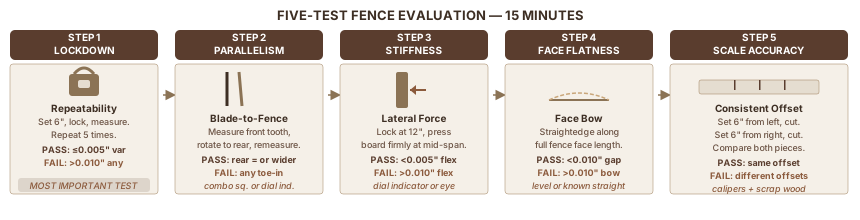
Most woodworkers never test their fence. These five checks take 15 minutes and a combination square or dial indicator.
The Five Tests
| Test | What to measure | Tool needed | Pass | Fail |
|---|---|---|---|---|
| 1. Lockdown repeatability | Set fence to 6", lock, measure. Unlock, slide away, return to 6", lock, measure. Repeat 5 times. | Combination square or calipers | ≤0.005" variation across all 5 | >0.010" on any repeat |
| 2. Parallelism | Measure fence-to-blade at front tooth and rear tooth (rotate same tooth to both positions) | Combination square, or dial indicator on miter bar | Rear equal to or 0.001"–0.005" wider than front | Any toe-in (rear closer), or >0.015" difference |
| 3. Lateral stiffness | Lock fence at 12". Press a board firmly against it at mid-span. | Dial indicator, or watch for visible deflection | <0.005" deflection | >0.010" deflection |
| 4. Face flatness | Run a straightedge along the full fence face | Reliable straightedge (a level works) | <0.010" gap over 24" | >0.010" bow |
| 5. Scale consistency | Set fence to 6" approaching from the left. Cut and measure. Then set to 6" approaching from the right. Cut and measure. | Calipers + scrap wood | Same offset both directions | Different offset depending on approach |
What Your Score Means
| Tests Passed | What to Do |
|---|---|
| All 5 | Your fence is fine. Don't spend money. |
| 4 of 5 (face flatness fail) | Bolt on an auxiliary face — $15–30, a couple hours |
| 4 of 5 (scale fail, consistent offset) | Recalibrate the cursor — free, 15 minutes |
| 3 of 5 | Improve: shimming, lock tightening, auxiliary face |
| 2 or fewer | Replace the fence or build a new one |
The lockdown repeatability test is the most important. Sawmill Creek's tolerance discussion puts the consensus at 0.003"–0.005" for furniture-quality work. A fence that doesn't return to the same position when you lock it is broken for precision work, regardless of what the other tests show.
Part 3: Fix, Improve, or Replace
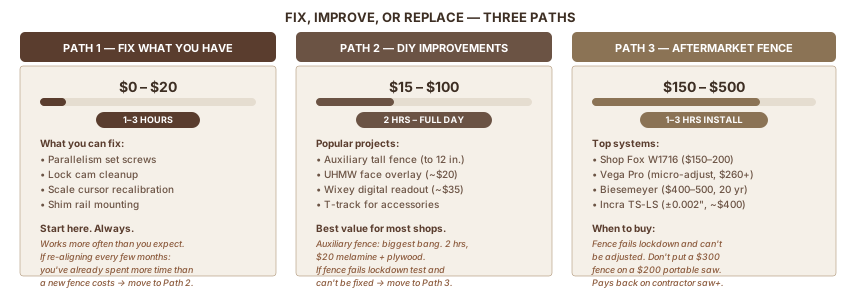
Three paths. Start with the cheapest. Move up only if the cheaper option doesn't solve it.
Fix What You Have ($0–$20)
Start here. Always.
Parallelism adjustment: Most T-square fences have set screws in the carriage that let you tweak the fence angle. Loosen the screws, nudge the fence until it reads 0.003"–0.005" toe-out, tighten in a cross pattern. On contractor saws without set screws, shim the rail mounting — brass shim stock from a hobby shop works, or a folded piece of aluminum foil for fine adjustment (about 0.001" per layer).
Lock cleanup: Blow sawdust out of the cam area with compressed air. Tighten any loose fasteners on the cam housing. If the cam feels sloppy even when clean, the mechanism may be worn — but cleaning alone fixes a surprising number of creeping problems.
Scale recalibration: Make a test cut at 6" by the scale. Measure the actual piece with calipers. If it's off by a consistent amount, loosen the cursor, reposition it to match reality, tighten. This takes 15 minutes and costs nothing.
When fixing works: The fence passes after one tune-up and stays that way for months.
When it doesn't: If you're re-aligning the same fence every few months, you've already spent more time than a new fence costs.
DIY Improvements ($15–$100)
The sweet spot for most woodworkers. These projects improve a mediocre fence without replacing it.
Auxiliary tall fence. The single most popular table saw improvement.
A standard fence face is 3–4 inches tall. An auxiliary fence extends that to 9–12 inches, which gives you better workpiece support for tall stock, a mounting surface for featherboards, and a sacrificial face for dado operations.
The Table-Saw/) takes 2 hours and about $20: a piece of melamine board (25" x 7.5" x 1") with two plywood supports that grip over the existing fence. Clamp or bolt it on.
The full version from MWA Woodworks runs $60–90 and a full day: laminated 3/4" Baltic birch plywood (two layers for rigidity), T-track embedded for accessories, Formica face for low friction. Bolt through tee-nuts for solid attachment, or use toggle clamps for tool-free removal.
UHMW face overlay. Adhesive-backed UHMW polyethylene sheet applied to the existing fence face. Self-lubricating, reduces friction, and doubles as a sacrificial surface. About $15–30 and under 2 hours.
Digital readout. A Wixey WR750 ($30–40) mounts to the fence and reads to ±0.002". Eliminates parallax and scale-reading errors. Worth it if your fence is mechanically sound but hard to read.
Aftermarket Fence Systems ($150–$500)
If your fence fails the lockdown repeatability test and can't be fixed, an aftermarket fence is the fastest path to better cuts.
| System | Accuracy | Price | Best For |
|---|---|---|---|
| Shop Fox W1716 | Not published (forum-verified reliable) | $150–200 | Best value upgrade |
| Vega Pro 40/50 | 0–0.001" repeatability (user reports) | $260–350 | Micro-adjust capability |
| Delta T2/T3 | ±1/64" (manufacturer spec) | $200–300 | Direct Delta saw replacement |
| Biesemeyer | ±1/64" (manufacturer spec) | $400–500 | Maximum reliability, 20+ year lifespan |
| Incra TS-LS | ±0.002" with 0.001" resolution | ~$400 | Precision joinery, indexed stops |
The Shop Fox W1716 gets recommended most often on woodworking forums for the money. It uses the same T-square principle as a Biesemeyer at less than half the cost. The Vega is the only T-square fence with a built-in micro-adjust knob — useful if you sneak up on dimensions often. The Incra uses a lead-screw positioning system with indexed stops every 1/32". Slower than a T-square for general ripping, but unmatched for repetitive precision cuts. The Wood Whisperer's hands-on review confirmed the ±0.002" accuracy claim.
One rule of thumb: Don't put a $300 fence on a $200 portable saw. The saw's table is too small and its trunnions are too imprecise for an aftermarket fence to deliver its full accuracy. On a contractor saw or cabinet saw ($500+), the investment makes sense.
Installation takes 1–3 hours for most T-square systems. You're bolting rails to the table edges and mounting the fence head — not rebuilding the saw.
The Weekend Woodworker's Bottom Line
Try adjustment first. It's free and it works more often than you'd expect. If adjustment fails, spend $150–250 on a mid-tier aftermarket fence. Skip the DIY build unless you need custom features. When you count your shop time, building a fence from scratch usually costs more than buying one.
Part 4: When a Bad Cut Isn't the Fence
Before you replace anything, learn to read the cut. The fence gets blamed for problems caused by dull blades, twisted lumber, and sloppy technique.
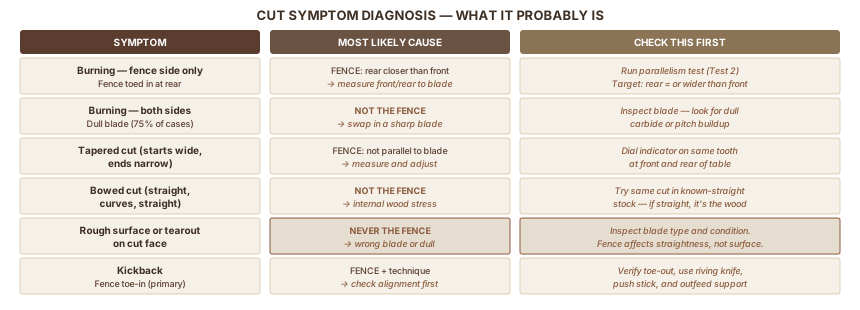
The Symptom Diagnostic Chart
| What You See | Most Likely Cause | Check This First |
|---|---|---|
| Burning on one side only (fence side) | Fence toed in at rear | Measure front/rear fence-to-blade distance |
| Burning on both sides | Dull blade (about 75% of cases) | Swap in a sharp blade |
| Tapered cut (starts wide, ends narrow) | Fence not parallel to blade | Measure and adjust parallelism |
| Bowed cut (straight, curves, straight) | Internal wood stress releasing | Try the same cut in known-straight stock |
| Rough surface or tearout | Wrong blade type, dull, or mounted backward | Inspect blade — this is never the fence |
| Kickback | Fence toe-in (primary) or technique (secondary) | Check fence alignment, then technique |
The most important line in that chart: rough surface is never the fence. The fence affects straightness, not surface quality. If your cuts have tearout, check the blade first.
The Five-Step Diagnostic Sequence
When a cut goes wrong, work this sequence from cheapest to most expensive fix.
- Technique first. Is the board flat on the table? Flush against the fence the entire cut? Are you using a push stick and outfeed support? Fixing technique costs nothing.
- Inspect the blade. Sharp? Clean? Correct type for the cut (rip blade for ripping, not a crosscut blade)? Mounted correctly (teeth pointing down at table level, toward the front)?
- Blade-to-miter-slot alignment. This is independent of the fence. As Katz-Moses Tools explains, put a dial indicator on the same tooth at the front and rear of the table. Target: ≤0.003" difference. If the blade is out, fix that first — no fence can compensate for a twisted blade.
- Fence-to-blade parallelism. Now check the fence. Measure at front and rear. Target: parallel or 0.003"–0.005" toe-out.
- Lockdown consistency. Lock, measure, unlock, re-lock, measure. Three times. If it varies more than 0.005", the fence mechanism needs attention.
Part 5: Keeping Your Fence Accurate
Fences drift. These checks keep yours accurate.
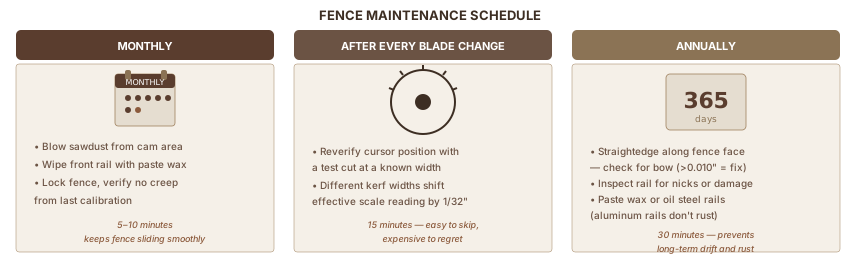
Monthly (if you use the saw regularly):
- Blow sawdust out of the cam area with compressed air or a stiff brush
- Wipe the front rail with paste wax — keeps the fence sliding smoothly
- Lock the fence, check it hasn't crept from your last calibration
After every blade change:
- Reverify cursor position with a test cut — different kerf widths shift the effective reading
Annually:
- Run a straightedge along the fence face and check for bow
- Inspect the rail for nicks or damage
- Apply paste wax or light machine oil to steel rail surfaces to prevent rust (aluminum doesn't rust, but steel rails do)
Part 6: What Fence Specs Actually Mean
What you're building determines what fence accuracy you need.
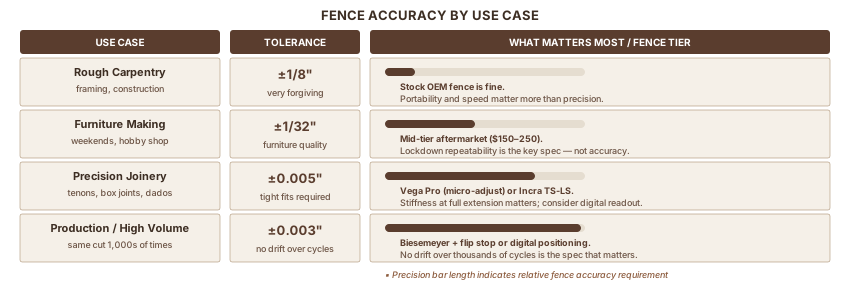
| Use Case | Tolerance Needed | Micro-Adjust? | Digital Readout? | Minimum Fence Tier | What Matters Most |
|---|---|---|---|---|---|
| Rough carpentry / framing | ±1/8" | No | No | Stock OEM | Portability, speed |
| Furniture making | ±1/32" | Helpful | Optional | Mid-tier aftermarket | Lockdown repeatability |
| Precision joinery (tenons, box joints) | ±0.005" | Yes | Recommended | Vega or Incra class | Stiffness at full extension |
| Production / high volume | ±0.003" over 1,000s of cuts | Yes | Yes | Biesemeyer + stop system | No drift over cycles |
If you're building furniture on weekends, a mid-tier aftermarket fence ($150–250) covers everything you'll need. Precision joinery pushes you toward a Vega (for the micro-adjust) or Incra (for indexed positioning). Production work (the same cut hundreds of times) needs a Biesemeyer with a flip stop or a digital positioning system.
Most weekend woodworkers never need more than a well-tuned mid-tier fence. The jump from a $200 Shop Fox to a $400 Biesemeyer buys you longevity and build quality, but the accuracy difference is marginal for hobby use.
Sources
This guide draws on woodworking textbooks, manufacturer specifications, expert practitioner reviews, and community discussion across major woodworking forums.
- BC Campus Woodworking Machinery — fence component anatomy and function
- Fine Woodworking — Dos and Don'ts of Fence Alignment — toe-out standard and alignment rules
- Fine Woodworking — Table Saw Kickback — fence toe-in as kickback cause
- Sawmill Creek — Acceptable Tolerances — 0.003"–0.005" parallelism consensus
- The Wood Whisperer — Incra LS32-TS Review — hands-on precision fence evaluation
- Incra Tools — TS-LS Fence Specs — ±0.002" manufacturer specification
- Tool Crib — Fence Buying Guide — aftermarket system comparison
- Tool Crib — 11 Reasons Your Table Saw Burns Wood — blade vs. fence burn diagnosis
- Sawmill Creek — Best Table Saw Fence — community recommendations and Shop Fox reviews
- MWA Woodworks — The Ultimate Table Saw Fence — full DIY auxiliary fence build
- Instructables — Auxiliary Fence for Table Saw — simple auxiliary fence build
- Katz-Moses Tools — Table Saw Blade Alignment — miter slot as reference for alignment checks
- Rockler — How to Align Your Table Saw Fence — fence setup and locking mechanism guidance
- Woodsmith — Best Table Saw Fences 2024 — current aftermarket product roundup
Tools Used
Also Referenced
Tagged
How We Research
We don't take affiliate revenue or accept review units. Picks come from multi-source research — manufacturer specs, OSHA / EPA / ASTM regs, and long-form practitioner threads — plus Ahmed's hands-on use where relevant. When we recommend something, we explain why.
Up Next
How to Use a Grizzly Table Saw
POWER TOOLS · Beginner