
How to Use This Guide
A thickness planer is one of the bigger power tool purchases in a home shop. This guide cuts through the model confusion, walks you through setup on arrival, and covers the technique that produces clean, snipe-free boards.
- Choosing a model: Start with Part 1. The comparison table has everything you need.
- Just bought one: Jump to Part 2 and Part 3.
- Not sure you need one: Read Part 4 first.
- Long-term care: Part 5 covers knives, rollers, and bed wax.
Grizzly Planers at a Glance
Grizzly makes the best-value helical-cutterhead planer in the benchtop category. The G0940 ($895–$950) gives you 30-insert helical quality — quieter operation, less tearout on hardwoods, no full knife changes — for less than most competitors charge for straight-knife machines. If you're milling rough lumber and want professional results from a benchtop tool, it's the clearest buy in its price range.
| Best model for most home shops | G0940 (13", helical cutterhead) |
| Max cutting width | 13" |
| Motor | 2 HP, 120V / 20A circuit |
| Cutterhead | 30 indexable carbide inserts |
| Max depth per pass | 1/8" |
| Snipe | Present on all benchtop planers; manageable with technique |
In this guide:
- [Which Grizzly model to buy — and how it compares to DeWalt and Makita](#part-1-grizzly-planer-models-which-one-to-buy)
- Step-by-step setup: unboxing through your first board
- How to use it: grain direction, depth per pass, snipe control
- Whether a planer is the right buy for your situation right now
Part 1: Grizzly Planer Models — Which One to Buy
Grizzly runs five planer models relevant to a home shop. The differences come down to width, cutterhead type, and price.
The Grizzly lineup
| Model | Width | Cutterhead | HP | Approx. Price | Best for |
|---|---|---|---|---|---|
| G0505 | 12.5" | Straight (HSS) | 2 HP | ~$430 | Budget first planer, light use |
| G0939 | 13" | Straight (HSS) | 2 HP | ~$580 | Budget benchtop, no frills |
| G0940 | 13" | Helical (30 inserts) | 2 HP | ~$895–$950 | Most home woodworkers |
| G0999 | 15" | Spiral | 2 HP | ~$1,195 | Wider panels, still benchtop |
| G0453Z | 15" | Spiral (74 inserts) | 3 HP | ~$1,495 | Serious production, floor-standing |
Verify current pricing directly with Grizzly before purchasing — prices shift.
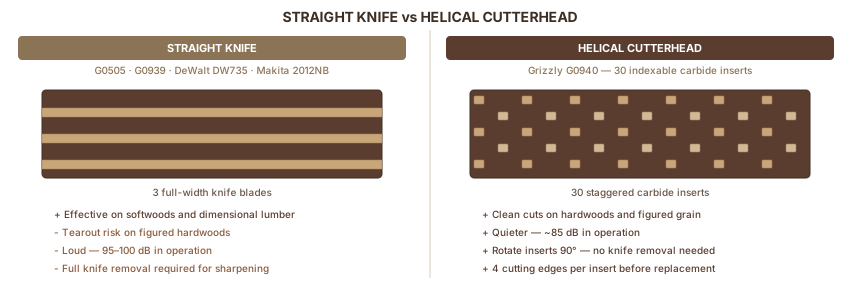
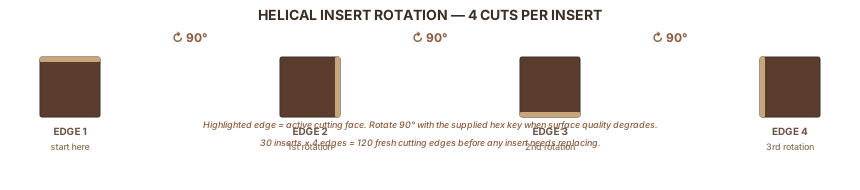
The G0940 is the right choice for most people reading this. It's the only benchtop model in the lineup with a helical cutterhead. Instead of two or three full-width straight knives, it uses 30 small carbide inserts arranged in a spiral. Those inserts slice wood fibers at an angle rather than hitting them head-on — less tearout on figured grain, noticeably quieter operation, and simpler maintenance. When an insert dulls, you rotate it 90° to expose a fresh edge. No knife removal, no height setting.
The G0505 at $430 is a legitimate option if you're uncertain how much you'll actually use a planer. Straight knives get the job done. But if you're regularly milling hardwoods, the $450 jump to helical on the G0940 is worth it.
The G0453Z is a different class of machine — floor-standing, 3 HP, 74-insert spiral head. It's what a small professional shop buys. For a home shop doing occasional projects, it's more than you need.
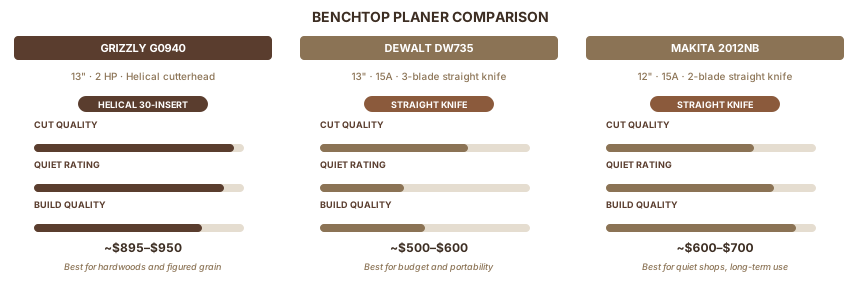
Grizzly G0940 vs. DeWalt DW735 vs. Makita 2012NB
These three are the most common benchtop planers in home shops at different price points.
| Grizzly G0940 | DeWalt DW735 | Makita 2012NB | |
|---|---|---|---|
| Cutting width | 13" | 13" | 12" |
| Cutterhead | Helical, 30 inserts | 3 straight blades | 2 straight blades |
| Feed rate | 25 FPM | 8 or 20 FPM | 20 FPM |
| Build | Granite base, metal-heavy | Plastic-heavy | Metal-heavy |
| Noise | Low | High | Low |
| Price | ~$895–$950 | ~$500–$600 | ~$600–$700 |
| Best for | Hardwoods, regular use, figured grain | Budget, portability | Quiet operation, long-term durability |
The DeWalt DW735 sells more units than any other benchtop planer because it's cheap and available everywhere. Two feed speeds help — slow for better surface quality, fast for hogging material. The plastic construction is the honest weakness; there are reports of machines failing after five to seven years of regular use. On a budget or if portability matters, it gets the job done.
The Makita 2012NB is regarded as the best-built benchtop planer in its price range. More metal, quieter, more durable. The limitation: 12" max width vs. 13" on the others.
As detailed by Machine Atlas in their benchtop planer comparison, the DW735 wins on value and versatility; the Makita wins on build quality; the Grizzly G0940 wins on cut quality — particularly on hardwoods and figured grain where straight knives produce tearout that the helical head avoids entirely.
The G0940 costs more than both. The helical cutterhead is why. If you're milling pine or poplar for hobby projects, the DW735 saves you $350. If you're building furniture from walnut, maple, or cherry and want the surface to look like furniture, the G0940 is the right tool.
RELATED: Jointer vs. Planer The two machines work together as a system. Jointer first for a flat reference face, then planer for consistent thickness. Worth understanding before you buy either one.
Part 2: Setting Up Your Grizzly Planer
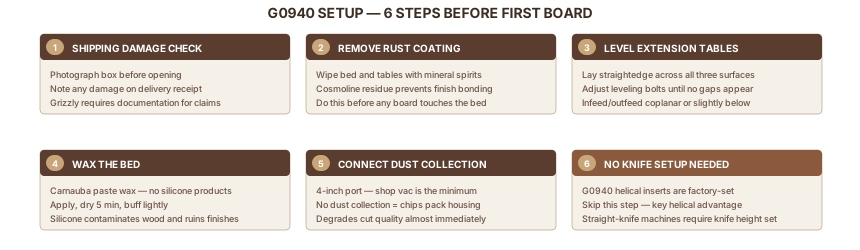
Most new planer problems come from skipping setup steps. The G0940 ships ready to run, but "ready to run" and "properly dialed in" aren't the same thing. Do these steps before the first board.
Before you plug it in
1. Inspect for shipping damage before signing the delivery receipt. Shipping damage — cracked base plates, bent extension tables, cutterhead alignment knocked off — is a documented issue with Grizzly benchtop planers. Photograph the outside of the box before opening it. Photograph the machine when it comes out. Note any visible damage on the delivery receipt before the driver leaves. Grizzly will make it right, but you need the documentation.
2. Remove the rust-preventive coating. The bed and tables arrive coated with cosmoline or a similar rust inhibitor. Wipe it off with mineral spirits before running any wood. Residue on the bed transfers to boards and can prevent finishes from bonding.
3. Level the extension tables. The infeed and outfeed tables should be coplanar with the main bed — flat and even, or very slightly below. Lay a straightedge across all three surfaces and adjust the leveling bolts under each wing until there are no gaps.
4. Apply paste wax to the bed. A light coat of Johnson's Paste Wax (any carnauba paste wax without silicone) helps boards feed smoothly and protects the bed from rust. Apply, let dry five minutes, buff lightly. No silicone-based products — silicone contaminates wood surfaces and prevents finishes from bonding.
5. Set up dust collection before you turn it on. A 13" planer at full depth produces a lot of chips fast. The G0940 has a 4" dust port. Connect a shop vac at minimum; a dedicated collector is better. Running without dust collection packs chips into the cutterhead housing and degrades cut quality almost immediately.
6. No knife setup needed for the G0940. The helical inserts are factory-set. You don't need to check knife height on arrival — one of the real advantages of a helical head over straight-knife machines.
The first board
Run a scrap piece of pine through before you touch project lumber. Seven steps:
- Raise the cutterhead high, slide your board underneath, lower until you feel light resistance, then crank down 1/16" more — that's your first pass depth.
- Check grain direction: the grain should slope downward toward the infeed end.
- Stand to the side of the machine, not directly behind the board.
- Feed the board in smooth and flat to the bed.
- Let the feed rollers pull the board. No pushing from behind.
- Support the outfeed end with your hand as the board exits.
- Check the result: even cut across the full width? Snipe at the ends? If snipe is deeper than 1/32", raise the infeed extension table slightly.
Part 3: Using a Thickness Planer — Technique and Snipe Control
What a planer does — and what it doesn't
A thickness planer removes a uniform layer from the top face of a board while the flat bottom rides on the bed. The output is a board with two parallel faces at a precise thickness.
"Flat bottom rides on the bed" is the key phrase. If the board going in has a cup or twist, the board coming out has the same cup or twist at a thinner dimension. The planer doesn't fix warped lumber. It accurately reproduces whatever shape enters it.
The correct milling sequence: jointer first to create a flat reference face, then planer to bring the board to consistent thickness using that face. Without the flat reference face, the planer propagates the warp through to both sides.
Two things a planer will never do:
- Plane end grain. Feeding end grain into a thickness planer causes violent kickback. Never do it.
- Handle boards with loose knots. A loose knot can eject as a projectile. Check boards before feeding.
RELATED: Electric Hand Planer An electric hand planer is a different tool — it trims doors, chamfers edges, and levels site lumber in place. Not the same as a thickness planer and not a substitute for one.
Grain direction and depth of cut
Grain direction: Feed so the grain fibers slope downhill toward the infeed end. The cutterhead cuts along the fibers from high to low instead of lifting them up. On figured or interlocked grain where direction reverses, the G0940's helical head handles it cleanly; straight-knife machines need lighter passes and may still show tearout.
Depth per pass: As documented on Woodweb's professional planing reference:
| Wood type | Roughing pass | Finishing pass |
|---|---|---|
| Softwoods (pine, poplar) | 1/8" max | 1/32"–1/16" |
| Hardwoods (oak, maple, walnut) | 1/16" max | 1/32" |
| Figured / interlocked grain | 1/32" | 1/32" |
Two light passes beat one heavy pass for surface quality every time. After hitting target thickness from one face, flip the board and take the same amount from the other side. Removing material equally from both faces reduces bowing as internal stresses release.
Snipe — what it is and how to stop it
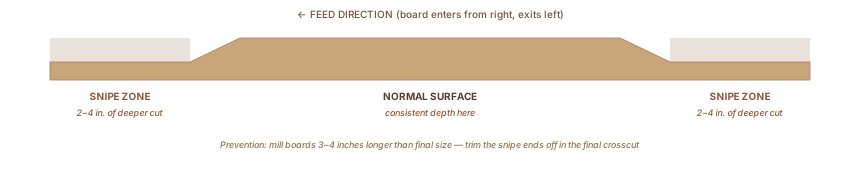
Snipe is the slightly deeper cut at the front and back 2–4 inches of a board. Run any board through any benchtop planer and check the ends. You'll see it. It's a physics problem, not a defect.
According to the Wood Whisperer's snipe analysis and confirmed by Matthias Wandel's mechanical breakdown at Woodgears: the board is gripped by two feed rollers with the cutterhead between them. At the leading edge, only the infeed roller is on the board. The cutterhead deflects slightly downward — nothing holds the board firmly from both sides yet — and cuts deeper. The same thing happens at the trailing edge as it exits. It's not a flaw in the machine. It's what happens when the geometry changes.
Three ways to prevent it:
1. Sacrificial boards. Cut two scraps to the same thickness as your workpiece. Place one immediately before and one after your workpiece, touching end to end. Feed all three through as a single continuous run. Snipe appears only on the sacrificial ends, which you discard.
2. Manual lifting. As the board's leading edge enters the cutterhead, lift the trailing end slightly — this pushes the leading end against the bed. As the board exits, lift the leading end. Takes a few passes to get the feel for it.
3. Angle feeding for short boards. For boards under 18 inches, feed at 15–30 degrees. The roller engages gradually across the width rather than hitting the full edge at once, reducing deflection. Fix This Build That documents this technique as one of the most reliable options for short stock.
The practical move: Mill all boards 3–4 inches longer than your final dimension. The snipe ends up in the waste you trim off anyway.
Per the Yale EHS wood planer safety procedure, always stand to the side of the infeed — not directly behind the board — and keep hands at least 3 inches from the infeed opening. Wear safety glasses and hearing protection. Never plane boards with loose knots.
Part 4: Do You Need a Thickness Planer?
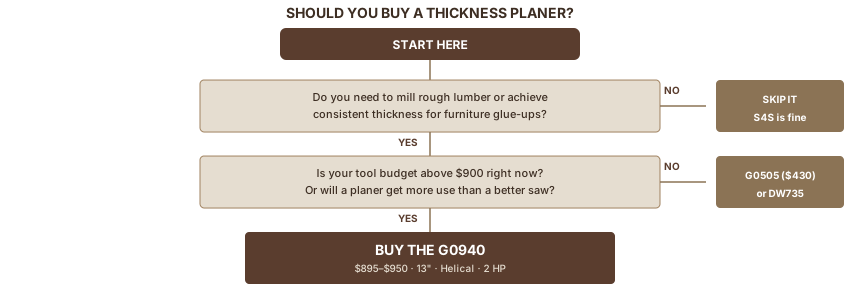
A planer isn't a beginner's first tool. S4S lumber from any hardware store works for most early projects, and milling rough stock adds skill requirements before you can use it. But the planer pays for itself once you're building furniture regularly.
When a planer makes sense
You want to buy rough lumber. According to Tyler Brown Woodworking's breakdown, rough-sawn lumber costs 30–50% less per board foot than S4S. On a 50-board-foot furniture project, that's $80–$150 in material savings. A G0940 pays back its cost in roughly eight to ten projects at that scale.
You need consistent thickness for glue-ups. Panel glue-ups — table tops, wide cabinet sides — require boards at the same thickness to assemble flat. Retail S4S lumber has real thickness variation. A planer sets every board to the same dimension before glue-up.
You need non-standard dimensions. Restoring furniture with 7/8" parts. Matching existing millwork. Getting precise thicknesses not available in dimensional lumber. A planer is the only power tool that handles this.
When you don't need one yet
| Your situation | Better move |
|---|---|
| Building from dimensional lumber plans | Buy S4S; the planer adds nothing here |
| Cutting boards, small shelves, boxes | S4S is fine; no milling needed |
| Total tool budget under $1,500 | A better saw or router gets more use |
| Limited space, no room for infeed/outfeed clearance | Measure first; planers need 8–10 ft of clear run |
| Mostly softwoods, single boards | A hand plane handles these faster without setup |
Planer vs. hand plane:
| Situation | Best choice |
|---|---|
| Single board, under 24" | Hand plane — faster, no setup |
| Multiple boards to same thickness | Planer — consistency is the whole point |
| Panels wider than 12" | Planer |
| Figured wood on a tight budget | Skew-angle hand plane cut works surprisingly well |
| Ten or more boards per session | Planer every time |
Part 5: Maintenance and Long-Term Use
Regular maintenance
Wax the bed. When boards start dragging instead of feeding smoothly, apply paste wax. Johnson's Paste Wax, Minwax Paste Wax — any carnauba-based product without silicone. Spread a thin layer, let it dry five minutes, buff with a clean rag. As the Timber Biscuit Woodworks tune-up guide notes, keeping the bed waxed is the single most effective maintenance step for consistent feeding. Silicone-based products contaminate wood surfaces and ruin finish adhesion — avoid them.
Clean the feed rollers. Resin from pine and other sappy woods builds up on the rollers and reduces grip. Wipe rubber rollers with a rag dampened in mineral spirits. For serrated metal rollers, brush the teeth with a wire brush, then wipe with mineral spirits.
Clear chip buildup. After a long session, clean chips from the cutterhead housing and around the pressure bars. Packed chips deflect boards and create inconsistent cuts.
Knives and inserts
Signs that knives or inserts need attention: the surface comes off fuzzy rather than smooth, the machine sounds like it's laboring, or you're spending twice as long sanding.
Straight knives (G0505, G0939): Remove one knife at a time, sharpen (if HSS) or replace, then re-seat at the correct height using a straightedge or a magnetic jig. Set all knives to the same height. Uneven knives leave ridges across the board. The owner's manual has the exact procedure.
Helical inserts (G0940): Rotate each dull insert 90° with the supplied hex key to expose a fresh cutting edge. Four edges per insert — four rotations before replacement. No height adjustment needed after rotation. Replace the insert when all four edges are used.
Rough maintenance schedule:
| Use level | Check knives / inserts |
|---|---|
| Light (a few times a year) | Inspect yearly |
| Regular (most weekends) | Inspect every 6 months |
| Heavy production | Inspect every 4–6 weeks |
Sources
Specifications, technique guidance, snipe mechanics, and maintenance procedures were drawn from the following sources.
- Grizzly G0940 product page — official specs and features
- Grizzly G0505 product page — budget model specs
- Grizzly G0453Z product page — floor-standing spiral model
- Grizzly Support — How to Set Up a Planer — setup procedure
- Machine Atlas — DW735 vs Makita 2012NB — competitor comparison
- The Wood Whisperer — Dealing With Planer Snipe — snipe causes and solutions
- Woodgears.ca — Causes of Planer Snipe — mechanical explanation
- Fix This Build That — 6 Ways to Reduce Planer Snipe — prevention techniques including angle feeding
- Woodweb — How Much Wood to Take Off Per Planer Pass — depth of cut data by wood type
- Tyler Brown Woodworking — Do I Need a Planer? — cost analysis and beginner decision framework
- Yale EHS — Wood Planer Safety Procedure — safety checklist
- Timber Biscuit Woodworks — Planer Tune-Up Guide — maintenance procedure
Tools Used
How We Research
We don't take affiliate revenue or accept review units. Picks come from multi-source research — manufacturer specs, OSHA / EPA / ASTM regs, and long-form practitioner threads — plus Ahmed's hands-on use where relevant. When we recommend something, we explain why.
Up Next
Jointer vs Planer
POWER TOOLS · Beginner