
1-Inch Plywood at a Glance
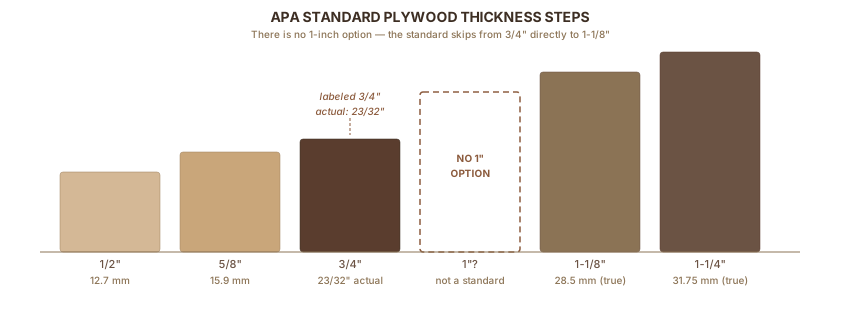
There's no standard "1-inch" plywood. The APA sizing system jumps from 3/4" to 1-1/8", so what you find at the store is 3/4" nominal (which actually measures 23/32"), 1-1/8", or 1-1/4" panels. Knowing this saves you from buying the wrong sheet, cutting dados that don't fit, and wasting money on a grade you don't need.
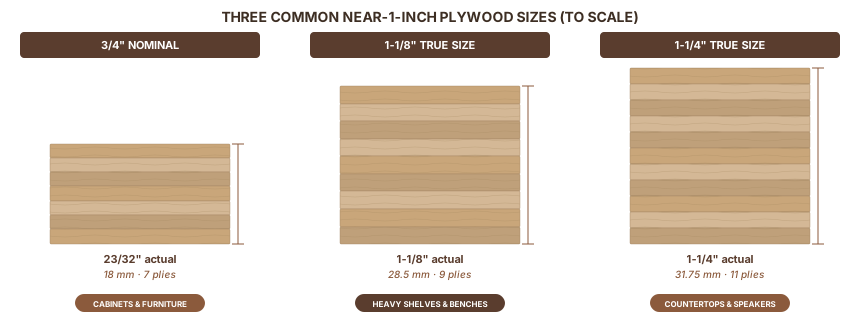
| Closest standard sizes | 3/4" (23/32" actual), 1-1/8", 1-1/4" |
| Why no true 1" | Not part of the APA/PS 1 standard sizing system |
| Grade for furniture | AC or better (A face, C back) |
| Best thick option | Baltic birch: 13 plies at 3/4", void-free core |
| Where to buy | Hardwood dealers beat big-box stores on grade and price |
In this guide:
- Part 1: Why "1-inch plywood" doesn't exist as a standard size
- Part 2: Choosing the right grade and core type
- Part 3: Baltic birch vs. domestic plywood
- Part 4: Where to buy and what to inspect
Part 1: Why "1-Inch Plywood" Doesn't Exist as a Standard Size
You won't find a 1-inch plywood sheet at the lumber yard because it isn't a standard size. The APA's Voluntary Product Standard PS 1-19, which governs plywood manufacturing in the US, defines these thickness steps: 1/4", 3/8", 1/2", 5/8", 3/4", 1-1/8", and 1-1/4". No 1-inch option.
The thicknesses you do find aren't what they claim to be, either.
Nominal vs. Actual: What You're Buying
Plywood loses material during sanding and shrinks as it dries. According to Inch Calculator's thickness reference, a sheet labeled 3/4" measures about 23/32" with calipers. Here's what you'll find on the rack:
| Nominal Size | Actual Thickness | Metric Equivalent |
|---|---|---|
| 3/4" | 23/32" (0.719") | 18 mm |
| 1-1/8" | 1-1/8" (true) | 28.5 mm |
| 1-1/4" | 1-1/4" (true) | 31.75 mm |
Panels 1-1/8" and thicker are true to their stated size. The PS 1 tolerance for panels over 13/16" is plus or minus 5% of the stated thickness.
This matters when you're cutting joinery. A dado routed to exactly 3/4" will be too loose for your 23/32" panel. Measure every sheet with calipers before you cut.
What Most People Actually Need
When someone searches "1-inch plywood," they're looking for one of three things:
Heavy-duty shelving or workbench tops. You want 1-1/8" plywood from a hardwood dealer. It's stiff, heavy, and overkill in the best way for long spans.
Standard cabinet and furniture panels. You want 3/4" (23/32" actual). This is the workhorse thickness for shelving, cabinet boxes, and tabletops with support underneath.
A true 1" panel for a specific build. Laminate two sheets: 3/4" plus 1/4", or two sheets of 1/2". Wood glue, even clamping pressure, 24-hour cure. Woodworkers do this all the time for workbench tops and shop fixtures.
Part 2: Choosing the Right Grade and Core Type
Two decisions drive quality and cost: the veneer grade (what the faces look like) and the core type (what's inside).
Plywood Grades
The APA grading system rates face and back veneers from A (best) to D (lowest). The first letter is the face, the second is the back.
| Grade | What You'll See | Use It For |
|---|---|---|
| A | Smooth, paintable, minimal defects | Visible furniture faces |
| B | Solid surface, minor repairs visible | Secondary visible surfaces |
| C | Knots up to 1.5", some splits | Backs, hidden surfaces |
| C-Plugged | Splits limited to 1/8" width | Underlayment |
| D | Knots up to 2.5", limited splits | Structural sheathing only |
For furniture and cabinets: Buy AC (smooth A face, economy C back) or better. If both sides show, go with AB or A1 from a hardwood dealer.
For painted cabinets: BC works fine. The paint hides the face imperfections, and you save 20-30% over A-grade.
Never use CDX for furniture. CDX is construction sheathing. The "X" means exterior glue, not high quality. It has voids, rough surfaces, and no place in a furniture project.
Core Types: What's Inside Matters
The core affects weight, flatness, screw holding, and how the panel performs in your project.
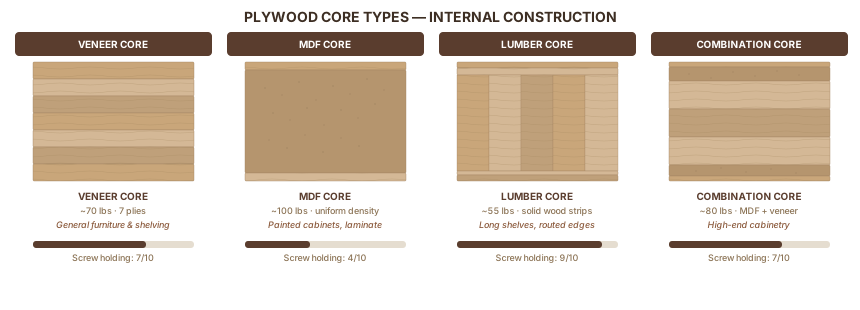
| Core Type | Weight (3/4" 4x8) | Screw Holding | Flatness | Best For |
|---|---|---|---|---|
| Veneer core | ~70 lbs | Good | Good | General furniture, shelving |
| MDF core | ~100 lbs | Fair | Excellent | Painted cabinets, laminate substrate |
| Lumber core | ~55 lbs | Excellent | Good | Long shelves, routed edges |
| Combination | ~80 lbs | Good | Excellent | High-end cabinetry |
Go with veneer core for most furniture builds. It's lighter than MDF, holds screws well, and costs less than lumber core. If you're building painted cabinets and need a dead-flat surface, MDF core is worth the extra weight. The Family Handyman's core guide has a good visual breakdown of each type.
Lumber core is the premium pick for long shelves and countertops where you want to rout the edges instead of applying banding. It's also the most expensive.
For a deeper dive into cabinet-specific sheet goods, see the sheet goods for cabinets guide.
Part 3: Baltic Birch vs. Domestic Plywood
The birch plywood at Home Depot and Baltic birch plywood share a name. That's about it. The construction, quality, and price are different enough that they're separate products for separate jobs.
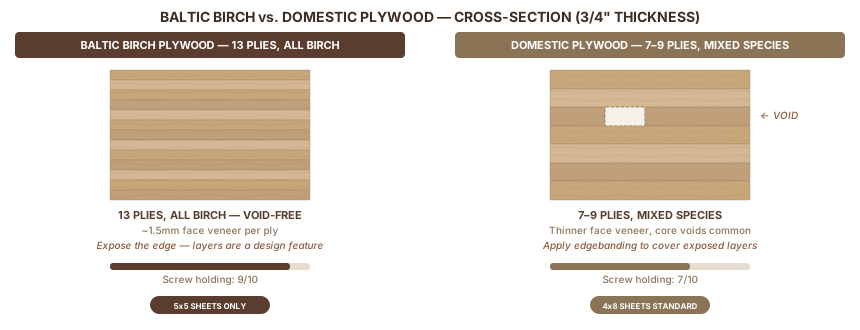
| Attribute | Baltic Birch | Domestic Plywood |
|---|---|---|
| Ply count (3/4") | 13 plies | 7-9 plies |
| Veneer material | All birch, every layer | Mixed species core, hardwood face |
| Voids | None (or nearly none) | Common in lower grades |
| Edge quality | Can be left exposed, routed, finished | Needs edge banding |
| Screw holding | Excellent: screws bite every ply | Moderate: threads can hit voids |
| Face veneer | Thick (~1.5mm), hard to sand through | Thin, easy to sand through |
| Standard sheet size | 5' x 5' (1525 x 1525 mm) | 4' x 8' |
| Cost | Higher per square foot | Lower per square foot |
When Baltic Birch Wins
Drawer boxes. The void-free core means clean dadoes with full glue coverage. Screws hold in the edge without splitting.
Jigs and fixtures. Dimensional accuracy and flatness make it ideal for router tables, crosscut sleds, and assembly tables.
Exposed edges. You can shape Baltic birch edges with a router and finish them directly. No banding required. The layered edge is a design feature, not a flaw.
CNC and laser work. Consistent density across the sheet means predictable cuts.
When Domestic Plywood Wins
Large panels. Domestic plywood comes in 4x8 sheets. Baltic birch tops out at 5x5 (though some suppliers stock 5x10 sheets at a premium).
Budget projects. For painted cabinet boxes or utility shelving, domestic plywood at half the cost makes more sense.
Structural applications. CDX and other structural grades aren't available in Baltic birch, and you don't need void-free construction for sheathing.
Part 4: Where to Buy and What to Inspect
Sourcing Options
Big box stores (Home Depot, Lowes) stock 3/4" sanded plywood in birch, oak, and maple face veneers. They rarely carry anything thicker than 3/4" or higher than BC grade. Quality varies by store and shipment. Check multiple sheets before buying.
Hardwood dealers and lumber yards carry a wider range: 1-1/8" panels, A-grade faces, Baltic birch in 5x5 sheets. Many woodworkers report better prices at hardwood dealers than at big box stores for equivalent or higher grades. The storage conditions are better too, which means flatter, drier sheets.
Online suppliers (Rockler, Woodcraft, Ocooch Hardwoods) stock specialty sizes and Baltic birch. The tradeoff is shipping cost. A single 5x5 sheet of 3/4" Baltic birch might cost $60-80 for the panel and another $40-60 in shipping. Check for local delivery options before ordering.
The Lamination Option
If you need a true 1-inch panel and can't find 1-1/8" stock, laminate two thinner sheets together. Glue 3/4" to 1/4", or two sheets of 1/2". Use Titebond III for moisture resistance. Spread glue evenly with a roller, clamp with cauls (flat boards) every 6-8 inches for even pressure, and let it cure for 24 hours.
This is standard practice for workbench tops and shop furniture. It's not a hack; it's how thick plywood panels get made when off-the-shelf sizes don't fit.
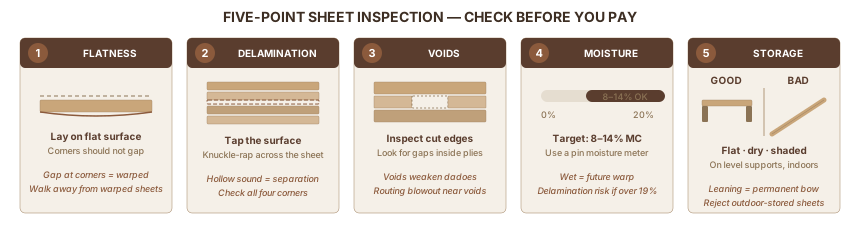
Five-Point Inspection Checklist
Check every sheet before you pay for it:
- Flatness. Lay the sheet on a flat surface. Gaps at the corners or edges mean the sheet is warped. Walk away.
- Delamination. Look at the edges for gaps between plies. Tap the surface with your knuckle. Hollow sounds mean layers have separated inside.
- Voids. Check the cut edges (if the sheet has been trimmed) for internal gaps. Voids weaken joints and cause blowout when routing.
- Moisture. Bring a pin moisture meter if you're buying from an outdoor yard. Target 8-14% moisture content. Wet plywood warps and delaminates.
- Storage. Sheets should be stacked flat on level supports, in a dry, shaded area. Reject sheets that were leaning against a wall or stored outside in the weather.
Part 5: Projects That Need Thick Plywood
When 3/4" Isn't Enough
Standard 3/4" plywood works for most cabinet and furniture builds, but it falls short in a few situations:
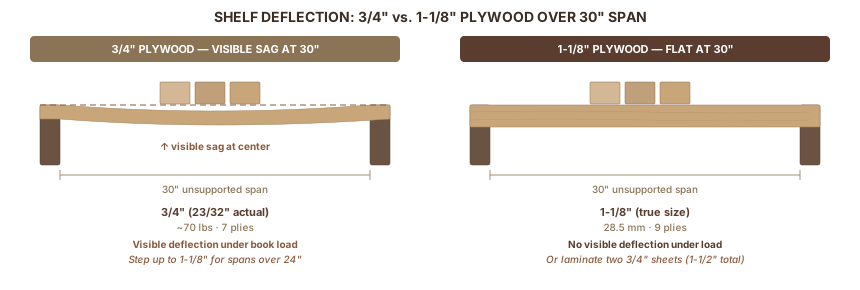
Long shelf spans over 24 inches. A 3/4" shelf loaded with books sags visibly at 30 inches unsupported. Stepping up to 1-1/8" or laminating to 1" eliminates the deflection.
Workbench tops. A single layer of 3/4" flexes under hand planing. Two laminated layers (1-1/2" total) or a single 1-1/8" sheet provides the rigidity a workbench needs.
Tabletops without aprons. A floating tabletop with no edge support needs thickness to resist sag under its own weight plus whatever you put on it.
Speaker cabinets. Thicker walls reduce resonance and vibration. 1" or thicker is standard for cabinet speakers.
Plywood vs. Solid Wood
Choose plywood when you need a wide, stable panel. Plywood doesn't expand and contract with humidity the way solid wood does. A 24-inch solid wood panel can move 1/4" seasonally. The same width in plywood barely moves at all.
Choose solid wood when edges will be visible and you want to shape profiles, or when the piece needs to be refinished years from now. You can sand and refinish solid wood many times. Plywood gets one or two sandings before you hit the core.
Part 6: Working With Thick Plywood
Cutting Clean
Thick plywood is harder to cut without tearout because the blade exits through more veneer layers. Three things fix this:
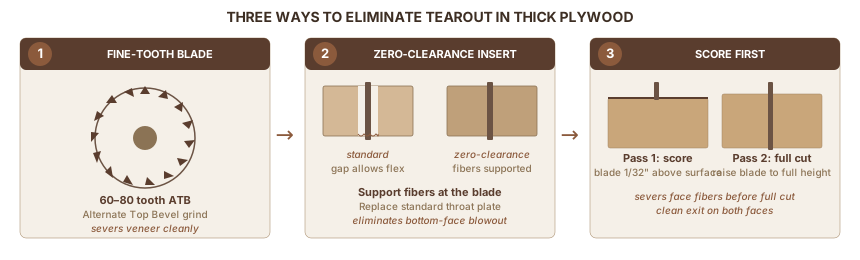
Use a fine-tooth blade. A 60 to 80 tooth ATB (Alternate Top Bevel) blade makes clean cuts through plywood veneer. The [Freud "Ultimate Plywood and Melamine" blade](https://www.rockler.com/learn/stopping-tearout-veneered-plywood) is a popular choice among woodworkers for tearout-free cuts.
Install a zero-clearance insert. The gap around a standard table saw insert lets the bottom veneer flex and tear. A zero-clearance insert supports the fibers right up to the blade.
Score first. Raise the blade 1/32" above the surface and make a light pass to sever the face veneer fibers. Then raise the blade to full height and cut through. The Wood Whisperer recommends this two-pass method for clean cuts on veneered panels.
For more on table saw setup and technique, see table saw essentials.
Edge Treatment
How you finish the edges depends on what you're working with:
Domestic plywood: Iron-on edge banding is the standard. Cut the banding 1/16" oversize, press it on with a household iron, and trim flush with an edge trimmer. Quick and effective.
Premium look: Glue solid hardwood strips to the edges. This gives a furniture-grade appearance and lets you round over or chamfer the edge with a router.
Baltic birch: Leave the edges exposed. The layered birch pattern is a design feature. Sand to 180 grit and finish with the rest of the piece.
Sources
This guide draws on the APA plywood standards, manufacturer specifications, and woodworking community expertise for thickness data, grading definitions, and practical buying advice.
- APA PS 1-19 Structural Plywood Standard — thickness tolerances and veneer grading definitions
- APA Grades and Specifications Product Guide — face grade descriptions and panel markings
- Inch Calculator: Actual Plywood Thickness and Size — nominal vs. actual thickness chart
- Woodworkers Source: Ultimate Guide to Baltic Birch Plywood — ply count, grading, and performance data
- Forest Plywood: Understanding Plywood Grades — A through D grade definitions
- The Family Handyman: Guide to Plywood Core Options — core type comparison
- Rockler: Stopping Tearout on Veneered Plywood — blade and technique recommendations
- The Wood Whisperer: Stop Tearout in Plywood — scoring pass method
How We Research
We don't take affiliate revenue or accept review units. Picks come from multi-source research — manufacturer specs, OSHA / EPA / ASTM regs, and long-form practitioner threads — plus Ahmed's hands-on use where relevant. When we recommend something, we explain why.
Up Next
1x4 Lumber: Actual Dimensions, Grades, and Uses
WOOD & MATERIALS · Beginner