
How to Use This Guide
A circular saw used as a table saw substitute is a workable trade-off that relies on either a guide-rail system or an inverted table setup to replicate rip cuts and crosscuts — each method delivering real capability alongside hard limitations that no technique fully closes. In a guide-rail setup, the saw travels along a clamped track; in an inverted table, the blade sits fixed and the stock feeds past it. Both approaches demand more setup time per cut than a table saw, and neither handles narrow rips, dado stacks, or repetitive production work with the same speed or safety margins.
(The terms "skill saw" and "circular saw" mean the same tool. "Skill saw" started as a brand name. Skil Corporation invented the handheld circular saw in the 1920s, and the name stuck as the generic term in construction trades.)
- Need straight rip cuts right now: Jump to Part 2: The Guide-Rail Method. This works and it's safe.
- Considering the inverted table setup: Read Part 3: The Inverted Table Method first. There are real safety trade-offs to understand before building one.
- Deciding whether to buy a table saw: Part 5: Should You Buy a Table Saw? has a decision framework and cost comparison.
Circular Saw to Table Saw at a Glance
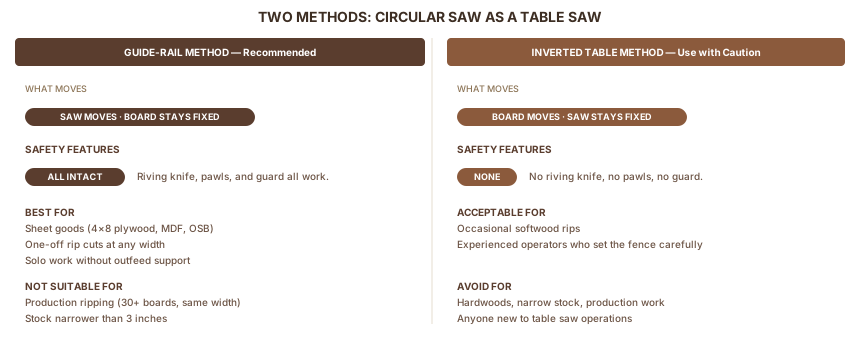
A circular saw with a guide rail can handle most rip cuts a table saw does, including sheet goods where it's actually the better tool. What it can't do: dado cuts, repeated identical rips at production volume, or cuts on stock narrower than about 3 inches. The inverted table method (saw mounted underneath a surface, blade pointing up) replicates the table saw's look but drops its three main safety features. The guide-rail method keeps the saw operating exactly as designed and is the approach worth building on.
| Circular saw cutting depth (90°) | 2-3/8"–2-9/16" |
| Table saw cutting depth (90°, 10" blade) | 3-1/8" |
| Kreg Rip-Cut fence accessory | ~$35 |
| Entry-level jobsite table saw | $250–$400 |
| What a circular saw can't replicate | Dado cuts, production ripping, narrow stock |
In this guide:
- What a table saw actually does
- The guide-rail method (the practical approach)
- The inverted table method (the safety reality)
- What a circular saw genuinely can't do
- Should you buy a table saw?
Part 1: What a Table Saw Actually Does
A table saw fixes the blade in position and moves the workpiece past it on a flat, supported surface. That's the whole principle. The fence sets the distance from blade to cut line, locks there, and every board pushed through comes out the same width without measuring, marking, or resetting.
That repeatability is the table saw's real advantage. Once the fence reads 3-1/2 inches, you can rip fifty boards to 3-1/2 inches and every one will match. A circular saw, even with a guide, requires clamping or resetting for each different width.
The table saw's second advantage is its safety system. Three features work together:
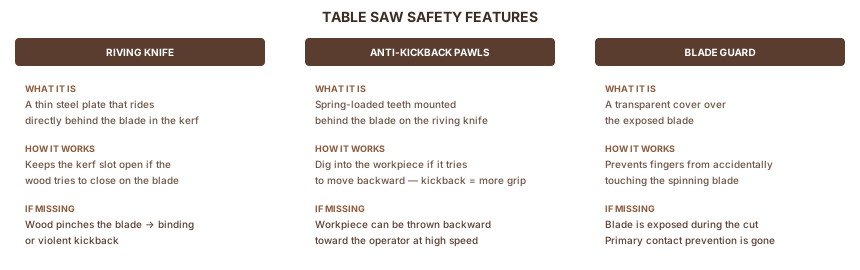
- Riving knife: A thin steel plate that rides just behind the blade in the kerf. If the wood has internal stress and tries to close on the blade, the riving knife keeps the slot open. Without it, the blade binds and the workpiece can be thrown violently.
- Anti-kickback pawls: Spring-loaded teeth mounted behind the blade that dig into the workpiece if it tries to travel backward. On a properly set up table saw, kickback pushes the pawls into the wood harder, stopping the board before it reaches the operator.
- Blade guard: Covers the blade except at the kerf. Its primary job is contact prevention, not kickback control. It stops fingers from accidentally hitting the blade.
OSHA 29 CFR 1910.213, the federal standard for woodworking machinery, requires all three on any table saw used commercially. Worth knowing before you build something that has none of them.
Part 2: The Guide-Rail Method
The guide-rail method keeps the circular saw exactly as designed: right-side up, all guards and safety features intact. Instead of moving the wood past a fixed blade, you move the saw along a guide clamped to the stationary workpiece. The physics are identical to a table saw. The trade-off is speed on repeated cuts.
How the Base Plate Acts as the Table
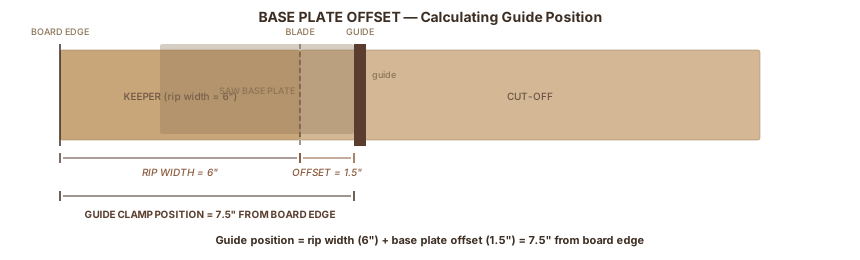
The saw's flat metal base plate (the shoe) is the reference surface. A straight guide clamped to the workpiece acts as the fence. The base plate rides along the guide and the cut line stays parallel to the guide edge.
To understand the DIY setup, you need to know the base plate offset: the distance from the left edge of the saw's base plate to the nearest tooth on the blade. Measure it on your saw. Common range: 1.5"–2.0". Every saw is different.
Your guide clamps at: (desired rip width) + (base plate offset) from the workpiece edge. Want a 6-inch rip with a 1.5-inch offset? Clamp the guide at 7.5 inches. Always run a test cut on scrap first. The math adds one step, but the setup takes about three minutes on unfamiliar stock.
Three Options, Ranked by Cost
| Method | Cost | Rip Capacity | Setup per Cut |
|---|---|---|---|
| DIY straightedge (MDF + clamps) | $0–$15 | Unlimited | 3–5 min |
| Kreg Rip-Cut | ~$35 | 0–24" | 30 sec |
| Festool/Makita track saw | $400–$800+ | Unlimited | 2–3 min |
The Kreg Rip-Cut is the practical choice for most woodworkers. It mounts to the saw's base plate, slides along the board edge, and reads the rip width directly on its scale. No offset calculation. No clamping. Adjustable from 0 to 24 inches. For $35, it turns a circular saw into a competent ripping tool for boards up to 24 inches wide.
Track saw systems (Festool TS 55 REQ, Makita SP6000J1) take the concept to its professional extreme: a dedicated saw rides in a groove on a precision aluminum rail, producing zero-tearout cuts with table-saw accuracy. The Festool system runs $600–$800 for saw plus rail. If you do a lot of sheet goods work and don't want a full table saw, a track saw is a real alternative.
Where a Circular Saw Beats a Table Saw
Sheet goods (4x8 plywood, OSB, MDF) are actually easier to cut with a circular saw and guide. Feeding a full 4x8 sheet through a table saw without outfeed support is awkward and sometimes dangerous. With a circular saw, you clamp the guide to the sheet on the floor or on sawhorses and bring the saw to the material. You can do it alone, without an outfeed table, in a normal garage.
Part 3: The Inverted Table Method
The inverted approach mounts the circular saw upside down under a plywood or MDF table, blade protruding up through a slot, and a fence guides the workpiece. Commercial conversion kits run $30–$80. Visually, it resembles a table saw. Functionally, it's meaningfully different.
What the Inverted Method Loses
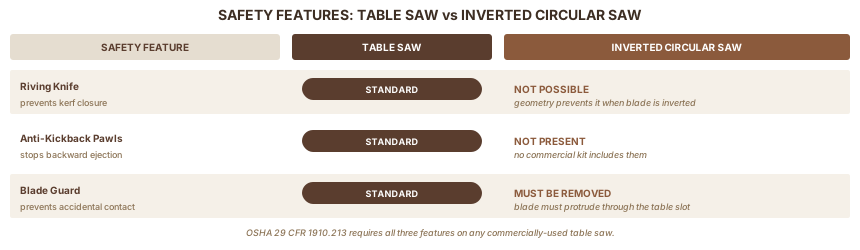
A table saw has three engineered safety features. An inverted circular saw has none:
| Safety Feature | Table Saw | Inverted Circular Saw |
|---|---|---|
| Riving knife (prevents kerf closure) | Standard | Not possible |
| Anti-kickback pawls | Standard | Not present |
| Blade guard | Standard | Must be removed |
Blade rotation direction is a second problem. A standard table saw rotates the blade top-toward-the-operator, pulling the workpiece down into the table surface. A circular saw mounted inverted may rotate the other way depending on orientation, pushing the workpiece up or back toward the operator. Kickback in that direction is less predictable and harder to stop.
Fence alignment is the third issue. A table saw fence rides on precision rails that keep it exactly parallel to the blade. A fence not parallel to the blade cams the workpiece into the blade mid-cut, which causes binding and kickback. On a DIY or kit inverted table, fence parallelism depends on careful setup every single time you use it.
When It's Acceptable
For occasional, light-duty ripping of softwood by an experienced operator who understands the risks and sets the fence carefully, it works. Many woodworkers have used it without incident.
Skip it for production work, hardwoods, stock narrower than 3–4 inches, or any situation where children are nearby. The missing safety features are what separate "close call" from "injury."
Part 4: What a Circular Saw Can't Do
Three table saw operations don't translate to a circular saw, regardless of the guide setup.
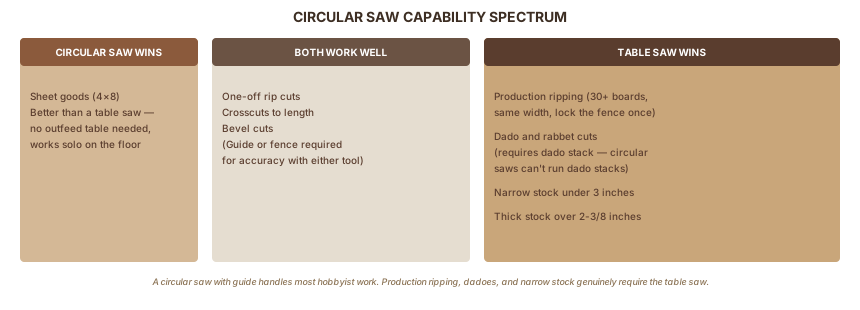
Dado and rabbet cuts. A dado cut is a flat-bottomed groove in the face of a board, used for cabinet shelves, drawer bottoms, and joinery. A table saw accepts a dado stack: two outer blades plus chippers that together cut a groove up to 13/16" wide in a single pass. Circular saws can't run dado stacks. You can make multiple overlapping passes with a circular saw to approximate a dado, but the bottom won't be flat without a router cleanup pass, and the result is imprecise.
Production ripping. If you need to rip 30 boards to the same width, a table saw fence locked at that width is the right tool. Resetting a clamped guide takes 2–3 minutes per cut. At 30 cuts, that's an extra hour of setup time. The circular saw guide is a one-off cut tool.
Narrow stock. Ripping a board down to 2 inches wide is straightforward on a table saw with push sticks. On a circular saw, the base plate has almost no support on the narrow offcut side. The saw wants to tip, and the cut drifts. Below about 3 inches in rip width, the guide-rail method becomes unreliable.
Across common operations, the breakdown looks like this:
| Task | Table Saw | Circular Saw + Guide |
|---|---|---|
| Rip board to width (one-off) | Excellent | Good |
| Rip board to width (repeated, same width) | Excellent | Poor |
| Sheet goods breakdown (4×8) | Fair | Excellent |
| Crosscut to length | Good | Good |
| Bevel cuts | Excellent | Good |
| Dado/rabbet cuts | Excellent | Not practical |
| Stock narrower than 3" | Good | Difficult |
| Stock thicker than 2-3/8" | Good | Limited |
Part 5: Should You Buy a Table Saw?
The answer depends on whether you already own the circular saw.
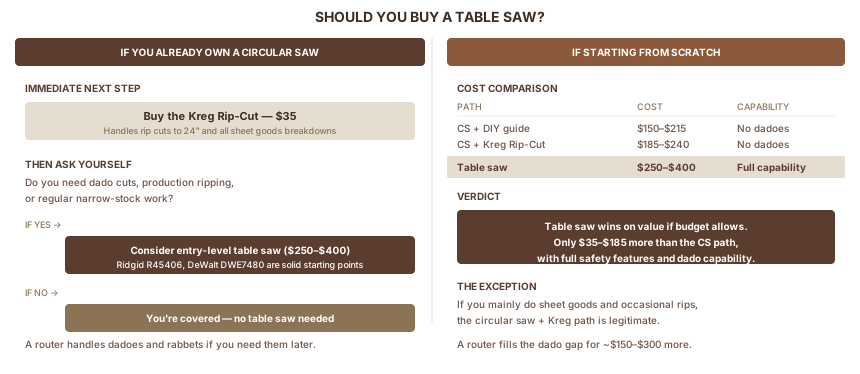
If you already own a circular saw: Buy the Kreg Rip-Cut for $35 and you have table-saw-like rip capability on boards up to 24 inches. For sheet goods, the circular saw with a guide is already the better tool. The only reasons to add a table saw are dadoes, production ripping, or frequent work with narrow stock.
If you're starting from scratch: An entry-level jobsite table saw costs $250–$400 and is safer, more capable, and only slightly more expensive than a circular saw plus conversion accessories. The math:
| Path | Cost | What You Get |
|---|---|---|
| Circular saw + DIY guide | $150–$215 | Rip cuts, sheet goods, no dadoes |
| Circular saw + Kreg Rip-Cut | $185–$240 | Rip cuts up to 24", faster setup |
| Entry-level table saw (Ridgid, DeWalt DWE7480) | $250–$400 | Full table saw capability, safety features |
| Mid-range table saw | $400–$600 | Better fence, more rip capacity |
If you need dados: A router with a straight-bit handles dadoes and rabbets without a table saw. The combination of a circular saw, router, and Kreg fence covers about 85% of what a table saw does in hobby woodworking, and the router handles the one thing a circular saw can't.
The circular saw workaround is a legitimate option for a woodworker who already has the tool and isn't doing high-volume work. Starting from scratch, it's not a cheaper path to a table saw; it's a different approach with different constraints. It's faster to set up for one-off cuts. It falls apart when the work requires repeatability at scale.
Sources
Research for this guide drew on manufacturer specifications, federal safety standards, and woodworking community resources. Sources are ordered by first appearance in the guide.
- OSHA 29 CFR 1910.213 — federal woodworking machinery safety standards requiring blade guards, riving knives, and anti-kickback devices on table saws
- Kreg Rip-Cut — fence accessory product specs, rip capacity range (0–24"), pricing
- Festool TS 55 REQ track saw — professional track saw system specs and pricing
- Makita SP6000J1 track saw — mid-range track saw option
- DeWalt DWE7480 — jobsite table saw specs and pricing reference
Tools Used
Tagged
How We Research
We don't take affiliate revenue or accept review units. Picks come from multi-source research — manufacturer specs, OSHA / EPA / ASTM regs, and long-form practitioner threads — plus Ahmed's hands-on use where relevant. When we recommend something, we explain why.
Up Next
Fix, Improve, or Replace Your Fence
POWER TOOLS · Beginner