
QUICK ANSWER: An electric hand planer is a specific-purpose tool, not a substitute for a bench-top planer or jointer. It trims stuck doors, chamfers edges, levels floor joists, and handles panels too wide to feed through a stationary planer. Standard cutting width is 3-1/4"; wider models go to 4-3/8". Buy one only when a specific job demands it — site work, a door that won't close, or a wide panel beyond your planer's capacity. For furniture stock, use a bench-top planer + jointer; their machined reference tables produce the precision a handheld can't match.
Electric Hand Planer at a Glance
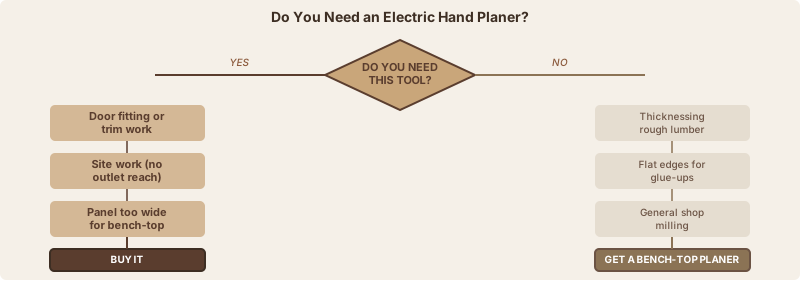
An electric hand planer is a specific-purpose tool. It trims stuck doors, chamfers edges, levels floor joists, and handles wide panels your bench-top planer can't reach. It's not a substitute for a bench-top planer or a jointer. Those tools thickness and flatten stock on a machined reference table. This one follows your hands, which makes it portable and flexible but not precise enough for furniture-quality surfaces. Buy one when a specific job demands it: a door that won't close, site work away from the shop, or a panel too wide to feed through your planer.
| Cutting width | 3-1/4" standard; 4-3/8" on wider models |
| Max depth of cut | 1/16"–5/32" depending on model |
| Motor power | 3.8–7.5 amps (corded) |
| Best use | Door fitting, chamfering, on-site lumber work |
| Price range | $60–$300 depending on tier |
| Not a substitute for | Bench-top planer (thicknessing) or jointer (flat edges) |
In this guide:
- What an electric hand planer actually does (and what it can't)
- When to buy one and when to skip it
- Recommended models by budget
- Technique: how to use it without ruining your work
- Blade maintenance
Part 1: What an Electric Hand Planer Actually Does
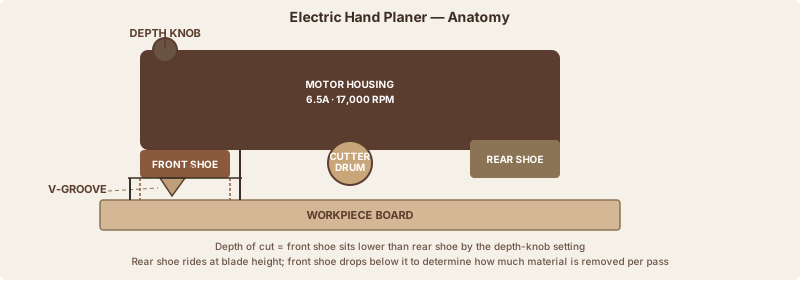
Think of it as a powered block plane. A spinning cutter head rotates two blades at 15,000–34,000 cuts per minute, shaving thin layers off a wood surface as you push the tool along. A bench-top thickness planer pulls boards through a machined frame and produces uniform thickness. The electric hand planer has no fixed reference. It follows your movement: portable, fast, and powerful enough to remove a lot of material quickly, but no more precise than the operator's hands.
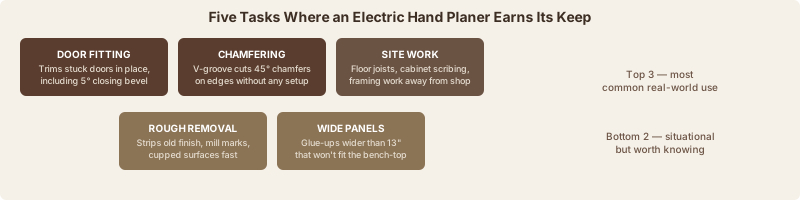
Five tasks where this tool earns its keep
Door fitting. This is the #1 real-world use. A door swells after painting or the house settles and the door sticks at the latch side. You can't run a hung door through a bench-top planer. A hand planer trims it in place, at any angle, including the 5-degree bevel a door edge needs to clear the jamb as it closes. This job alone justifies owning one.
Chamfering. Most models have a V-shaped groove on the underside of the front shoe. Run that groove along a 90-degree corner and it cuts a consistent 45-degree chamfer without any setup. Handrails, deck posts, furniture legs: wherever you want that broken corner, this is faster and more consistent than a router setup.
On-site work. Floor joist leveling, scribing cabinet sides to wavy walls, rough-dimensioning framing lumber on site — these jobs require taking material off something that isn't moving into a shop. An electric hand planer runs on a cord or battery and works wherever you are.
Rough surface removal. Old finish, heavy mill marks, cupped surfaces on reclaimed lumber — the hand planer removes 1/16" to 1/8" per pass fast. Not precision work, but it gets the board ready to go through the bench-top planer without those surfaces fighting the feed rollers.
Wide panels. Most bench-top planers max out at 12"–13" cutting width. A large glue-up or wide timber won't fit. The hand planer goes anywhere across any width.
What it can't do
This matters as much as what it can. The electric hand planer is not a substitute for:
-
A bench-top planer. The bench-top planer pulls boards through a rigid frame and produces truly uniform thickness. The hand planer follows the operator's movement and follows surface contours. You can't thickness stock to consistent dimension with it. As Woodworkers Journal puts it: "The better tool for thicknessing stock is a dedicated benchtop planer."
-
A jointer. A jointer has a machined infeed and outfeed table that creates a truly flat reference surface. The hand planer has no such table. You can approximate edge jointing with the fence attachment, but the result isn't furniture-quality. Gaps in glue-up joints come from edges that aren't truly flat and square.
-
End-grain work. Never run an electric hand planer across end grain. The blades tear out material aggressively. End-grain planing belongs to a shooting board, a disc sander, or a sharp hand plane.
-
Short boards. Anything under 12"–18" is difficult to control. Snipe (a deeper cut at the start or end of a pass) happens when both shoes can't simultaneously rest on the board.
Part 2: When to Buy One and When to Skip It
Buy one if:
- You do trim carpentry or door fitting. Even one door-fitting job pays for a budget model.
- You work with oversize panels that won't go through your bench-top planer.
- You need to chamfer edges at scale or on-site.
- You do site work (framing, decking, floor leveling) where your bench-top tools can't go.
- You've already got a bench-top planer and want a portable complement for the jobs it can't reach.
Skip it for now if:
- Your goal is thicknessing rough lumber to consistent dimension. A bench-top planer does that better, every time.
- You want flat edges for panel glue-ups. Use a jointer or a shooting board.
- You're building out a home shop from scratch. Drill, table saw, and miter saw come first. This fills a specialist gap, not a general gap.
Most woodworkers buy their first electric hand planer because a specific job demands it: a door that won't close after a humid summer, or a timber too wide for the benchtop. If you don't have that job yet, you don't need this tool yet.
Where it fits in the tool sequence
Think of it as a gap-filler, not a foundation tool. It belongs after you've got the core shop tools established and you're running into the jobs those tools can't reach. At that point, a $75 budget model solves the immediate problem. A $150 mid-range model is the right buy if you use it regularly.
Part 3: Recommended Models by Budget
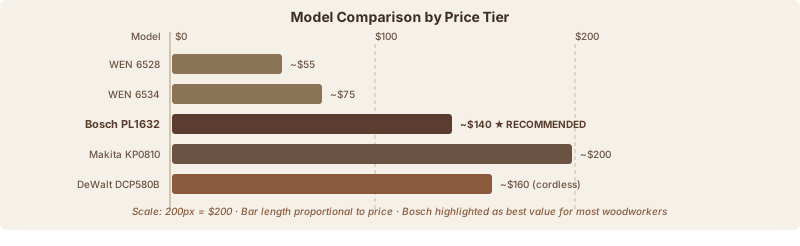
Start with the Bosch PL1632. It's $130–$150, produces smooth cuts right out of the box, includes the fence attachment and dust bag, and is the model tradespeople reach for when they need consistent results. If budget is tight, the WEN 6534 gives you reliable performance and a wider 4-3/8" cutting width for $75. If you already own Makita or DeWalt batteries, the matching cordless model is worth the premium for site flexibility.
Budget tier ($60–$100)
WEN 6534 (~$75): 8-amp motor, 4-3/8" cutting width, 32,000 cuts per minute. That wider cutting width is the differentiator. Most models in this price range are 3-1/4" wide, which means more passes on door edges and wide boards. Good for occasional use, DIY projects, and anyone who wants to test whether they'll actually use the tool before committing to a mid-range model.
WEN 6528 (~$55): 3.8-amp, 4.3 pounds. Notably lighter than most hand planers. If door fitting is your primary task and you'll be holding the tool overhead or one-handed, the weight difference matters more than the motor power.
Mid-range ($120–$180) — the recommendation for most woodworkers
Bosch PL1632 (~$130–$150): 6.5-amp motor, 3-1/4" cutting width, 16,500 RPM, 5/64" maximum depth. Includes the side fence and dust bag. Bob Vila's tested review puts it as best overall: smooth cuts with less hand-setting than budget models, and the build quality that holds up to regular shop use. The fence fits snugly without wobble, which matters for edge work.
SKIL PL201201 (~$120): A solid alternative if the Bosch is out of stock or you find it on sale. Similar specs and comparable surface quality.
Premium corded ($180–$250)
Makita KP0810 (~$200): 7.5-amp motor, 17,000 RPM, 5/32" maximum depth. That's deeper than any standard model. Two-blade cutter head, smooth feed. Built for the contractor who planes lumber daily. If you're a home woodworker who planes a board every few weeks, this is more than you need.
Makita KP0800K (~$170): Same brand confidence as the KP0810 at 6.5 amps. The lighter option in the Makita line, closer in spec to the Bosch but with the Makita build quality.
Cordless ($150–$200, tool only)
DeWalt DCP580B (~$160, 20V MAX): 15,000 RPM, 32,000 cuts per minute. Integrates with the DeWalt 20V MAX battery system. If you already own DeWalt batteries, this is the practical choice for site work without dragging a cord. Performance matches a good corded mid-range model.
Makita XPK01Z (~$200, 18V LXT): Automatic speed adjustment based on workload. The motor senses resistance and increases power through tough spots. Best ergonomics in the cordless category. The choice if you're already in the Makita 18V ecosystem.
| Model | Price | Motor | Cut Width | Max Depth | Best For |
|---|---|---|---|---|---|
| WEN 6528 | ~$55 | 3.8A | 3-1/4" | 1/16" | Light DIY, overhead door work |
| WEN 6534 | ~$75 | 8A | 4-3/8" | 5/32" | Budget + wider boards |
| Bosch PL1632 | ~$140 | 6.5A | 3-1/4" | 5/64" | Most home woodworkers |
| Makita KP0810 | ~$200 | 7.5A | 3-1/4" | 5/32" | Heavy use, deepest cuts |
| DeWalt DCP580B | ~$160+ | 20V | 3-1/4" | 5/64" | Site work, DeWalt battery owners |
| Makita XPK01Z | ~$200+ | 18V | 3-1/4" | 5/32" | Site work, Makita battery owners |
Part 4: Technique: How to Use It Without Ruining Your Work
A single technique mistake costs you a board. The two most common: snipe and tearout. Both are predictable and both are preventable once you know what causes them.
Setting depth of cut
Start shallow. Always.
- Smooth finish on hardwood edge: 1/64"–1/32" (0.4–0.8mm)
- Door fitting and general stock removal: 1/32"–1/16"
- Aggressive removal on softwood framing lumber: up to 1/8"
For hardwoods like oak and walnut, Obsessed Woodworking recommends 0.4–0.5mm maximum depth. Deeper cuts on hardwood stress the motor and produce a rougher surface that takes longer to sand out than the time you saved on the cut.
Reading grain direction
Always plane with the grain. Planing against the grain catches wood fibers and tears them out instead of slicing them. If your surface looks fuzzy or chunks are lifting, you're going the wrong direction. Turn the board around and plane from the other end.
Read grain direction by looking at the board's long edge. The grain lines angle toward the surface you're planing. Plane in the direction those lines point upward (the direction the grain rises). If you're unsure, take one test pass. A torn, fuzzy surface means reverse direction.
Knots complicate this. Reduce depth to minimum at knots, slow your feed rate, and expect more tearout near them regardless of direction.
Preventing snipe
Snipe is a deeper cut at the start or end of a pass: a scalloped gouge in the last inch or two. It happens when the front shoe drops off the end of the board and the blades take a bite at a steeper angle.
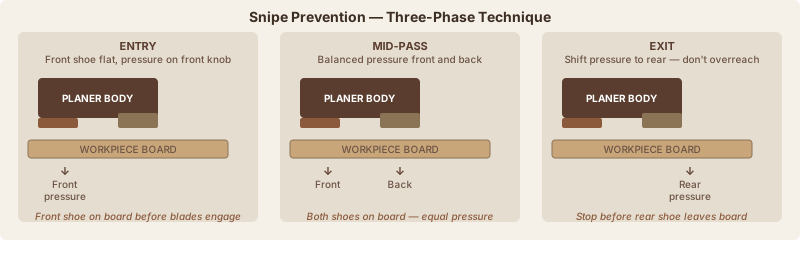
Family Handyman's pressure-transfer technique prevents it:
- Rest the front shoe flat on the workpiece before letting the blades touch the wood.
- Start the motor. Let it reach full speed before moving.
- Ease the planer into contact. Don't drop it in.
- Apply initial pressure on the front knob/grip as the planer enters the cut.
- Balance pressure between front and back handles when both shoes are fully on the board.
- As you approach the end of the board, shift pressure to the rear handle. This prevents the front shoe from dropping.
- Stop your forward motion as the rear shoe nears the end. Don't overreach.
That hand-pressure shift from front to back is the whole technique. Practice it on scrap before working on a door.
Using the fence for edge work
The side fence (included with most mid-range and premium models) attaches to either side of the planer and rides against the face of the board to maintain a consistent angle while you plane the edge.
Setup:
- Attach the fence to the side that will ride against the board face.
- Set fence height at least 2" above the cutter blades. More height gives more stability.
- Check that the fence is perpendicular to the planer shoe with a combination square. A fence that's even 1–2° off produces an edge that won't mate square.
- Set depth to 1/32" for edge work.
- Run the fence face against the board face throughout the pass.
This gives you approximate edge jointing: good enough for fitting doors and scribing panels, not good enough for furniture glue-up joints. For glue-up quality, you need a jointer.
Part 5: Blade Maintenance: When to Sharpen, When to Replace
Dull blades produce fuzzy surfaces, burn marks, and tearout that looks like a grain-direction problem but isn't. Check blades before a project, not after a ruined board.
Signs blades need attention
- Surface finish becomes fuzzy or rough even at correct grain direction and depth
- Burning smell when the blade contacts wood
- Motor sounds like it's working harder than before
- Increased vibration through the handles
- Tearout where there wasn't any previously
Reversible Blades: The Practical Approach
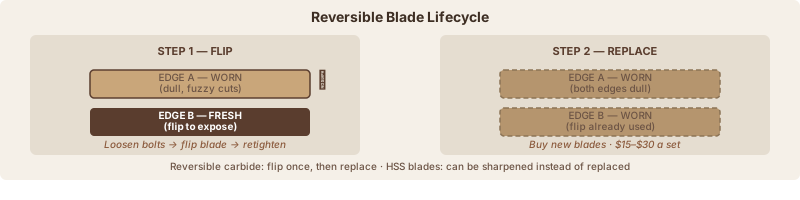
Most modern electric hand planers use double-edge blades: when one edge dulls, loosen the retaining bolts, flip the blade to expose the fresh edge, and retighten. Two fresh edges per blade. When both edges are dull, replace the blade.
Reversible carbide blades are the standard on mid-range and premium models. Don't try to sharpen carbide. Replace it. Budget models often use HSS (high-speed steel) blades, which can be sharpened.
Sharpening HSS blades
Use a flat diamond hone or waterstone. Sharpen the bevel at 5° steeper than the factory angle. This removes less metal and gets a usable edge faster. After sharpening, use a blade-height setting gauge (or a straight edge across the cutter drum) to verify both blades sit at equal height. Unequal blade height causes vibration and uneven cuts.
Replacing blades
- Unplug the tool (or remove the battery on cordless models).
- Rotate the cutter drum manually to expose the blade retaining bolts.
- Loosen the retaining clips or bolts.
- Remove the old blades.
- Seat the new blades fully in their slots.
- Tighten the retaining bolts evenly, alternating sides to keep blades seated flat.
- Check blade height with a straight edge across the drum. Both blades should contact the straight edge simultaneously at the drum's highest point.
Replacement blades for most major brands run $15–$30 for a set. Factor this into your tool budget: a $75 WEN with $25 replacement blades every 20–30 hours of use is still the cheapest tool in the category.
Where This Fits
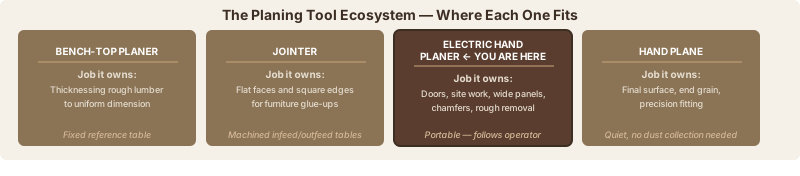
An electric hand planer slots in alongside your bench-top planer and jointer, not instead of them. The bench-top planer thicknesses. The jointer flattens and squares edges. The hand planer reaches jobs neither of them can: hung doors, site lumber, panels too wide for the bench-top, chamfers at scale.
If you don't own a bench-top planer yet, read Jointer vs Planer first. That guide covers the core tool decisions. Come back to the hand planer when you've hit a job it's built for.
Sources
Guide research drew on manufacturer specifications, tested tool reviews, and woodworking practitioner forums covering technique, real-world applications, and honest limitations.
- Family Handyman — How To Use an Electric Planer — pressure-transfer technique, snipe prevention
- Woodworkers Journal — Should I Use a Handheld Power Planer for Thicknessing? — bench-top planer vs. hand planer limitations
- Bob Vila — Best Electric Hand Planers, Tested — tested model comparison, Bosch as best overall
- Obsessed Woodworking — Mastering the Electric Hand Planer — depth settings by material, grain direction
- Tools Advisers — How To Prevent Planer Snipe — snipe prevention techniques
- Handyman's World — Hand Planer vs Bench Planer — side-by-side comparison
- LumberJocks Forum — Benchtop vs Handheld — practitioner opinions
- Rockler — Power Planer vs Jointer — use case distinction
- Byrd Tool Experts — Mastering the Electric Planer — grain direction and tearout
- Norton Abrasives — Sharpening Planer Blades — blade sharpening technique
How We Research
We don't take affiliate revenue or accept review units. Picks come from multi-source research — manufacturer specs, OSHA / EPA / ASTM regs, and long-form practitioner threads — plus Ahmed's hands-on use where relevant. When we recommend something, we explain why.
Up Next
8 Inch Jointer: The Hobbyist Sweet Spot and What to Buy
POWER TOOLS · Beginner