
Crown Moulding Compound Miter at a Glance
Crown moulding spans both the wall and ceiling simultaneously, so a simple miter won't work. You need a compound cut that combines a horizontal miter rotation and a vertical bevel tilt at the same time. The spring angle of your moulding determines both numbers. For standard 52/38 crown — the profile that sells for $1 to $8 per linear foot depending on material — that's 31.6° miter + 33.9° bevel for a 90° corner using the flat method. Pros cope inside corners instead of mitering them. It's the only approach that stays tight as wood moves.
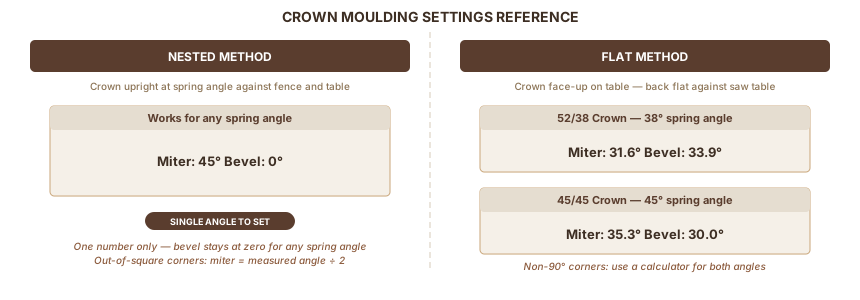
| Spring angle | Angle the moulding makes with the wall — usually 38° (52/38 crown) or 45° (45/45 crown) |
| Flat method, 52/38 crown | 31.6° miter + 33.9° bevel for a 90° corner |
| Flat method, 45/45 crown | 35.3° miter + 30.0° bevel for a 90° corner |
| Nested method | 45° miter + 0° bevel — works for any spring angle at 90° corners |
| Inside corners | Cope for wood trim; miter only if corners are dead square and wood won't move (MDF cabinet crown) |
| Out-of-square rooms | Measure actual corner angle; nested method: miter = angle ÷ 2 |
In this guide:
- Why crown moulding requires a compound cut
- How to identify and verify your spring angle
- Flat vs. nested method: setup and tradeoffs
- Exact angle table for 90° corners and non-standard rooms
- Coping inside corners step by step
Part 1: Why Crown Moulding Needs a Compound Miter
A picture frame gets a 45° miter and it works because both pieces sit flat. One plane, one cut angle. Crown moulding sits at an angle spanning two planes at once: wall and ceiling. The spring angle is the tilt between them.
Try a simple miter on crown and the cut face won't match the installed geometry. The pieces rock on each other. You get a gap you can't close by adjusting the angle. It's the wrong type of cut.
A compound miter solves this by combining two adjustments in one pass:
- The miter (horizontal blade rotation) accounts for the corner direction
- The bevel (vertical blade tilt) accounts for the spring angle
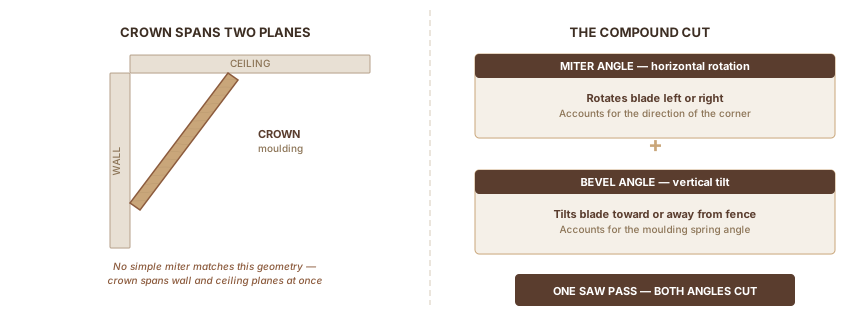
One saw pass, both angles simultaneously. The cut face aligns with the installed geometry.
Think of crown moulding as a ramp between two walls. The ramp has a steepness (spring angle) and a direction (corner angle). Your cut has to match both. Change either one and the required angles change. That's why the angle tables exist — you don't derive these from scratch. You look up spring angle plus corner angle and read the settings.
The nested method sidesteps compound cuts entirely by positioning the moulding at its spring angle against the fence, so only a simple miter is needed. More on that below. For moulding under 4 inches of face width on a standard miter saw, nested is usually easier.
Part 2: Reading Your Spring Angle
The spring angle is the single number that determines your saw settings. Get it wrong and every corner in the room will be systematically off.
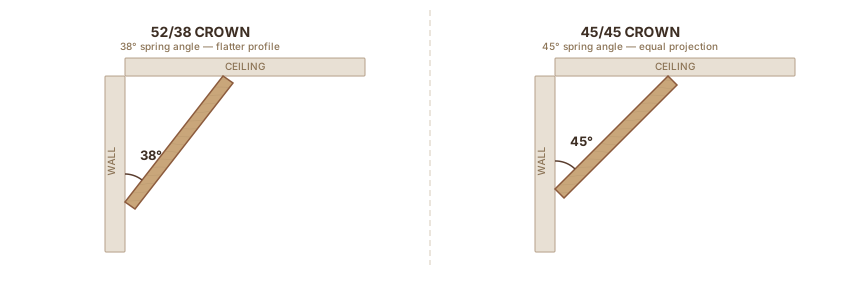
The spring angle is the angle the moulding makes with the wall when installed. Hold crown against a wall and ceiling as it will sit. The back forms a triangle with the wall and ceiling. The angle between the back and the wall is the spring angle.
The Two Common Profiles
| Profile Label | Spring Angle | Appearance | Best For |
|---|---|---|---|
| "52/38" | 38° | Flatter against ceiling, less projection | Standard 8–9 ft ceilings; most common at big-box stores |
| "45/45" | 45° | Equal projection on wall and ceiling | Taller ceilings; more formal, larger profile appearance |
The label gives you the ceiling angle and the wall angle. The spring angle is the second number — the wall angle. "52/38" has a 38° spring angle.
Three Ways to Verify
Don't trust the label alone. Labels can be wrong. Northeast Wood Products notes one case where crown labeled 52/38 was actually 45/45. Verify before you cut.
Back triangle measurement. Hold the moulding in installed position. Measure the wall leg and ceiling leg on the back triangle:
- Equal legs → 45° spring
- Longer wall leg → 38° spring
- Longer ceiling leg → 52° spring
The 45° wedge test. Cut a 45° wedge from scrap. Hold crown in position and slide the wedge behind it:
- Fits perfectly → 45° spring
- Won't fit → 38° spring
- Has play → 52° spring
Digital angle finder. Place it against the back of the moulding while it's held in position. Read directly.
Misidentifying the spring angle affects every cut in the room, not just the first one. Sixty seconds of verification before touching the saw.
Part 3: Nested vs. Flat: The Two Ways to Cut Crown
Both methods produce identical corner joints when executed correctly. The choice depends on your moulding width and how you prefer to work.
The Nested Method (Crown Upright Against the Fence)
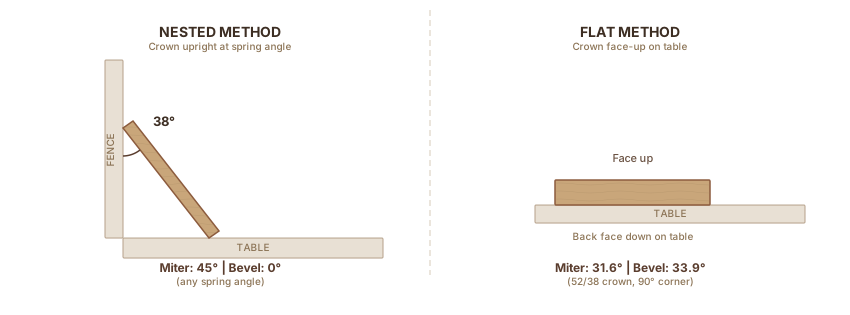
Position the moulding against the saw fence and table as it sits against the wall and ceiling:
- Bottom flat against the fence
- Top flat against the table
The moulding holds its spring angle physically. A standard miter cut with no bevel produces the correct compound geometry.
Settings for a 90° corner: miter 45°, bevel 0°. Works for any spring angle because the spring angle is handled by the position, not the saw setting.
Advantages:
- One angle to set instead of two
- For out-of-square corners, only the miter changes (new miter = corner angle ÷ 2)
- Spring angle has no effect on saw settings
Limitation: the moulding has to fit between fence and table. Profiles wider than roughly 5 inches on the face may exceed the saw's clearance. Dry-fit before anything else.
Holding technique: press the moulding firmly against both fence and table on every cut. Any rocking changes the effective angle. A stop block clamped to the fence keeps consistent position across multiple pieces.
The Flat Method (Crown Face-Up on the Table)
Lay the moulding face up, broad back flat on the saw table. Set both a miter and bevel angle, then cut.
Per compoundmiter.com's angle chart, the standard settings for 90° corners are:
| Crown Profile | Miter | Bevel |
|---|---|---|
| 52/38 (38° spring) | 31.6° | 33.9° |
| 45/45 (45° spring) | 35.3° | 30.0° |
As Family Handyman points out, most miter saws have detents at 31.6° and 33.9° specifically for this — you'll feel them click into place.
Advantages:
- Works for any moulding size
- Moulding lies stable on the table
Disadvantage: two angles to set. For out-of-square corners, both change and you need a calculator.
Which Method to Use
If the moulding fits the saw's clearance, nested is faster and simpler for rooms that aren't square. Use flat when the profile is too large for nested, or when you prefer the stability of the moulding lying flat. Both work.
Part 4: Angle Table for 90-Degree Corners
Flat Method — Inside and Outside Corners
52/38 Crown (38° spring angle):
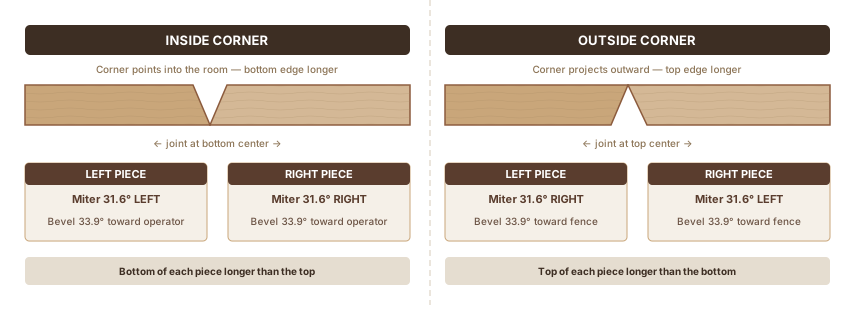
| Corner Type | Piece | Miter Angle | Miter Direction | Bevel Angle | Bevel Direction |
|---|---|---|---|---|---|
| Inside | Left piece | 31.6° | Left | 33.9° | Toward operator |
| Inside | Right piece | 31.6° | Right | 33.9° | Toward operator |
| Outside | Left piece | 31.6° | Right | 33.9° | Toward fence |
| Outside | Right piece | 31.6° | Left | 33.9° | Toward fence |
45/45 Crown (45° spring angle):
Same direction rules as above. Only the angles change:
- Miter: 35.3°
- Bevel: 30.0°
Inside vs. Outside: The Quick Rule
Inside corners (the corner points into the room): bottom of each piece is longer than the top.
Outside corners (the corner points outward): top of each piece is longer than the bottom.
Identify the corner type before every cut. Set saw direction accordingly.
Formulas for Non-90° Corners
Crownmoldingangles.github.io calculates exact settings for any corner angle. Enter your spring angle and measured corner angle; it returns both settings. The underlying formulas:
- Miter = arctan(tan(½ × corner angle) ÷ cos(spring angle))
- Bevel = arcsin(sin(spring angle) × sin(½ × corner angle))
Use these when rooms consistently run non-square — older construction, unusual floor plans.
Part 5: How to Cope an Inside Corner
Professionals cope inside corners for site-built wood trim. Mitered inside corners look fine on install day. Six months later, they open.
Why Coping Beats Mitering for Inside Corners
As Fine Homebuilding puts it: a mitered inside joint will almost inevitably open over time. Three reasons:
Wood moves. Painted pine crown moves 1/16" or more seasonally. A mitered inside joint has both pieces contributing movement — the joint opens. A coped joint uses one square-cut piece as a fixed reference; the coped piece floats against it.
Rooms aren't square. A coped joint tolerates corners a few degrees off because the profile matches whatever it touches. A mitered joint needs the corner at the exact calculated angle.
End grain soaks up glue. Mitered inside corners rely on end-grain adhesion. End grain absorbs glue faster than it bonds, leaving a starved joint. Coped joints don't depend on end-grain glue.
Mitering inside corners is fine for MDF or finger-jointed cabinet crown where wood movement is minimal and corners are verified square.
Coping Step by Step
Per This Old House's coping guide and THISisCarpentry's detailed breakdown:
Tools: coping saw (or jigsaw with fine-tooth blade), rasp or file, pencil.
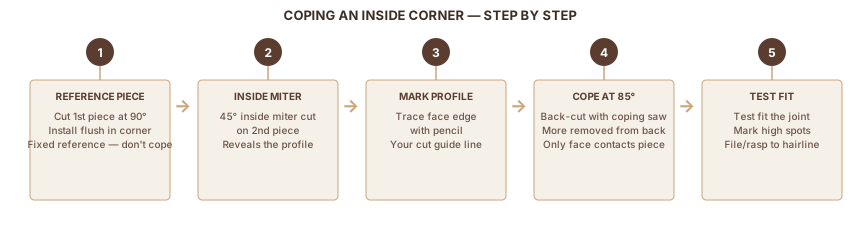
Step 1. Cut the first piece at 90°. Install it flush to the corner wall. This is your reference piece.
Step 2. Cut a 45° inside miter on the second piece to reveal the profile. Leave it a few inches long. Trim to length after coping.
Step 3. Mark the profile edge with pencil. This is your cut guide.
Step 4. Make relief cuts perpendicular to any tight curves. This keeps the coping saw from binding on direction changes.
Step 5. Cut the cope at about 85° (slightly past vertical) so the blade removes more material from the back than the front. Only the profile face contacts the adjacent piece.
Step 6. Test fit. Mark tight spots with pencil. Remove small amounts with a rasp or file. Target a hairline joint on the face.
Step 7. Cut to final length and install.
After painting, a thin bead of latex caulk along the wall and ceiling lines fills any remaining hairline gaps. The cope handles the structural fit; caulk handles the cosmetic finish.
Part 6: Handling Out-of-Square Corners
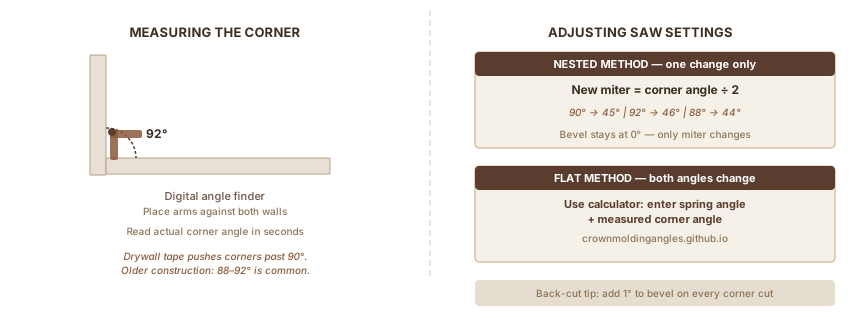
Most rooms have corners that aren't exactly 90°. Drywall tape buildup pushes corners past 90°. Older construction runs 88–92° routinely.
Measure First
A digital angle finder (Wixey and similar, around $30) gives you the actual corner angle in seconds. Place it in the corner with both arms touching the walls. A bevel gauge and protractor works if that's what you have.
Note every corner angle before cutting crown for the room.
Adjusting the Nested Method
New miter angle = measured corner angle ÷ 2.
A 92° corner: 46° miter. An 88° corner: 44° miter. The bevel stays at 0°. Only one setting changes.
Adjusting the Flat Method
Both miter and bevel change for non-90° corners. Use the crownmoldingangles.github.io calculator — enter the measured angle and spring angle, get both settings.
The Back-Cut Trick
Add 1° to the bevel on every corner cut. This makes the back of the moulding slightly hollow. The outer face contacts before the back, so the joint closes tight even when the corner angle is slightly off from the calculated value.
The Test-and-Tweak Method
For tricky corners: cut pieces long. Hold the first piece without nailing the corner end. Same with the second piece. Slide both into the corner, roll the crown slightly until the joint closes, then nail. Absorbs small angle errors without re-cutting.
Part 7: The Cuts That Cause Gaps
| Mistake | What You See | Fix |
|---|---|---|
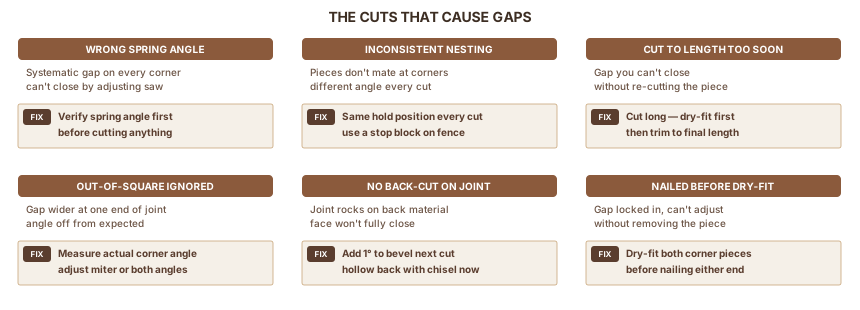
| Wrong spring angle assumed | Systematic gap on every corner, can't close by adjusting | Verify spring angle before cutting anything |
| Inconsistent nesting | Each piece has a different compound angle; pieces don't mate | Hold identically against fence and table every cut; use a stop block |
| Cut to final length too soon | Gap you can't adjust without re-cutting | Cut long; dry-fit; trim to length after confirming fit |
| Ignored out-of-square corner | Gap at top or bottom of joint, wider on one end | Measure actual corner angle; adjust miter (nested) or both angles (flat) |
| No back-cut | Joint face doesn't fully close; rocks on back material | Add 1° to bevel on next cut; hollow the back with a chisel on current piece |
| Nailed before dry-fitting | Gap locked in; have to remove piece to fix | Dry-fit both pieces of a corner before nailing either end |
Coping gaps: The most common coping mistake is too little back-cut angle. The profile contacts the front of the adjacent piece, but wood behind the profile also touches and prevents the faces from closing. Hold the coping saw at a steeper angle and test again.
On caulk: Caulk belongs at the wall and ceiling lines where the room breathes. It doesn't fix corner joint gaps. A caulked corner gap cracks through paint within a season.
Part 8: What to Learn Next
Crown moulding compound miters use the miter saw's full capability. If you can make accurate basic miter cuts and your saw has bevel adjustment, you're set.
Read first:
- Compound Miter Saw vs. Miter Saw — confirm your saw has bevel capacity for the flat method
- Miter Joints — the geometry behind simple miters before adding bevel complexity
Related technique:
- Dado Joint with Table Saw — for built-in shelving that goes with the crown work
Once you can cut crown, you can cut any compound trim work. Chair rail, base moulding returns, picture frame moulding. The geometry is the same. Only the spring angle changes.
FAQ
What's the difference between 52/38 and 45/45 crown moulding?
Both labels give you the ceiling angle and the wall angle. "52/38" means the ceiling face is at 52° and the wall face at 38° — the spring angle is 38°, giving a flatter profile suited to standard 8 to 9 foot ceilings. "45/45" has a 45° spring angle with equal projection on wall and ceiling, a fuller look better suited to taller rooms. The spring angle is the number that determines your flat-method saw settings.
Can I cut crown moulding without a compound miter saw?
Yes — use the nested method. Position the moulding at its spring angle between the fence and table, mimicking how it sits against the wall and ceiling. A standard 45° miter with no bevel produces the correct compound geometry for any spring angle. The limitation is clearance: profiles wider than roughly 5 inches on the face may not fit between the fence and table, and wider profiles may need a sliding compound saw.
Why do inside corner miter joints open after painting?
Wood moves seasonally — painted pine crown can shift 1/16" or more as humidity changes. A mitered inside corner has both pieces contributing movement, so the joint opens. A coped joint avoids this: one piece is cut square and nailed flush as a fixed reference, and the second piece is shaped to overlap it. The coped piece can float against the reference piece, so seasonal movement doesn't force the joint open.
How do I find the spring angle on an unmarked piece of crown?
Hold the moulding in its installed position against a wall and ceiling. Cut a 45° wedge from scrap and slide it behind the moulding — if it fits flush, the spring angle is 45°; if it won't fit, the spring angle is 38°; if it has play, it may be 52°. You can also use a digital angle finder placed against the back of the moulding while it's held in position and read the angle directly.
Sources
Research for this guide drew on authoritative trim carpentry sources, professional training materials, and miter angle reference calculators.
- compoundmiter.com angle chart — comprehensive miter and bevel tables for all spring angles and corner angles
- Family Handyman — flat method angle settings and saw detent positions
- Fine Homebuilding: coping vs. mitering — professional case for coping inside corners
- Fine Homebuilding: crown molding fundamentals — installation fundamentals and corner angle handling
- This Old House: coping a joint — coping step-by-step
- THISisCarpentry: cutting and coping crown — detailed coping technique
- crownmoldingangles.github.io — interactive calculator for any corner angle and spring angle
- Northeast Wood Products: spring angle — spring angle identification and common mislabeling
- DeWalt: how to cut crown molding — nested vs. flat method comparison
- Woodshop Diaries: cutting crown with a miter saw — installation sequence and step-by-step
Tagged
How We Research
We don't take affiliate revenue or accept review units. Picks come from multi-source research — manufacturer specs, OSHA / EPA / ASTM regs, and long-form practitioner threads — plus Ahmed's hands-on use where relevant. When we recommend something, we explain why.
Up Next
Compound Miter Saw vs Miter Saw
POWER TOOLS · Beginner