
QUICK ANSWER: A cordless compact router handles roughly 90% of handheld routing — edge profiles, flush trimming, hinge mortising, inlay — with no meaningful performance difference vs. a corded compact. Two real limits: every cordless model accepts 1/4 inch shanks only (raised panels and large joinery bits are off the table), and one battery lasts 30–60 minutes of continuous routing. If your work stays in the trim-and-edge zone, cordless is fine as a primary router. For multi-hour furniture sessions or any bit over 1 inch diameter, you'll still want a corded router on the bench.
Cordless Routers at a Glance
A cordless compact router handles roughly 90% of handheld routing tasks — edge profiles, flush trimming, hinge mortising, inlay work — with no meaningful performance penalty compared to a corded compact. The real limits are two: all compact models accept only 1/4" shanks (so raised panels and large joinery bits are off the table), and a battery lasts 30–60 minutes of continuous routing. If your work stays in the trim and edge profiling zone, cordless is a legitimate choice. If you ever need to run a raised panel bit or do a multi-hour furniture session, you'll want a corded router too.
| Best overall | Bosch GKF18V-25N — 1.39 HP, 10,000–30,000 RPM, 2 lb 8 oz (lightest tested) |
| Best value | Milwaukee M18 FUEL 2723-20 — $199 includes edge guide, dust chute, and second base |
| Collet size | 1/4" on all compact models — the collet is the chuck that grips router bits (1/2" only on Milwaukee M18 FUEL 2838-20 full-size) |
| Battery runtime | 30–60 min continuous; ~250 ft of 3/8" roundovers per charge |
| What it replaces | Corded compact trim router for ~90% of handheld tasks |
| What it can't do | Raised panels, large 1/2"-shank profiles, sustained multi-hour sessions |
In this guide:
- Which tasks cordless handles — and where it falls short
- [Top model comparison — Bosch, DeWalt, Milwaukee, Makita](#part-2-the-best-cordless-routers-right-now)
- Battery platform: does your ecosystem actually matter?
- First router or second router — the honest call
Part 1: What Cordless Routers Handle Well
The short version, backed by hands-on testing: for any task where you're guiding a 1/4"-shank bit freehand, cordless performs as well as corded. The cord is gone, the bit spins at the same speed, and the cut feels identical.
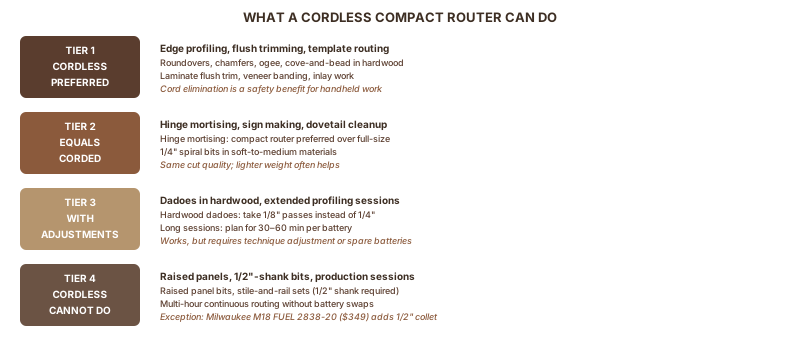
Tasks where cordless is as good as corded (or better):
- Edge profiles — roundovers, chamfers, ogee profiles, cove-and-bead in solid hardwood. This is the core use case. Modern brushless motors maintain constant RPM under load, so the cut quality matches corded.
- Flush trimming — laminate, veneer banding, proud tenons, template trimming. Cord elimination is actually a safety benefit here; the cord has nowhere to snag.
- Hinge mortising — compact trim routers are the preferred tool for this. A full-size router is too heavy to balance on a narrow door edge; the lightweight cordless is easier to control.
- Inlay work and butterfly keys — precise, shallow excavation where control matters more than power.
- Template routing — bearing-guided bits track smoothly without speed degradation.
- Shallow dadoes in softwood — a single 1/4" pass. In hardwood, take 1/8" passes and it works fine.
- Sign making and lettering — 1/4" spiral bits in softer materials. Trim routers are the standard tool for this.
- Dovetail cleanup — removing waste between tails, where a 1/4" bit fits and a 1/2" won't.
Katz-Moses Tools, in an unsponsored compact router test: "There isn't a big difference in power between corded and battery powered palm routers — at least on higher end models."
Family Handyman's extended test agrees: "90 percent of routing tasks" are within the compact cordless range.
Where cordless falls short
Four scenarios where cordless genuinely can't keep up:
1. Bits with 1/2" shanks. Raised panel bits, stile-and-rail sets, large crown molding profiles — all require a 1/2" collet and at least 2 HP sustained. Compact cordless routers accept 1/4" shanks only. This isn't a power problem; the bit physically won't fit. The only exception is the Milwaukee M18 FUEL 2838-20 ($349, 8.8 lbs), which takes both 1/4" and 1/2" shanks at 2.25 HP.
2. Multi-hour production sessions. Running 1/2" roundovers on 50+ board feet of oak for a dining table set means 2–4 battery swaps. Every swap requires resetting bit height. One professional builder noted on a woodworking forum that "when a router becomes unusable during a job, it's quite a hassle to move the bit to another router and get the height exactly the same." For sustained production work, corded is simpler.
3. Router table use. Compact cordless routers can be table-mounted, but there are real compromises: the baseplate is 3–3.5" diameter (full-size routers use 7–9" inserts), the battery raises the center of gravity when mounted upside down, and there's no built-in safety switch. Use cordless in a router table only for light profiles. Heavy work — raised panels, large molding runs — needs a full-size corded router.
4. Thermal throttle under sustained heavy load. Fine Homebuilding's extended test documented the Metabo HPT M1808DA throttling after ~97 feet of continuous hardwood routing. All cordless routers have thermal protection; it prevents damage, but it stops your cut. Corded routers have no such limit.
Part 2: The Best Cordless Routers Right Now
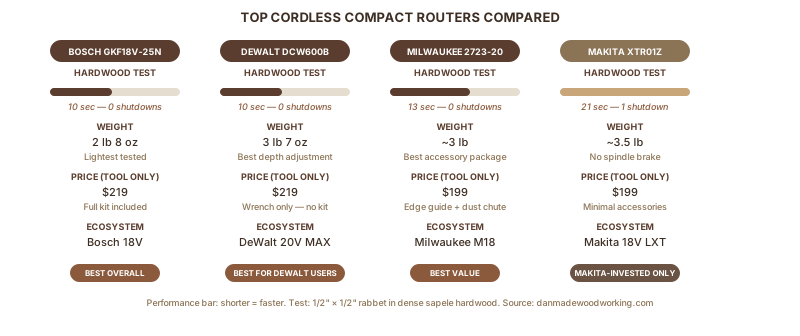
The recommendation depends on which battery platform you're already in. If you're platform-neutral, Bosch wins on pure performance.
If you're in DeWalt 20V MAX: get the DCW600B. It tied for the fastest in danmadewoodworking.com's head-to-head hardwood stress test — a 1/2" × 1/2" rabbet in dense sapele in 10 seconds flat. The depth adjustment is the best reviewed of any compact router: a single ring with 1/64" tick marks and exactly 1/2" of travel per full rotation. The 250+ tool DeWalt ecosystem means batteries everywhere. Weak point: the $219 price includes only a wrench. No edge guide, no dust chute, no second base.
If you're in Milwaukee M18: get the M18 FUEL 2723-20. Fine Homebuilding named it "Best Overall" in their compact router test. At $199 it includes an edge guide, dust chute, and second base — the most useful accessory package of any tested model. Milwaukee rates it at 250 feet of 3/8" roundovers per charge with a 5Ah battery; a Woodsmith reviewer confirmed similar output routing hard maple. The M18 ecosystem also offers the 2838-20 full-size router (2.25 HP, 1/2" collet) — the only major-brand cordless option for 1/2"-shank work.
If you're in Makita 18V LXT: use the XTR01Z only if you're already deeply invested. The Makita is the weakest of the major-brand compact routers under load: danmadewoodworking.com's test clocked it at 21 seconds for the same sapele rabbet, versus 10 for Bosch and DeWalt. It also lacks a spindle brake (the mechanism that stops the bit within a few seconds of switch-off), which is a real safety concern. If you're buying your first router and considering Makita, the DeWalt DCW600B is a better router at the same price.
Platform-neutral pick: Bosch GKF18V-25N. Lightest at 2 lb 8 oz, fastest in hardwood testing, unique drop-detection (auto-shutoff if the router falls), and dual dust chutes including one specifically for edge profiling. The $219 kit from Bosch includes a full accessory set. The Bosch 18V AMPShare platform is compatible with other brands via adapters, though it's smaller than DeWalt or Milwaukee's ecosystems.
How they compare
| Model | HP | RPM Range | Weight | Platform | Price |
|---|---|---|---|---|---|
| Bosch GKF18V-25N | 1.39 peak | 10,000–30,000 | 2 lb 8 oz | Bosch 18V | $219 |
| DeWalt DCW600B | not rated | 16,000–25,500 | 3 lb 7 oz | DeWalt 20V MAX | $219 |
| Milwaukee M18 FUEL 2723-20 | 1.25 peak | 10,000–31,000 | ~3 lb | Milwaukee M18 | $199 |
| Flex FX4221-Z | 1.5 peak | 16,000–31,000 | 3 lb 9 oz | Flex 24V (proprietary) | $199 |
| Makita XTR01Z | not rated | 10,000–30,000 | ~3.5 lb | Makita 18V LXT | $199 |
| Milwaukee M18 FUEL 2838-20 | 2.25 peak | 12,000–25,000 | 8.8 lb | Milwaukee M18 | $349 |
Hardwood performance test
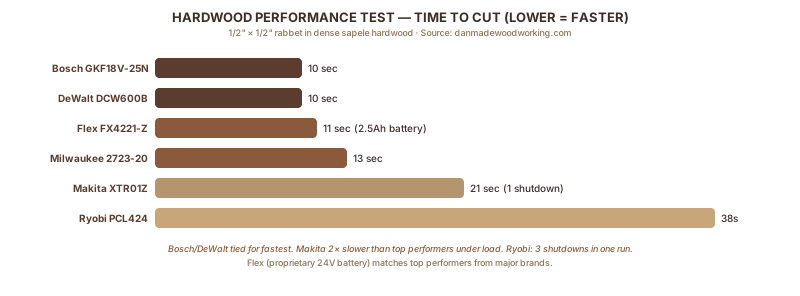
Source: danmadewoodworking.com — timed 1/2" × 1/2" rabbet in dense sapele:
| Model | Time | Battery | Shutdowns |
|---|---|---|---|
| Bosch GKF18V-25N | 10 sec | 4Ah | 0 |
| DeWalt DCW600B | 10 sec | 5Ah | 0 |
| Flex FX4221-Z | 11 sec | 2.5Ah | 0 |
| Milwaukee M18 FUEL 2723-20 | 13 sec | 2Ah | 0 |
| Makita XTR01Z | 21 sec | 2Ah | 1 |
| Ryobi PCL424 | 38 sec | — | 3 |
Bosch and Flex hit near-identical times with smaller batteries than DeWalt, which points to better motor efficiency. Makita's 21-second time with a mid-test shutdown is more than twice as slow as the top performers under load.
The Flex FX4221-Z would be the best-value pick if not for its proprietary 24V battery. If you have no existing platform and want the best performance per dollar, Flex is worth a look. If you have any investment in another platform, stick with it.
Avoid the Ryobi PCL424 for anything beyond occasional light work. Three shutdowns in one test run is not acceptable.
Part 3: Your Battery Platform: Does It Matter?
Short answer: it matters for which router you can buy, not much for how it performs once you have it.
Battery platforms are brand-proprietary. A Makita 18V battery physically won't fit a Milwaukee 18V tool, despite the identical voltage label. The connectors and communication electronics are brand-specific.
Battery size (2Ah vs. 5Ah) affects runtime only — not cutting power. Family Handyman tested a 5Ah and 2Ah battery in the same router: "no discernible difference in actual cutting performance." A larger battery runs longer before needing a charge, nothing more. For handheld freehand work, a 2–3Ah battery is the better choice. It's lighter and less top-heavy.
How the major platforms compare for routing:
| Platform | Best Router | Hardwood Test | Notes |
|---|---|---|---|
| DeWalt 20V MAX | DCW600B | 10 sec | 250+ tool ecosystem, widest availability |
| Milwaukee M18 | M18 FUEL 2723-20 | 13 sec | Best accessories; only brand with full-size cordless (2838-20) |
| Makita 18V LXT | XTR01Z | 21 sec | Weakest under load; world's largest 18V platform (325+ tools) |
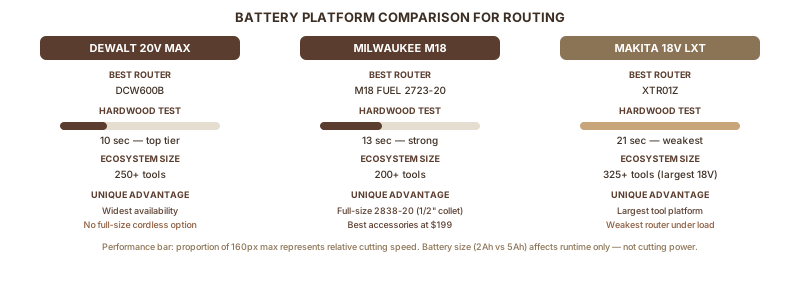
These differences matter only for heavy hardwood work. For roundovers, chamfers, and light profiling, all three feel identical. The Australian Wood Review compared DeWalt and Milwaukee directly and called it "impossible to pick a favourite" for typical trim work.
The Milwaukee advantage if you need more power. The M18 FUEL 2838-20 ($349) is the only full-size cordless router from a major brand that accepts 1/2"-shank bits. If you're in the Milwaukee ecosystem and want to eventually do more demanding router work without plugging in, this extends what's possible. DeWalt and Makita users wanting 1/2"-shank work need a corded router.
Expert consensus: Family Handyman put it plainly: "Stick with the battery system you have. Extra batteries outweigh minor performance differences between brands." Unless you're buying into a new platform purely for routing (don't), stay with what you own.
Part 4: Cordless as Your First Router vs. Your Second
Most woodworking educators recommend a corded router as your first router. They're right for some builders and wrong for others. The answer depends on what you're planning to build.
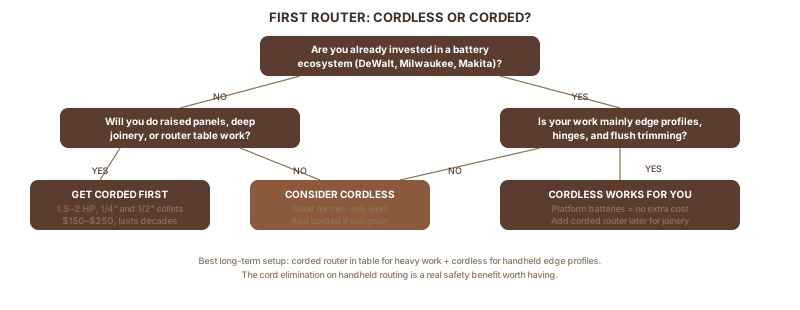
Get corded first if:
- You plan to do raised panels, stile-and-rail cabinet doors, or router table work
- You want to do deep dadoes or mortises in hardwood
- You don't already own batteries in a major platform
- You want one tool that does everything
A corded mid-size router (1.5–2 HP, 1/4" and 1/2" collets) costs $150–$250, never runs out of power, and lasts decades. It handles every task a compact cordless can, plus the 10% of heavy work that cordless can't touch.
Get cordless first if:
- You already have 2+ batteries in DeWalt, Milwaukee, or Makita
- Your work is primarily edge profiling, hinges, inlays, and flush trimming
- You're a trim carpenter or installer — site work with no power available
- You value the cord-free convenience for handheld work
For that use case, a cordless compact handles everything you need. You can always add a corded router later if your work expands into joinery.
The best setup — if you can — is both. Keep the corded router in a router table for raised panels and production dados. Use the cordless for handheld edge work. The cord elimination on handheld routing is a real safety benefit; the cord has nowhere to snag, and you can move around the workpiece freely.
If you can only have one, be honest about your work. If you're building furniture with joinery, get corded. If you're doing trim work and edge profiles, cordless is enough.
Part 5: Getting the Most from Your Cordless Router
The technique is nearly identical to a corded compact router. Three things change: pass depth, battery selection, and how you handle bit changes.
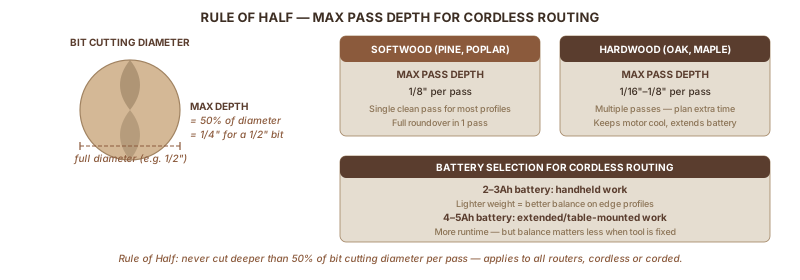
Pass depth matters more with cordless. The Rule of Half applies to all routing: never cut deeper than 50% of the bit's cutting diameter in a single pass. With a cordless router, err toward the conservative end. For hardwood, Woodsmith recommends "stick to 1/8"-deep cuts" with the M18 FUEL for optimal performance. In softwood, 1/4" passes are fine. Shallower passes produce cleaner cuts with less tearout and better surface finish.
Use the right battery for the job. A 2–3Ah battery keeps the tool better balanced for handheld work. The battery sits on top, and a 5Ah pack makes the router top-heavy during edge profiling. Save the larger battery for table-mounted work where balance doesn't matter. Keep a spare charged.
Bit changes: remove the battery first. The same as unplugging a corded router. Collet mechanics are identical — insert the bit shank fully, retract 1/16"–1/8", tighten with the wrench (or use the spindle lock on Bosch, DeWalt, and Milwaukee models for one-wrench changes). Never bottom out the shank; it damages the collet and can cause the bit to eject.
Speed selection by bit diameter. This doesn't change from corded:
- Bits under 1/2" diameter: max speed (25,000–31,000 RPM)
- Bits 1/2"–1" diameter: 18,000–22,000 RPM
- Larger bits: 12,000–18,000 RPM (but most large bits require 1/2" shanks anyway)
Feed direction. Always move the router against the cutter's rotation. For handheld edge routing, move left to right on the far edge, right to left on the near edge. This is identical to corded routing — nothing changes.
For router bit selection and setup, see the router bits guide. For setting up a router table with a compact router, the router tables guide covers baseplate options and light-duty mounting.
If you eventually want to do dovetails and joinery with a router, see the dovetail router bit guide for bit selection and technique.
FAQ
Can a cordless router replace a corded one entirely?
For trim and edge work — flush trimming, roundovers, chamfers, hinge mortises, inlay — yes. The motors are equivalent, the cuts are equivalent, and the freedom from the cord is a real productivity gain on awkward workpieces. The case where cordless can't replace corded: any 1/2 inch shank bit (raised panels, large joinery bits, lock miter), any sustained multi-hour furniture session that would burn through 4–6 batteries, or any router-table use where the table itself needs the bigger 2-1/4 HP corded fixed-base motor. Most home shops want both.
Why are cordless routers limited to 1/4 inch shanks?
Two reasons. First, the 18V/20V cordless motors top out around 1.25 HP equivalent — enough for any 1/4 inch bit but marginal for the larger steel mass of 1/2 inch bits at full RPM. Second, the smaller compact-router collet (5/16 inch outside diameter typical) physically can't be enlarged without redesigning the spindle. Milwaukee released the M18 FUEL 2838-20 with a 1/2 inch collet and corded-equivalent power in 2024, but it's bigger, heavier, and more expensive — most cordless buyers want the compact body, which means staying with 1/4 inch.
How long does one battery last in continuous routing?
Real-world: 30–60 minutes on a 5.0 Ah battery, depending on bit diameter, depth of cut, and material. A 1/4 inch roundover in poplar is at the low end of motor draw — expect 60+ minutes per battery. A 1/2 inch flush-trim in hard maple or walnut at full depth is at the high end — 25–35 minutes. The XR / FUEL brushless motors handle voltage sag well, so cuts stay clean until the battery cuts out abruptly. Always have a second battery charging.
What's the difference between a compact router and a trim router?
In current marketing, "compact router" and "trim router" mean the same thing: the small one-handed router with a 1/4 inch collet, ~1.25 HP motor, and ~3 lb body. Older usage called the smallest pre-cordless models (Bosch Colt, DeWalt 611) "trim" because trim carpenters used them on baseboards and laminate edges. Modern cordless versions inherited the form factor and the name. If a tool is sold as either, expect the same capability range.
Do I need to buy more batteries to use a cordless router practically?
If you're already on the same 18V/20V platform as another tool (drill, impact, circular saw), no — you'll have spares. If this is your first cordless tool on that platform, plan on owning at least two 5.0 Ah batteries: one in the router, one charging. For long workflow sessions across multiple tools, three is the practical minimum. Battery cost is the hidden ongoing expense of going cordless across the shop.
Sources
Research for this guide draws on hands-on test data from independent tool reviewers, professional woodworking publications, and official manufacturer specifications.
- danmadewoodworking.com — Cordless router head-to-head — timed hardwood stress test, full specs, accessory comparison
- Fine Homebuilding — Cordless routers tested — professional publication, extended runtime testing with linear feet data
- Katz-Moses Tools — Compact router buying guide — unsponsored, accuracy testing with calipers
- DeWalt — DCW600B official specifications — manufacturer specs
- Milwaukee Tool — M18 FUEL 2723-20 specifications — manufacturer specs
- Milwaukee Tool — M18 FUEL 2838-20 specifications — full-size cordless router specs
- Bosch — GKF18V-25N specifications — manufacturer specs
- Makita — XTR01Z specifications — manufacturer specs
- Woodsmith — Milwaukee M18 FUEL compact router review — Rob Petrie, hands-on evaluation
- Family Handyman — Cordless router review — runtime testing, battery size comparison, ecosystem advice
- Australian Wood Review — DeWalt vs Milwaukee — head-to-head comparison with weight measurements
Tools Used
Also Referenced
Tagged
How We Research
We don't take affiliate revenue or accept review units. Picks come from multi-source research — manufacturer specs, OSHA / EPA / ASTM regs, and long-form practitioner threads — plus Ahmed's hands-on use where relevant. When we recommend something, we explain why.
Up Next
Choosing the Right Dovetail Router Bit
POWER TOOLS · Beginner