
Epoxy Resin River Table at a Glance
A river table puts two wood slabs side-by-side with a poured epoxy channel connecting them. The epoxy simulates a river running through the wood. Two things trip up every first build: using the wrong epoxy type (table-top epoxy poured 2 inches deep overheats and cracks) and skipping the seal coat (unsealed wood outgasses bubbles straight up through the pour, making it look like a snow globe). Get those two right and the rest is patience and sanding.
| Difficulty | Beginner — no joinery required |
| Active build time | 1–2 full days |
| Total elapsed time | 2–3 weeks (mostly cure time) |
| Materials cost | $400–900 (coffee table size) |
| Epoxy types needed | Deep-pour (channel) + table-top (topcoat) |
| Critical prerequisite | Wood must be below 10% moisture content |
In this guide:
- The one thing beginners get wrong about epoxy
- Choosing your wood slabs and channel width
- Tools, materials, and what it costs
- Building a leakproof mold
- The seal coat, the pour, and bubble removal
- Flattening and sanding to glass-smooth
- Troubleshooting the six ways it goes wrong

Part 1: What a River Table Actually Is
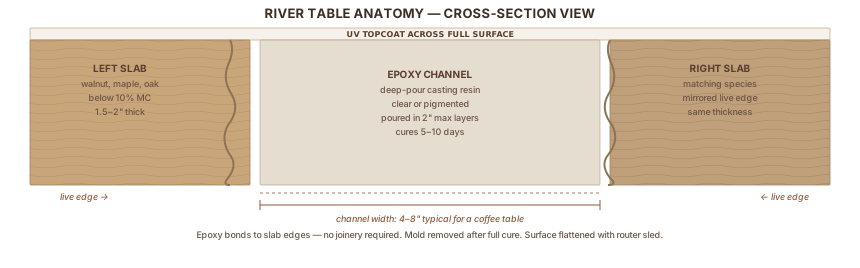
Two wood slabs sit parallel in a mold with a gap between them. You fill that gap with poured epoxy. When it cures, the epoxy and wood become a single rigid panel. The "river" effect comes from the contrast between the wood grain and the clear or pigmented channel running through the middle.
The good news for beginners: no joinery. No mortises, no tenons, no fitting joints. The epoxy does all the structural work. The skills you actually need are mold building (carpentry-level), epoxy pouring (following instructions carefully), and sanding (patience). All three are learnable in a single weekend project.
Before you start, you should be able to:
- Use a circular saw or track saw to make straight cuts
- Use a router (you'll need one for flattening the slabs)
- Sand a surface to a consistent finish
If those feel unfamiliar, read the Epoxy Coffee Tables guide first — it covers epoxy basics and finishing without the complexity of a large pour.
Part 2: Deep-Pour vs. Table-Top Epoxy: The Distinction That Makes or Breaks Your Build
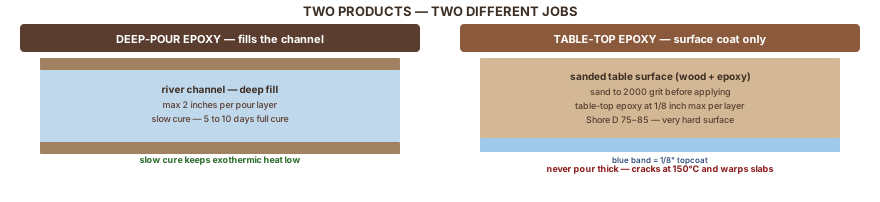
There are two completely different epoxy product categories. Using the wrong one is the most common way first-time river table builds fail.
| Deep-Pour Epoxy | Table-Top Epoxy | |
|---|---|---|
| Use | Filling the river channel | Seal coat + final protective surface |
| Max pour depth per layer | 1.5–2 inches | 1/8 inch |
| Cure time | 5–10 days | 24–72 hours |
| Viscosity | Thin — flows easily, releases bubbles | Thicker — self-leveling but not gap-filling |
| Cured hardness | Moderate (flexible) | Very hard — Shore D 75–85 |
| UV inhibitors | Buy brands that include them | Usually included |
What happens if you pour table-top epoxy 2 inches deep: The epoxy generates heat as it cures through an exothermic reaction. Table-top epoxy is formulated to cure fast, which generates a lot of heat in a large mass. Per TotalBoat's deep pour depth guide, a 5-liter mass in a confined area can reach 150°C. The epoxy cracks, clouds up, may smoke, and warps the slabs around it. The pour has to come out.
Deep-pour epoxy cures slowly on purpose. The slow cure spreads out the heat generation, keeping temperatures low enough to handle a thick mass without cracking.
The two-product approach used by most experienced builders: Use deep-pour epoxy to fill the channel. Use table-top epoxy for the initial seal coat on the wood and for the final protective flood coat over the entire surface.
Specific products with verified specs:
- TotalBoat Thickset Fathom: 2:1 mix ratio by volume, 2-inch max pour depth, 5–10 day full cure — a reliable deep-pour choice that includes UV inhibitors
- TotalBoat Table Top Epoxy: 1:1 by volume, 1/8-inch max, tack-free in 4–8 hours
On UV inhibitors: Epoxy yellows from UV exposure. As Best Bar Top Epoxy explains, cheap deep-pour formulas often skip UV inhibitors to cut costs. A table in indirect sunlight yellows visibly within 2–3 years without UV protection. Buy epoxy that specifically states UV inhibitors or UV-stabilized formula. Then apply a UV-filtering topcoat over the finished surface.
Part 3: Choosing Your Wood Slabs
Species
Black walnut is the go-to species for river tables. The deep chocolate-brown grain creates dramatic contrast with clear or blue-tinted epoxy. It's also dimensionally stable, which means it moves less than softer species as humidity changes — important for a thick slab bonded to rigid epoxy.
If walnut is out of budget, white oak and ash both work beautifully and cost significantly less. Hard maple gives a clean contrast with colorful pigmented channels. Cherry works well but is softer and more prone to denting on a coffee table surface.
Species to avoid:
- Pine: Resinous — the natural oils bleed into the epoxy and cause clouding and adhesion failure
- Teak: High silica content prevents epoxy from bonding — the river channel will eventually delaminate
- Any wet or green wood: See moisture content below
| Species | Appearance | Janka Hardness | Cost (relative) |
|---|---|---|---|
| Black walnut | Dark chocolate, dramatic grain | 1,010 lbf | $$$ |
| Hard maple | Creamy white, subtle grain | 1,450 lbf | $$ |
| White oak | Gray-tan, open grain | 1,360 lbf | $$ |
| Ash | Light tan, pronounced grain | 1,320 lbf | $ |
| Cherry | Warm reddish-pink, darkens with age | 950 lbf | $$ |
Moisture Content
Target: 6–10% moisture content (MC). This is non-negotiable.
Wood above 12% MC still contains water vapor. When you seal it in a mold and pour warm epoxy over it, that vapor has nowhere to go except up through the epoxy. The result is a bubble cloud that looks like a snow globe frozen in your river channel. You cannot fix it after the pour — the cloud is permanently cured in.
Get a pin moisture meter ($25–40) and check 5–6 spots per slab, including the end grain (end grain reads higher and is where most moisture escapes). If the reading is above 10%, let the slab air dry in a heated, conditioned space. Put it on stickers (small pieces of scrap wood) for airflow underneath. Allow roughly one month per inch of thickness for air drying.
Kiln-dried slabs from a reputable live-edge dealer will usually arrive in range. Ask for the MC reading before you buy.
Live-Edge vs. Straight-Cut
Live-edge slabs retain the natural wavy contour of the tree. The gap between two live-edge slabs creates an organic, irregular river — wider in some spots, narrower in others. This is the classic river table look and what most people picture. Live-edge slabs cost more because they're cut from larger logs and handled more carefully to preserve the edge.
Straight-cut slabs have both edges ripped straight on a table saw or band saw. The channel between them is a uniform width from end to end. This gives a cleaner, more modern look and is easier to design around if you want a specific channel width. You can use standard dimensional lumber for a straight-cut approach, which brings costs down significantly.
Sizing a Coffee Table
For a 24"×48" coffee table: two slabs each roughly 10–12" wide × 48" long × 1.5–2" thick, with a 4–6" channel between them. Total table width = slab 1 width + channel width + slab 2 width. Narrower channels (3–4") use less epoxy but look more like a seam than a river. Wider channels (6–8") are more dramatic and use more epoxy.

Part 4: Everything You Need
Tools
- Router and router sled: To flatten slabs before and after pouring. A 3/4" upcut spiral bit works best. If you don't own a router, a lumber yard or makerspace may rent wide-belt drum sanding time by the hour — call ahead.
- Circular saw or track saw: Cut slabs to length
- Random orbital sander: 5-inch, with 60–400 grit discs
- Wet/dry sandpaper: 400, 600, 800, 1000, 1500, 2000 grit sheets
- Propane torch or heat gun: Bubble removal after each pour
- Digital scale or graduated mixing containers: Accurate ratio is critical
- Long mixing stick or paddle mixer on a drill
- Drill: Attaching legs
- Pin moisture meter
Materials
| Item | Amount (24"×48" table) | Budget Range |
|---|---|---|
| Wood slabs (oak or ash) | 2 slabs, ~10–12"×48"×2" | $60–150 |
| Wood slabs (black walnut) | Same | $150–400 |
| Deep-pour epoxy | 1–2 gallons (see calculation below) | $80–200 |
| Table-top epoxy | 1 quart (seal coat + topcoat) | $40–80 |
| 3/4" melamine-coated MDF (mold) | One 4'×8' sheet, cut down | $30–50 |
| 100% silicone caulk | 1 tube | $8 |
| Paste wax (Johnson's Paste Wax) | Small can | $10 |
| Epoxy pigment paste (optional) | 2 oz jar | $12–20 |
| Hairpin legs (set of 4, 16") | — | $35–90 |
| Sandpaper (full progression) | — | $25–40 |
| PPE (nitrile gloves, respirator, glasses) | — | $30–60 |
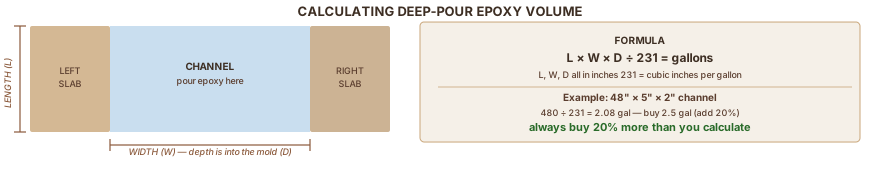
Calculating epoxy: Measure the channel length × width × depth in inches, then divide by 231 to get gallons. Lumber Grand's epoxy calculator guide explains the calculation in detail. A 48" × 5" × 2" channel = 480 cubic inches ÷ 231 = 2.08 gallons. Buy 20% extra — wood absorbs some, and you'll lose a little in the mixing containers. For this example, buy 2.5 gallons of deep-pour epoxy.
Part 5: Building a Leakproof Mold
This is the most important prep step. A leaky mold loses the entire pour. Test it with water before you ever open an epoxy can.
Materials
- 3/4" melamine-coated MDF or particleboard (not raw MDF — the melamine surface is what prevents the epoxy from bonding to the mold)
- 1.5" wood screws
- 100% silicone caulk
- Paste wax (Johnson's Paste Wax, two coats on all melamine surfaces)
If you want a reusable mold: HDPE sheet (High-Density Polyethylene) is the premium option. Cured epoxy cannot bond to HDPE at all — no release agent needed, and the mold will release cleanly 50+ times. More expensive upfront (~$80 for a 4'×8' sheet) but pays off if you build multiple tables.
Build Steps
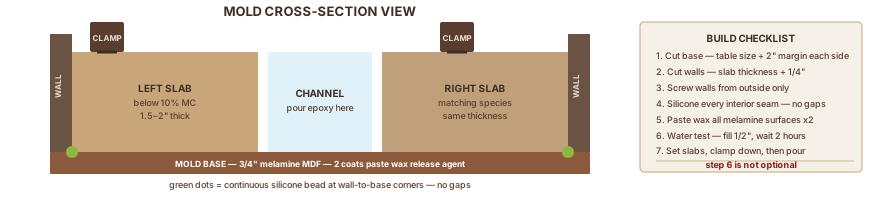
1. Cut the mold base. Size: your table width + 2" on each side, your table length + 2" on each end. This extra gives you clearance for the mold walls and a small overpour zone.
2. Cut the mold walls. Four strips of melamine MDF. Height: your slab thickness + 1/4" (the extra height lets epoxy overpour slightly, which you'll sand flat later). Width: enough to screw to the base.
3. Assemble. Screw walls to the base from the outside — screws must not penetrate the interior mold surface. Pre-drill pilot holes to prevent splitting.
4. Seal every interior seam. Run a continuous bead of 100% silicone along every joint: all four base-to-wall joints and the four wall corners. Press with a wet fingertip to seat the caulk into the seam. No gaps, no bubbles. Let cure 24 hours.
5. Apply paste wax. Two coats of paste wax on every interior melamine surface — base and all four walls. Buff lightly. This is your release agent.
6. Water test. Pour 1/2" of water into the assembled mold. Wait 2 hours. Check all seams. Any drip or damp spot means more silicone needed. Fix and re-test. Skip this step and you'll be cleaning epoxy off your garage floor.
Positioning the Slabs
Set slabs in the mold with your chosen channel width. Weight them or clamp from above. Epoxy at roughly 9 lbs per gallon will try to float slabs that are less dense. If the slabs float even slightly, the top surface won't be flat.
Use hold-down clamps that can reach from the mold walls to the slab surface, or drive short screws up through the mold base into the slab bottoms (fill the holes with silicone first so epoxy doesn't seep through).
Part 6: Sealing, Mixing, and Pouring
The Seal Coat (Don't Skip This)
Mix a small amount of table-top epoxy — enough to coat all exposed wood surfaces inside the mold. Apply with a foam brush or chip brush to every surface that will touch the deep pour: the inner faces of both slabs, the top surfaces, and the end grain.
Epoxy has a limited chemical bonding window. Pour the deep-pour epoxy onto the seal coat when it's tacky but not fully cured — typically 3–6 hours after the seal coat goes on, depending on the product. A tacky seal coat means the two layers will bond chemically. A fully cured seal coat means you'll need to sand it before pouring (mechanical bond instead of chemical — it works but adds a step).
The seal coat closes the wood's pores so trapped air has nowhere to escape during the main pour.
Temperature and Timing
Work at 65–75°F (18–24°C). Below 60°F, the epoxy cures too slowly and may stay soft for weeks. Above 80°F, the cure accelerates and generates more exothermic heat — increasing the risk of cracking in a thick pour. If your shop gets cold at night, set up a space heater to maintain temperature during the first 48 hours.
Calculate and Mix
- Calculate the volume as described in the materials section. Add 20% for waste.
- Measure by volume — a 2:1 ratio means 2 parts resin for every 1 part hardener. Use graduated buckets or a digital scale with the manufacturer's weight conversion.
- Pour resin and hardener into a clean mixing bucket. Mix for 3–4 minutes with a paddle mixer or long stick, scraping the sides and bottom.
- Transfer to a second clean bucket. Mix 1 more minute. This two-bucket technique prevents unmixed resin or hardener stuck to the walls of the first bucket from ending up in your pour.
If you want colored epoxy: Add epoxy pigment paste now, after the full mix. Dosage: start with 1% by weight of total epoxy (so for 2 lbs of epoxy, add 0.3 oz of pigment). Stir until fully incorporated. More pigment = more opaque; less = translucent. For a translucent blue river, 1–2% is typically right.
Pour
Pour slowly from one end of the channel, moving toward the other. Hold the container 12–18 inches above the surface — the thin stream pops surface bubbles as it falls. Fill to 2 inches maximum for the first layer.
Right after pouring, pass a propane torch or heat gun 6–8 inches above the surface in slow, sweeping passes. The heat lowers the epoxy's viscosity momentarily, allowing bubbles to rise and pop. According to Best Bar Top Epoxy's bubble guide, this is the most effective method for surface bubble removal in large pours. Keep the torch moving — holding still scorches the epoxy. Repeat for the first 3 hours after each pour.
Cover with plastic sheeting propped above the epoxy (don't let the plastic touch the surface). This keeps dust off during the cure without trapping heat.
If the channel is deeper than 2 inches: Wait 24 hours for Layer 1 to firm up (firm to the touch, slightly tacky), then pour Layer 2 to fill the remaining depth. The tacky surface creates a chemical bond between layers. Don't wait more than 48 hours between layers or you'll need to sand before pouring.
Full Cure
Allow 5–10 days for a full cure at room temperature. The epoxy is firm enough to handle after 24–48 hours but not fully hardened. Don't try to sand it before 5 days — under-cured epoxy gums up sandpaper instantly.

Part 7: Sanding to a Glass-Smooth Finish
Step 1: Flatten the Surface
After demolding, the surface won't be flat. Even if you poured perfectly level, epoxy shrinks slightly as it cures. Set up your router sled again over the cured panel and take light passes (1–2mm) until the entire surface — wood and epoxy — is in the same plane. This typically removes the slight dome or depression in the epoxy channel.
If you don't have a router sled: a wide-belt drum sander at a lumber yard will do this in minutes for a rental fee. Call ahead — not every lumber yard has one, but most hardwood dealers do.
Step 2: Sand Through the Grit Progression
Dry sanding (ROS or hand):
80 grit → 120 → 180 → 220 → 320
Work through each grit until the scratches from the previous grit are gone. This is not a step to rush. Skipping from 120 to 220 leaves deep scratches that show up under the topcoat.
Wet sanding (from 400 grit up):
400 → 600 → 800 → 1,000 → 1,500 → 2,000
Wet sanding is mandatory from 400 grit onward. Per Equalle's epoxy sanding guide, dry sanding epoxy generates heat that melts the epoxy micro-particles and loads the paper within seconds. Keep a spray bottle of water nearby and mist the surface between passes. Use wet/dry sandpaper (silicon carbide, typically black). Sand in circular motions or with a wet-sanding orbital pad.
After 2,000 grit, the surface should look uniformly matte. It's already quite smooth — the haze is just from the fine scratches.
For a mirror finish: Use a cutting compound (Meguiar's M100 or similar) followed by a polishing compound, applied with a random orbital polisher or foam buffer. This takes the surface from matte to glass.
For a satin finish: Apply a topcoat instead of polishing.
Step 3: Apply the Topcoat
The deep-pour epoxy channel is relatively soft. Without a topcoat, it scratches. Three options:
Table-top epoxy flood coat (most durable): Mix and pour 1/8 inch of table-top epoxy over the entire surface. Self-levels. Let cure 24 hours. Sand with 320 grit if applying a second coat. Two coats is enough for most tables. This is the hardest, most scratch-resistant result.
Water-based polyurethane (easiest): Three coats with a foam brush or foam roller, sanding with 320 grit between coats. Less durable than the epoxy flood coat but much easier to apply and touch up. See the Applying Polyurethane guide for application technique.
Hardwax oil (most natural feel): Osmo Polyx-Oil or Rubio Monocoat penetrate the wood portion and sit on top of the epoxy. The wood and epoxy areas will have slightly different sheens (the oil doesn't penetrate epoxy). Good choice if you want the wood to feel like wood, not glass. Easy to touch up years later with another coat.

Part 8: Attaching the Legs
The Options
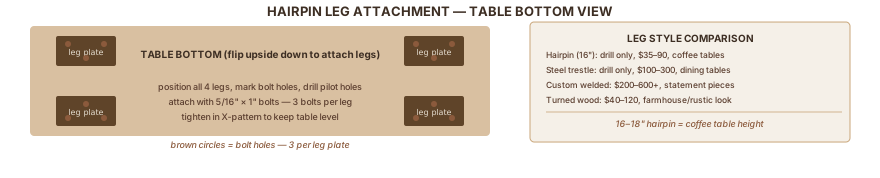
| Style | Cost | Skill Required | Best For |
|---|---|---|---|
| Hairpin legs | $35–90 | Drill only | Coffee tables, side tables |
| Pre-made steel base/trestle | $100–300 | Drill only | Dining tables |
| Custom welded steel base | $200–600+ | Welding (or hire out) | Statement furniture |
| Turned wood legs | $40–120 | Lathe or buy pre-turned | Farmhouse, rustic |
For a beginner making a coffee table: hairpin legs. They need no fabrication, attach with three bolts per leg, and are widely available at hardware stores and online. Standard height for a coffee table: 16–18 inches. Each leg has a flat mounting plate with pre-drilled holes.
Attachment: Flip the table upside down on a padded surface (moving blankets work). Position all four legs. Mark the bolt hole locations with a pencil. Drill pilot holes at each mark — diameter slightly smaller than the bolt. Attach legs with 5/16" × 1" bolts (usually included). Tighten in an X-pattern across all four legs to ensure the table sits level. Check with a level before final tightening.
Part 9: Troubleshooting: The Six Ways It Goes Wrong
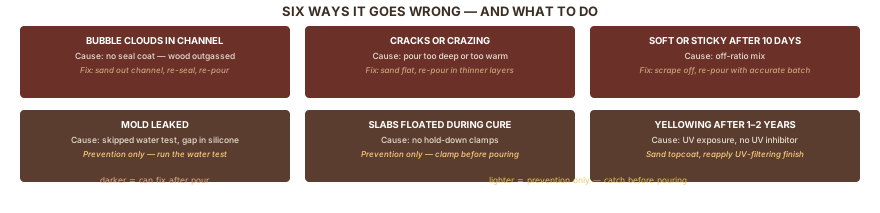
| Problem | Most Likely Cause | What to Do |
|---|---|---|
| Bubble clouds in the channel | No seal coat — wood outgassed into the pour | Grind or sand out the channel, re-seal the wood, re-pour. |
| Cracks or crazing | Too-deep single pour, or temperature too warm | Sand flat, let remaining epoxy fully cure, re-pour in thinner layers at cooler temps |
| Soft or sticky epoxy after 10+ days | Off-ratio mix | Sand or scrape off the uncured layer. Re-pour with accurately measured epoxy. |
| Mold leaked | Incomplete silicone sealing, skipped water test | Prevention only. Always run the water test. |
| Slabs shifted or floated during cure | No hold-down clamps | Prevention only. Clamp before pouring. |
| Yellowing after 1–2 years | UV exposure + no UV inhibitors | Sand topcoat off with 220 grit, apply new topcoat with UV-filtering finish. The yellow is in the topcoat, not the deep pour, if you used quality deep-pour epoxy. |
The last three can only be prevented before the pour. The water test is the single most valuable 2 hours you spend on this project.
Part 10: Safety While Working with Epoxy
Epoxy resin is a skin sensitizer. Repeated skin contact triggers an allergic reaction that worsens with each exposure. Once sensitized, you may not be able to work with epoxy again. WEST SYSTEM's epoxy safety guidelines identify this as the primary occupational health risk of epoxy work — not the fumes, the skin contact.
Required PPE every time:
- Nitrile gloves, 4-mil minimum — not latex (too thin), not examination gloves (too thin). For pours lasting more than 30 minutes, double-glove.
- Safety glasses
- Respirator with organic vapor cartridges — a standard dust mask does not filter chemical vapors. You need the organic vapor (OV) cartridges, gray or yellow, in a half-face respirator.
- Long sleeves and an apron to protect skin from splashes
Ventilation: Run a fan exhausting air out of the workspace. Open windows on the opposite side to create cross-ventilation. Epoxy resins are low-VOC but vapors still accumulate in still air. Working outdoors is ideal for large pours.
Cleanup: Clean tools and spills with acetone before the epoxy cures. Cured epoxy is inert — safe to handle without gloves. Uncured epoxy waste should be allowed to cure fully in open air before disposal. Never pour liquid epoxy down a drain.

Where This Fits
Before this project, you should understand:
- Epoxy Coffee Tables — covers epoxy basics and the two-product approach with less complexity than a full river table
After this project, you're ready for:
- Applying Polyurethane — if you want to use poly as your topcoat and want full technique depth
- How to Refinish a Table — if your river table surface needs repair or refinishing down the road
If something went wrong:
- See the troubleshooting table above. Most first-build failures come from skipping the seal coat or using the wrong epoxy product. Both are fixable by re-pouring.

Sources
Research for this guide drew on manufacturer technical documentation, epoxy supplier application guides, and woodworking community resources. Specific manufacturer TDS documents and pour depth specifications were verified against current product pages.
- TotalBoat: Table Top vs Deep Pour Epoxy — explains exothermic heat and maximum pour depths
- TotalBoat Thickset Fathom Product Page — product specs: 2:1 ratio, 2" max depth, 5–10 day cure
- TotalBoat: How Deep Can I Pour Epoxy in a Single Layer — exothermic heat mechanics
- Entropy Resins: How to Make a River Table — complete build sequence from a manufacturer
- EcoPoxy: How to Build an Epoxy Casting Mold — mold construction steps
- Bad Owl Tool: Reusable HDPE Forms — HDPE vs. melamine mold comparison
- WEST SYSTEM: General Epoxy Safety Guidelines — skin sensitization, PPE requirements
- Best Bar Top Epoxy: Why Epoxy Yellows — UV inhibitors, yellowing prevention
- Best Bar Top Epoxy: Preventing and Removing Air Bubbles — outgassing and torch technique
- Equalle: How to Sand Epoxy River Tables — grit progression, wet sanding
- Lumber Grand: How Much Epoxy for a River Table — volume calculation
- Chagrin Valley Custom Furniture: Best Wood Slabs for Epoxy Tables — species selection guidance
Wood Species