
Best Wood for Staining at a Glance
Oak is the best wood for staining if you want consistent, dramatic results from a big-box store. Open-grain species like oak, ash, and hickory absorb stain evenly and make the grain pop. Closed-grain woods like maple, pine, and birch blotch — some patches go dark while others stay light. Choosing the right species saves more frustration than any amount of technique or product fixes.
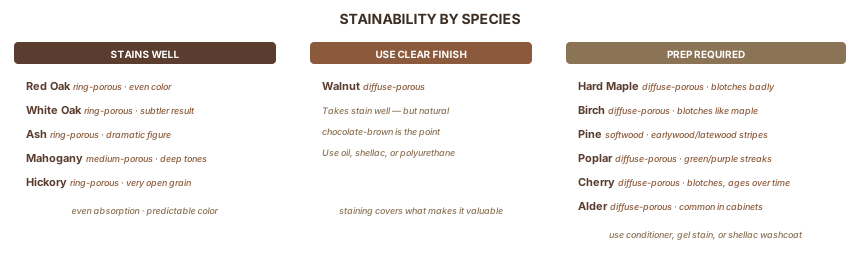
| Easiest to stain | Red oak — open grain absorbs evenly, available at big-box stores |
| Most dramatic results | Ash — bold cathedral grain goes very dark with stain |
| Most commonly disappointing | Pine — earlywood/latewood contrast creates striped, uneven color |
| Blotch-prone hardwoods | Hard maple, birch, cherry, alder, poplar |
| Skip staining entirely | Black walnut — its natural color is the reason you buy it |
| Sanding stop point | 150 grit for oil-based stain, 180 grit for water-based |
In this guide:
- Which species stain well and why
- Which species blotch and what causes it
- How to fix a blotch-prone wood
- Surface prep and testing before you commit
Part 1: Open-Grain Woods That Stain Well
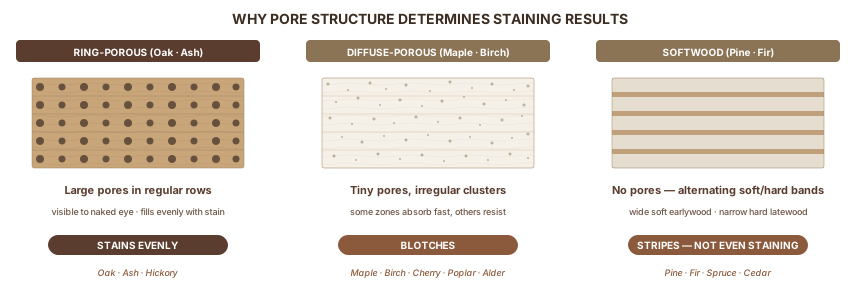
The wood species question isn't about personal preference or cost. It's about how the wood absorbs liquid. Stain color comes from pigment suspended in oil or water. When you apply it, the carrier soaks into the wood and deposits pigment in the pores — the channels that carried sap when the tree was alive. Big pores, evenly distributed, mean even color. Irregular or tiny pores mean uneven color.
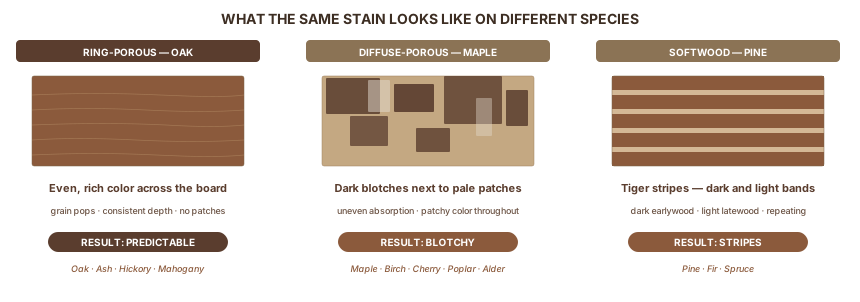
Ring-porous (open-grain) woods like oak and ash have large, clearly visible pores arranged in distinct bands. You can see them without a magnifying glass. These pores accept stain consistently across the surface, so the color lands evenly and the grain becomes more dramatic. Diffuse-porous (tight-grain) woods like maple and birch have much smaller pores scattered irregularly. Some clusters absorb aggressively; others resist. That unevenness shows up as dark blotches next to pale patches. Softwoods like pine alternate between soft earlywood (soaks fast) and hard latewood (resists absorption) — the result is stripes, not grain enhancement.
Red Oak: The Safest Bet
Red oak is ring-porous. The large vessels running through the wood are visible to the naked eye. Stain fills those vessels evenly, and the result is rich, consistent color with dramatically enhanced grain. Red oak has a slight pink/red undertone that shows through stain — warm colors like Jacobean and dark walnut look excellent on it. Cool grays can look slightly off until the topcoat goes on.
Most Home Depot and Lowe's lumber sections carry red oak boards (1×4, 1×6, 1×8). For a first stained project, it's the best combination of price, availability, and reliable results.
Red vs. white oak: White oak has pores partially plugged with structures called tyloses, which make white oak nearly impervious to water (useful for outdoor pieces and barrels). Both stain well, but white oak absorbs more subtly — lighter, more neutral results compared to red oak's bold grain pop.
Ash: Dramatic Figure
Ash is ring-porous like oak. Its bold cathedral grain figures (the arching, sweeping patterns on flat-sawn faces) become even more dramatic when stained, because the denser latewood absorbs less stain than the softer earlywood, amplifying the contrast. Ash's light, neutral natural color means stain shades show accurately without competing undertones.
Finding ash boards requires a hardwood lumber yard in most areas. Worth the trip if dramatic grain enhancement is the goal.
Mahogany: Deep, Consistent Tones
Genuine mahogany and its common substitutes (African mahogany, Sapele) are medium-porous with consistent pore distribution. Stain absorbs evenly across the surface. The natural warm reddish-brown base means dark stains look especially rich. Furniture makers use mahogany for exactly this reason.
Availability: requires a specialty lumber yard. Not found at big-box stores.
Walnut: Skip the Stain
Walnut is diffuse-porous with large, consistent pores. It actually takes stain well. Most woodworkers skip staining it because black walnut's natural chocolate-brown is the reason you bought it. Staining it darker covers what makes it beautiful. Use a clear finish (oil, shellac, or polyurethane) and let the natural color show.
The one exception: blending sapwood. Black walnut boards often have pale sapwood streaks running alongside the dark heartwood. A light stain can bring those streaks closer to the heartwood color. Otherwise, leave it alone.
Part 2: Species That Blotch and Why
Pine: The Beginner Trap
Pine is the #1 cause of staining disappointment. It's cheap, available everywhere, and stains badly without serious prep. The problem: pine alternates between soft earlywood (spring growth, absorbs stain like a sponge) and hard latewood (summer growth, barely absorbs any). The result looks like a tiger: dark stripes next to pale stripes, not the even warm color you were picturing.
The honest answer: if you want even stained color, don't use pine. Red oak boards at the same store cost more but produce dramatically better results with zero extra prep.
If you must stain pine — because you already have it, or it's built in trim you can't replace — use pre-stain conditioner plus gel stain. Expect some variation regardless. And always test on scrap from the same board first.
Paint is actually a better fit for pine than stain. Pine takes paint beautifully.
Hard Maple and Birch
Hard maple is dense with tight, irregular grain. Fine Woodworking's finishing guide calls it one of the most difficult woods to finish with pigment stain. Pre-stain conditioner helps but doesn't eliminate the blotching. Professional cabinet shops either spray a dye stain (finer molecules, more uniform penetration) or apply gel stain.
Birch blotches just as badly as maple. The Woodweb finishing knowledge base confirms: "Birch plywood blotches just as bad as maple." The combination of density and irregular pore distribution gives the same result. Both species are common in big-box plywood. Cabinet shops get around this by spraying, not brushing.
Poplar: The Green Streaks Problem
Poplar adds something unique on top of blotching: greenish or purplish heartwood that shows through stain. You can't neutralize those streaks with conditioner. The fix, if you choose poplar, is selecting pieces where the wood is uniformly pale cream-white and avoiding the green or purple heartwood portions. The lighter the board, the more consistent the staining result.
Cherry: Wait for It
Cherry is pale pinkish-brown when freshly cut. That pale color is why people want to stain it darker. Two problems: cherry blotches, and cherry is photosensitive — it naturally deepens to a rich medium-brown with red undertones over 6–18 months of UV exposure. Stain it dark now, and the color shifts as the wood ages, leaving you with something different from what you intended. See Cherry Wood Color for the full color timeline.
Many woodworkers leave cherry in indirect sunlight for a few weeks before applying a clear finish. The wood ages to a rich brown without any blotching risk. If you stain cherry, a thin shellac washcoat before the stain is the most reliable blotch prevention.
Part 3: Solutions for Blotch-Prone Woods

Pre-Stain Conditioner: Fast and Widely Available
Pre-stain conditioner partially fills the most porous areas of the wood before stain is applied, slowing their absorption rate and bringing it closer to the slower-absorbing areas. Minwax says their conditioner is "especially necessary when working with soft or porous woods such as pine, fir, alder, aspen, birch and maple."
Application: brush or cloth in the direction of grain. Let penetrate 5-15 minutes. Wipe excess with a dry cloth. Apply stain within 2 hours — waiting longer lets the conditioner cure and become a sealer.
Critical detail: oil-based conditioner is for oil-based stains only. Water-based conditioner is for water-based stains. Mixing bases defeats the purpose. Both Minwax and General Finishes make versions of each type.
Commercial pre-stain conditioners improve results but don't fully eliminate blotching on very difficult species. Popular Woodworking's finishing expert Bob Flexner notes the directions on most commercial conditioners still lead many woodworkers to get blotching.
Gel Stain: Easiest Option for Difficult Species
Gel stain has a thick, mayonnaise-like consistency. It doesn't penetrate as deeply as liquid stain, so it's less dependent on pore structure for color consistency. It sits more on the surface. The Wood Whisperer recommends gel stain as one of the most reliable approaches for pine, maple, and birch.
Application is the same as liquid stain — apply, let sit 1-2 minutes, wipe off. Colors are slightly less vibrant and grain definition is slightly muted compared to liquid stain on good wood, but results are far more consistent on difficult species.
Recommended: General Finishes Gel Stain (available at Woodcraft and online), Old Masters Gel Stain.
Shellac Washcoat: Most Effective, Slightly More Work
A thin coat of dewaxed shellac seals the wood surface more thoroughly than commercial conditioners. Popular Woodworking's blotching guide describes this as the method professionals use: Zinsser SealCoat (dewaxed shellac) thinned to about a 1 lb cut, applied, dried, lightly sanded with 280 grit, then stained.
The stain now sits more on the surface than inside the wood. Colors come out slightly lighter and less saturated, but blotching is largely eliminated. Best for maple and cherry where you need maximum blotch control.
Part 4: Prep and Testing Before You Stain
Which Grit to Stop At
How finely you sand before staining affects how much pigment absorbs and how even the color lands. Coarser grit leaves more surface texture for pigment to fill; finer grit burnishes the wood and reduces absorption.
- Oil-based stains: stop at 150 grit
- Water-based stains: stop at 180 grit
Don't go past 180 before staining. Sanding to 220 burnishes wood fiber and can create patchy areas on close-grain woods — exactly the opposite of what you want. Always finish the last grit pass by hand, sanding in the direction of the grain. Orbital sander swirl marks are visible under stain on pine and soft maple.
Test on Scrap Before You Commit
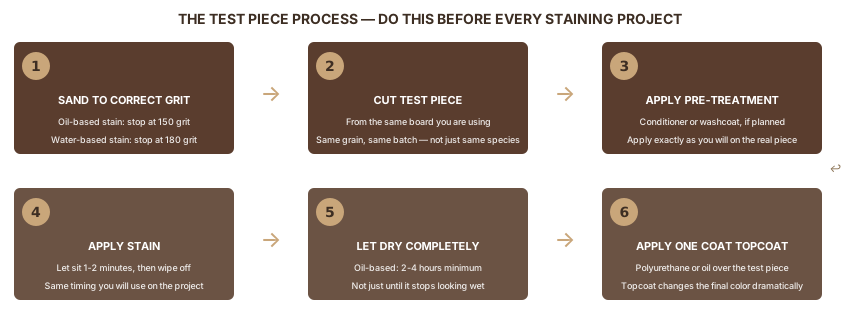
Always test on a piece cut from the same board. The exact same species can vary between boards. Process:
- Cut a piece from the same board, or from surplus of the same material
- Sand to the same final grit as your project
- Apply any pre-treatment (conditioner, washcoat) exactly as you plan to on the project
- Apply stain, let it sit the same amount of time (typically 1-2 minutes), wipe off
- Let it dry completely — not just until it's no longer wet. Oil-based stains take 2-4 hours to show their final color.
- Apply one coat of your topcoat over the test piece
The topcoat changes the appearance dramatically. A matte polyurethane makes the color look flatter; satin or gloss deepens and enriches it. Test with topcoat to see what you'll actually have.
Part 5: Wood Species for Staining — Quick Reference
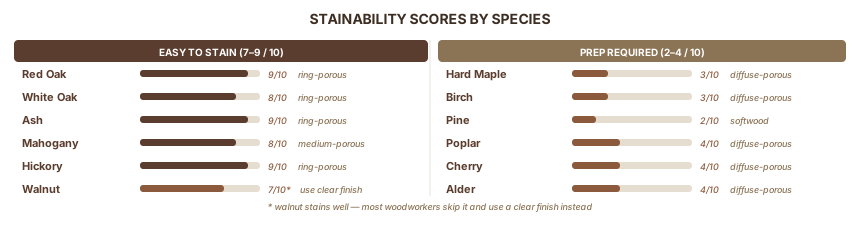
| Species | Grain Type | Stains Well? | Notes | Where to Find |
|---|---|---|---|---|
| Red oak | Ring-porous | Yes | Bold grain pop, warm undertones | Big-box stores |
| White oak | Ring-porous | Yes | Subtler than red oak, more neutral | Lumber yard |
| Ash | Ring-porous | Yes | Very dramatic cathedral figures | Lumber yard |
| Mahogany | Medium-porous | Yes | Warm, deep tones, consistent | Lumber yard |
| Hickory | Ring-porous | Yes | Very open grain, dramatic figure | Lumber yard |
| Walnut | Diffuse-porous | Yes (skip it) | Use clear finish — natural color is better | Lumber yard |
| Hard maple | Diffuse-porous | Difficult | Blotches badly — use gel stain or dye | Lumber yard / big-box |
| Birch | Diffuse-porous | Difficult | Blotches like maple | Big-box plywood |
| Pine | Softwood | Difficult | Striped from earlywood/latewood | Big-box stores |
| Poplar | Diffuse-porous | Difficult | Blotching + green/purple streaks | Big-box stores |
| Cherry | Diffuse-porous | Difficult | Blotching + photosensitive aging | Lumber yard |
| Alder | Diffuse-porous | Difficult | Blotch-prone, common in cabinets | Lumber yard |
Where This Fits
This guide covers wood selection before you start finishing. For choosing the right stain type — oil vs. water vs. gel stain, plus deck vs. interior — see the Wood Stain Guide. The next steps:

- Troubleshooting Stain Problems — when blotching, streaks, or uneven color has already happened and needs fixing
- Surface Preparation — the full sanding process before any finish goes on
- How to Apply Polyurethane — applying the topcoat after staining
- Best Stainable Wood Filler — filling holes and gaps before you stain
Sources
This guide draws on professional finishing references, manufacturer technical data, and woodworking community expertise on wood staining behavior.
- Popular Woodworking: Battling Blotching — definitive guide to blotching causes and solutions (Bob Flexner)
- Popular Woodworking: How to Control Blotching — washcoat and conditioner techniques
- The Wood Whisperer: Blotch Control to Rule Them All — gel stain and dye stain approaches
- General Finishes: How to Prep Wood for Stain — sanding and preparation
- General Finishes: Prep Sanding Grit FAQ — grit recommendations
- Minwax: Pre-Stain Wood Conditioner — product instructions and target species
- Woodweb: Staining and Blending Difficult Woods — maple, birch, poplar
- Woodweb: Tips for Non-Blotchy Maple and Birch — specific techniques
- Fine Woodworking: Avoid Color Mistakes and Fix Blotchy Stain — professional staining techniques
- Woodweb: Staining Cherry to Even Out Color — cherry-specific techniques